
DELVENTHAL LAW
INJURED FROM A ROLLOVER ACCIDENT?
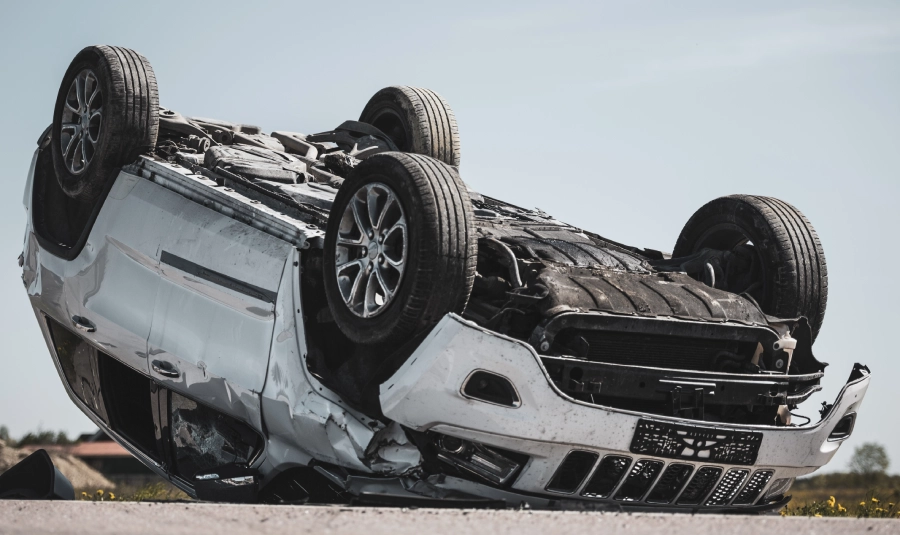
Rollovers are a leading cause of car accident fatalities. These accidents tend to occur with vehicles that are taller and leaner, which as a result have a higher center of gravity. But any vehicle could roll over, causing devastating injuries to passengers trapped inside.
If you have been injured in a rollover accident, you might be able to sue someone for compensation, but you will need an experienced car accident attorney in your corner. Contact Delventhal Law Office today.
CAUSES OF ROLLOVER ACCIDENTS
There are two types of rollovers[1]:
- Tripped rollovers. These accidents usually occur when a vehicle leaves the roadway and ends up flipping because its tires dig into soil or it hits a guardrail.
- Un-tripped rollovers. These accidents typically occur on the road as a result of a sudden movement to avoid a collision and are most common with top-heavy vehicles.
Of the two, tripped rollovers are the most common, accounting for 95% of all rollovers. They can occur in the following situations:
- A driver goes onto the soft shoulder and then tries to correct to get back on the road. As the tires dig into the soft soil, the vehicle can flip on its side or roof.
- One side of the vehicle rides up on a guardrail or other object, causing the vehicle to flip.
- A vehicle going too fast downhill tries to make a turn, which causes the vehicle to flip onto its side.
There are many contributing factors[2] to rollover accidents. For example, alcohol use can contribute to poor driving and require sudden overcorrection, leading to rollovers. According to the federal government, about 50% of all fatal rollover crashes involved alcohol.
ROLLOVER INJURIES
Rollover accidents can leave motorists with devastating injuries, which is perhaps not surprising. It is very difficult to protect yourself when you are thrown upside down. Passengers who are not wearing a seat belt are at the greatest risk of suffering an injury, as they can be thrown clear of the vehicle or end up landing on their heads or necks.
At our law firm, we have met with clients who have suffered the following after a rollover:
- Broken bones. Motorists can fracture any bone in the body, but injuries to arms, hands, legs, and facial bones are very common. Broken bones must be set properly, otherwise they can lead to chronic pain and immobility.
- Nerve damage. Any nerve can become compressed by nearby tissue or bone. If the compression is not relieved promptly, the nerve endings could die.
- Traumatic brain injury (TBI). Any hard knock to the head can jiggle the brain inside the skull, changing how the brain works. As a result, TBI victims can experience impairments with respect to speech, mobility, balance, memory, and emotional control.
- Spinal cord injury. Any bruising, stretching, tearing, or shredding of the spinal cord can lead to devastating loss of mobility or sensation, or both. Some spinal cord injuries improve with rehab, but others are permanent.
- Back injury. Damage to the vertebrae can cause constant pain and immobility.
- Neck injury. A passenger can suffer whiplash, a compressed nerve, or cracked vertebrae in the neck.
COMPENSATION FOR A ROLLOVER CAR ACCIDENT
To receive compensation, you will need to identify who is responsible for your injuries. According to the federal government, about 85% of rollovers are single-vehicle. This means that the vehicle flipped without coming into contact with another vehicle.
Nevertheless, sometimes another entity is responsible:
- A defective road could have caused you to roll over. Whoever designed or is responsible for maintaining the road could be on the hook for your injuries.
- A design or manufacturing flaw in your vehicle could be responsible for your injuries. In this case, you can sue the manufacturer for in a products liability lawsuit.
And if another driver’s actions were responsible for the crash, you can also sue them if they were negligent.
OUR ROLLOVER CAR ACCIDENT ATTORNEYS IN FORT WAYNE ARE HERE FOR YOU
As a leading Fort Wayne law firm, we meet with many victims of rollover accidents. They tell a common story: they have exploding medical bills and are worried about how they will pay for these unexpected expenses.
We are here to help. As part of our practice, we represent auto accident victims when they are injured because of someone else’s wrongful conduct. Reach out to us today.
One of our Fort Wayne rollover accident attorneys will gladly meet with you for a free initial consultation. All you need to do is call (260) 238-8608 or fill out our contact form and we will give you a call.
The Indiana law that applies to your rollover crash case
Indiana's two-year personal-injury statute at IC 34-11-2-4[3] controls almost every Fort Wayne rollover crash claim, and the 51% modified comparative-fault bar at IC 34-51-2-6[4] governs allocation. Rollover cases frequently combine driver-negligence theories under IC 9-21-8-52[5] with parallel product-liability claims under IC 34-20[6] against the vehicle manufacturer when roof crush, seatbelt failure, or stability defects contributed to the occupant's injury. SUVs and light trucks dominate the rollover population because of their higher center of gravity.

How insurance carriers fight Fort Wayne rollover crash claims
Rollover defendants in Allen, Whitley, and DeKalb County run a coordinated four-front defense aimed at the manufacturer side and the driver side. First is the driver-input argument — the manufacturer's counsel blames the driver for over-steer, panic braking, or excessive speed to deflect from the underlying stability defect at issue in the case. Second is the FMVSS 216 compliance argument, where the manufacturer points to minimum roof-crush testing as proof the vehicle was reasonably safe under federal standards. Third is the occupant-positioning argument, claiming the seatbelt was unworn or improperly routed despite physical evidence of webbing loading at impact. Fourth is the post-collision-sequence argument, blaming a secondary impact for the catastrophic occupant injury. We counter with NHTSA recall data at the NHTSA recalls database[7], IIHS rollover testing, and credentialed restraint-systems analysis.
Evidence we preserve in the first 48 hours
Rollover cases turn on vehicle-defect documentation, occupant-restraint forensics, and the full rollover-sequence reconstruction performed before salvage. From day one we lock down:
- The vehicle itself under written preservation, with no scrapping or salvage release, for full inspection of the roof structure, seatbelt webbing, and stability-control module.
- NHTSA recall history, manufacturer service bulletins, prior similar-incident litigation, and FMVSS 216 roof-crush certification data for the specific make and model year.
- Event Data Recorder and Rollover Sensing Module downloads capturing trip-event timing, occupant-restraint signals, and pre-rollover dynamics.
- Scene photographs, drone imagery, yaw and roll-mark mapping, vehicle rest position, and any pavement gouges that establish the rollover sequence.
- Occupant kinematics evidence including webbing-load marks, headliner contact patterns, ejection-trajectory analysis, and seatbelt-pretensioner deployment data.

Damages categories in an Indiana rollover crash case
Rollover damages are typically catastrophic and divide into economic and non-economic categories. Economic damages cover ICU and trauma surgery, spinal-cord and traumatic-brain-injury rehabilitation, lifetime attendant care, durable medical equipment, home and vehicle modifications, lost wages, and lost future earning capacity over a working lifetime. Future-care damages routinely reach seven figures when roof crush causes cervical spinal-cord injury, and the manufacturer's recall and crashworthiness history at the NHTSA recalls database[7] grounds punitive exposure under Indiana product-liability law. Non-economic damages capture pain, paralysis, disfigurement, and the lifelong loss of enjoyment.

What our rollover crash clients ask most
How much is a Fort Wayne rollover crash case worth?
Rollover crashes produce the highest occupant fatality and serious-injury rates in NHTSA statistics, and case values track the severity. A rollover with documented roof crush, cervical spinal-cord injury, and a viable product-defect theory against the manufacturer regularly supports seven- to eight-figure recoveries when the inspection, reconstruction, and life-care plan are built early.
Can I sue the vehicle manufacturer for a rollover crash?
Yes, when a roof-crush defect, seatbelt failure, stability-control malfunction, or tire defect contributed to the rollover or to the catastrophic occupant injury. Product-liability claims under IC 34-20[6] run parallel to the driver-negligence case, and recall history at the NHTSA database often supports the defect theory. The vehicle must be preserved immediately.
What if I was thrown from the vehicle during the rollover?
Occupant ejection most often signals seatbelt failure, door-latch failure, or window-glazing failure — all manufacturing or design defects under IC 34-20[6]. Webbing-load marks, latch-mechanism testing, and the deployment timing of pretensioners distinguish unworn belts from belts that failed under load. Ejection is also evidence of severe rollover forces.
How long do I have to file a rollover crash lawsuit?
Indiana's two-year personal-injury statute at IC 34-11-2-4[3] applies to driver-negligence claims, and product-liability claims also run under the two-year clock with an outer ten-year statute of repose at IC 34-20-3-1[8]. Wrongful-death claims under IC 34-23-1[9] carry a separate two-year clock from death. Preserve the vehicle immediately to keep all theories alive.
What does FMVSS 216 mean for my rollover case?
Federal Motor Vehicle Safety Standard 216 sets the minimum roof-crush strength a manufacturer must demonstrate before selling a vehicle. Mere compliance with the minimum is not a defense under Indiana product-liability law — plaintiffs routinely prove that a reasonable alternative design would have prevented the cabin collapse, with credentialed engineering testimony and comparative testing data.

What happens after you hire us
From the day we open the rollover file we issue a written vehicle-preservation letter, retain a reconstructionist and a restraint-systems engineer, and inspect the vehicle before any salvage transfer. We pull NHTSA recall and complaint history, subpoena manufacturer service bulletins, and pursue both the driver-liability and product-liability tracks. We coordinate trauma and long-term rehabilitation, build a life-care plan, and demand at maximum medical improvement. If carriers fall short, suit is filed in Allen Superior Court or federal court for diverse manufacturers.