

DELVENTHAL LAW
Hip Injury From A Work Accident?
Hip injuries are debilitating. Accident victims who fracture a bone or damage other tissue in the hip might lose the ability to walk, which can impede their ability to work and provide for their families. Hip injuries can be very slow to heal, which means pricey medical care and rehabilitation are often necessary.
If you have suffered a hip injury, contact one of our hip injury lawyers in Fort Wayne today for a free consultation. You might be able to receive compensation to cover financial losses.
TYPES OF HIP FRACTURES
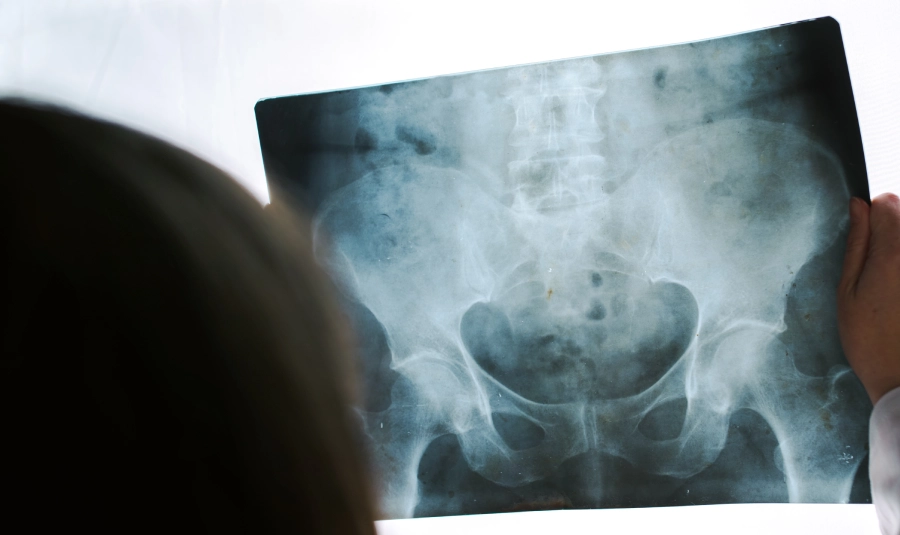
The worst hip injuries[1] are usually fractures. When a bone breaks, a person can feel excruciating pain. They might also need to immobilize their hips so that the bones can heal. Doctors will need to order imaging tests to ensure that they have correctly identified the fractured bone, and they could perform surgery, if necessary, to ensure that the fractured bones fuse together properly.
Depending on the fracture, many complications could result, such as interrupted blood flow which can lead to tissue or bone death.
- Femoral Neck Fractures The femoral neck is located a few inches away from the hip joint. It is also the weakest point in a person’s hip bone, which is why these fractures are very common. If you have suffered a femoral neck fracture, then immediate medical treatment is necessary. Any fracture at the femoral neck promises to restrict blood flow and must be treated to prevent this from happening.
- Intertrochanteric Hip Fracture This fracture usually happens father away from the hip joint. As a result, it is typically less serious than a femoral neck fracture and will not restrict the flow of blood. Of course, intertrochanteric fractures are serious injuries and quite painful, often requiring extended rehabilitation. About half of all hip fractures caused by falls are of this type.
- Intracapsular Fracture This fracture occurs within the joint capsule where the ball and socket are located. Obviously, this is a very serious injury, since any damage to either the ball or socket can completely impair a person’s ability to move. Intracapsular fractures are incredibly painful but also, unfortunately, difficult for a doctor to repair. Treatment for this type of hip fracture is often extended physical therapy following surgery. Patients should remain committed to their rehabilitation, which gives them the best chance at making a recovery.
- Soft Tissue Injuries Not all hip injuries are fractures. Instead, a person could damage any muscles, tendons, or ligaments in the hip area. Traumatic accidents often cause tears in these tissues, which can become inflamed and lead to swelling and pain. When a tear has been very serious, a patient might need surgery to complement resting, ice, and compression treatment.
COMPLICATIONS FROM HIP INJURIES
The pain and immobility caused by most hip injuries are only some of the complications that victims must struggle with. The unfortunate reality is that many people cannot move and must remain immobile to promote recovery.
Unfortunately, this immobility can bring with it a host of complications, such as:
- Compression sores (called bed sores)
- Blood clots
- Infections, such as urinary tract infections
- Long periods of immobility can lead to weight gain and associated problems, such as high blood pressure.
Many victims will also struggle with depression or other emotional distress as they try to recover, which can put added stress on a victim’s family.
Causes of Hip Injuries
At our firm, we have seen victims suffer a serious hip injury in the following types of accidents:
- Car accidents
- Pedestrian accidents
- Slip and falls
- Sports injuries
- Dangerous premises cases
- Workplace accidents
Each case is different. But if another person or entity is responsible for an injury, then under Indiana law they should pay compensation. Meet with a Fort Wayne hip injury attorney to review the circumstances leading up to your accident.
COMPENSATION FOR YOUR LOSSES
Medical care for hip injuries is expensive. Many victims need multiple surgeries and extended stays in the hospital to treat complications. Even if surgery is uneventful or not even required, extensive rehabilitation is costly, as are prescription painkillers, antidepressants, and other drugs.
Fortunately, a Fort Wayne hip injury lawyer can help accident victims get full and fair compensation for their injuries. Indiana law allows victims to seek “damages,” which are sums of money for certain economic and non-economic losses:
- The cost of medical care, including the cost of an ambulance to the hospital, surgery and after care, rehab, prescription drugs, and other necessary treatments.
- The amount of lost wages or lost income if the accident victim could not return to work after suffering their hip injury.
- Any property damage, such as damage to a car that needs repairing.
- Pain and suffering as a result of the hip injury.
To receive compensation, your Fort Wayne hip injury lawyer must establish liability for the accident. If you were injured in a car accident, then the negligent driver who caused the accident is to blame. If you fell in a public or private building, then the owner or occupier is liable if they failed to take reasonable steps to make the property safe.
Determining what is a fair settlement requires taking a close look at the accident and your bills. Generally, the more serious your hip injury, the more you should qualify for. But the right attorney can make a big difference when negotiating a settlement or filing a lawsuit in court.
WORKPLACE ACCIDENTS & WORKERS’ COMPENSATION BENEFITS
If you were injured at work, you might qualify for workers’ compensation benefits, which can cover medical care and replace a portion of your wages. However, Indiana law has eliminated the ability of workers to sue their employer even when their employer was negligent.
In some situations, a hip injury might have been caused by a third party. For example, if you travel for work, you might have been involved in a car accident or fallen in a public or private building not owned by your employer. Injured workers can sue third parties when their reckless or negligent conduct contributed to their hip injury. Even better, victims can receive benefits, such as pain and suffering damages, which are unavailable under the workers’ compensation system.
SEEK THE HELP OF A FORT WAYNE HIP INJURY LAWYER
Hips injuries are devastating, and accident victims need an aggressive hip injury attorney in Fort Wayne to look out for them. Please call Delventhal Law Office today. We are pleased to offer a free consultation where we can discuss your case in more detail. So call us today at (260) 484-6655.
The Indiana law that applies to your hip injury case
Indiana's two-year personal-injury statute of limitations at IC 34-11-2-4[2] governs almost every Fort Wayne hip-injury claim — femoral neck fractures, acetabular fractures, labral tears, and dislocations from crashes and falls. The 51% modified comparative-fault rule at IC 34-51-2-6[3] bars recovery if a jury finds the injured person more than half at fault. Many serious hip injuries in this region arise from falls on commercial premises, and the CDC has documented falls as the leading cause of nonfatal trauma in adults at CDC Falls Prevention[4].

How insurance carriers fight Fort Wayne hip injury claims
Hip-injury claims face a coordinated carrier defense built around age, anatomy, and fall mechanics. First is the osteoporosis argument — defense counsel and IMEs argue any femoral neck fracture in an older client would have occurred from minor stress regardless of the fall, characterizing the incident as a coincidence rather than a cause. Second is the pre-existing-arthritis argument: nearly every adult hip x-ray shows some degenerative joint space narrowing, and carriers leverage that to claim the labral tear, impingement, or post-traumatic arthritis was already established. Third is the prosthesis-restoration argument — once a total hip arthroplasty is implanted, the adjuster insists the patient is "fixed" and discounts dislocation risk, leg-length discrepancy, and revision risk over the patient's remaining lifespan. Fourth is the fall-causation argument, particularly in premises cases where the carrier blames footwear or inattention. We counter with the AAOS evidence base at American Academy of Orthopaedic Surgeons[5].
Evidence we preserve in the first 48 hours
Hip-injury cases turn on imaging precision, fall-mechanism documentation, and a long-term care plan accounting for revision surgery. From the moment we open the file we secure:
- Initial AP pelvis and frog-leg lateral x-rays plus dedicated hip views capturing fracture pattern, displacement, and any acetabular involvement at presentation.
- MRI of the hip when labral, chondral, or occult fracture injury is suspected — particularly when initial films appear negative but mechanical symptoms persist.
- CT scan with three-dimensional reconstruction for acetabular fractures and complex femoral neck patterns that drive operative planning and case value.
- Premises evidence — incident location photographs, surface coefficient-of-friction testing, lighting measurements, and the property owner's prior fall records and maintenance logs.
- Pre-incident hip and orthopedic records for the prior decade so the carrier cannot ambush with surprise degenerative-condition exhibits at deposition.

Damages categories in an Indiana hip injury case
Hip-injury damages are substantial because the joint controls weight-bearing and gait. Economic damages cover ER, ORIF or total hip arthroplasty, the implant itself, inpatient rehabilitation that commonly runs several weeks, home health, durable medical equipment, and lost wages during the typical three- to six-month non-weight-bearing and restricted-activity period. Future damages account for revision surgery — published National Institutes of Health[6] outcome research documents revision rates and long-term pain. Non-economic damages cover gait alteration, loss of enjoyment, leg-length discrepancy, and lifelong dislocation precautions.

What our hip injury clients ask most
How much is a Fort Wayne hip-injury case worth?
Settlement value tracks fracture pattern, surgical procedure, and the projected revision arc over the client's remaining lifespan. A displaced femoral neck fracture treated with total hip arthroplasty, complicated by dislocation or leg-length discrepancy, regularly supports a mid- to high-six-figure recovery. A non-displaced fracture treated with percutaneous pinning that achieves full union resolves substantially lower.
I had hip arthritis before the fall — does that hurt my case?
Indiana applies the eggshell plaintiff rule. Pre-existing arthritis does not defeat a hip-injury claim; the law allows recovery for the aggravation of an underlying condition. A radiologist will distinguish chronic degenerative findings from acute traumatic fracture lines, and your pre-incident imaging establishes the baseline against which the new injury is measured by the jury.
What if I needed a total hip replacement after the fall?
A total hip arthroplasty triggered by trauma is one of the more valuable orthopedic outcomes in personal-injury litigation. The case must account for the implant cost, inpatient rehabilitation, home health, lifelong dislocation precautions, and the statistical likelihood of revision surgery within fifteen to twenty years, plus lost activity and gait alteration documented through formal functional testing.
How long do I have to file a hip-injury lawsuit in Indiana?
Indiana's two-year personal-injury statute at IC 34-11-2-4[2] runs from the date of injury. Premises-liability claims against a commercial property owner follow the same deadline. Indiana Tort Claims Act notice against a city, county, or state defendant must be served within 180 days for political subdivisions and 270 days for state entities, including municipal-owned premises.
Can I recover if I slipped on ice or wet floor at a business?
Indiana premises law requires a business invitee to show the property owner knew or should have known of the hazardous condition. Maintenance logs, prior fall reports, weather records, surveillance footage, and coefficient-of-friction testing build that knowledge case. Indiana's natural-accumulation doctrine creates a tougher path for parking-lot ice but does not bar interior wet-floor or unmaintained-surface claims.

What happens after you hire us
From the day we open the hip-injury file we preserve initial imaging, place hospital and rehabilitation records on litigation hold, and lock down premises evidence — photographs, video, prior incident reports, and maintenance logs — before the property owner can spoliate. We coordinate with the orthopedic surgeon and physical-therapy team, monitor non-weight-bearing progression, and send a demand once you reach maximum medical improvement after arthroplasty or fixation. Contingency-fee — no fee unless we recover.