



DELVENTHAL LAW
YOUR GUIDE TO NEGLIGENCE AND CAR ACCIDENT CLAIMS IN INDIANA
Negligence is one of the most important concepts in personal injury law — it is the legal foundation of most auto accident injury claims in Indiana. Indeed, much of the work that a Fort Wayne car accident attorney does on a case goes towards proving negligence. At the Delventhal Law Office, we are committed advocates for injured victims and their loved ones. We want every person to have the information that they need to protect their rights. Here, our team answers some frequently asked questions (FAQs) about negligence and car accident claims.
WHAT IS NEGLIGENCE?
Negligence is the failure to exercise reasonable care. An individual or entity is negligent when their actions or inactions create an unreasonable danger. When that danger then causes injuries to another party, the defendant can be held legally liable. Negligence has four required elements:
- The defendant owed the victim a duty of care;
- The defendant breached that legal duty;
- There is a causal link between the breach of duty and the plaintiff’s injuries; and
- The victim suffered actual harm in the accident.
WHY DOES NEGLIGENCE MATTER?

Indiana is a fault-based auto accident jurisdiction. If another party was at fault for your accident, you have the right to hold them liable for your damages. As a general matter, liability is based on the legal theory of negligence. In other words, a plaintiff can hold a defendant liable for their damages if they can prove that the defendant’s failure to exercise reasonable care (negligence) caused the accident.
HOW DO YOU PROVE NEGLIGENCE AFTER A CRASH?
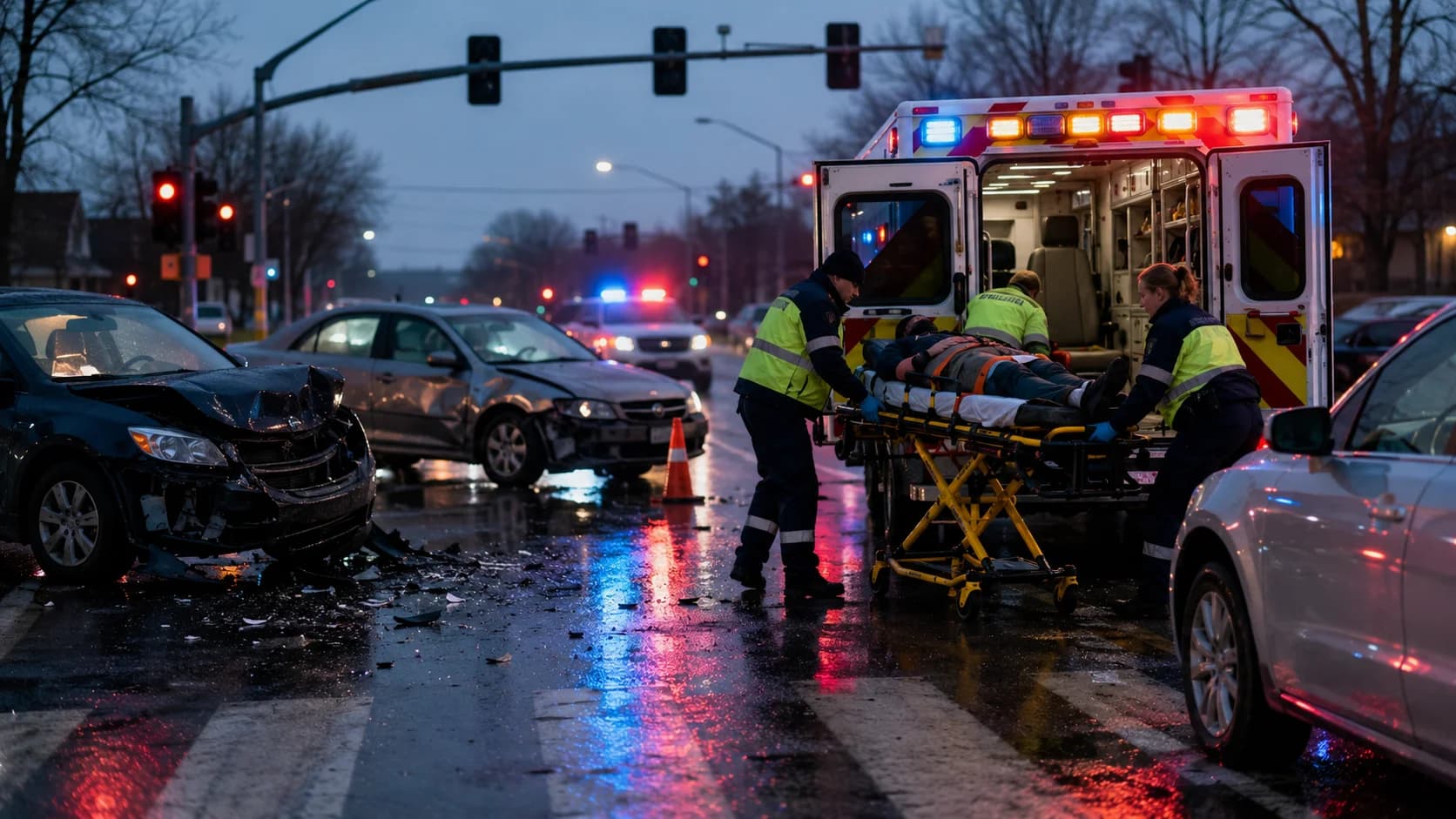
Indiana is a ‘fault’ auto insurance state. To establish that a defendant is legally responsible for your Fort Wayne motor vehicle accident, you will be required to prove that their negligence contributed to your crash. What constitutes negligence can vary widely based on the specific circumstances in question. In most auto accident cases, the negligent party is one of the drivers. Indeed, according to a meta-analysis from the Center for Internet and Society at Stanford Law School[1], driver error is a factor in more than 90 percent of traffic accidents. There are many different examples of driver negligence, including:
- Your statement;
- The other driver’s statement;
- The police report;
- Eyewitness testimony;
- Photographs of the vehicle damages;
- Photographs of your injuries;
- Medical records; and
- Expert testimony.
Major car accidents should be investigated by an experienced professional. If you were involved in a serious crash and you believe that the collision occurred because of another party’s negligence, it is imperative that you reach out to an Indiana auto accident attorney immediately. Your attorney will conduct a review of the crash and secure all relevant evidence.
WHAT ARE SOME COMMON EXAMPLES OF NEGLIGENCE?

Negligence comes in a wide variety of different forms. In most cases, auto accidents are caused by negligent drivers. In fact, some studies have found that driver error is the primary cause of approximately 95 percent of traffic collisions in the United States. Examples of driver error that could constitute negligence include:
- Speeding;
- Unsafe lane changes;
- Failure to yield;
- Running stop signs or red lights;
- Violation of other traffic laws;
- Aggressive driving;
- Distracted driving; and
- Drunk driving.
To be clear, car accident claims can also be brought against other defendants who are not drivers. For example, an auto manufacturer can be held liable if a plaintiff suffered injuries as a result of its negligence.
WHAT IS COMPARATIVE NEGLIGENCE?
Under Indiana law (I.C. § 34-51-2-6[2]), car accident claims are subject to the state’s modified comparative negligence standard. With comparative negligence, each party will be held liable in proportion to their “share of the blame” for an accident. For instance, if a drunk driver is deemed responsible for 100 percent of the crash, they can be held liable for 100 percent of the resulting damages.
Of course, not all cases are so straightforward. With comparative negligence, liability may be split amongst multiple parties. For example, if a driver is found to be liable for 30 percent of a crash, then they will be responsible for 30 percent of the damages. Notably, Indiana has a strict 51 percent bar on recovery. If a plaintiff is deemed to be at fault for 51 percent of an accident, or more, they are legally prohibited from recovering damages.
SPEAK TO OUR FORT WAYNE CAR ACCIDENT LAWYER TODAY

At the Delventhal Law Office, our car accident attorneys in Fort Wayne have the skills and legal experience needed to help you establish negligence after a collision. If you were involved in a crash that was caused by a careless or reckless driver, we are here to help. For a free, completely confidential case evaluation, please contact us right away. From our office in Fort Wayne, we serve communities in Allen County and throughout Indiana.
The Indiana law that applies to your negligence case
Negligence is the foundation of most Indiana personal-injury claims, governed by the two-year statute of limitations in IC 34-11-2-4[3] and the 51% modified comparative-fault rule in IC 34-51-2-6[2]. Recovery requires proof of duty, breach, proximate causation, and damages. The standard of care varies with the relationship: a driver owes other road users ordinary care, a property owner owes invitees reasonable care to inspect and warn, a professional owes clients the skill and care of a reasonably competent practitioner. Government-defendant cases trigger Indiana Tort Claims Act notice as short as 180 days under IC 34-13-3-8[4].
How insurance carriers fight Fort Wayne negligence claims
Defense carriers in any negligence case run a familiar four-part playbook. First, they argue no duty was owed — that the relationship between the parties did not give rise to the legal obligation alleged. Second, they argue no breach — that the conduct met the applicable standard of care, citing industry standards, compliance with regulations, and customary practice. Third, they argue no proximate cause — that an intervening event, pre-existing condition, or unrelated factor caused the injury. Fourth, they argue comparative fault to push the plaintiff above the 51% threshold. We counter with standard-of-care expert testimony, regulatory compliance and safety frameworks specific to the underlying conduct, and federal authority published at sources like the Centers for Disease Control and Prevention[5] and the underlying-conduct's regulator.

Evidence we preserve in the first 48 hours
Negligence cases rest on the evidence that establishes each of the four elements — duty, breach, causation, and damages — in the specific context of the conduct involved.
- Documentation establishing the relationship that creates the duty — contract, statute, premises-status, or professional engagement records.
- Conduct evidence — incident reports, video, witness statements, communications, and any internal records reflecting the defendant's behavior.
- Standard-of-care evidence — industry standards, regulatory compliance records, accreditation and training documentation, and qualified-expert opinions.
- Causation evidence — medical records, reconstruction analysis, and any objective data linking the breach to the resulting injury.
- Damages documentation — medical bills, wage records, treatment-progression records, and any permanent-impairment evaluations.
Damages categories in an Indiana negligence case
Negligence damages in Indiana cover the same economic and non-economic categories as any personal-injury claim — medical expenses past and future, lost wages and earning capacity, pain and suffering, loss of enjoyment of life, and disfigurement. Punitive damages under IC 34-51-3[6] are available for willful or wanton conduct that goes beyond ordinary negligence. Federal injury and severity research at authorities such as the Centers for Disease Control and Prevention[5] grounds the long-term-impact damages model regardless of the specific underlying tort.

What our negligence clients ask most
What is negligence and how does Indiana define it?
Indiana negligence law requires four elements: a legal duty of care owed by the defendant to the plaintiff, a breach of that duty by acting unreasonably or violating a safety standard, proximate causation linking the breach to the injury, and compensable damages. Without all four elements, the claim fails as a matter of law, regardless of how clearly the conduct seems wrong intuitively.
How is the standard of care determined in a negligence case?
The standard of care depends on the relationship and the conduct. Drivers owe other road users ordinary reasonable care. Property owners owe invitees a duty to inspect for and warn of hazards. Professionals owe their clients the skill and care of a reasonably competent practitioner in the same field. Expert testimony establishes the applicable standard in cases requiring specialized knowledge.
What is the difference between negligence and gross negligence?
Ordinary negligence is the failure to exercise reasonable care under the circumstances. Gross negligence (and the related willful-and-wanton standard) requires a conscious disregard of a substantial and known risk — conduct that goes beyond mere carelessness. Gross negligence supports punitive-damages claims under IC 34-51-3[6], and some statutes carve out specific defendants who are liable only for gross negligence.
How does Indiana comparative fault apply to a negligence claim?
Indiana applies the 51% modified comparative-fault rule under IC 34-51-2-6[2]. A jury allocates a fault percentage to each party. If the plaintiff is found 50% or less at fault, damages are reduced by that percentage. If the plaintiff is found 51% or more at fault, the claim is barred entirely. This makes early evidence preservation and reconstruction work central to every negligence case.
How long do I have to file a negligence lawsuit in Indiana?
Most Indiana negligence claims fall under the two-year personal-injury statute of limitations in IC 34-11-2-4[3]. Government defendants trigger Indiana Tort Claims Act notice deadlines as short as 180 days under IC 34-13-3-8[4]. Property-damage negligence claims often run on a different limitations period, and professional-malpractice claims may follow specialized procedural rules under separate statutes.
What happens after you hire us
From day one, we work the evidence on each of the four negligence elements — duty, breach, causation, and damages. We send preservation letters, retain qualified experts when standard-of-care testimony is required, coordinate ongoing medical care, send a documented demand once the file is complete, and file in Allen Superior Court or federal court depending on diversity. Every step is on a contingency-fee basis: no fee unless we recover.