This guide focuses on motorists and passengers involved in highway-rail crossing collisions. It is not a filing guide for railroad employees, passenger derailments or wrongful-death cases. For broader help, see our Fort Wayne train-accident legal services.
Key takeaways
- Get away from the tracks, obtain emergency help, and do not return for photographs or belongings.
- Use the blue-and-white Emergency Notification System sign to identify the crossing and notify the railroad of an emergency from safety.
- Separate what you saw or heard from guesses about speed, signal timing or responsibility.
- Ask about preserving video, vehicle evidence and railroad records before repairs or disposal.
- Have the parties and filing dates reviewed promptly; a government notice may be due well before a lawsuit.

Indiana crossing rules
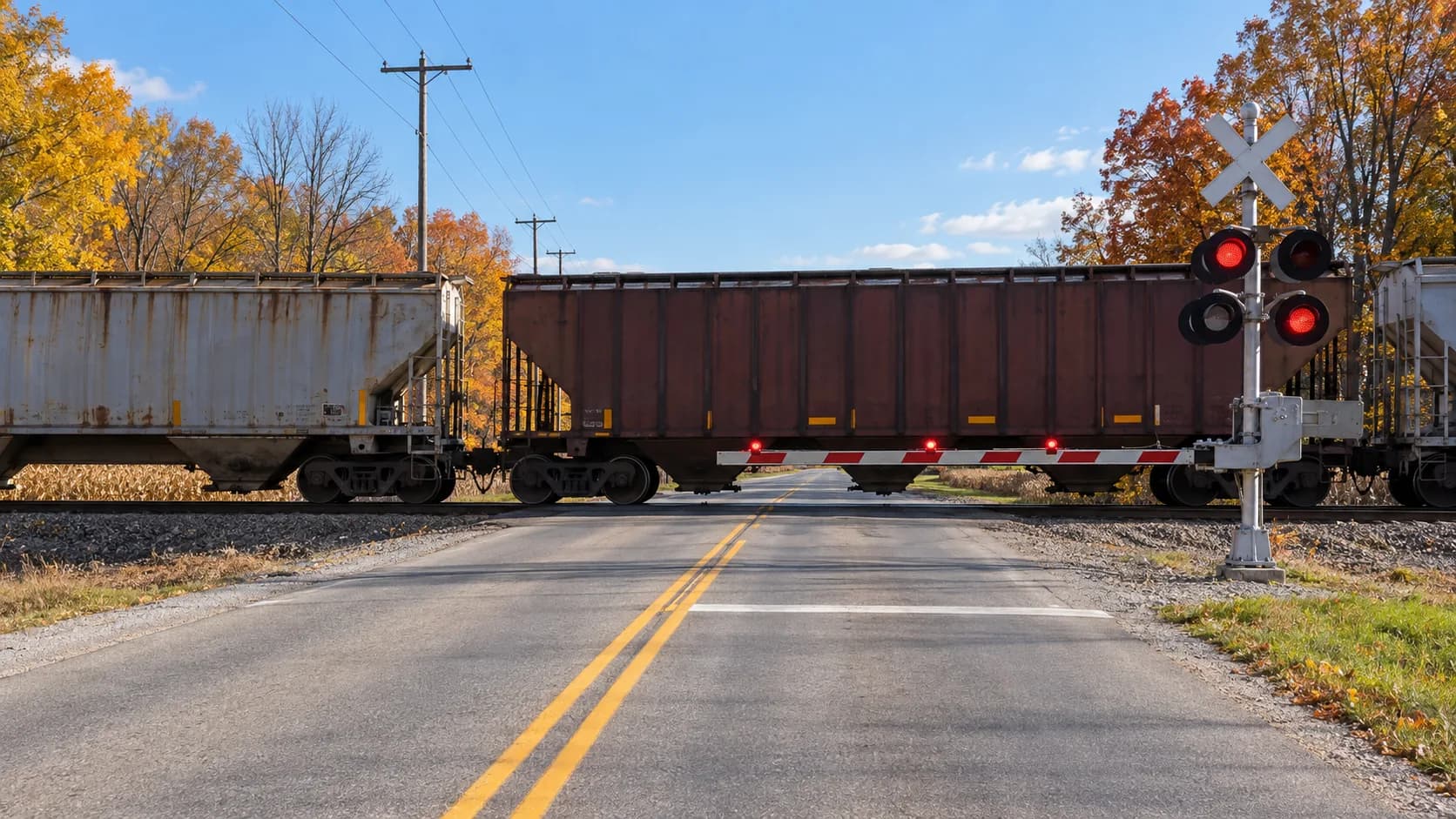
Indiana Code 9-21-8-39[1] requires a driver to stop 15 to 50 feet from the nearest rail and not proceed until safe when any of the listed conditions exists: a clearly visible signal warns of an immediately approaching train or other on-track equipment; a gate is lowered or a flagger signals its approach or passage; an approaching train or equipment within 1,500 feet sounds an audible signal and is an immediate hazard because of speed or nearness; or an approaching train or equipment is plainly visible and dangerously close to the crossing.
INDOT’s passive-warning guidance[2] says drivers must treat a crossbuck as a yield sign. Where a stop sign is installed at a crossing, motorists must stop each time they approach, even when no train is in sight.
INDOT distinguishes public and private crossings[3]. Public crossings are on public roads and require advance warning signs and crossbucks; some also have train-activated lights or gates. Private crossings are on roads not maintained by a public authority and are not required to have those advance warning signs or other markings.
A useful investigation question is: what warnings were installed, and what was observed at the time? Record the warning arrangement and what was happening at the time; keep conclusions about legal responsibility separate.
Safety and crossing identification
Move away from the tracks and call 911 for an injury or immediate danger. Follow emergency responders’ instructions. Do not step onto railroad property or delay emergency care to gather evidence.
The Federal Railroad Administration’s ENS instructions[4] explain that the blue-and-white sign contains the railroad’s emergency telephone number and U.S. DOT National Crossing Inventory Number. From a safe location, call the listed railroad number to report a crossing emergency and give the crossing number and nature of the problem.
Practical identification checklist: Once safe, write down the road name, nearest intersection, travel direction, date and approximate time. If someone safely photographed the crossing number, preserve that original photograph. A familiar road name alone can be ambiguous where a road crosses more than one rail line.
For a broader preparation checklist, see our early steps after a Fort Wayne car accident. The crossing-specific record below supplements that checklist.

Crossing evidence checklist
The FRA Rail Crossing Locator[5] is now a web application replacing the former mobile app. It searches by crossing ID, address or geographic location and provides access to crossing inventory records and collision-report histories. FRA says its information comes from data submitted by states and railroads.
Save the record you find with its retrieval date and crossing number. Use it as an investigation lead, not as proof that every listed feature was present or working during your collision. The following table is a practical preparation tool. Some listed materials may not exist or may be restricted; ask counsel about access.
| Question | Useful material | Important distinction |
|---|---|---|
| Which crossing and approach? | DOT number, road name, travel direction and original location photographs | Identify your approach, not just the nearest street name. |
| What warnings were observed? | Witness accounts, dashcam files and photos of gates, lights and signs | Separate observations at the collision from conditions seen later. |
| What could someone see? | Safe public-location photos of vegetation, buildings, weather and lighting | Do not stand on tracks or recreate the driver's path to test visibility. |
| Where might technical evidence exist? | Questions for counsel about signal records, inspections, train records and available recordings | Record the possible custodian; do not access railroad equipment yourself. |
| What happened to the vehicle? | Tow location, photographs, repair estimates and salvage messages | Ask about inspection and preservation before alteration or disposal. |
| What losses need documentation? | Your medical bills, work restrictions, missed-work records and correspondence | Keep sensitive material private and discuss secure delivery with counsel. |
Preserve original files where possible rather than only cropped screenshots or edited clips. Note who supplied a recording and when. Our dashcam preservation guide and passenger-vehicle event data recorder guide explain those narrower evidence questions.
Example: A passenger recalls flashing lights, while a nearby camera shows the crossing after the impact. Save both accounts with their times. The later recording should not be described as showing the signal before impact unless it actually does. This is an illustrative example, not a client case.

Warning systems and responsibility
Start by identifying the railroad, roadway authority, maintenance contractors and other involved motorists. Identification is only the starting point. Ask who controlled the relevant equipment, what work was performed, and which records could confirm its condition.
INDOT assigns advance warning signs and pavement markings to the public roadway authority[2], and crossbuck installation and maintenance to the railroad.
INDOT’s crossing-facts guidance[6] states that the railroad maintains an automatic crossing signal system once installed. These general maintenance descriptions are starting points for identifying records, not a finding of liability in a particular case.
Federal law also matters. 49 U.S.C. § 20106[7] limits state railroad-safety requirements when federal regulations or orders cover the subject. It also preserves specified state-law damages claims alleging failure to follow a federal standard of care, a railroad plan or rule created under federal requirements, or a compatible state requirement. An attorney must evaluate the particular claim and applicable regulations; the statute does not make every crossing claim available or bar every claim.
Bring questions about warning-device history, installation projects, inspection records and prior complaints to counsel. Request records through lawful channels; do not enter railroad facilities, handle signal equipment or copy restricted employer files into personal accounts.

Fault and filing deadlines
For a claim governed by Indiana’s Comparative Fault Act, IC 34-51-2[8], the claimant’s fault proportionately reduces damages, and fault greater than 50% bars recovery. The allocation can include defendants and nonparties. The Act expressly does not apply to tort claims against governmental entities or public employees under the Indiana Tort Claims Act, so do not apply the ordinary 51% rule to those claims.
IC 34-11-2-4(a)[9] generally requires a personal-injury or personal-property action to begin within two years after the cause of action accrues. Accrual, the claim type and any applicable exceptions require individual review; this is not a deadline calculation for a particular reader.
IC 34-13-3-6 and -8[10] generally require notice within 270 days after the loss for a state claim and 180 days for a political-subdivision claim, subject to statutory exceptions. The required recipients and form matter, and section 9 addresses incapacity. Notice is a separate requirement from filing a lawsuit.
If a road authority may be involved, review our Indiana government tort-claim notice guide and have counsel identify the proper entity and requirements. Do not assume a police report or an insurance conversation satisfies formal notice.
Evidence preservation should not wait for the last filing date. Ask about available video, the vehicle’s location and relevant record custodians while that information can still be identified.
Insurance and consultation preparation
As practical preparation, locate your policy and write down questions for the claims contact: what reporting and cooperation requirements apply? Keep claim numbers, letters and copies of submissions. Describe what you know; label estimates and uncertainties rather than guessing about train speed, sight distance or signal timing.
Questions to bring to counsel before signing paperwork include: what does this document cover, and should inspection or preservation happen first? For more preparation questions, see the firm’s guide to adjuster paperwork and interviews. Ask counsel to review your particular documents.

For a consultation, bring the crossing number if available, the police report number, your evidence list, vehicle location, insurance correspondence and a simple injury/work timeline. If you do not have an item, say so; do not return to a dangerous location to complete the list.
Bring your information and questions to attorney Chad Delventhal for an individual discussion. Request a free case evaluation if you need help deciding the next step. Do not post medical records or sensitive case details publicly.
Frequently Asked Questions
What is the number on the blue railroad-crossing sign?
The U.S. DOT crossing number identifies the crossing. The ENS sign also lists the railroad’s emergency telephone number. From safety, use that number and describe the emergency; call 911 for injuries or immediate danger.
Does every public crossing have gates?
No. INDOT describes public crossings with advance warning signs and crossbucks, and some with train-activated lights or gates. Record the actual warning arrangement for individual review.
Can I look up a crossing’s history?
Yes. FRA’s web-based Rail Crossing Locator provides crossing inventory records and collision-report histories. Search by crossing ID, address or location, and save the record and retrieval date for review.
Should I try to obtain railroad signal records myself?
Identify possible records and custodians for counsel. Do not enter railroad property or access equipment or restricted systems to collect evidence. An attorney can discuss lawful requests and preservation needs.
How long do I have to file an Indiana train-collision injury lawsuit?
IC 34-11-2-4[11](a) generally allows two years after the cause of action accrues for personal injury. Government notice can be due much earlier. Have the claim type, parties, accrual and exceptions reviewed individually.
What should I bring to a crossing-collision consultation?
Bring the crossing and police report numbers if available, photographs, witness contacts, vehicle location, insurance letters and an injury/work timeline. Note missing items and do not revisit a dangerous scene to obtain them.
This article is general information about Indiana law and is not legal advice. Reading it does not create an attorney-client relationship, and neither does contacting us.
Sources
- Indiana Code 9-21-8-39 (iga.in.gov) ↩
- INDOT’s passive-warning guidance (in.gov) ↩
- INDOT distinguishes public and private crossings (in.gov) ↩
- Federal Railroad Administration’s ENS instructions (railroads.fra.dot.gov) ↩
- FRA Rail Crossing Locator (railroads.fra.dot.gov) ↩
- INDOT’s crossing-facts guidance (in.gov) ↩
- 49 U.S.C. § 20106 (uscode.house.gov) ↩
- Indiana’s Comparative Fault Act, IC 34-51-2 (iga.in.gov) ↩
- IC 34-11-2-4(a) (iga.in.gov) ↩
- IC 34-13-3-6 and -8 (iga.in.gov) ↩
- IC 34-11-2-4 (iga.in.gov) ↩