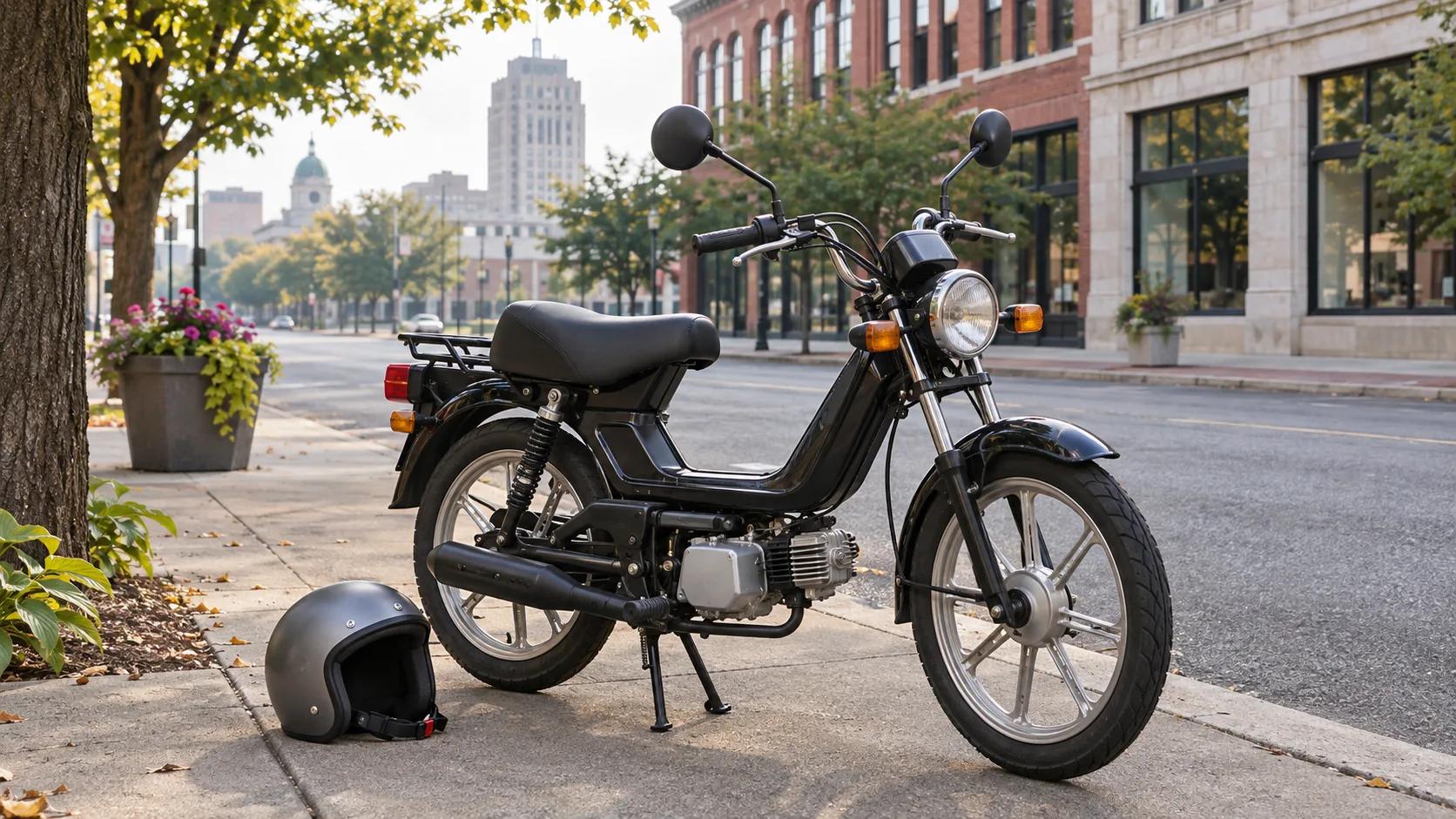
People often use “moped” for several kinds of two-wheeled vehicles, but the vehicle’s legal classification matters. The BMV classification guide[2] lists a seat or saddle, no more than three wheels, applicable equipment requirements, and cylinder capacity not exceeding 50 cubic centimeters; electric bicycles are excluded.
- Indiana prohibits passengers on motor driven cycles.
- A motorcycle may carry one passenger on a firmly attached regular seat designed for passenger use, subject to the operator’s credentials and other operating restrictions.
- Preserve evidence of what each person did before the crash.
- Build a document list for each person, vehicle, and policy rather than assuming all “mopeds” are alike.
- Preserve the vehicle, registration records, policy documents, photographs, and medical paperwork before evidence becomes harder to obtain.

Start with the vehicle’s legal classification
A label in an advertisement or casual conversation does not settle the classification question. Check the vehicle identification number, title or ownership paperwork, registration, manufacturer information, engine displacement, and physical design.
The Indiana Bureau of Motor Vehicles classification guide[2] distinguishes motorcycles from motor driven cycles. The BMV states that a motor driven cycle has an engine capacity not exceeding 50 cubic centimeters and is not an electric bicycle.
If the vehicle is larger or registered differently, motorcycle rules may apply instead. Delventhal Law Office’s Fort Wayne moped accident guide explains broader issues involving operators, registration, and crash evidence.
| Question to verify | Why it matters | Record to locate |
|---|---|---|
| Is it registered as a motor driven cycle? | Indiana prohibits passengers on a motor driven cycle. | Registration and BMV records |
| Is it legally a motorcycle? | A motorcycle may carry one passenger if it has the required passenger seat. | Title, registration, VIN, and manufacturer specifications |
| Who owned or supplied it? | Identify the owner and preserve permission messages. | Title, purchase records, rental agreement, or written messages |
| Was the trip connected to work or delivery activity? | Add the business documents and trip records to the review file. | App records, dispatch messages, receipts, and work records |

Indiana’s passenger rule
Indiana Code 9-21-10-1[3] states that a passenger may not be carried on a motor driven cycle. The same section permits one passenger on a motorcycle only on a firmly attached regular passenger seat. That does not override separate operating restrictions: the BMV motorcycle learner’s permit guidance[4] prohibits a permit holder from carrying passengers.
The BMV also states that motor driven cycle operators must be at least 15, may not exceed 35 miles per hour, and may not operate on an interstate highway or sidewalk.
Do not treat a passenger-rule violation as a complete answer to a civil claim. IC 34-51-2-3[1] expressly preserves causation requirements for both fault and contributory fault in claims governed by that chapter. Insurance questions must be addressed separately; the passenger statute does not itself promise a payment under any policy.
If the vehicle is actually a motorcycle, the more focused Indiana motorcycle passenger injury guide may be the better starting point.
Possible claims after a crash
Begin with conduct, not assumptions. A useful investigation separates what the moped operator did, what another motorist did, who owned or supplied the vehicle, and whether anyone was acting for a business.
The operator
For a fault-based claim governed by the Comparative Fault Act, IC 34-51-2-15[5] preserves the claimant’s burden to prove that the defendant’s fault caused all or part of the harm. Practical investigation questions include: Was the operator distracted? Was there an unsafe turn or loss of control? Did carrying the passenger affect operation? Preserve the answers rather than assuming the passenger rule proves the entire case.
Another driver
For another involved motorist, collect scene photographs, witness information, video, the crash report, vehicle-damage photographs, and the policy details. The same fault-and-causation inquiry applies under IC 34-51-2-15[5].
The owner or a business
For an owner, rental company, or business, gather the title, permission messages, rental agreement, and work or delivery records. Ask counsel to evaluate any separate conduct or legally relevant relationship before naming that person or business in a claim; this checklist does not establish a claim against everyone listed.

Insurance policies to investigate
Indiana does not require liability insurance for a vehicle registered as a motor driven cycle, according to the BMV. Motorcycles, by contrast, require insurance.
Practical document checklist, not a coverage determination: Ask for complete policy forms and the carrier’s written explanation. The rows below identify questions to ask; they do not establish that a particular policy pays this passenger.
| Potential source | What to request | Key question |
|---|---|---|
| Operator’s or owner’s policy | Declarations, forms, endorsements, and exclusions | Does the policy insure this vehicle, operator, and use? |
| Other motorist’s liability policy | Carrier, claim number, insured names, and available limits | Did that motorist’s conduct contribute to the crash? |
| Passenger’s household auto policy | UM/UIM forms, definitions, exclusions, and written rejections | Does the passenger qualify as an insured for this event? |
| Business or platform policy | Commercial policy and trip-status records | Was anyone acting within a covered business use? |
| Health plan | Plan document, claims instructions, and reimbursement terms | How should treatment bills be submitted while liability is investigated? |
The Indiana Department of Insurance[6] explains that newly written Indiana auto liability policies include uninsured- and underinsured-motorist coverage unless it is rejected in writing. That general description is not a decision about this crash. Ask the carrier to identify the insured-person definition, vehicle definition, exclusions, and any written rejection it relies on. Ask specifically how those provisions apply to a passenger on this particular vehicle; do not assume household auto insurance pays merely because the operator had no policy.
For a deeper explanation of missing liability insurance, see Delventhal Law Office’s guide to Indiana uninsured-driver recovery options.

Evidence to preserve after a moped passenger crash
Preserve evidence without altering the vehicle or putting yourself at risk. A practical file can include:
- Photographs of the entire vehicle, passenger area, seat, foot supports, controls, damage, tires, and identifying labels.
- The VIN, registration, title or ownership records, engine-size information, and manufacturer specifications.
- Names, contact details, insurance cards, and driver-license information for every operator and owner.
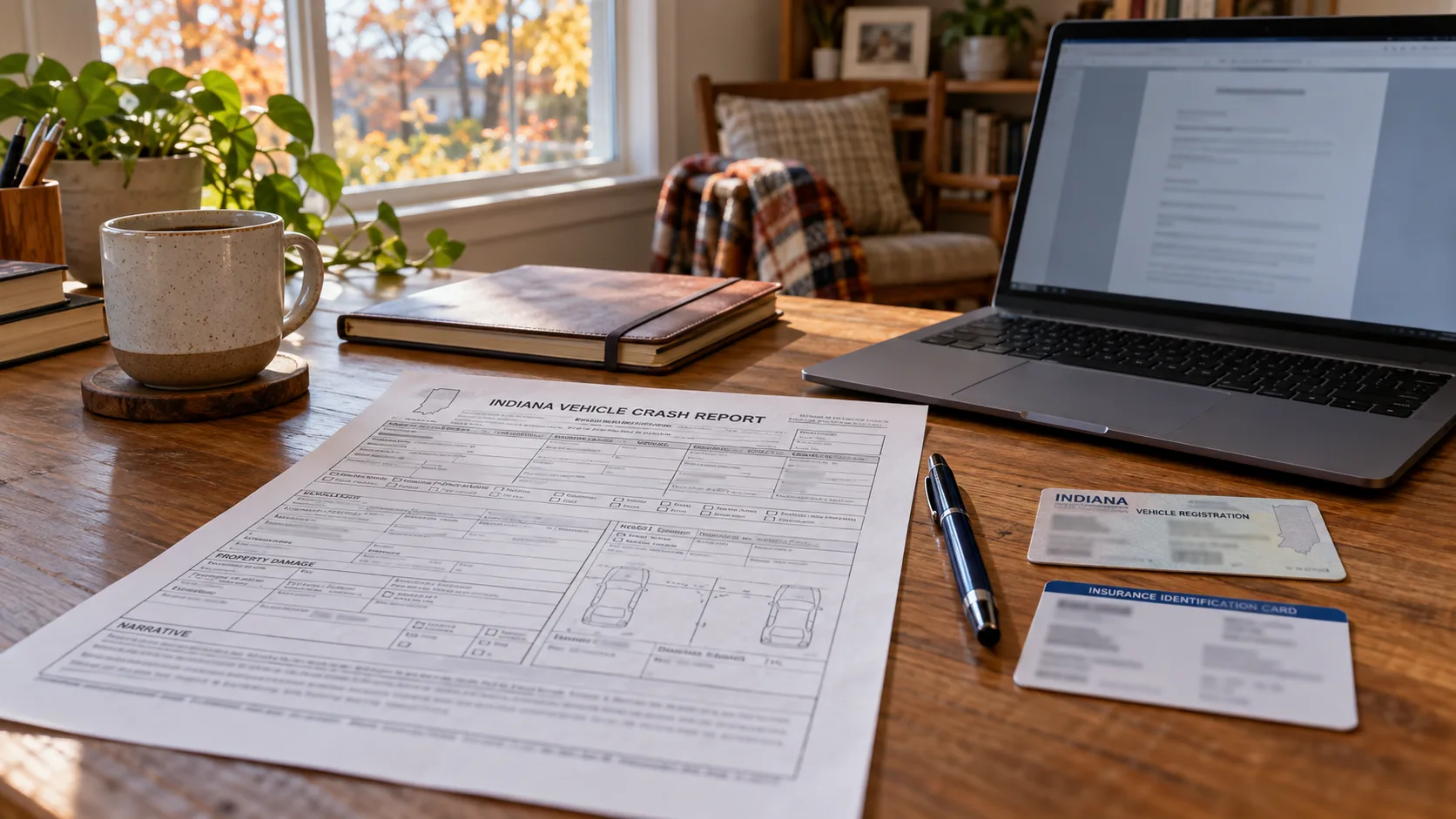
- The original crash report, witness details, nearby camera locations, and unedited photo or video files.
- Messages showing permission, trip purpose, destination, work activity, rental terms, or delivery-app status.
- Medical visit summaries, bills, prescriptions, work notes, and a simple dated record of symptoms and missed activities.
- Every policy, declarations page, endorsement, denial letter, reservation-of-rights letter, and recorded-statement request.
For a Fort Wayne or Allen County crash, keep the responding agency’s name and report number with the scene file. Compare the report with unedited photos, witness accounts, and available video; record disagreements as questions to investigate.
Our broader guide to evidence in an Indiana vehicle-injury claim offers a more detailed preservation checklist.

Shared fault and filing deadlines
For claims governed by Indiana’s Comparative Fault Act, a claimant more than 50% at fault is barred; at 50% or less, claimant fault reduces damages, and each defendant’s allocated share also matters. See IC 34-51-2-5 through -8[7]. The Act excludes governmental-entity and public-employee tort claims under the Tort Claims Act (IC 34-51-2-2[1]); do not apply the private-defendant formula to those claims.
Under IC 34-11-2-4(a)[8], an Indiana personal-injury action generally must be commenced within two years after the cause of action accrues. Accrual and exceptions need individual review. Government claims can require earlier notice under IC 34-13-3-6 and -8[9]. Have the applicable filing and notice dates checked rather than treating the general two-year rule as permission to wait.
Do not wait for every insurance question to be resolved before identifying the applicable deadline. Keep the crash date, identity of every potentially involved person or entity, and all correspondence together for review.
Frequently Asked Questions
Is it legal to ride as a passenger on a moped in Indiana?
If the vehicle is legally classified as a motor driven cycle, no. Indiana Code 9-21-10-1[10] prohibits carrying a passenger on a motor driven cycle.
Does the passenger prohibition mean I have no injury claim?
Not automatically for a claim governed by the Comparative Fault Act: IC 34-51-2-3[11] still requires a causal relationship for fault and contributory fault. That does not guarantee a viable claim or an insurance payment.
Can I make a claim against the person operating the moped?
For a claim governed by the Comparative Fault Act, IC 34-51-2-15[12] requires proof that the defendant’s fault caused all or part of the harm. Gather evidence of the operator’s actions and discuss the facts with counsel.
Could my household auto insurance apply?
Do not assume it does. IDOI says newly written Indiana auto liability policies include UM/UIM unless rejected in writing. Ask the carrier for the policy forms, insured-person and vehicle definitions, exclusions, and any written rejection before drawing a conclusion about this crash.
Does Indiana require insurance on a moped?
The BMV states that insurance is not required for a registered motor driven cycle, while insurance is required for a motorcycle.
What should I do first?
Identify and preserve the vehicle, obtain its registration and specifications, collect every available policy, document the people and trip involved, and keep your medical and expense records together.
Indiana legal and agency sources checked November 12, 2026.
Preparing for a consultation
If you were injured while riding as a passenger and the vehicle or insurance classification is unclear, Delventhal Law Office can review the records, explain the issues that may affect the claim, and help you consider the next step through a free consultation.
This article is general information about Indiana law and is not legal advice. Reading it does not create an attorney-client relationship, and neither does contacting us.
Sources
- IC 34-51-2-3 (iga.in.gov) ↩
- BMV classification guide (in.gov) ↩
- Indiana Code 9-21-10-1 (iga.in.gov) ↩
- BMV motorcycle learner’s permit guidance (in.gov) ↩
- IC 34-51-2-15 (iga.in.gov) ↩
- Indiana Department of Insurance (in.gov) ↩
- IC 34-51-2-5 through -8 (iga.in.gov) ↩
- IC 34-11-2-4(a) (iga.in.gov) ↩
- IC 34-13-3-6 and -8 (iga.in.gov) ↩
- Indiana Code 9-21-10-1 (iga.in.gov) ↩
- IC 34-51-2-3 (iga.in.gov) ↩
- IC 34-51-2-15 (iga.in.gov) ↩