Key takeaways
- Document vehicle identifiers and storage locations from records or places you are authorized to access. Discuss evidence-changing work with counsel before consenting to it.
- Save original phone files, dashcam recordings, messages, receipts, location history, and witness contact information without editing the originals.
- Identify nearby businesses, homes, traffic systems, and commercial vehicles that may have recorded the route or collision.
- Write each request narrowly enough to identify the location, date, time range, direction of travel, and record sought.
- Keep a request log showing what you requested, from whom, when, and how the recipient responded.
Why immediate preservation matters
A fatal highway collision may leave evidence in several places: the vehicles, the roadway, law-enforcement files, nearby cameras, phones, commercial-fleet systems, and witness accounts. No single record necessarily explains the entire sequence. A careful preservation plan therefore identifies each source separately and records who possesses or controls it.
This is especially important on the major routes around Fort Wayne and Allen County. A collision on US-30, US-24, I-69, or I-469 may involve passenger vehicles, commercial trucks, multiple investigating agencies, highway infrastructure, or businesses located some distance from the point of impact. The practical task is to map the entire route and timeline, not merely the final resting place of the vehicles.
For general post-crash steps, see our first-72-hours guide. This article focuses on coordinating evidence custodians after a death, not calculating damages or deciding who can bring a claim.

The first preservation actions
- Identify every vehicle. Record the year, make, model, license plate, VIN, unit number, trailer number, and current storage location when that information is available to you.
- Ask that the vehicles remain unchanged. Ask counsel to send a vehicle-specific request addressing repair, dismantling, data collection, salvage and disposal. Ask the custodian to confirm the vehicle’s location and proposed work. Do not obstruct necessary emergency towing or an authorized investigation.
- Preserve original digital files. Keep original photographs, videos, dashcam files, voicemails, messages, and downloaded account records. Work from copies when organizing or sharing them.
- Locate possible witnesses. Save names, telephone numbers, email addresses, vehicle descriptions, and the location from which each person observed events.
- Map possible cameras. Note businesses, homes, intersections, ramps, overpasses, work zones, tolling equipment, and commercial vehicles along the approach and departure routes.
- Start a written log. Record every call, request, response, transfer, inspection, and storage-location change.
Do not enter an active interstate, shoulder, median, or restricted area to collect debris or take photographs. Give law enforcement and roadway crews room to work, and document only from a lawful, safe location.
Practical safeguards: A preservation request asks someone to keep evidence; it is not itself a subpoena or court order. Do not assume the request gives the family access to another person’s vehicle, phone, account or private property. Ask counsel to determine the necessary permission or legal process and coordinate any inspection with the custodian and other interested parties. Indiana’s formal discovery procedures are addressed in Trial Rule 34[1].
Confirm storage charges and proposed transfers promptly. A request does not resolve towing bills or ownership issues. As a practical precaution, ask counsel to explain any salvage paperwork before you sign it. If disposal or overwriting is imminent, tell counsel the specific date and custodian immediately rather than assuming a letter has stopped it. After a death, ask counsel who is authorized to act for the estate; do not assume a relative can consent for everyone.
Ask before touching, powering on, disconnecting, downloading or testing equipment. A qualified examiner should plan authorized data collection and document the methods used. Do not access another person’s password-protected accounts or surrender original devices without keeping a transfer record.
Evidence priority table
| Evidence category | What to identify | Immediate preservation step |
|---|---|---|
| Vehicles and components | VIN, plate, unit or trailer number, tow yard, damaged parts, tires, lights, and restraints | Photograph identifying details and send a vehicle-specific written hold request. |
| Electronic data | Passenger-vehicle EDR, commercial-vehicle ECM, dashcam, infotainment system, phone, and fleet platform | Identify the device and custodian; request preservation of the original data and related metadata. |
| Police and agency records | Crash report, photographs, diagrams, recordings, dispatch records, measurements, and supplemental reports | Record the agency, incident number, investigating officer, and the exact records requested. |
| Video | Business, residential, traffic, work-zone, toll, and vehicle cameras | Specify the date, time range, location, camera direction, and travel direction in writing. |
| Roadway evidence | Lane markings, signs, lighting, barriers, pavement, debris field, sight lines, and work-zone layout | Use safe photographs, official records, and qualified inspection rather than entering traffic. |
| Witness information | Contact details, observation point, travel direction, and original recordings | Preserve the witness’s own words and files without coaching or rewriting the account. |

Vehicle and electronic data
The National Highway Traffic Safety Administration explains that an event data recorder may capture technical vehicle and occupant information for a brief period before, during, and after a crash, but the available information varies by system. NHTSA’s event-data-recorder resource[2] lists possible categories such as vehicle dynamics, driver inputs, crash measurements, and restraint information.
That makes identification more important than assumption. Record the exact vehicle and equipment involved, then have a qualified person determine whether retrievable information exists and how it can be acquired without changing other evidence. Delventhal Law Office’s guide to preserving passenger-vehicle EDR data discusses this issue in more detail.
Commercial vehicles may also lead to separate sources, including onboard cameras, electronic control modules, fleet telematics, dispatch communications, inspection records, and cargo documents. List each possible source independently so that a response about one system is not mistaken for a response about every system.

Reports, video, and roadway records
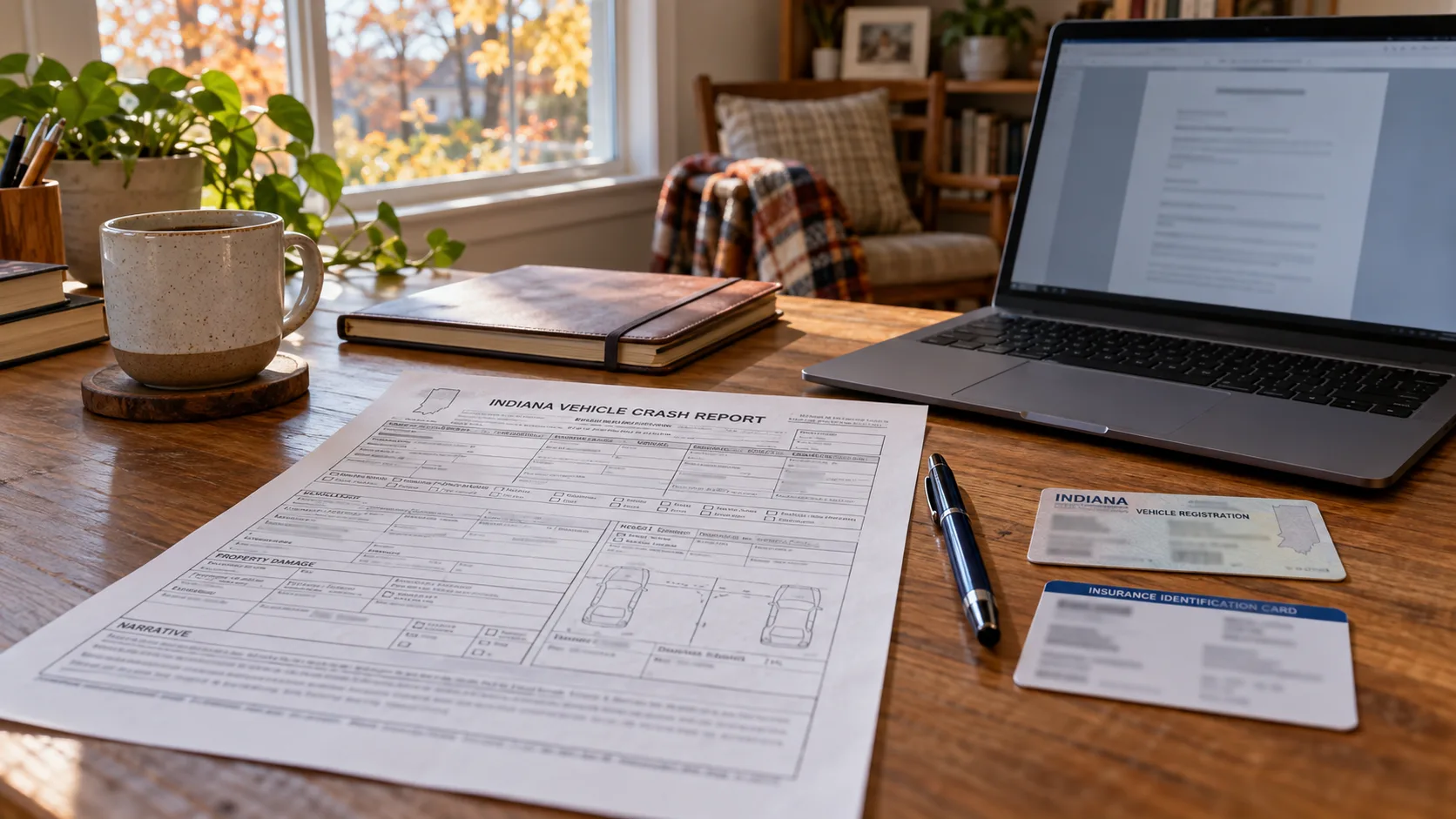
The Indiana State Police maintains Indiana’s central repository of vehicle crash reports and makes electronic reports available through BuyCrash for a fee. The official Indiana State Police crash-report page[3] explains where members of the public can request a report.
A crash report is a starting point for identifying vehicles, agencies, witnesses, and report numbers. Also ask whether photographs, diagrams, measurements, recordings, supplements, or reconstruction materials exist rather than assuming every attachment appears in the basic report.
For state-highway records, INDOT requires written public-record requests to describe the requested records with reasonable particularity. Its public-record request page[4] advises requesters to use details such as a date range and identified senders or recipients when seeking correspondence.
A focused roadway request might identify the route, mile marker or interchange, travel direction, date, and a narrow time range. Depending on the facts, the requested categories might include traffic-control plans, work-zone documents, maintenance records, inspection records, incident communications, photographs, or available traffic-system records.
Do not assume a traffic camera records footage or retains it for a fixed period. Ask the custodian whether responsive recordings exist and whether they can be preserved. A public-records request is not a promise that every record is available for release. Private video requests should be equally specific. The guide to traffic-camera, business-surveillance, and doorbell video after an Indiana crash provides a practical framework for identifying cameras and tracking requests.

Build a usable preservation file
Copyable custodian log: Evidence item | vehicle/VIN or device | custodian and contact | current location | requested hold scope | request date/delivery receipt | response | proposed transfer/disposal | authorized examiner | next follow-up.
Organize the preservation file so another person can understand it without relying on memory. Use one folder or index entry for each vehicle, witness, agency, business, device, and request.
- Keep the original file name, creation information, and unedited original whenever possible.
- Label copies separately from originals.
- Save sent emails, delivery confirmations, letters, envelopes, and portal receipts.
- Record the full name and role of each person who responds.
- Note gaps, unanswered requests, and conflicting information instead of silently resolving them.
- Maintain a simple chronology linking each item to a date, time, location, and source.
Indiana Trial Rule 34 allows parties in a lawsuit to request documents, electronically stored information, tangible things, and inspection of property within the rule’s scope. The current Indiana Trial Rule 34[1] also addresses the form in which electronically stored information may be requested and produced.
Rule 34(B) addresses when party discovery can begin, and Rule 34(G) describes nonparty requests accompanied by a subpoena. Those procedures are different from an informal preservation letter. Counsel should choose the appropriate process.
Early organization does not require deciding what every item proves. The goal is to preserve the source, record who collected, stored, copied or transferred it, and make later review possible. A log is an organizational aid, not an automatic path to admission in court. Indiana Evidence Rule 901(a)[5] requires evidence sufficient to support a finding that an item is what its proponent claims it is. A Fort Wayne car accident attorney can help identify custodians, prepare tailored requests, coordinate inspections, and determine which follow-up steps fit the specific collision.

Frequently Asked Questions
Should a family let the vehicle be moved from the tow yard?
First document where the vehicle is stored and who controls it. Before approving repair, salvage, destructive testing, or disposal, consider sending a written preservation request and arranging an appropriate inspection. Ordinary relocation and evidence-changing work are different issues, so identify exactly what the recipient proposes to do.
Does every vehicle have useful black-box data?
No assumption should be made from the vehicle’s age or appearance alone. NHTSA states that event data recorders vary in design, scope, and the information they record. Identify the exact year, make, model, VIN, and installed systems before asking a qualified examiner what may be retrievable.
Where can an Indiana crash report be obtained?
The Indiana State Police says electronic Indiana vehicle crash reports are available through BuyCrash for a fee. Save the report number, agency name, crash date, location, and involved driver or vehicle information before beginning the search.
How should a camera-record request be written?
Identify the date, a narrow time range, exact location, travel direction, and camera or record sought. For an agency request, avoid a blanket demand and use enough detail to help the custodian locate responsive records.
Can photographs and videos be edited for clarity?
Keep the original files unchanged. If you crop, brighten, annotate, or convert a copy for review, label it as an edited copy and retain the original separately.
If your family is trying to preserve evidence after a fatal crash near Fort Wayne, Delventhal Law Office can review the available records, identify potential evidence custodians, and help you decide what to do next. You may request a calm, no-obligation conversation through the firm’s contact page.
This article is general information about Indiana law and is not legal advice. Reading it does not create an attorney-client relationship, and neither does contacting us.