

That does not mean every adjuster request is improper. Insurance companies investigate claims. They need basic facts. Medical records matter. But there is a major difference between providing necessary claim information and giving the insurance company extra ammunition before you know your diagnosis, prognosis, fault issues, insurance coverage, or claim value. You can use our Indiana car accident settlement calculator to organize the factors that may affect a claim’s value; it is an educational tool, not a promise of any result.
At Delventhal Law Office, we see this issue early in Fort Wayne car accident claims. A person is still sore, waiting on the police report, trying to get their vehicle repaired, and suddenly the adjuster wants a recorded call or a release for medical records. That is often when good people accidentally say too much, guess about facts, minimize symptoms, or sign away more medical history than the claim requires.
Delventhal Law Office represents injured people in Fort Wayne car accident claims, truck accident claims, hit-and-run accidents, underinsured/uninsured motorist claims, and injury cases involving back and neck injuries, brain injuries, and herniated discs.
Key takeaways
- A recorded statement is not just “telling your side.” It becomes evidence the insurer can replay, quote, and compare against later records.
- You generally should not give the other driver’s insurance company a recorded statement before getting legal advice.
- Your own insurance policy may require cooperation, but that does not mean you should guess, speculate, or answer without preparation.
- A broad medical release can let an insurer search years of unrelated medical history for prior injuries, old pain complaints, mental health history, or gaps in care.
- HIPAA allows medical information to be disclosed with a valid authorization, but the scope of that authorization matters.
- Indiana comparative fault can make early wording important because insurers may try to assign part of the blame to you.
- Do not rush into settlement. The Indiana Department of Insurance specifically advises consumers not to rush into a settlement and to seek professional advice if they have questions about fairness.
What is a recorded statement in an injury claim?

A recorded statement is a question-and-answer interview taken by an insurance adjuster, usually by phone, where your answers are recorded and saved in the claim file. The adjuster may ask about how the crash happened, what you saw, what hurt, your medical history, your work, your vehicle damage, passengers, prior accidents, and what you have done since the collision.
The problem is timing. Recorded statements often happen before you have the crash report, before you know whether video exists, before your pain has fully developed, and before a doctor has explained your injuries. If you answer too quickly, you may accidentally lock yourself into incomplete facts.
For example:
| Adjuster question | Risk if you answer too casually |
|---|---|
| “How fast was the other car going?” | A guess can later be used against you if the evidence differs. |
| “Did you see them before impact?” | “No” may be twisted into an attention/fault argument. |
| “Are you feeling better?” | A polite answer can be used to minimize injuries. |
| “Did you have back pain before?” | A vague answer can open a prior-condition attack. |
| “What exactly hurts today?” | Early symptoms may not capture delayed concussion, neck, back, or radiating pain. |
That is why “I do not know yet” is sometimes the most accurate answer. You are not required to guess.
Do you have to give a recorded statement to the other driver’s insurance company?
Usually, you should not give a recorded statement to the other driver’s insurance company before getting legal advice. The other driver’s insurer has a job: investigate the claim, evaluate defenses, and protect its insured and its money. It does not represent you.
There may be situations where a limited statement is eventually appropriate, but it should be intentional. The adjuster does not need a recorded interview to learn basic facts like your name, contact information, vehicle location, claim number, or whether you are receiving treatment.
A safer response is:
“I am not giving a recorded statement today. Please send me your request in writing, including what information you need and why.”
If you are represented, the response is simpler:
“Please contact my attorney.”
What about your own insurance company?
Your own insurance policy may require you to cooperate with your insurer after a claim. That can matter for property damage, medical payments coverage, uninsured motorist coverage, underinsured motorist coverage, or other benefits under your policy.
But cooperation does not mean careless guessing. If your own insurer asks for a statement, you can still ask:
- Is this being recorded?
- What part of my policy requires this statement?
- What topics will be covered?
- May I review the police report first?
- May I have my attorney present?
- Will you provide a copy of the recording or transcript?
This is especially important if your own insurer may later become adverse to you, such as in an uninsured or underinsured motorist claim. Indiana’s uninsured/underinsured motorist statute is found at Indiana Code § 27-7-5-2[1]. That coverage can be crucial when the at-fault driver has no insurance or too little insurance.
See DLO’s Fort Wayne underinsured and uninsured accident attorney page for more on that issue.
Why are recorded statements risky after a Fort Wayne accident?
Recorded statements are risky because insurance companies compare them against later evidence. A statement taken on day three may be measured against medical records from week six, deposition testimony two years later, witness statements, vehicle photos, and the police report.
That creates several common problems.
1. You may not know your injuries yet
After a crash, adrenaline can mask symptoms. Neck pain, back pain, headaches, dizziness, confusion, numbness, tingling, shoulder pain, knee pain, and concussion symptoms can develop or worsen after the first day. The National Institute of Neurological Disorders and Stroke explains that traumatic brain injury can result from a forceful bump, blow, or jolt to the head or body, and that some TBI-related problems can develop gradually after injury.[1]
If you say “I’m just sore” too early, the insurer may later argue your more serious symptoms came from something else.
2. You may not know the crash facts yet
You may not have the police report. You may not know whether the other driver was cited. You may not know whether a nearby business had video. You may not know whether the defendant was working, texting, speeding, impaired, or driving a company vehicle.
DLO’s article on the first 72 hours after a Fort Wayne car accident explains why early evidence can disappear quickly.
3. Indiana comparative fault makes wording matter
Indiana uses modified comparative fault in many injury cases. Fault percentages can reduce or bar recovery depending on the facts and the percentage assigned. Indiana’s Comparative Fault Act is found at Indiana Code Chapter 34-51-2[2].[2]
That is why adjuster questions about speed, lookout, lane position, timing, “what you could have done,” and whether you saw the other driver are not harmless small talk. They may be aimed at shifting some percentage of fault to you.
4. Polite answers can be misread
People in Fort Wayne and northeast Indiana tend to be polite. They say “I’m okay,” “I’m doing better,” or “I’m sorry this happened” because they are trying to be decent human beings.
Insurance claim files are not always generous with context. A polite phrase can become:
- “Claimant admitted improvement.”
- “Claimant did not initially report severe pain.”
- “Claimant apologized at the scene.”
- “Claimant could not identify mechanism of injury.”
You do not need to be rude. You do need to be careful.
What is a medical release or medical authorization?
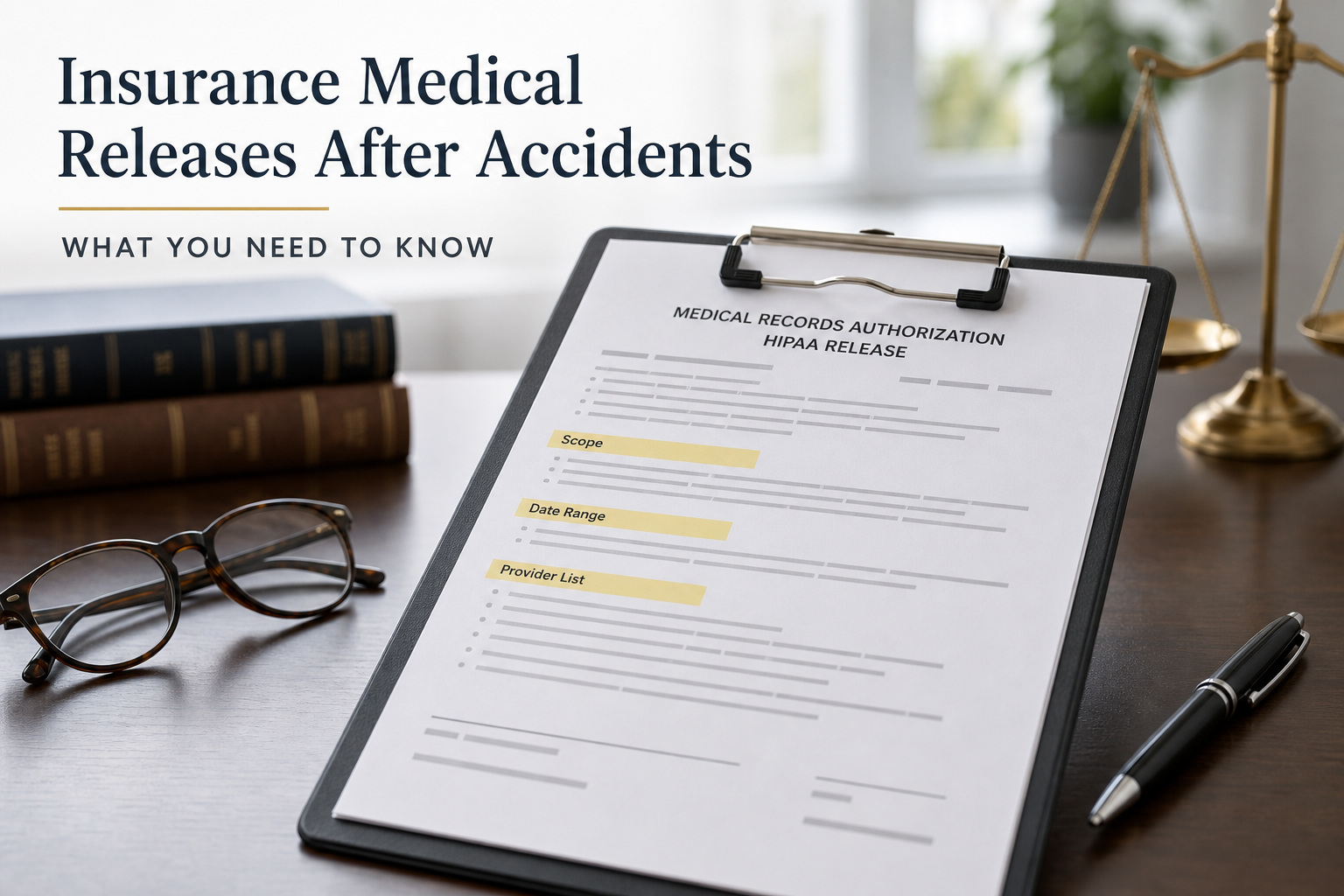
A medical release is a document that authorizes health care providers, hospitals, clinics, pharmacies, therapists, or insurers to release medical information. In an accident claim, medical records are important because they help prove injury, treatment, causation, diagnosis, prognosis, restrictions, bills, and future care.
But the scope matters.
A narrow authorization might request records from the crash date forward from providers who treated accident-related injuries. A broad authorization might allow the insurance company to obtain years of records from any provider for any condition.
Those are very different documents.
HIPAA’s Privacy Rule protects individually identifiable health information and generally requires a valid authorization for many uses and disclosures of protected health information. HHS explains that the Privacy Rule sets national standards for protecting certain health information while allowing appropriate information flow for health care and related purposes.[3] Federal regulations also describe when an authorization is required and what makes an authorization valid.[4]
The legal point is practical: if you sign a broad authorization, you may be giving the insurer permission to look far beyond the accident.
Why do insurance companies ask for medical releases?
Insurance companies ask for medical releases because they need medical proof to evaluate injury claims. Some of that is legitimate. If you claim a neck injury, the insurer will want records, bills, diagnosis, treatment dates, imaging, therapy notes, restrictions, and provider opinions.
The problem is when the request goes beyond what is reasonably tied to the claim.
A broad release may allow the insurer to search for:
- old back, neck, shoulder, knee, or headache complaints;
- prior car accidents;
- prior workers’ compensation claims;
- chiropractic records;
- physical therapy records;
- mental health history;
- prescription history;
- pain-management records;
- missed appointments;
- old imaging findings;
- unrelated conditions that can be used to distract from the crash.
Prior medical history is not always irrelevant. If the accident aggravated a pre-existing condition, that may still be compensable under Indiana law depending on the facts. But you do not want the insurance company roaming through your medical life without limits before your claim is properly framed.
See DLO’s pages on back and neck injuries, herniated disc injuries, brain injuries, shoulder injuries, and knee injuries for examples of injuries where prior records and causation arguments often matter.
What should you do before signing a medical release?
Before signing any medical release after an Indiana accident, slow down and read the scope. Ask what records are being requested, from which providers, for what time period, and for what purpose.
Use this checklist:
- Does the release identify specific providers, or does it allow “any and all” providers?
- Does it limit the date range, or does it allow years of records?
- Does it limit records to accident-related body parts or conditions?
- Does it include mental health, substance-use, HIV, genetic, reproductive, or other sensitive categories?
- Does it allow the insurer to speak directly with providers, or only obtain records?
- Does it expire?
- Can it be revoked?
- Will you receive copies of anything obtained?
- Is the request from your insurer, the at-fault insurer, health insurance, MedPay, workers’ comp, or another source?
If the release is too broad, you can ask for a narrower version. You can also provide relevant records through your attorney rather than giving the adjuster a blank check.
How recorded statements and medical releases work together against a claim

The most dangerous pattern is when the insurer gets both an early recorded statement and a broad medical release.
Here is how that can play out:
- The adjuster records you saying, “My back is sore, but I think I’m okay.”
- You sign a broad medical authorization.
- The insurer finds a five-year-old primary-care note mentioning back pain after yard work.
- Your symptoms worsen, MRI shows a disc issue, and you need injections or surgery.
- The insurer argues the crash did not cause the problem because you minimized symptoms early and had prior back history.
That does not mean the claim is lost. But it gives the insurer arguments it may not have had otherwise.
What information should you provide after an accident?
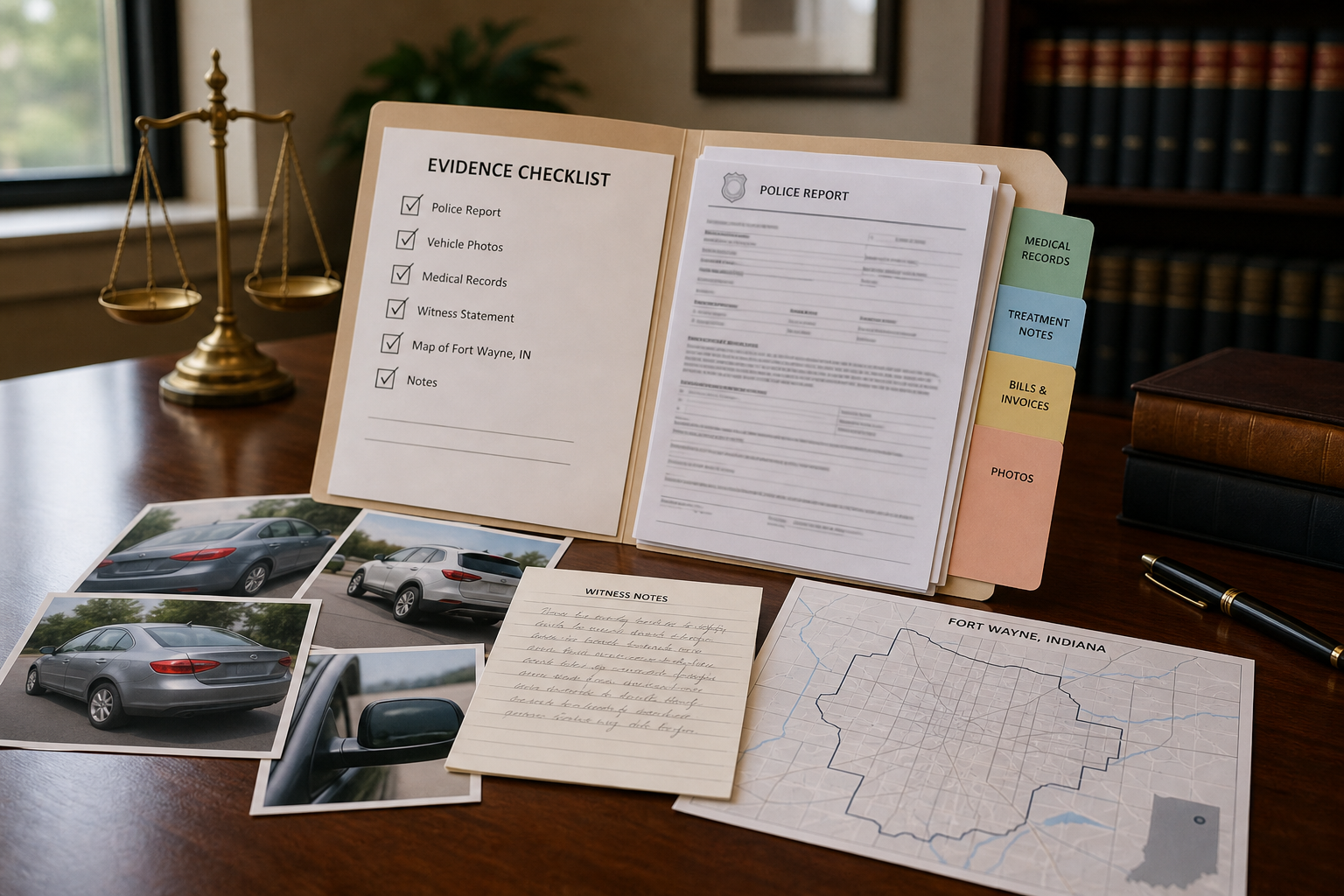
You should still communicate responsibly. Ignoring all insurance contact can create problems, especially with your own insurer. The Indiana Department of Insurance advises consumers to file claims as soon as possible, provide complete and correct information, keep copies of correspondence, ask questions, and not rush into settlement.[5]
Basic information may include:
- your name and contact information;
- date, time, and location of crash;
- vehicles involved;
- police report number, if known;
- your insurance information;
- where the vehicle is located;
- whether you are receiving medical care;
- claim number;
- property-damage information.
But you should avoid:
- guessing about speed, distance, or timing;
- admitting fault;
- minimizing injuries;
- giving a full medical history;
- agreeing that symptoms are unrelated;
- signing broad releases;
- accepting settlement before diagnosis/prognosis is clear;
- letting the other driver’s insurer pressure you into a recorded statement.
What if the adjuster says they cannot process the claim without it?
Ask them to put that in writing. Specifically ask:
“Please identify what you need, why you need it, and the policy or legal basis for the request.”
Sometimes the adjuster needs documentation, not a recorded statement. Sometimes they need accident-related medical records, not a blanket release. Sometimes the request is routine, but routine does not mean mandatory.
If the adjuster refuses to explain, delays without reason, or makes an unfair settlement offer, document the interaction. Indiana’s Department of Insurance Consumer Services states that it assists consumers with insurance inquiries and complaints involving automobile and property/casualty insurance policies, among others.[6]
What should you say if an adjuster calls after a Fort Wayne crash?
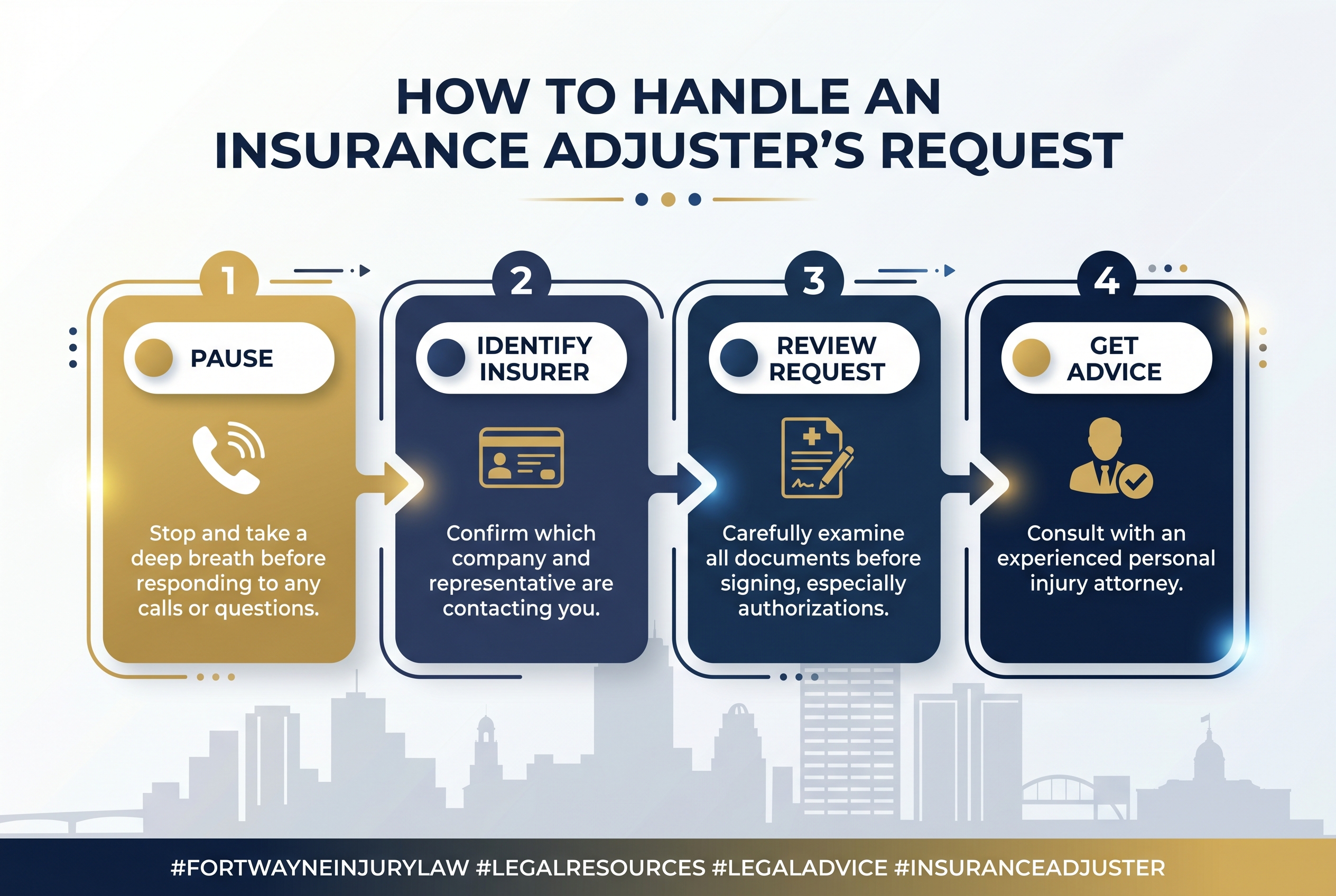
You can be polite and firm.
If the at-fault driver’s insurer calls
“I’m not giving a recorded statement today. Please send your questions and any requested forms in writing. I am still evaluating my injuries and reviewing the claim.”
If they ask for a medical release
“Please send the authorization in writing. I want to review the scope, date range, providers, and purpose before signing anything.”
If they ask how you are feeling
“I’m still treating and do not know the full extent of my injuries yet.”
If they ask you to guess
“I do not want to guess. I can answer once I have accurate information.”
If they pressure you
“I understand you want to move the claim forward, but I am not comfortable answering recorded questions or signing a broad release without advice.”
When should you call a lawyer?
You should speak with an Indiana personal injury lawyer before giving a recorded statement or signing a medical release if:
- you went to the ER, urgent care, primary care, therapy, imaging, pain management, or a specialist;
- you have neck pain, back pain, headaches, dizziness, numbness, tingling, memory issues, shoulder pain, knee pain, or worsening symptoms;
- the other driver disputes fault;
- the police report is wrong or incomplete;
- the crash involved a semi, delivery vehicle, company vehicle, rideshare vehicle, uninsured driver, drunk driver, or hit-and-run;
- the injured person is a child;
- you missed work or may need restrictions;
- the insurer wants a broad medical authorization;
- the adjuster is pushing for a quick settlement;
- you have prior injuries the insurer may blame.
Indiana’s general personal injury statute of limitations is often two years under Indiana Code § 34-11-2-4[3], but some claims have shorter practical deadlines because evidence disappears quickly and some government-related claims may require earlier notice. Do not use the lawsuit deadline as a reason to wait.
The Delventhal Law Office approach
We find what others miss. With recorded statements and medical releases, that means we look beyond the form request and ask what the insurer is really trying to learn.
We evaluate:
- who is requesting the statement or release;
- what policy or claim relationship exists;
- whether the request is too broad;
- what accident-related records should be provided;
- what prior medical history may become an issue;
- whether comparative fault is being developed;
- whether UM/UIM, MedPay, health insurance, Medicare, Medicaid, ERISA, or lien issues are involved;
- whether early evidence still needs to be preserved.
A strong injury claim is not built by handing the other side every tool it asks for on day one. It is built by providing necessary proof while protecting the client from unfair claim tactics.
If you were injured in Fort Wayne, Allen County, Auburn, Columbia City, Huntington, South Bend, Indianapolis, or anywhere in Indiana, start with DLO’s free case evaluation or call 260-484-6655 before giving detailed recorded answers or signing broad medical forms.
Frequently Asked Questions
Should I give a recorded statement after an Indiana car accident?
Usually not to the other driver’s insurance company before getting legal advice. Your own insurer may require cooperation under your policy, but even then you should avoid guessing, minimizing injuries, or answering without understanding the purpose and scope of the statement.
Can the at-fault driver’s insurance company force me to give a recorded statement?
In most ordinary injury claims, the at-fault insurer cannot force you to give a recorded statement just because it asks. The insurer can request information, but you should ask for the request in writing and get advice before providing recorded answers.
Is it safe to sign the insurance company’s medical release?
Not always. Some medical releases are too broad and may allow the insurer to obtain years of unrelated medical history. Before signing, review which providers, conditions, records, and date ranges are covered.
Can I give the insurance company only accident-related medical records?
Often, yes. A narrower approach may provide the records needed to evaluate the accident injuries without giving the insurer unlimited access to unrelated medical history. An attorney can help decide what should be produced and when.
What if I already gave a recorded statement?
Do not panic. Tell your attorney exactly what happened, ask for a copy of the recording or transcript, and avoid giving additional statements until you understand the claim issues. A bad or incomplete statement can sometimes be explained, but it should be handled carefully.
What if I already signed a medical authorization?
Ask for a copy of what you signed and determine whether it can be revoked or limited going forward. Also ask what records have already been requested or received. If the authorization was broad, talk to a lawyer quickly.
What should I do if the adjuster says I sounded fine on the phone?
Explain that phone tone is not a medical diagnosis. Many injured people sound calm or polite while still having significant pain, concussion symptoms, or worsening injuries. Medical records, diagnostic testing, restrictions, and treatment history matter more than how you sounded during a short call.
Can a recorded statement hurt my Indiana comparative fault case?
Yes. Statements about speed, lookout, lane position, distractions, visibility, or apologies can be used to argue you were partly at fault. Indiana comparative fault can reduce or bar recovery depending on the percentage assigned.
Should I settle before signing medical releases or giving statements?
Do not rush. The Indiana Department of Insurance advises consumers not to rush into settlement and to seek professional advice if they have questions about fairness. Settlement before you understand your diagnosis, future treatment, work restrictions, and liens can leave money on the table.
Bottom line
A recorded statement and a medical release can look like routine paperwork. They are not. After an Indiana accident, they can shape the claim file, fault arguments, medical causation defenses, and settlement value.
Be cooperative with necessary claim information. Be careful with recorded answers. Be even more careful with broad medical authorizations. And if the crash caused real injuries, talk to someone who handles Indiana injury claims before the insurance company writes the story for you.
Delventhal Law Office helps injured people in Fort Wayne and across Indiana protect their claims, preserve evidence, and avoid early mistakes that insurers use later. Call 260-484-6655 or request a free case evaluation.
Sources and further reading
[1] National Institute of Neurological Disorders and Stroke: Traumatic Brain Injury (TBI)[4]
[2] Indiana General Assembly: Indiana Code Chapter 34-51-2, Comparative Fault[2]
[3] U.S. Department of Health and Human Services: Summary of the HIPAA Privacy Rule[5]
[4] Legal Information Institute / e-CFR: 45 CFR § 164.508 — Uses and disclosures for which an authorization is required[6]
[5] Indiana Department of Insurance: Insurance Claim Tips[7]
[6] Indiana Department of Insurance: Consumer Services[8]
[7] Indiana General Assembly: Indiana Code § 34-11-2-4[3]
[8] Indiana General Assembly: Indiana Code § 27-7-5-2, Uninsured/Underinsured Motorist Coverage[1]
Sources
- Indiana Code § 27-7-5-2 (iga.in.gov) ↩
- Indiana Code Chapter 34-51-2 (iga.in.gov) ↩
- Indiana Code § 34-11-2-4 (iga.in.gov) ↩
- Traumatic Brain Injury (TBI) (ninds.nih.gov) ↩
- Summary of the HIPAA Privacy Rule (hhs.gov) ↩
- 45 CFR § 164.508 — Uses and disclosures for which an authorization is required (law.cornell.edu) ↩
- Insurance Claim Tips (in.gov) ↩
- Consumer Services (in.gov) ↩