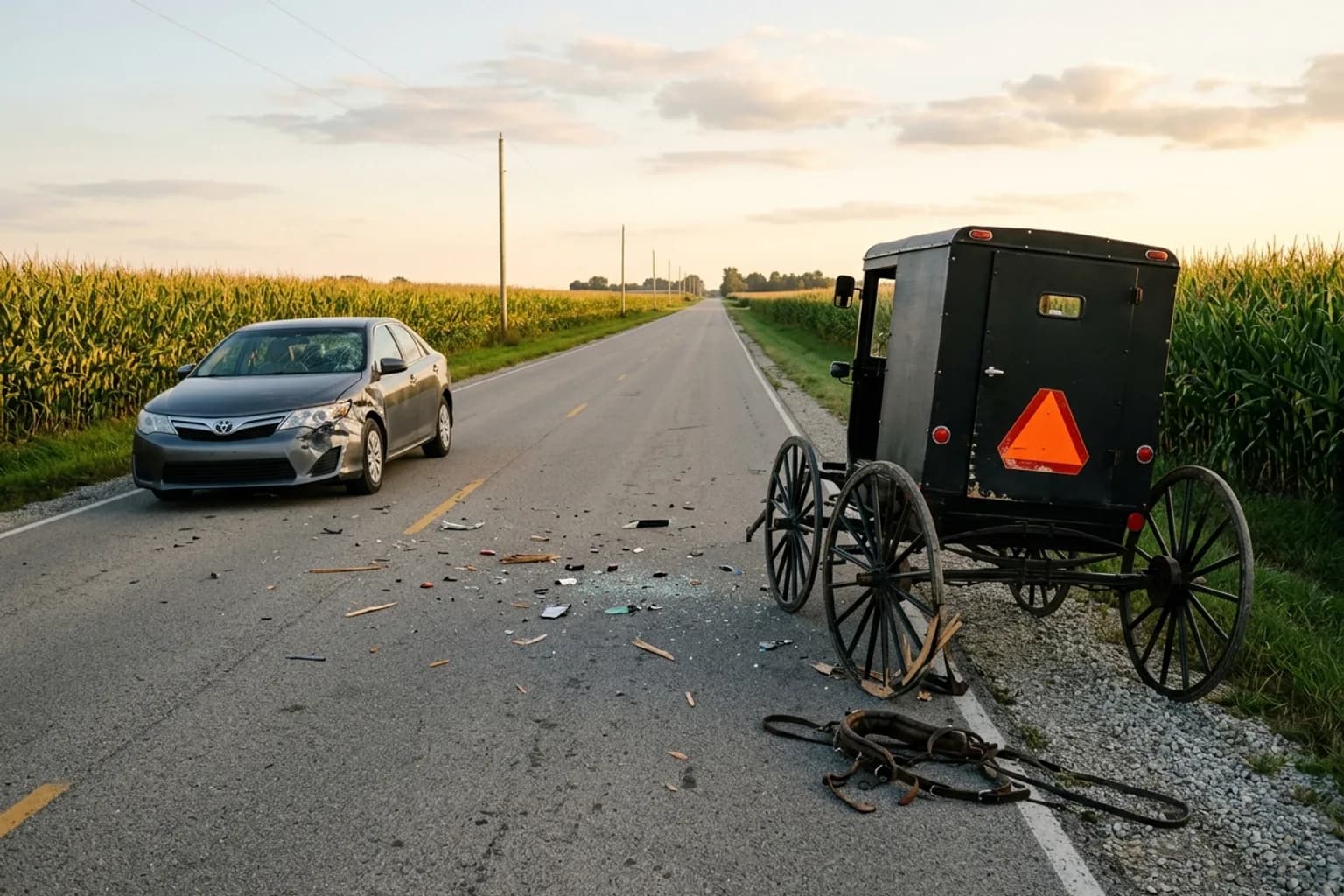
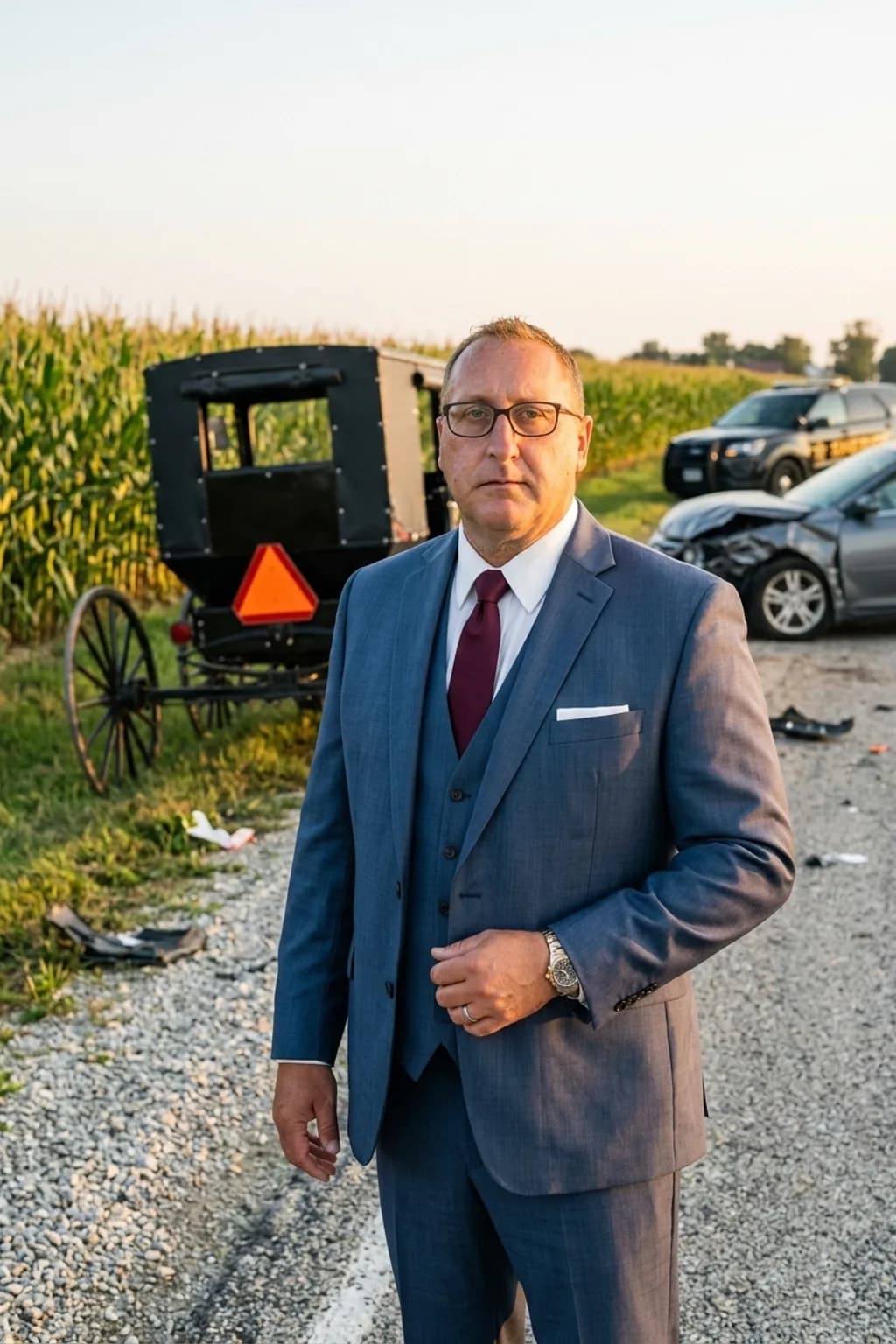
If you were driving when your car or truck struck a horse or a horse-drawn buggy, you may be facing serious vehicle damage, your own injuries, and hard questions about who is responsible. Delventhal Law Office represents the drivers of motor vehicles in these collisions across Fort Wayne, Allen County, and northeast Indiana, including the LaGrange, Elkhart, Noble, DeKalb, and Adams County corridors where horse-and-buggy travel is a daily reality. We help you sort out fault, deal with the insurance company, and pursue the compensation you are entitled to under Indiana law.
A horse or horse-and-buggy collision is handled as a motor-vehicle claim under Indiana negligence and comparative-fault law. Fault is not automatic in either direction. It depends on the facts, and both the driver and the animal's owner or handler can share it. What makes these cases unusual is how much of the fault analysis turns on the buggy's own equipment and conduct: whether it carried the required slow-moving-vehicle emblem, whether it was lit and reflectorized after dark, whether the horse was under control, and whether the driver of the car had a realistic chance to see and avoid it. Those questions decide who pays, and they need to be investigated quickly, before the buggy is repaired, the animal is moved, and the scene changes.
How we help drivers after a horse or buggy collision
We built this practice for one side of the caption: the person behind the wheel of the car or truck. That focus shapes everything from the first scene inspection to the demand package. Our work for drivers typically includes:
- Recovering for your injuries and medical bills after striking a horse or buggy.
- Repair or total-loss claims for your vehicle, including dispute of lowball property-damage valuations.
- Defending you when the animal's owner or a buggy occupant claims you were at fault.
- Uninsured and underinsured motorist (UM/UIM) claims when the animal owner or buggy has no applicable coverage.
- Investigating owner negligence, such as a loose horse, an unlit buggy, a missing slow-moving-vehicle emblem, or an animal left unsecured near a roadway.
- Documenting the buggy's equipment condition and the sight lines at the crash location before that evidence disappears.
- Working with your own insurer so you are not pressured into a fast, low settlement or a damaging recorded statement.
Why is a horse-and-buggy crash different from an ordinary car accident?
A horse-and-buggy is a legal vehicle on Indiana roads. Under IC 9-21-1-10[1], a person who rides an animal or drives an animal drawing a vehicle on a roadway is subject to the same traffic provisions as the driver of a vehicle, except those that by their nature cannot apply. That means the buggy operator owes real duties: to stay to the right, to signal, to yield where required, and to make the buggy visible to overtaking traffic.
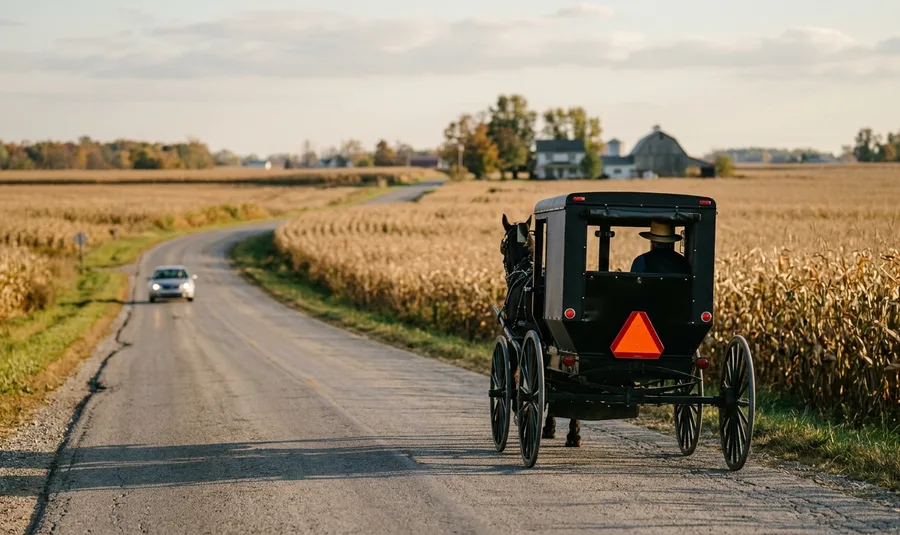
But buggies also behave like nothing else on the road. They travel at five to eight miles per hour while rural traffic moves at fifty-five. They sit low and narrow, with dark bodies that fade into tree lines and twilight. The closing speed between a car and a buggy over the crest of a hill can leave a driver only a few seconds of reaction time, and that is when everything is working as designed. When a reflector is caked with mud, an emblem is missing or faded, or a lantern is out, the buggy can be effectively invisible until it is too late. A horse adds a second layer of unpredictability: it can spook at a passing truck, bolt across the centerline, or stop dead in a travel lane. An ordinary rear-end case never asks whether the vehicle in front was physically capable of being seen. These cases always do.

What does Indiana law require of horse-drawn buggies?
Indiana's slow-moving-vehicle chapter, IC 9-21-9[2], applies to any vehicle — pulled, towed, self-propelled, or animal-drawn — that ordinarily moves at no more than twenty-five miles per hour (IC 9-21-9-1[3]). Under IC 9-21-9-2[4], a slow-moving vehicle operated on a highway open to vehicular travel must display the triangular slow-moving-vehicle emblem, mounted near the center of the rear between two and ten feet off the ground, and it must be entirely visible from the rear, day or night. A buggy running without that emblem, or with one so faded it no longer reflects, is out of compliance with the statute that exists precisely to protect overtaking drivers.
Lighting and reflectors are governed separately. Under IC 9-19-6-12[5], an animal-drawn vehicle not otherwise required to carry lamps must be equipped with at least two red reflectors visible from one hundred to six hundred feet to the rear when illuminated by headlamp upper beams, during all the hours when Indiana requires lighted lamps under IC 9-21-7-2[6] — essentially nighttime and other periods of poor visibility. Many Amish-country counties, including LaGrange and Elkhart, have gone further with local ordinances and community standards on lanterns and reflective tape. When we take a driver's case, one of the first things we determine is whether the buggy you struck actually met these requirements at the moment of impact — because if it did not, that failure is fault, and Indiana law assigns fault a percentage and a price.

How is fault decided when a car hits a horse or buggy in Indiana?
Indiana uses modified comparative fault. Under IC 34-51-2-6[7], your recovery is reduced by your percentage of fault, and you are barred from recovering only if your fault is greater than the combined fault of everyone else who contributed to the crash — in practice, more than fifty percent. A jury or an adjuster assigns percentages to every actor: the driver of the car, the buggy operator, and, where a loose or poorly controlled animal is involved, the animal's owner or handler.
That structure matters enormously for drivers. Even if an insurer argues you carry some share of fault — say, that you could have slowed sooner — you can still recover the majority of your damages so long as the buggy's missing emblem, dead lantern, or sudden turn carries the greater share. And the reverse is true when you are the one being blamed: pushing the percentages down below the bar is often the whole case. The fault investigation, not the sympathy narrative, is the center of these claims. For a practical walk-through of that first week after a collision, read our post Hit a Horse or Buggy on an Indiana Road? What Drivers Need to Know.
Is the driver automatically at fault for hitting a buggy?
No — and this is the assumption we spend the most time dismantling. People hear that a car struck a buggy and reflexively blame the car. Indiana law does not work that way. Fault turns on reasonable care on all sides, and in real cases the buggy or its operator is frequently the party who created the danger:
- An unlit buggy at night. A dark buggy on an unlit county road after sunset, without working reflectors or a lantern, may be impossible to perceive within normal headlight range.
- A missing or degraded SMV emblem. Without the triangle required by IC 9-21-9-2[4], an overtaking driver loses the one cue that says "this vehicle is moving at walking speed."
- A sudden turn across traffic. Buggies turning left into farm lanes and driveways sometimes swing across the centerline without a signal, directly into a passing or oncoming car's path.
- A bolting or spooked horse. A horse that shies at a dog, a semi, or a plastic bag can drag a buggy sideways into a travel lane in under a second.
- A buggy stopped in the roadway. Stopping in a travel lane below a hill crest or around a curve leaves overtaking traffic no room to react.
In each of these scenarios, the law asks whether you had a reasonable opportunity to see and avoid the hazard. When the answer is no, the fault belongs to the person who created it.
What if you hit a loose horse or escaped livestock?
Not every animal collision involves a buggy. Drivers across northeast Indiana hit loose horses, cattle, and other livestock that escaped a pasture and wandered onto the road. Indiana treats letting that happen as a serious matter: under IC 15-17-18-8[8], a person responsible for livestock who knowingly or intentionally permits the animals to run at large commits a Class B misdemeanor. On the civil side, the case is built on the owner's negligence — a fence that had failed and gone unrepaired, a gate left unlatched, a history of prior escapes the owner ignored, or an animal tied off next to a highway with nothing between it and traffic.
These cases rise and fall on evidence gathered early: photographs of the fence line and gate hardware, testimony from neighbors about earlier escapes, county animal-control run reports, and the owner's own statements at the scene. A large animal strike at highway speed can total a vehicle and cause catastrophic injury to the people inside it, and the owner's insurer will not volunteer the fence history. We go get it.
How will the insurance company fight your claim?
Whether you are pursuing the buggy owner's liability coverage, a farm policy, or your own carrier, expect a familiar playbook aimed at drivers in animal collisions:
- "You should have seen it." The adjuster argues that any attentive driver would have perceived the buggy in time, ignoring the physics of closing speed, hill crests, and a vehicle with no lights.
- Speed and following distance. Carriers lean on the instinct that the rear vehicle is always at fault — the same presumption they use in rear-end collision cases — even where the buggy was legally required to be marked and was not.
- The sympathy frame. Insurers know jurors feel for buggy occupants and horses, and they price their offers to drivers accordingly, betting you will not push back.
- The fast, low property-damage settlement. A quick check for your vehicle, offered before your injuries have even been diagnosed, paired with a release that ends the whole claim.
- The recorded statement. An early call asking you to estimate speeds and distances in the dark — estimates that later become the basis for putting fault on you.
- The empty-coverage shrug. A claim that the buggy owner simply has no applicable policy, without ever identifying the household, farm, or umbrella coverage that may actually respond.
Every one of these moves has an answer, but the answers depend on evidence — which is why the investigation below starts immediately.

The evidence checklist that decides these cases
Buggy-collision liability is proved with physical facts, and most of them are perishable. From the first days after the crash we work to lock down:
- Scene photographs and measurements — skid marks, debris fields, the point of impact relative to hill crests and curves, shoulder width, and lane position.
- 911 audio and dispatch logs, which capture what callers actually saw in the moment — including descriptions of an unlit or unmarked buggy — before anyone's story hardens. Our post on 911 calls and police body-camera video in Indiana injury cases explains how we obtain them.
- The buggy's equipment condition — the presence, placement, and reflectivity of the SMV emblem, the state of the rear reflectors required by IC 9-19-6-12[5], and whether any lantern or battery lamp was functional, photographed before repairs.
- Lighting and visibility reconstruction — a nighttime sight-distance study at the same location, moon and weather data, and headlamp-range analysis showing what a reasonable driver could actually perceive and when.
- Your vehicle's event data recorder, which documents speed, braking, and steering in the seconds before impact and can independently corroborate your account.
- The crash report and witness statements, gathered while memories are fresh, plus any doorbell, dash, or farm-security camera footage along the corridor.
- Fence, gate, and pasture documentation in loose-animal cases, together with prior-escape history from neighbors and animal control.

What compensation can an injured driver recover?
Striking a thousand-pound animal or a wooden buggy at road speed is a violent event for the people inside the car. Windshield intrusion, airbag deployment, and secondary impacts with trees or ditches produce head injuries, cervical and lumbar spine trauma, fractures, and lacerations. An injured driver's recoverable damages under Indiana law include emergency and follow-up medical care, future treatment, lost wages and diminished earning capacity, pain and suffering, and the repair or total-loss value of the vehicle. Where a crash proves fatal, the family's claim proceeds under Indiana's wrongful death framework.
The harder question in buggy cases is usually not the amount of harm but the source of payment. Many buggy operators carry no liability insurance at all, and a horse owner's exposure may sit inside a farm or homeowner's policy nobody mentions. That is where your own coverage becomes the case: your uninsured and underinsured motorist coverage, medical payments coverage, and collision coverage may all respond, and Indiana law restricts how your own carrier can treat you when they do. We identify every policy that could pay — liability, farm, umbrella, and first-party — before deciding where to press.
Where do these collisions happen in northeast Indiana?
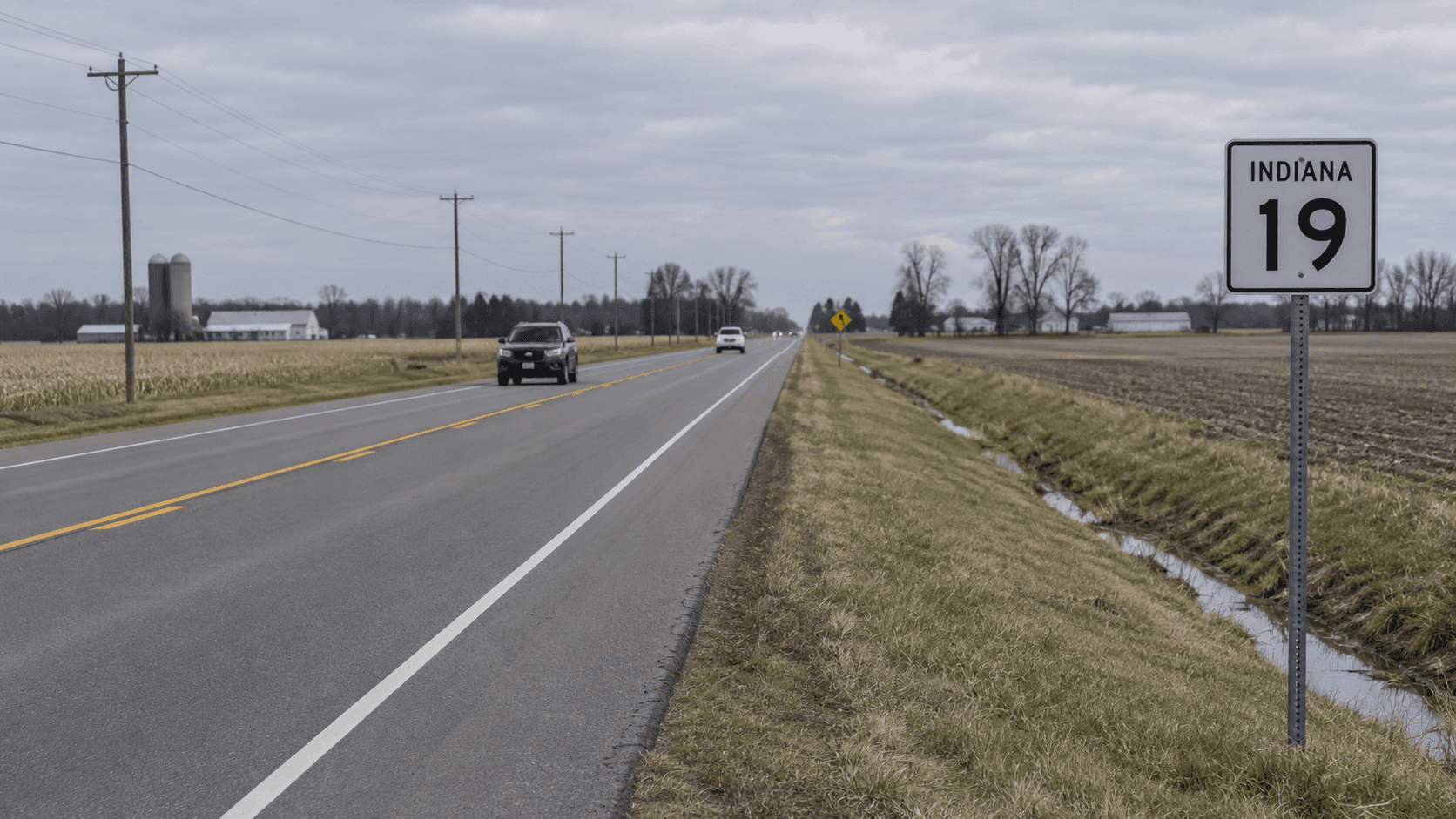
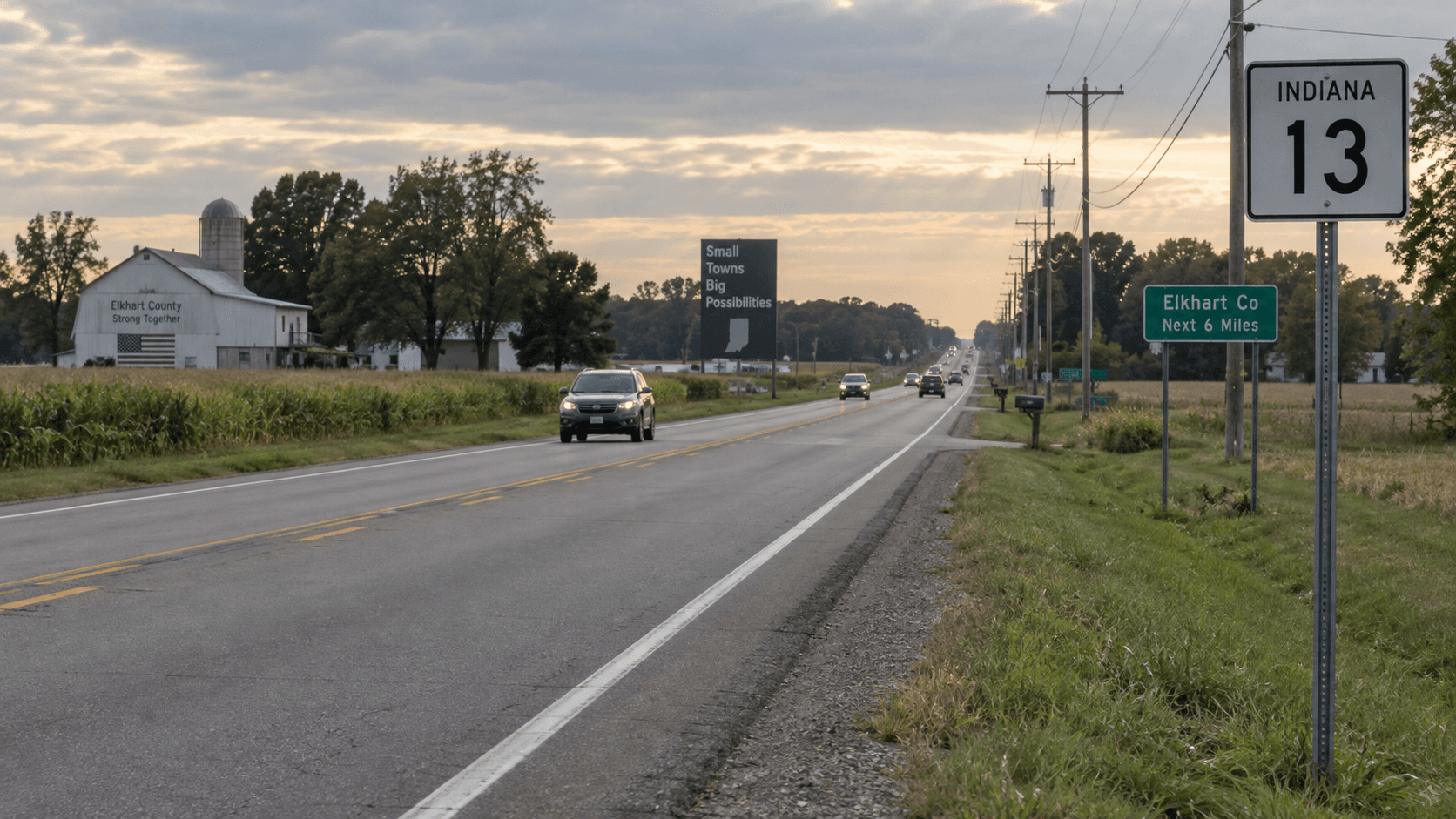
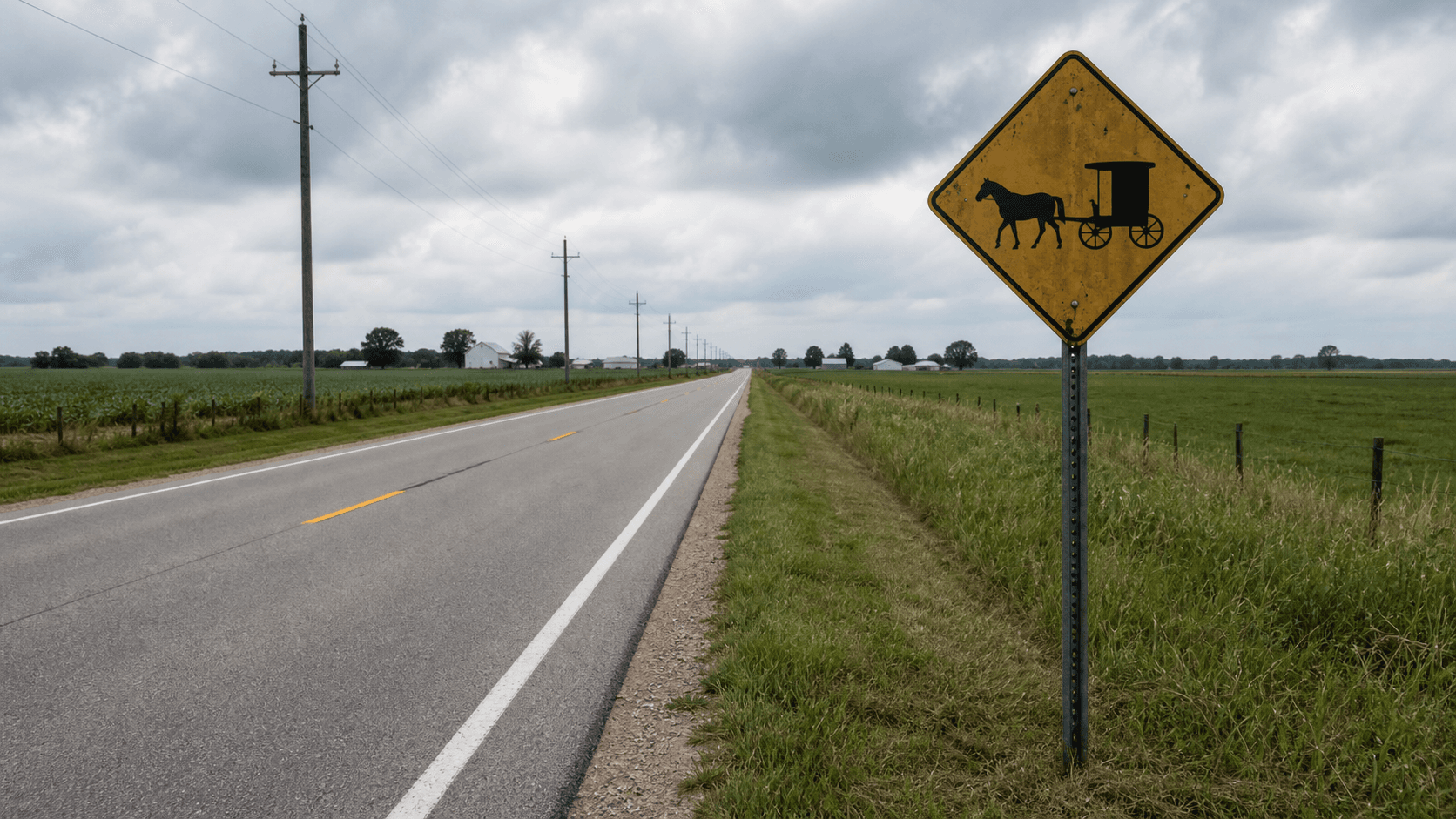
Northeast Indiana is home to some of the largest Amish and Old Order settlements in the country, and the region's buggy traffic is concentrated along a handful of corridors we know well. In LaGrange County, buggies share US 20 and State Road 5 around Shipshewana and Topeka with heavy tourist and truck traffic. In Elkhart County, the Nappanee settlement puts buggies on US 6, State Road 19, and State Road 13 — the same stretch where rear-end buggy crashes make the news year after year. In Adams County, US 27 between Berne and Geneva runs directly through buggy country, and Allen County sees daily buggy travel around Grabill, Harlan, and the county roads northeast of Fort Wayne, alongside DeKalb and Noble County routes.
These are rural highways with 55 mph limits, limited lighting, narrow or absent shoulders, and rolling grades — a geometry that produces exactly the overtaking and left-turn collisions described above, and that also generates serious car accident and truck accident claims when grain trucks and semis share the same lanes. Cases from these counties are worked from our Fort Wayne office, and venue, local juries, and county-specific buggy ordinances all factor into how we value and present them.
How long do you have to bring a claim?
Indiana's general personal-injury statute of limitations, IC 34-11-2-4[9], gives you two years from the date of the crash to file suit, and property-damage claims run on the same two-year clock. Shorter deadlines can hide inside a case: if a government entity's conduct is involved — a missing warning sign, an obstructed right-of-way on a county road — the Indiana Tort Claims Act requires written notice far earlier, as short as 180 days under IC 34-13-3-8[10]. UM/UIM policies also carry their own contractual notice requirements. Evidence deadlines are shorter still: buggies get repaired, fences get fixed, and 911 recordings get purged on retention schedules measured in months. The practical deadline for building a strong case is measured in weeks, not years.
Frequently asked questions
Do you represent the horse or buggy owner, or the driver?
We represent the driver of the car or truck. We help motor-vehicle drivers with their injuries, vehicle damage, insurance claims, and any claim the buggy occupants or animal owner makes against them. If you were in the buggy, we are not the right firm for your claim — but if you were behind the wheel, this is exactly what we do.
Am I automatically at fault because I hit something slower?
No. Indiana decides fault by reasonable care on all sides under its comparative-fault statute, IC 34-51-2[11]. Fault can rest partly or entirely with the buggy operator or the animal's owner — for example, when a buggy was unlit after dark, was missing the slow-moving-vehicle emblem required by IC 9-21-9-2[4], turned suddenly across your lane, or when a horse was loose because a fence failed.
Can I still recover if I was partly at fault?
Usually, yes. Under IC 34-51-2-6[7], your recovery is reduced by your percentage of fault, and you are barred only if your share exceeds fifty percent. A driver found twenty percent at fault for a nighttime buggy collision still recovers eighty percent of proven damages. Keeping your assigned percentage honest — and supported by the physical evidence rather than assumptions — is a core part of our job.
What if the buggy or animal owner has no insurance?
This is common, and it is why your own policy matters. Your uninsured and underinsured motorist coverage, medical payments coverage, and collision coverage may each apply, and farm, homeowner's, or umbrella policies covering the animal's owner may also respond. We identify every policy that could pay before anyone tells you there is "no coverage."
How long do I have to bring a claim?
Generally two years from the date of the crash under IC 34-11-2-4[9], but government-entity involvement can shorten the notice window to 180 days under the Indiana Tort Claims Act, and key evidence disappears far faster than any statute runs. Talk to a lawyer early, even if you are still deciding what to do.
Talk to a Fort Wayne lawyer about your horse-and-buggy collision — free consultation
If you were hurt or your vehicle was damaged in a collision with a horse or a horse-drawn buggy anywhere in northeast Indiana, a free consultation can help you understand your options before you give a statement or accept a check. We will review what happened, explain the deadlines that apply, tell you honestly how the fault picture looks, and help you decide the next step — with no fee unless we recover for you. Contact Delventhal Law Office today.
Disclaimer: This page is general information about Indiana law and is not legal advice. Contacting the firm does not create an attorney-client relationship.