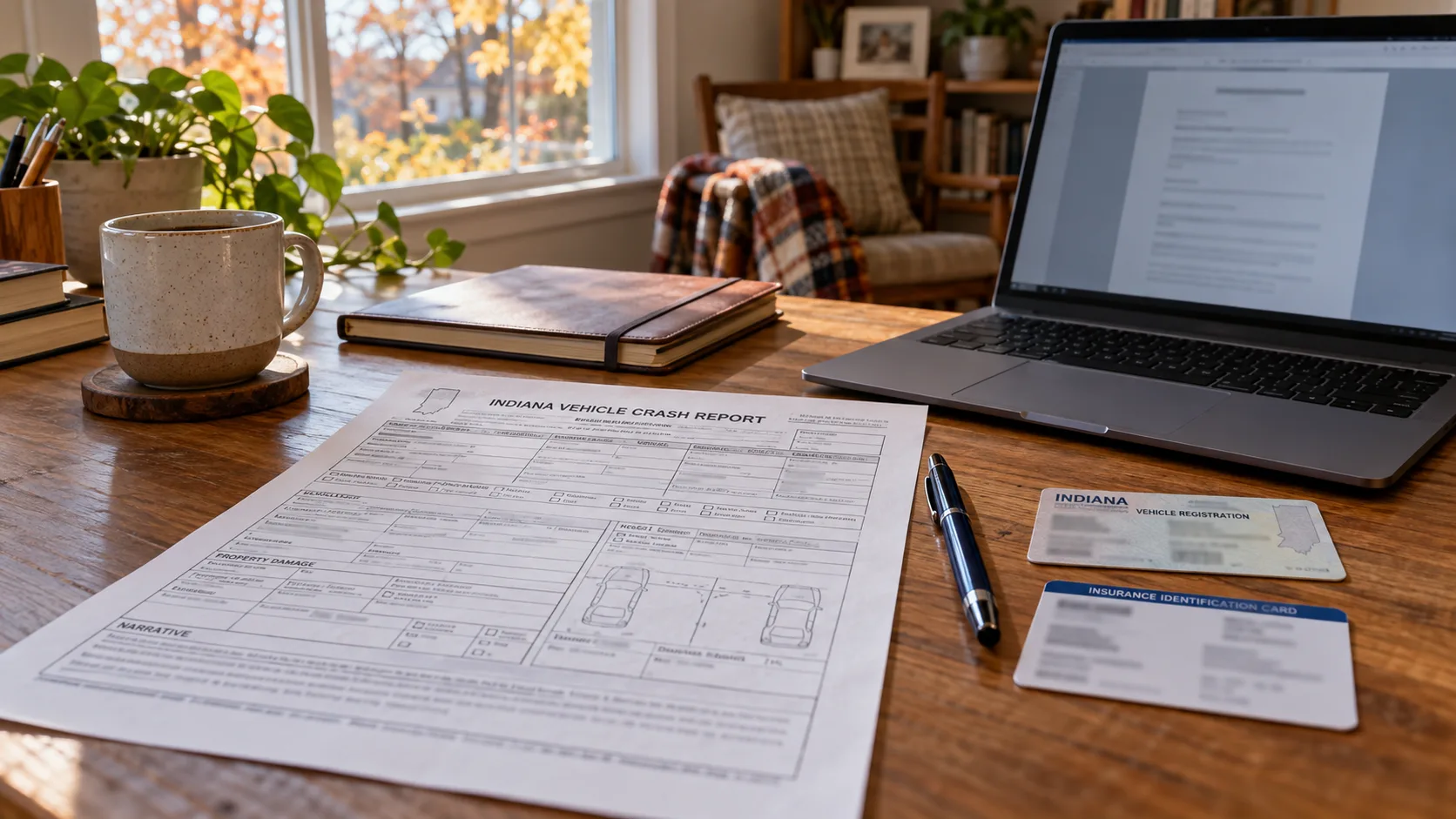
This guide provides a sample message and a tracking method—not an official police form or a promise that an officer will change a report. For the BMV insurance-verification process, use our Indiana factual-error and BMV guide. For a disagreement about how the collision happened, see our guide to a report that assigns you part of the fault.
Start with a focused request
A useful request lets the recipient locate the disputed entry without reconstructing the entire collision. Identify the report number, crash date, page, vehicle or unit number, and field label. For each proposed change, distinguish what the report says from what your supporting material shows.
In its insurance-verification guidance, the Indiana BMV directs a customer who believes the reporting officer entered incorrect vehicle information to contact that officer and request a correction[1]. That guidance addresses errors affecting the BMV process; it is not a general promise that every disputed narrative will be rewritten.
If you do not have the report, the Indiana State Police crash-report page[2] identifies ISP as Indiana’s central crash-report repository and directs users to BuyCrash for electronic purchases. Save the version you obtain and note its download date.
The remaining packet suggestions are practical organization tools, not statewide submission requirements. Before sending attachments, ask the reporting agency which contact, file format, and delivery method it accepts.

Build an attachment index
Use short attachment labels so the officer can match each proposed change to its supporting material. Send copies, preserve originals, and avoid including unrelated personal information. Do not alter the report file itself or present your annotations as an official amendment.
| Packet item | What to include | What to check |
|---|---|---|
| A — Report excerpt | The page containing the entry, with the report number visible | Quote the existing entry exactly; label any marked copy as your annotation |
| B — Supporting record | A registration record or other document directly addressing that entry | Confirm it concerns the vehicle and date in question |
| C — Supporting image | A relevant original photograph and a separate explanatory copy if useful | Identify what it shows without overstating what it proves |
| D — Request message | The proposed replacement and a short explanation | Keep distinct issues in separately numbered paragraphs |
| E — Response record | Delivery confirmation, agency response, and any returned report | Keep the original and later versions separately labeled |
For example, if a report lists a blue vehicle but the registration and relevant photographs show a red vehicle, point to the color field and those two attachments. Keep that narrow request focused on the color entry. If a photograph is ambiguous, acknowledge what it does not show.

Sample correction-request message
Adapt this illustrative message only after confirming the correct recipient. Replace every bracketed field, remove any statement you cannot verify, and retain the sent version.
Subject: Request to review a factual entry — crash report [number], [crash date]
Dear [officer or agency contact]:
I am writing about report [number] for the collision at [location] on [date]. On page [page], under [field or section] for vehicle/unit [number], the report states: “[exact entry].”
I request review of that entry. I believe it should read “[proposed replacement]” for this reason: [brief factual explanation]. Attachment [label and filename] shows [specific supporting information].
Please let me know whether this is the correct process for requesting review, whether you need other material, and how I can obtain any amended or supplemental report if one is issued. If the entry is not changed, please let me know whether the agency accepts a separate statement or supporting documents for its file.
Thank you,
[Name]
[Preferred contact information]
Attachments: [list]
A request for an amendment and a request to accept a supplemental statement are different requests. Ask which, if either, the agency will consider. Keep the tone specific and factual; avoid accusations, guesses about another person’s motives, or a demand that the officer adopt a legal conclusion.

Record delivery and follow-up
Create a simple tracking note with these fields: date sent, recipient, delivery method, report number, attachment names, confirmation received, response, and next action. If you speak by telephone, write down the person’s name and your understanding of the next step. Ask for clarification if you are unsure where to send the material.
For communications with your insurance company, the Indiana Department of Insurance recommends keeping correspondence and a telephone or in-person conversation log that records the date, the person’s name and title, and what was said[3]. Keep that insurance log separate from your police-agency submission record so you can tell who received which version.
If no response arrives, follow up through the agency’s published contact information. Ask whether the request was received and whether anything is missing. This checklist sets no universal response period and makes no promise that sending a request will produce an amendment.
Compare the returned version
When another copy becomes available, compare the particular entry you asked about—not just the filename. Record whether the field changed, whether a supplement was added, or whether the document appears unchanged. Keep the earlier copy rather than replacing it.
Use clear names such as “Report — downloaded [date]” and “Report — later copy received [date].” Reserve “amended” for a document identified that way by the issuing agency. Keep your own summary outside the official report, clearly labeled as your notes.
If you send a later version to a claim contact, identify the report number and explain what changed. Save that delivery message too. Do not assume every recipient has automatically received the same document.

Final packet checklist
- Report number, date, page, field, and vehicle/unit identified.
- Existing wording quoted and proposed wording clearly separated.
- Each attachment labeled and connected to a specific entry.
- Original files preserved; annotations identified as your own.
- Recipient and submission method confirmed with the agency.
- Sent message, attachment list, and delivery confirmation saved.
- Response and later report versions stored together without overwriting earlier copies.
Do not let document organization become the only action you take after a serious collision. If you have been hurt, receive an official notice, or are unsure what else needs attention, arrange an individual review promptly. A packet is an organizing tool, not a substitute for advice about your particular situation.

Correction-packet questions
Is this an official Indiana correction form?
No. The sample message is an organizational aid. Ask the reporting agency whether it uses a particular form or accepts requests through a specific channel.
Should I mark up the report before sending it?
Preserve the downloaded original unchanged. If highlighting helps explain the request, make a separate copy and label it as your annotation, not an official amended report.
What if I have several entries to question?
Number the entries separately. For each one, identify the page and field, quote the existing wording, and name the attachment supporting the requested change.
What if the officer does not change the entry?
Save the response. Ask whether the agency accepts a separate statement or additional material, and consider individual advice about the underlying dispute. Do not label your own statement an official correction.
How do I know which version I sent?
Keep the sent message and its attachment list. Use filenames with download or receipt dates, and retain earlier versions rather than overwriting them.
Does this packet cover a BMV insurance notice?
It can help organize the documents, but it is not a complete guide to responding to a BMV notice. Read the notice itself and use the separate factual-error/BMV guide linked above for that distinct process.
Bring the packet to a consultation
For help connecting the report issue to an injury claim, bring the original report, your request, the supporting attachments, every response, and any later report version. That lets a lawyer see the exact disagreement instead of relying on a summary.
Read about our Fort Wayne car-accident practice or contact Delventhal Law Office to discuss a consultation. You can also review Chad Delventhal’s attorney profile.
This article is general information about Indiana law and is not legal advice. Reading it does not create an attorney-client relationship, and neither does contacting us.
Sources
- Indiana BMV directs a customer who believes the reporting officer entered incorrect vehicle information to contact that officer and request a correction (in.gov) ↩
- Indiana State Police crash-report page (in.gov) ↩
- Indiana Department of Insurance recommends keeping correspondence and a telephone or in-person conversation log that records the date, the person’s name and title, and what was said (in.gov) ↩