
Being a passenger changes the practical questions after a collision. A useful way to stay organized is to keep one notebook and one digital folder for the crash. Put names, dates, questions, photographs, letters, and phone-call notes in chronological order. Bring that collection to appointments and conversations so the same details do not have to be reconstructed repeatedly. Clear organization also makes missing documents easier to spot. You may not know whether one driver or both caused the crash. You may have been riding with a parent, spouse, coworker, or close friend and feel uneasy about making an insurance claim. You also may receive calls from multiple adjusters, each asking for a statement while saying another carrier should pay.
This guide addresses an injured passenger car accident claim in Indiana involving an ordinary privately owned car, SUV, van, or pickup. For a two-wheel crash, see our separate guide to Indiana motorcycle passenger injury claims. If you were riding through a transportation app, our Uber and Lyft passenger guide explains the different commercial coverage questions. Those narrower situations should not be treated as ordinary private-car claims.
For the broader legal-service overview, visit our Indiana car accident lawyer page.
Key takeaways
- A passenger should investigate every driver's conduct instead of assuming the first insurer to call is the only source.
- Liability coverage, MedPay, health insurance, and UM/UIM coverage serve different roles and may interact.
- The relationship with the occupied-vehicle driver does not erase a possible insurance claim.
- Seating position, belt and airbag evidence, doors, seats, and interior contact points can be unusually important.
- A recorded statement or broad release deserves careful review before it is given or signed.
- Deadlines and evidence-loss risks make prompt, case-specific review sensible.
First steps after a passenger is hurt

At the scene, call 911 when emergency help is needed. If you can do so safely, collect each driver's name, contact information, driver's-license information, license plate, and insurer. Ask for the police report number. Identify witnesses and nearby cameras. Photograph the vehicles, their resting positions, the roadway, traffic controls, debris, and visible interior damage.
Tell responders where you were sitting and what parts of the vehicle or restraint system contacted you. Do not guess about speed, distance, or fault. If you do not know an answer, say so. Our first 72 hours after a Fort Wayne car accident guide gives a more detailed evidence-preservation plan.
Keep the clothing, shoes, glasses, child restraint, or personal property affected in the crash. Do not allow damaged interior components to be discarded without first documenting them. Write a private timeline while the sequence is fresh: where you sat, whether you were belted, which direction you faced, the first impact you noticed, any second impact, airbag deployment, broken glass, door movement, and what happened immediately afterward.
The Indiana Criminal Justice Institute crash-statistics portal[1] is an official source for statewide crash data. General statistics, however, do not establish what happened in an individual passenger's collision.
Who may be responsible for an injured passenger's claim?
The other driver
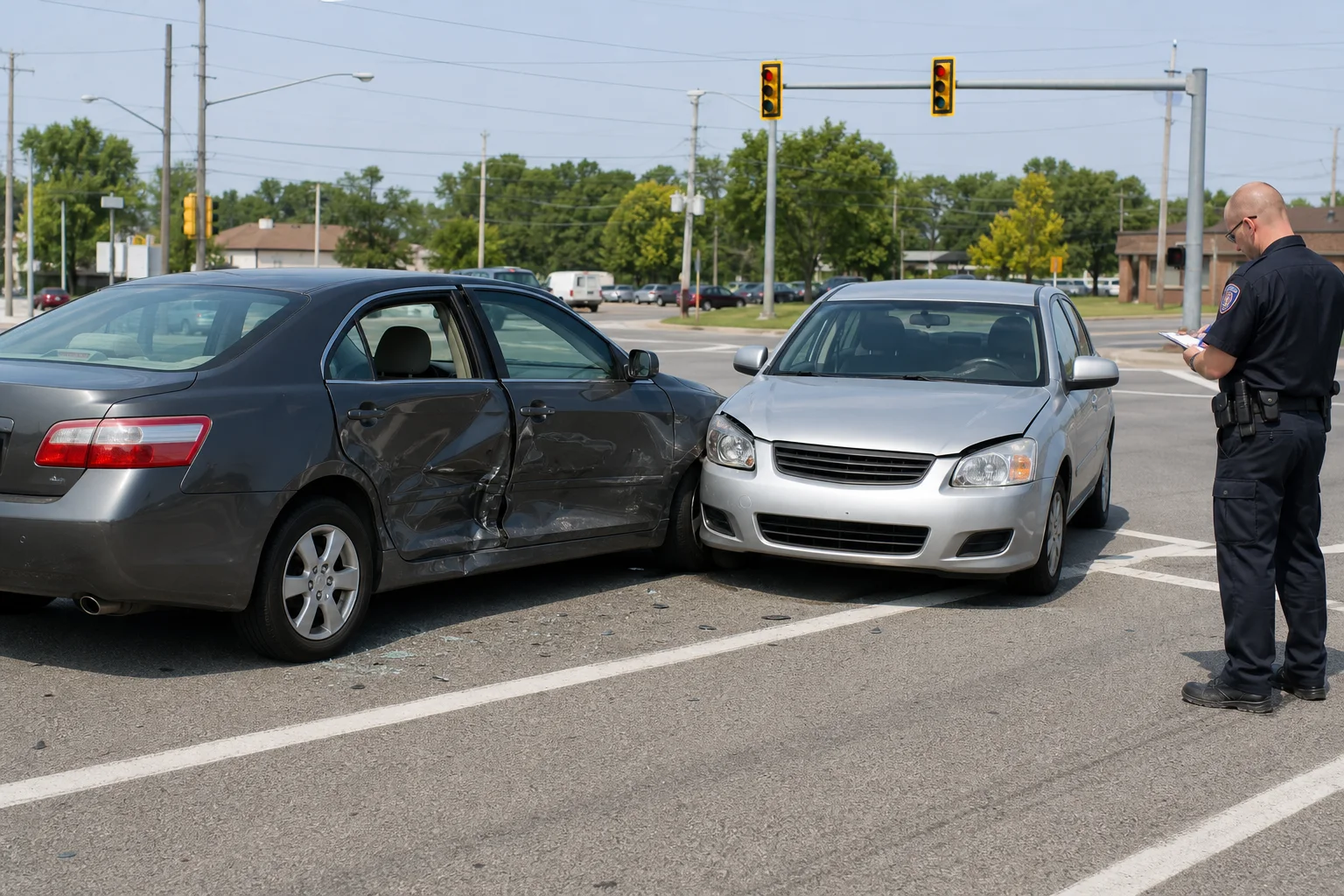
If another motorist contributed to the crash, the passenger can present a claim based on that driver's conduct. Evidence may include scene photographs, witness accounts, vehicle damage, available video, event data, and each driver's own account. A traffic citation or one adjuster's early opinion should not replace a complete investigation.
The driver of the vehicle you occupied
The occupied-vehicle driver may also have contributed. This can be difficult when that person is a friend or family member. A tactful way to understand the process is that the claim is ordinarily directed to applicable liability insurance; it is not a declaration that the relationship no longer matters. Still, coverage limits, exclusions, disputed fault, or uninsured losses can affect the practical path, so no one should promise that personal finances can never become relevant.
You do not have to accuse someone at the scene. Preserve the facts and let the investigation address lane position, right of way, attention, lookout, speed, following distance, impairment evidence, and other circumstances.
Both drivers and additional parties
More than one driver may share responsibility under Indiana's Comparative Fault Act. The Act addresses allocation of fault and the effect of a claimant's percentage of fault in covered actions. See Indiana Code chapter 34-51-2[2] and our plain-language guide to the Indiana 51 percent fault rule.
Other possible defendants are fact-dependent. A vehicle owner may matter when a legally supported owner-liability theory fits the evidence. An employer may matter when a driver's work and the collision are sufficiently connected. A commercial maintenance provider, alcohol vendor, product maker, or government body raises distinct facts and rules; naming one merely because it exists is not enough. The investigation should identify a supportable connection before treating any third party as responsible.
Which insurance paths may pay?

Start by identifying policies before deciding which carrier should pay. Obtain declarations pages and relevant policy language when possible. The word “covered” can hide important questions about who qualifies as an insured, which vehicle was involved, exclusions, priority, notice, consent, limits, offsets, and reimbursement.
| Path | What it may address | Questions to verify |
|---|---|---|
| Other driver's liability policy | Losses attributed to that driver's conduct | Fault evidence, available limits, other claimants, and exclusions |
| Occupied-vehicle driver's liability policy | Losses attributed to that driver's conduct | Driver status, permission, household terms, and exclusions |
| Medical payments coverage (MedPay) | Qualifying medical expenses under applicable policy terms | Who is an insured, limit, submission process, coordination, and reimbursement language |
| Health insurance | Medical bills under the health plan's terms | Network rules, deductibles, copays, lien or reimbursement assertions, and explanation-of-benefits records |
| Uninsured motorist coverage | A qualifying loss involving an uninsured motorist | Applicable policy, insured status, notice, exclusions, and policy conditions |
| Underinsured motorist coverage | A qualifying loss when the responsible motorist's coverage is insufficient under governing terms | Policy definitions, limits, credits, notice, consent, and preservation of carrier rights |
Indiana Code 27-7-5-2[3] generally requires covered Indiana automobile policies to make uninsured and underinsured motorist coverage available, ordinarily at bodily-injury liability limits, subject to statutory exceptions and a written rejection. A named insured may reject both or, when offered separately, either coverage; the rejection operates for other insureds and people entitled to coverage under the policy. Review the current text at the Indiana General Assembly's official site[3]. Whether a passenger qualifies under a particular policy depends on its terms and the facts.
If the responsible driver appears uninsured, read our focused guide on what happens when the at-fault driver has no insurance. Do not assume the policy on the occupied vehicle is the only UM/UIM policy worth examining; ask about the passenger's own auto policy and potentially relevant household policies, while recognizing that policy definitions and exclusions control.
Passenger-specific evidence insurers may overlook
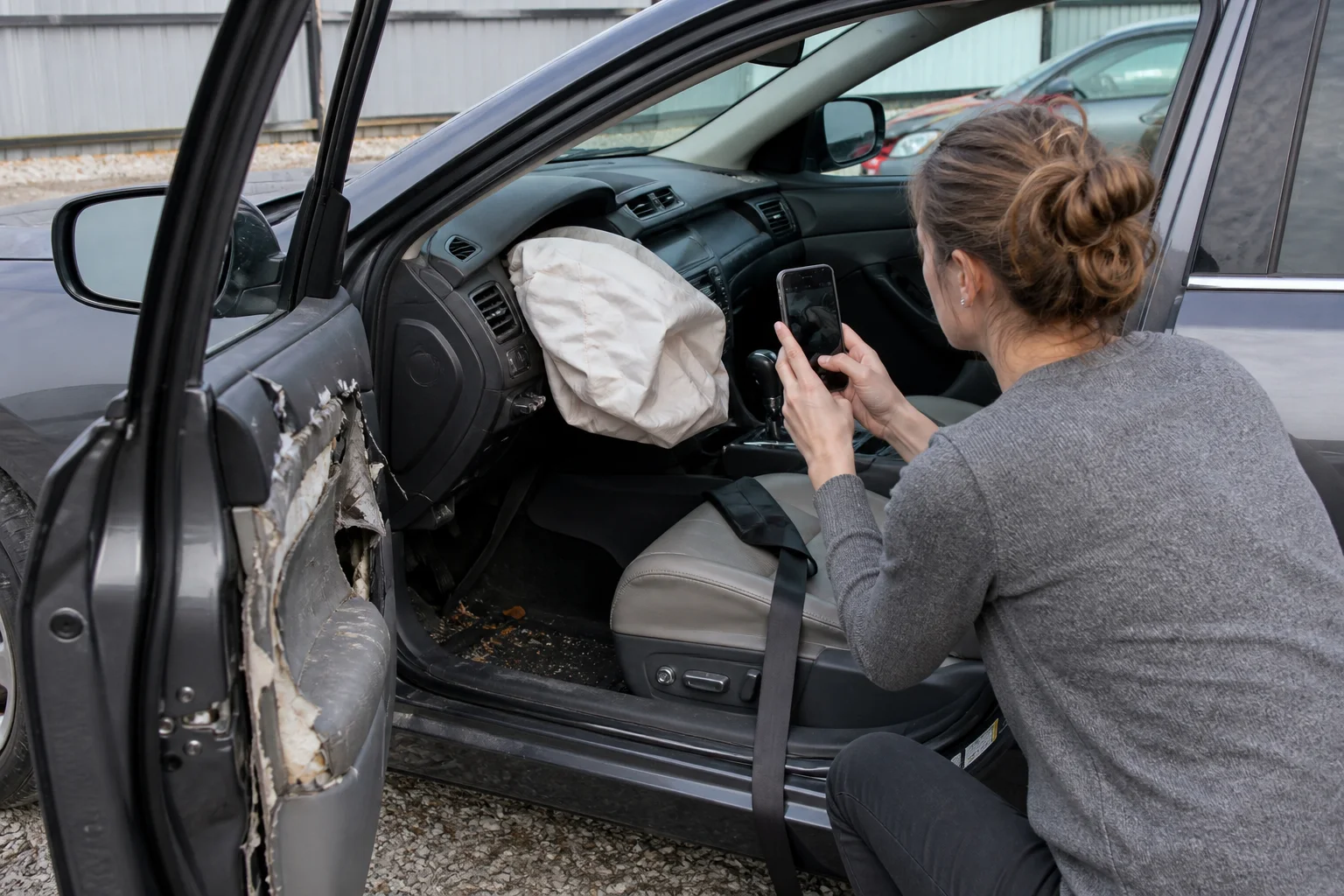
A passenger has a different viewpoint and a different physical environment from either driver. Record the exact seat: front passenger, rear driver-side, rear center, rear passenger-side, or third row. Note whether the seat had been moved, folded, reclined, or rotated after the crash.
Photograph the seat, head restraint, belt webbing, buckle, latch plate, pretensioner area, airbag, dashboard, glove compartment, center console, door panel, window, pillars, roof, floor, and loose objects. Capture scuffs, deformation, broken trim, glass, fabric transfer, blood, and unusual marks without disturbing them. Include wide views that show location and close views that show detail.
Ask where the vehicle will be stored and request notice before sale, destruction, repair, or release. Save towing and storage documents. Record the vehicle identification number. If a child restraint was occupied, preserve it in its post-crash condition and keep its label and model information visible.
Digital evidence may include phone photos with original metadata, dashcam video, traffic or business video, 911 audio, body-camera footage, and vehicle data. Availability and retention differ, so make focused requests promptly. Keep originals and share copies. A tidy folder organized by date is more useful than scattered screenshots.
When an adjuster asks for a recorded statement or medical authorization, first identify whom the adjuster represents and what coverage is being evaluated. A broad medical release can reach information beyond the care at issue, and a signed settlement release can resolve claims described in its text. Read our guide to recorded statements and medical releases in Indiana before responding. Ask for any proposed authorization or release in writing, read every page, and get case-specific advice if its reach is unclear.
Medical bills, liens, and the losses a claim documents

Medical bills often arrive before the liability investigation ends. Ask each provider for an itemized bill, not only a balance notice. Keep explanations of benefits, receipts, pharmacy records, mileage notes, and correspondence from every payer. Compare the provider's billed amount, insurance adjustment, insurer payment, your payment, and remaining balance.
Do not ignore bills while waiting for the auto insurer. Ask the provider what billing information it needs and whether health insurance or MedPay can be submitted. Our detailed guide explains who pays medical bills after an Indiana car accident.
A health plan, government benefit program, medical provider, or other payer may assert a lien, reimbursement, or subrogation interest, depending on the governing law and documents. Do not calculate a net settlement from the gross number alone. Request written payoff information and determine which asserted interests are valid before distribution.
A passenger claim may document reasonable medical expenses, income loss, reduced ability to earn, property loss, pain, and limitations associated with supported injuries. The available categories and proof vary. Keep employer wage records, tax documents where relevant, missed-work notes, out-of-pocket receipts, photographs, and a restrained daily log describing concrete activities you could not do or had to modify.
Our Indiana car accident settlement calculator is an educational organizer, not a prediction or promise of value. No calculator can replace evidence about fault, causation, insurance, medical documentation, liens, or the individual effect of an injury.
Passenger fault, seat belts, child passengers, and deadlines

Can a passenger share fault?
In an action governed by Indiana’s Comparative Fault Act, recoverable damages are reduced in proportion to the claimant’s fault, and recovery is barred when the claimant’s fault is greater than the combined fault of all persons whose fault proximately contributed to the claimant’s damages. The Act does not govern every defendant or claim, so the exact application depends on the parties and facts. Simply riding in the vehicle does not prove passenger fault.
An insurer may examine allegations that a passenger interfered with driving, knowingly entered an obviously dangerous situation, or failed to use available protection. An allegation is not proof. Demand the factual and legal basis, and separate conduct said to have caused the collision from conduct said only to have affected a particular loss.
The Indiana seat-belt rule
For a cause of action accruing after June 30, 2024, involving a plaintiff who was at least 15 when the claim accrued, Indiana Code 9-19-10-7[4] may allow restraint-system noncompliance evidence only to mitigate damages. The defendant must prove both noncompliance and that compliance would have reduced the injuries. Noncompliance is not comparative fault and does not limit an insurer’s liability. For a younger child passenger, Indiana Code 9-19-11-8.5[5] provides a separate rule, so child-restraint issues require age- and vehicle-specific analysis. Read the exact current statute at Indiana Code 9-19-10-7[4]. NHTSA also provides general seat-belt safety information at its official seat-belts page[6]. Safety guidance does not decide admissibility or damages in a particular Indiana claim.
When the passenger is a child
A child passenger claim requires adult attention to medical decisions, records, preservation, insurance communications, and any proposed resolution. The child's age can affect how conduct is evaluated, and special procedures may apply to a minor's settlement. Do not rely on a general statement that every deadline is automatically paused. A parent or guardian should obtain advice tied to the child's age, parties, claims, and dates before assuming how any tolling or approval rule operates.
Deadlines and early notice
Indiana Code 34-11-2-4[7] generally requires an action for injury to person or character to be commenced within two years after the cause of action accrues. See the official text at Indiana Code 34-11-2-4[7]. That general period does not answer every deadline question. Government involvement, estates, minors, contractual policy duties, and other circumstances require individual analysis. Evidence and insurance-notice issues also arise before a filing deadline, so waiting is risky.
Practical passenger-claim checklist
- Address safety and care. Call for emergency help when needed and follow appropriate provider instructions.
- Identify every participant. Record both drivers, vehicle owners, employers if a driver was working, witnesses, police agency, and report number.
- Map your position. Write down the exact seat, belt use and condition, airbag deployment, door movement, and interior contacts.
- Preserve physical evidence. Photograph the cabin and vehicles; retain damaged personal items and child-restraint information.
- Request video promptly. Identify dashcams, residences, businesses, traffic cameras, and responding-agency recordings.
- Build a policy list. Include both vehicles, the passenger's policy, potentially relevant household policies, MedPay, health insurance, and UM/UIM.
- Track bills and work loss. Keep itemized bills, explanations of benefits, receipts, wage proof, and payer correspondence.
- Control communications. Keep an adjuster log and review recorded-statement requests, authorizations, and releases before agreeing.
- Calendar dates. Record the collision date, evidence-retention dates, policy notices, appointments, and legal-review reminders.
- Get tailored help when needed. Multiple drivers, serious harm, a child passenger, disputed fault, limited coverage, or a proposed release can justify prompt advice.
Frequently asked questions
Who pays when a passenger is injured in an Indiana car accident?
Payment may come from one or more sources, including an at-fault driver's liability coverage, MedPay, health insurance, and applicable uninsured or underinsured motorist coverage. The facts and policy language control.
Can I make a claim if the driver was my friend or family member?
Yes, when that driver's conduct contributed to the crash. The practical claim is ordinarily presented to an insurance carrier, even though the relationship can make the process feel personal.
What if both drivers share fault for the collision?
A passenger may investigate claims involving both drivers. Indiana's comparative-fault framework allocates fault among responsible actors, so evidence about each driver's conduct matters.
Can an injured passenger be assigned fault?
Possibly, but simply occupying a vehicle does not make a passenger responsible for how either driver operated. A passenger-fault argument must be tied to the passenger's own conduct and the claimed harm.
Does not wearing a seat belt defeat an Indiana passenger claim?
No. For a cause of action accruing after June 30, 2024, involving a plaintiff who was at least 15 when the claim accrued, Indiana Code 9-19-10-7[4] may allow restraint-system noncompliance evidence only to mitigate damages. The defendant must prove both noncompliance and that compliance would have reduced the injuries. Noncompliance is not comparative fault and does not limit an insurer’s liability.
Should I give the insurance adjuster a recorded statement or broad medical release?
You can ask who the adjuster represents, which coverage is involved, and whether a statement is required before agreeing. Read any release carefully because signed language can affect the claim.
How long does an injured passenger have to act in Indiana?
Indiana Code 34-11-2-4[7] generally requires an action for injury to person or character to be commenced within two years after the cause of action accrues, but different parties and circumstances can create other requirements. Get case-specific advice promptly.
What evidence is especially important in a passenger injury claim?
Preserve the passenger's seating position, seat and belt condition, airbag deployment, door and interior contact points, vehicle damage, scene images, witness details, medical records, expenses, and all insurance communications.
Sources
- Indiana General Assembly: Indiana Code chapter 34-51-2, Comparative Fault Act[2]
- Indiana General Assembly: Indiana Code 27-7-5-2, uninsured and underinsured motorist coverage[3]
- Indiana General Assembly: Indiana Code 34-11-2-4, injury limitation[7]
- Indiana General Assembly: Indiana Code 9-19-10-7, restraint-system evidence[4]
- National Highway Traffic Safety Administration: Seat Belts[6]
- Indiana Criminal Justice Institute: Crash Statistics[1]
A calm next step
If you are sorting through multiple drivers, policies, bills, or a proposed release, Delventhal Law Office can review the facts and explain the available paths. There is no promise about outcome; the goal is to help you make an informed decision.
Explore our Indiana car accident practice or request a free case evaluation.
This article provides general information, not legal advice for a specific situation. Reading it does not create an attorney-client relationship, and neither does contacting us. If you do contact us about a possible claim, Indiana Rule of Professional Conduct 1.18 requires us to keep what you tell us confidential whether or not we take the case — but please do not send documents or detailed facts until we have agreed in writing to represent you. Results depend on the facts, evidence, law, policy language, and available coverage.