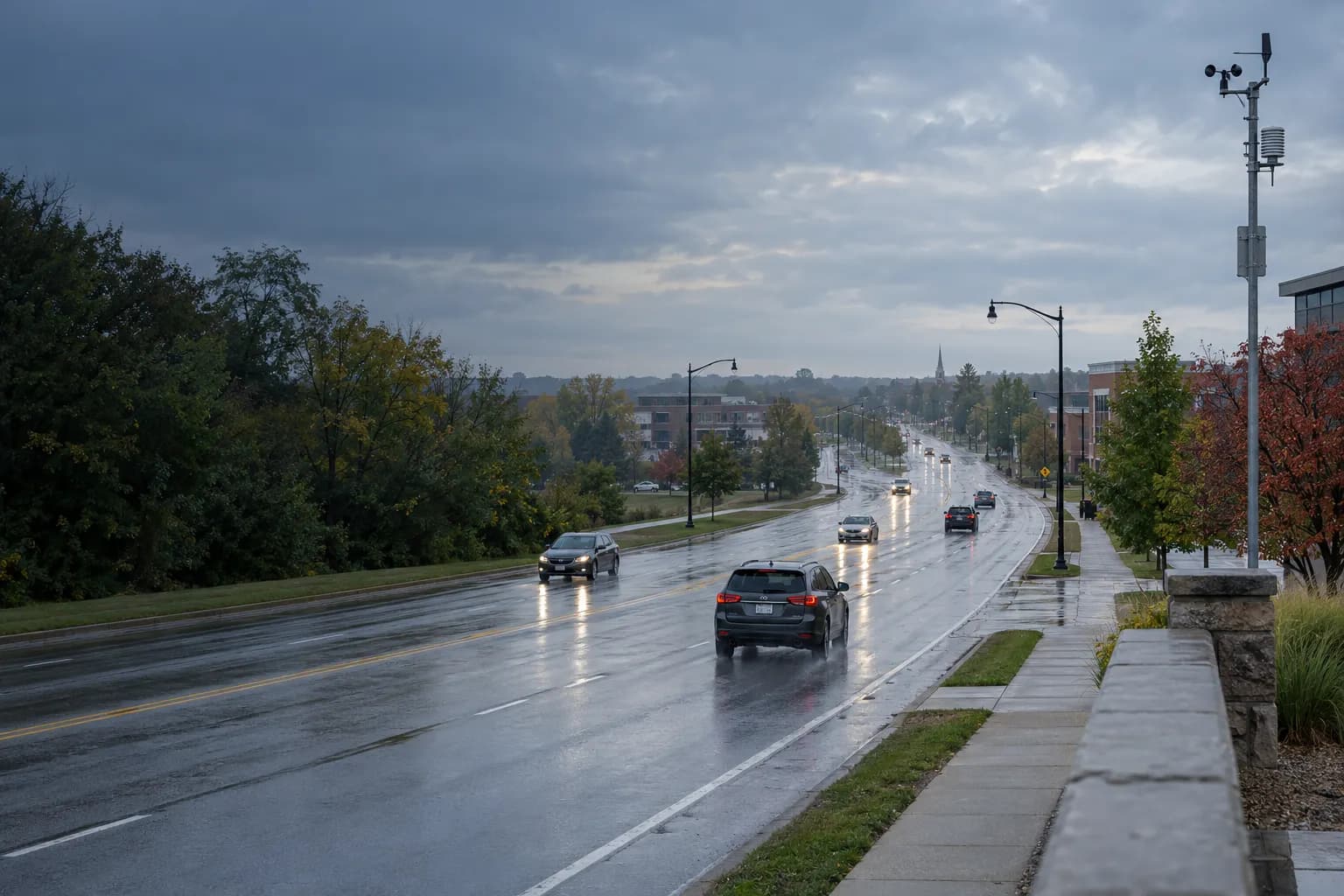
After a Fort Wayne or northeast Indiana collision, a statement such as “the road was icy” or “the lane was closed” leaves important details unanswered. Which stretch of road? At what time? What did someone actually observe, and what was recorded elsewhere?
This guide focuses on finding and organizing weather, traffic, and road-maintenance records. For photographs, witness information, and the rest of your file, start with our broader Indiana car-accident evidence checklist.
Key takeaways
- Write down the exact roadway, direction, nearest intersection or mile marker, and estimated crash time before searching.
- Distinguish a daily weather summary from an observation near the time of the collision.
- Save the source, station or record identifier, displayed time zone, and original download.
- Identify the road’s custodian before sending a maintenance-record request.
- Ask whether a specific camera recorded and retained anything; do not assume a visible camera means an available recording.
Which record answers which question?
Build a list of questions before collecting documents. A weather download may be a useful lead when the issue is visibility. A lane-closure entry addresses a different question. The following table is a starting point for organizing the search, not a promise that every listed record exists.
| Question | Record to investigate | Detail to check |
|---|---|---|
| What was observed in the area? | Historical weather-station observations | Station location, observation time, units, and missing data |
| Was a restriction reported? | Traffic or construction restriction entries | Road segment, direction, reported start/end, and later updates |
| What work was documented? | Existing work orders, inspection entries, or maintenance activity logs | Exact location, activity date, and whether an entry describes planned or completed work |
| What could be seen from the roadway? | Contemporaneous photographs or any retained video | Camera position, field of view, timestamp, and whether the scene changed |
Keep the question and the answer in separate columns in your notes. “The log lists a deicing run” is different from “the exact lane was clear at the crash time.” Preserve the original record so someone reviewing it can check your interpretation.

Find historical weather observations, not just a forecast
NOAA’s Climate Data Online[1] provides access to historical weather and climate data and station-history information. It is a starting point for looking up past conditions instead of relying on today’s weather app.
For a narrower time window, NOAA’s Global Hourly Integrated Surface Database[2] contains hourly and synoptic surface observations. The agency lists fields such as temperature, wind, visibility, precipitation, and snow depth, as observed by each station. NOAA also notes that some stations have breaks in their records.
Before using a download, record:
- The station name and identifier, not only the city used in the search.
- The station’s location and its relationship to the crash location.
- The observation time and the time zone specified by the dataset.
- Whether the result is an individual observation, a daily summary, or another type of product.
- The units, explanatory notes, missing values, and quality flags supplied with the data.
Practical example: If your collision occurred near a particular Allen County intersection, a station result elsewhere in the county is not a measurement taken at that intersection. Keep the station result and the scene photographs together, but label the locations separately. Likewise, do not turn a daily precipitation total into a statement that rain was falling at the exact minute of the collision.
Leave the source timestamp intact. If you convert it to local time, keep both the original and your conversion and note the date. When the format or time convention is unclear, ask for help interpreting it rather than silently guessing.

Separate a current traffic map from historical road information
INDOT’s Travel Information page[3] directs motorists to 511IN.org for road conditions, closures, and restrictions. It explains that the Condition Acquisition Reporting System, or CARS, collects data supporting that service, including information about restrictions and closures of shoulders, ramps, and lanes.
Use those tools to identify the roadway, project, or restriction you need to investigate. Do not assume the map you see today reproduces what was displayed when the crash happened.
If you already have a relevant screenshot, save the uncropped original, the page address, the time you captured it, and any update time shown within the display. A screenshot’s capture time and the event time described on the screen are not necessarily the same.
For a camera near the location, make the initial inquiry specific:
- Who operates that particular camera?
- Was it recording or only providing a live view?
- Does a recording for the relevant date and time still exist?
- What direction and area did the camera cover?
- What is the process for requesting any available material?
These are questions to ask, not assumptions about INDOT or any other camera system. Do not rely on a universal number of days that footage is supposedly kept.

Identify the road’s custodian before requesting maintenance records
According to INDOT’s description of its responsibilities[4], the department constructs and maintains interstate highways, U.S. routes, and state roads, including adjacent ramps and traffic-control devices. Local cities, counties, and towns handle roads outside those categories.
For a northeast Indiana crash, do not choose the recipient solely from a description such as “in Fort Wayne” or “in Allen County.” Start with the route designation and the precise segment. A state route passing through a city and a nearby local street may lead you to different offices.
Ask the office to confirm whether it maintains the relevant records. Depending on the issue, useful categories to discuss may include existing snow-removal or deicing activity entries, inspection records, pavement-repair work orders, reported road problems, or construction restriction records. Availability depends on what was actually created and retained; the list is not a representation that every agency keeps every item.
Be precise about the distinction between a planned activity and a completed activity. A scheduled work order should not be described in your notes as proof that the work occurred. Preserve any completion field, location detail, or explanatory attachment that came with it.

Write a focused records request
The official INDOT public-records request page[5] says its requests must be in writing and reasonably particular. It advises against wording such as “any and all,” and asks that requests for email or correspondence include a date range and identify the desired senders and recipients. INDOT says it normally provides records electronically unless paper copies are specifically requested.
A practical starting description for discussion with counsel is:
For [road or route], [direction], between [specific intersections or mile markers], please provide existing [identified record category] for [date and time range]. The location of interest is [precise location]. Electronic copies are preferred. If another office maintains these records, please identify that office if known.
This is an organizational example, not a substitute for the agency’s form or a request tailored to your circumstances. Describe the records you seek rather than asking the records office to decide why the crash happened. If you do not know the name of the relevant log, first ask which record category describes the activity.
Keep a request log with the recipient, submission date, description, confirmation number, response, and any clarification you supplied. A confirmation of receipt is not the same as receiving the requested documents.

Organize the results around place, time, and source
Create one folder for originals and a separate working timeline. For each item, note the source, when it was obtained, the location it describes, the time period it covers, and what remains uncertain. Keep the agency’s cover email and any explanation that accompanied a file.
Compare those records with the crash report and contemporaneous photographs without rewriting the source material. For help obtaining the report itself, use our Indiana police-report guide. If two records appear inconsistent, list the difference—for example, a different location, time zone, or observation interval—before drawing a conclusion.
Do not return to an unsafe roadway or enter restricted property to recreate a photograph. Use material already available and discuss any further site documentation with the person handling the investigation.
Our Fort Wayne car-accident practice can help organize these questions alongside the rest of the collision file. Bring the records you have and a list of the gaps; you do not need to finish the entire search before arranging a conversation.
Frequently asked questions
Is a daily weather summary enough to describe the crash time?
A daily summary is not the same thing as an observation at the crash time. Check the product description and reporting period. When timing matters, look for available observations near the event and retain the station and time-zone details.
Can I use a nearby airport’s weather observations?
They may be a starting point, but identify the station and its distance and location relative to the roadway. Label them as that station’s observations, not measurements made at the crash scene.
Does a traffic camera mean footage is available?
Do not assume it does. Ask the operator whether the camera recorded, whether the relevant material was retained, and how to request any available record. Keep that response with your notes.
Should every road-record request go to INDOT?
No. Use the state-versus-local distinction described above as a starting point, then confirm the custodian for the specific road segment and record. A city or county office may be the appropriate contact for a local road.
What should I bring to a consultation about these records?
Bring the exact location and estimated time, your photographs, any weather downloads or traffic screenshots, agency responses, and a simple list of unanswered questions. Keep originals separate from annotated copies.
If you were hurt and want help sorting the records and next steps, request a free consultation with Delventhal Law Office.
This article is general information about Indiana law and is not legal advice. Reading it does not create an attorney-client relationship, and neither does contacting us.