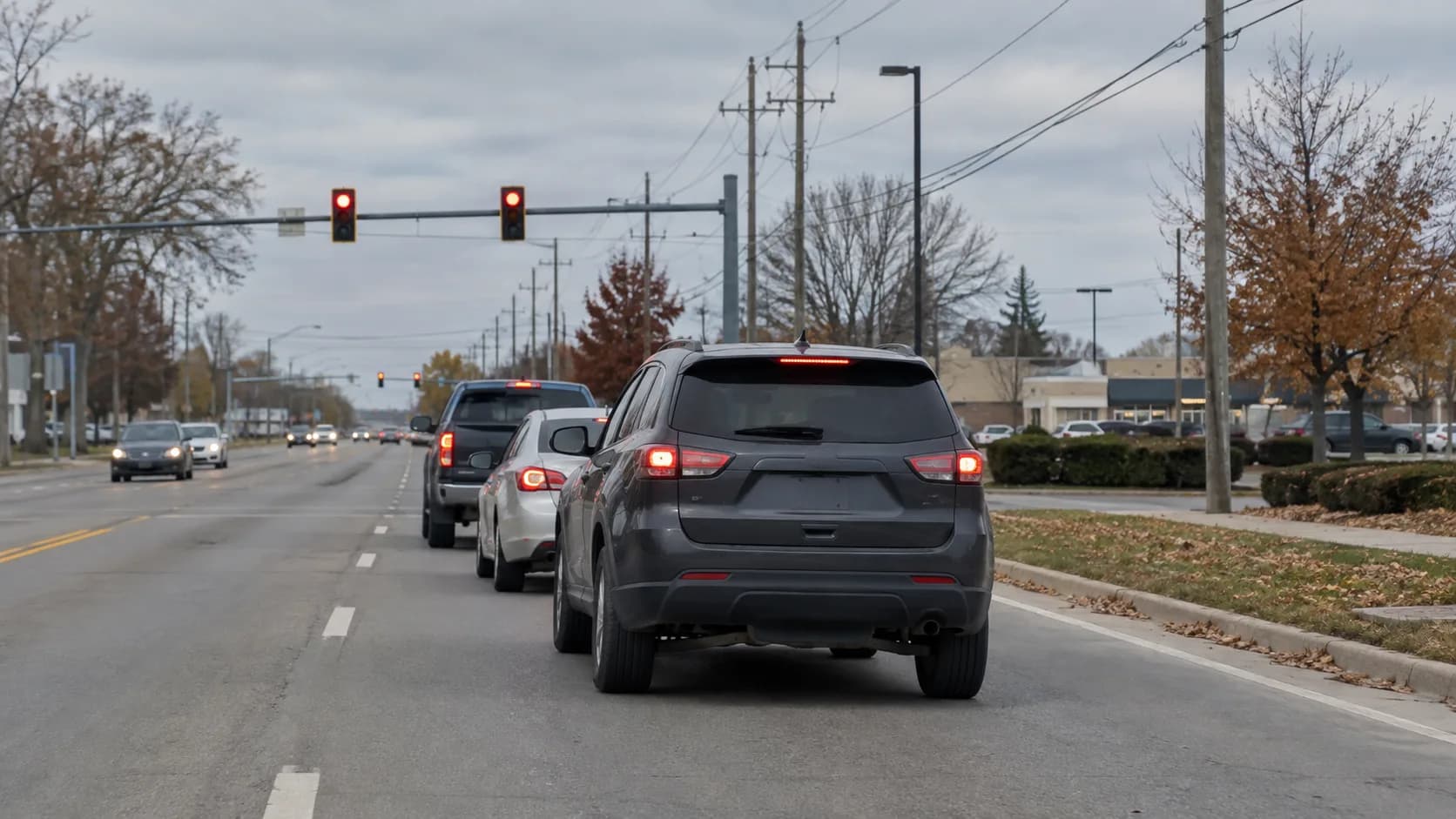
For someone in the middle car, the difference between being pushed into traffic ahead and making contact before a second impact is an important question to investigate. A useful timeline does not begin by assigning blame. It begins with an accurate account of the few seconds before, during, and after each contact.
This guide offers a practical worksheet for organizing that account. It is not a reconstruction method or a legal test. Our separate guide to who may pay after an Indiana multi-vehicle crash covers the broader insurance and fault questions. For help reviewing your records, see our Fort Wayne car accident practice.
- Use one vehicle key consistently, but preserve the police report’s original unit numbers.
- Separate firsthand observations, another person’s statement, and your own inference.
- Record what happened before the first contact, not just where vehicles ended up.
- Keep original records and identify missing information; a polished timeline is not a substitute for evidence.
Start with a vehicle key and location
Write down the date, approximate time, road, direction of travel, and lane. For a Fort Wayne or Allen County collision, “near the intersection” is less useful than identifying which road you were on, the cross street or landmark, and the direction you were facing. Label a sketch as an illustration from memory, not a measured scene diagram.
For your own notes, use A for the vehicle ahead, B for the middle vehicle, and C for the vehicle behind. Add the make, color, and driver name if known. If the police report calls your B “Unit 1,” note that cross-reference explicitly. Do not renumber or alter the original report.
Separate locations observed before contact from final resting positions. If you only saw a vehicle after everyone had moved to a shoulder, say so. Do not describe that photograph as showing the point of impact.

Use an impact-by-impact worksheet
The following is Delventhal Law Office’s organization suggestion, not a legally required form. Make one row for each event you can actually identify. Leave a field “unknown” when you cannot fill it reliably.
| Entry | What to record | Source and uncertainty |
|---|---|---|
| Before contact | Whether you were moving or stopped; what you personally observed ahead and behind | Your position and view; whether speed or spacing is measured, estimated, or unknown |
| First perceived event | A sound, movement, or contact, described in your own words | What you directly perceived, not an assumed pair of colliding vehicles |
| Next perceived event | Another contact or movement, if distinguishable | Whether the interval is known, estimated, or too short to distinguish |
| After contact | Where vehicles stopped and whether anyone moved them before photographs | Photo filename, person who took it, and when it was taken if known |
| Other account | What a witness or other occupant says happened | Name, viewing position, date of statement, and whether they saw the beginning |
| Open question | The competing explanations that remain | The missing record or observation that could help compare them |
Give records simple identifiers such as Photo 01, Video A, or Witness Note 02, and keep an index linking each identifier to the original file. Work on a copy when adding arrows or explanatory labels to a photograph. Retain the unmarked original.
For video, note whether a time comes from the displayed camera clock, a file label, or another record. Do not assume different devices show synchronized times. If you cannot verify a clock, describe the relative order visible in the clip without presenting its displayed time as an independently confirmed crash time.

A worked example with two competing sequences
Hypothetical only: You were in B, between A and C. You remember being stopped, feeling a contact from behind, and then seeing your car against A. Another driver says B touched A before C arrived. Neither description should silently become the starting assumption for every record.
- Your account: “I remember being stopped. I felt a contact from behind. I do not know the exact interval before the front of my car contacted A.” Record when you wrote this note.
- Other account: “A’s driver says there were two contacts.” Identify whether you heard that directly, read it in a report, or learned it from an adjuster.
- Available record: “Photo 01 shows B between A and C after the vehicles stopped.” That description does not claim the photograph establishes which contact happened first.
- Unresolved question: “Did B contact A before C contacted B?” Identify any available video or witness who actually watched the vehicles before the first impact.
This example is only a way to organize competing descriptions, not an expert analysis or a decision about the case. Its value is that a reviewer can see both accounts and the exact gap between them. A person who heard two sounds may not have seen the contacts that produced them.
If your recollection later changes, add a dated clarification and explain what prompted it rather than quietly replacing the first note. Accuracy matters more than making every account sound identical.

Compare the records without overstating them
Use photographs, the crash report, video, and firsthand accounts together. Ask what each record actually shows and what it leaves unanswered:
- Photographs: Which vehicle and surface are visible? Was the image taken before towing or repairs? Does it show contact occurring or only damage afterward?
- Video: Does the clip include the beginning? Is a vehicle hidden from view? Are you watching the original available recording or a shortened copy?
- Witness accounts: Where was the person looking? Did they observe a collision or turn toward it after hearing a sound? Preserve different accounts rather than combining them into one story.
- Crash report: Which statements are attributed to a driver or witness, and which observations did the officer record? Keep the report’s narrative and diagram alongside your timeline, not rewritten to fit it.
The Indiana State Police links page[1] directs people requesting a crash-report copy to BuyCrash. Once you have the report, check the vehicle identifiers and whether its account addresses the disputed order.
Record what the photograph shows rather than adding your own technical interpretation. Bring questions about what the image means to the appropriate professional. For a wider list of records to discuss with counsel, see our Indiana crash-evidence guide.

Ask the adjuster which sequence the decision uses
When reviewing an adjuster’s explanation, look for the sequence it uses and list any missing steps. A focused question is more useful than simply saying the conclusion is wrong:
“Does your assessment assume that my vehicle contacted the car ahead before it was struck from behind? Please identify the statement, photograph, video, or other information supporting that sequence, and explain how you considered the different account in my notes.”
This is an example of a factual question, not wording that every claimant must use. Keep the response and note whether the disagreement concerns the sequence itself or the legal effect of an agreed sequence.
In its March 27, 1985 Bulletin 49 on unfair claim practices[2], the Indiana Department of Insurance expressed the opinion that arbitrary fault assignments ignoring the statutory definition of comparative fault or the particular accident facts represent an unfair claims-settlement practice. The bulletin does not decide any driver’s fault in your collision. For this worksheet, record the facts the adjuster identifies and the questions still unanswered.
For the broader legal discussion, read our guide to fault in an Indiana rear-end collision. This worksheet is deliberately limited to organizing the sequence of contacts.
Prepare a small, organized review packet
A useful first packet contains the vehicle key, your dated timeline, a list of unresolved questions, the report, original photographs or video in your possession, and the adjusters’ written explanations. Include relevant repair or towing documents you already have. Tell the reviewer which materials you do not have.
The Indiana Department of Insurance’s claim tips[3] recommend keeping copies of correspondence and a record of telephone or in-person contacts, including the date, name, title, and what was said. The same guidance recommends photographs or video before temporary repairs if possible and advises against permanent repairs before the insurer’s inspection.
When preparing the packet, also note where the vehicle is now, any planned work, and the contact person at the shop or storage location. Include questions about any proposed inspection in your discussion with counsel.

Questions about an impact timeline
What if I cannot remember which impact came first?
Write down what you do remember and label the order unknown. Distinguish a sound from a contact you actually saw or felt. Do not adopt another person’s version as your own recollection.
Does feeling two impacts prove that two drivers were at fault?
No. Describe the two impacts as your observation, not a legal conclusion. The timeline helps identify questions for further review; it does not assign fault.
Can photographs alone show that I was pushed forward?
A photograph may document vehicle positions or damage, but do not assume an after-the-crash image establishes the order of contacts. Identify when it was taken and compare it with the other available records.
Should I use the police report’s vehicle numbers?
Keep those numbers unchanged when referring to the report. If your worksheet uses letters for clarity, add a key connecting each letter to the correct report unit and vehicle.
Is a timeline still useful without video?
Yes, as an organization tool. It can show what you personally recall, which accounts differ, and what remains unknown. It is not a substitute for a missing recording or proof of a disputed event.
If you were injured and need help sorting out conflicting accounts, Chad Delventhal can review the available records and discuss the next steps in a free case evaluation. The worksheet is a preparation aid, not a claim filing or a substitute for case-specific advice.
This article is general information about Indiana law and is not legal advice. Reading it does not create an attorney-client relationship, and neither does contacting us.