

If you were hit by a semi on I-69, I-469, US 30, or a busy Allen County road, you are probably focused on your injuries, not on data files. That is understandable. But some of the most powerful evidence in a commercial-truck case lives inside the truck's electronics, and it does not wait for you to recover. This guide explains, in plain language, what black-box or ECM evidence is, what it can and cannot show, why it disappears, and how injured people in Fort Wayne and across northeast Indiana can push to preserve it.
This is general legal information for Indiana readers, not legal advice about your specific crash. What a particular truck recorded depends on its make, model, engine, and equipment.
Key takeaways
- The "black box" in a truck case usually means data stored on the engine control module (ECM) and related onboard systems, not a single aircraft-style recorder.
- Depending on the truck, this data may include speed, RPM, throttle, brake use, and hard-braking or fault events in the seconds around a crash.
- Not every truck records the same thing. The federal event-data-recorder rule (49 CFR Part 563) applies to light vehicles, not heavy trucks, so heavy-truck data depends on the engine manufacturer's system.
- Related records — electronic logging device (ELD) hours-of-service data, accident registers, and maintenance files — have their own retention windows and custodians.
- Data can be overwritten, lost, or returned with the truck, so a prompt written preservation demand matters.
- Indiana generally gives injured people two years to file suit (IC 34-11-2-4[1]), but evidence preservation is a much shorter, practical clock.
On this page
- What "black box" or ECM evidence actually means
- What data a truck may record
- Why not every truck records the same data
- Why ECM data matters to an Indiana injury claim
- How this evidence gets lost
- How the evidence is preserved and obtained
- If the electronic logging device malfunctioned, was replaced, or lost data
- How ECM data fits with other evidence
- Evidence-preservation checklist
- Frequently Asked Questions
What "black box" or ECM evidence actually means
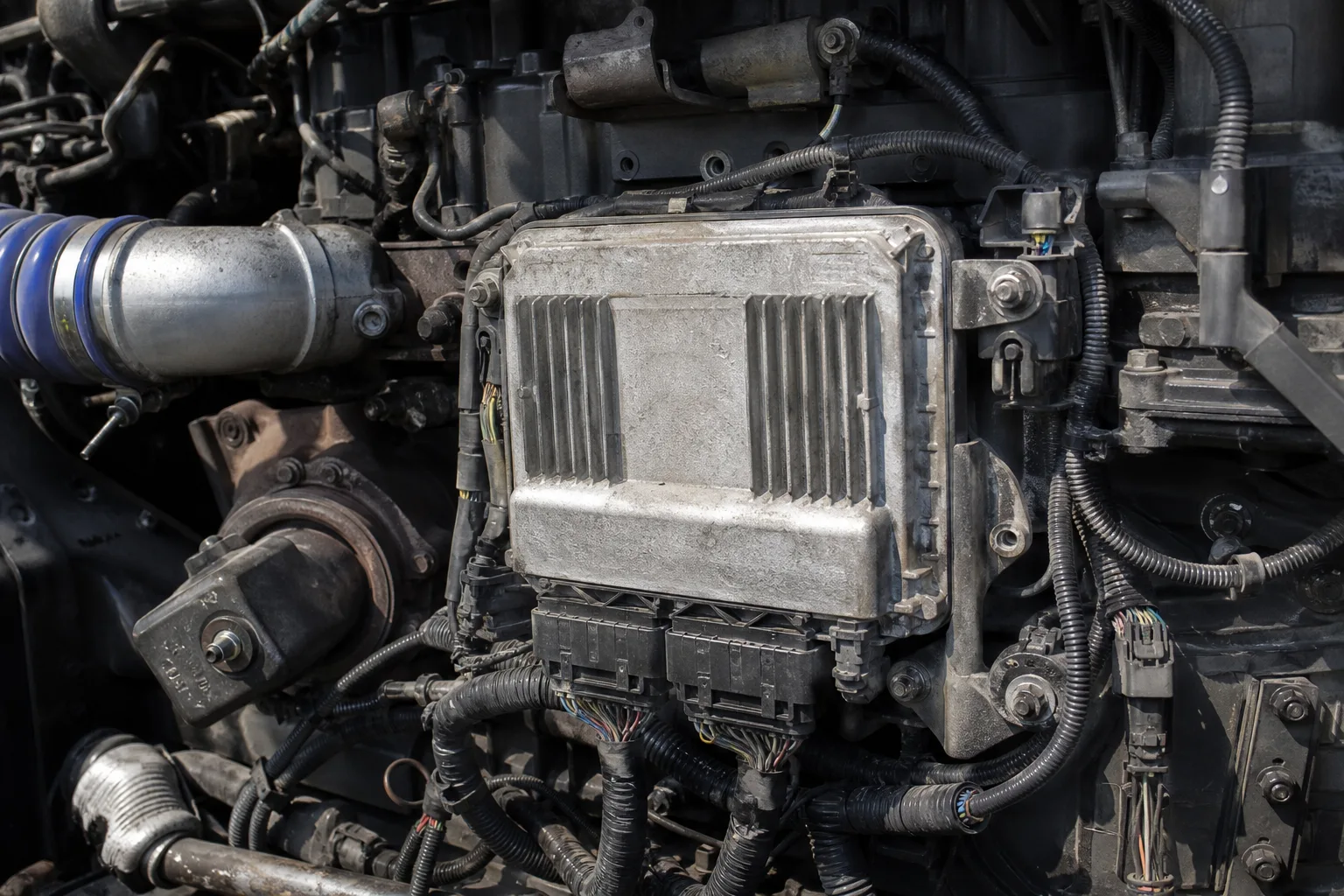
People borrow the phrase "black box" from aviation, but a commercial truck does not carry one sealed recorder that captures everything. Instead, modern tractors run on networked computers. The central one is the engine control module (ECM) — sometimes called the electronic control module or engine control unit. It manages the engine and, on many trucks, stores operating data that engineers and crash reconstructionists can download with manufacturer-specific software.
Other systems can also hold useful data: the transmission controller, anti-lock brake and stability control modules, collision-avoidance or forward-facing camera systems, telematics units, and the truck's electronic logging device (ELD) for hours of service. When people say "the black box," they usually mean this collection of electronic evidence, with the ECM at the center.
Careful download and interpretation is a technical job. Our overview of how accident reconstruction experts help prove fault after a semi-truck crash explains how this data is combined with the physical scene.

What data a truck may record
What a specific truck captured depends on its equipment, but ECM and related systems commonly can store some combination of the following around a "triggering" event such as hard braking or a sudden speed change:
- Vehicle road speed in the seconds before an event
- Engine RPM
- Throttle or accelerator position
- Brake application (on/off) and clutch use
- Cruise-control status
- Hard-braking, sudden-deceleration, and last-stop records
- Fault and diagnostic trouble codes
- Total engine hours and mileage
Separately, the ELD keeps hours-of-service records that show driving time, on-duty time, and rest — data that can reveal fatigue. If fatigue or scheduling pressure is a concern, see our guide to hours-of-service violations and fatigued truck driving in Indiana.
Why not every truck records the same data
This is the point most billboard ads skip. There is no single federal rule requiring every heavy truck to record crash data in a uniform way. The federal event data recorder regulation, 49 CFR Part 563[2], applies to lighter vehicles — those with a gross vehicle weight rating of 3,855 kilograms (8,500 pounds) or less — not to the heavy tractors involved in most catastrophic truck crashes. So a heavy truck's recorded data depends on the engine manufacturer's system (for example, the way a particular Detroit, Cummins, PACCAR, or Caterpillar engine and its software are configured), on how the fleet set it up, and on whether the truck also carries telematics, cameras, or advanced driver-assistance systems.
Because of that, a lawyer should never promise that a given truck holds a perfect second-by-second story. The honest approach is to identify what systems the truck actually had, request the data before it is lost, and interpret it with a qualified expert.

Why ECM data matters to an Indiana injury claim
Truck insurers and defense lawyers frequently dispute speed, braking, and who had the right of way. Independent electronic data can cut through a self-serving driver narrative. For example, ECM speed and brake records may contradict a claim that the driver was under the limit or braked in time, and ELD data may show the driver had been on the road too long.
Fault in Indiana is governed by modified comparative fault under IC 34-51-2-6[3]: a claimant who is found more than 50% at fault generally recovers nothing, and any recovery is reduced by the claimant's share of fault. Because a few percentage points can change the outcome, objective data that pins down speed and braking can be decisive. Understanding who is legally responsible in an Indiana truck accident often starts with what the electronics show.
Strong liability and injury proof also affects value. If you are trying to understand the range of what a claim may be worth, our guide on our Fort Wayne accident settlement calculator walks through the factors that matter.
How this evidence gets lost
ECM and related data are fragile. Several things can erase or bury it:
- Overwriting. Some systems keep only a limited buffer, and continued operation or key cycles can overwrite older event data.
- Repairs and return. Once a wrecked truck is repaired, sold, scrapped, or returned to service, access to the original data is often gone.
- Short retention of related records. Under federal rules, a motor carrier must retain ELD records of duty status and supporting documents for six months (49 CFR 395.8[4]), and must keep an accident register for three years (49 CFR 390.15[5]). Those are not long windows.
- Control by the other side. The truck and much of the data are usually in the possession of the trucking company or its insurer — not you.
When evidence is destroyed after a party knew a claim was likely, that can raise a spoliation issue. But the better strategy is to prevent loss in the first place with a prompt, written preservation demand.
How the evidence is preserved and obtained
The practical path usually looks like this:
- Preservation ("spoliation") letter. Early written notice to the trucking company and insurer demanding they preserve the truck, ECM data, ELD/hours-of-service records, telematics, camera footage, and maintenance files.
- Prompt inspection and download. A qualified expert downloads the data using the correct manufacturer software, ideally with both sides present so the process is not disputed later.
- Discovery. If a lawsuit is filed, formal requests and subpoenas can compel production of data and records held by the carrier, insurer, or third parties.
Different pieces live with different custodians — the carrier, a leasing company, a telematics vendor, a repair shop, or a maintenance contractor — which is one reason truck cases are more complex than ordinary car crashes. Our overview of how our Fort Wayne truck accident attorney handles these claims explains that multi-party investigation, and the companion piece on why truck maintenance logs matter covers the paper trail that sits alongside the electronic data.

If the electronic logging device malfunctioned, was replaced, or lost data
Short answer: A missing or malfunctioning ELD does not necessarily mean the hours-of-service record is gone. Federal rules require back-up copies, paper logs during a malfunction, and supporting documents that can be checked against the driver's logged hours.
- Back-up copy. A motor carrier must keep a back-up copy of ELD records for six months on a device separate from the one that stores the original data (49 CFR 395.22(i)[6]).
- Paper logs during a malfunction. When an ELD malfunctions, the driver must give the carrier written notice within 24 hours, reconstruct the record of duty status for the current 24 hours and the previous seven days unless those records are already available, and keep paper logs until the device is back in compliance. The carrier must take action to correct the malfunction within eight days (49 CFR 395.34[7]).
- Supporting documents. Carriers must keep supporting documents for six months: bills of lading or itineraries, dispatch and trip records, expense receipts such as fuel, fleet-management messages, and payroll or settlement records (49 CFR 395.11[8] and 395.8(k)[4]). Because these documents carry dates and locations, they can be compared with the logs.
- Other systems. Telematics, GPS tracking, and camera systems may hold time-and-location data even when the ELD record is incomplete.
Six months can pass quickly, so a preservation letter should specifically name the ELD records, the back-up copy, any malfunction notices and paper logs, and the supporting documents. A gap or malfunction in the logs is a reason to look closer, but it does not by itself prove that a driver was fatigued or at fault. What it means depends on the rest of the evidence.
How ECM data fits with other evidence
Electronic data is powerful, but it is rarely the whole case. A download may be incomplete, corrupted, or ambiguous, and it does not capture everything a human witness saw. That is why reconstruction combines ECM and ELD data with physical evidence — skid marks, crush damage, debris fields, roadway measurements — plus the crash report, camera footage, and witness accounts.
If a crash involved a public road defect, a government-owned vehicle, or a municipal entity, an extra deadline can apply. Indiana's Tort Claims Act requires a notice to a political subdivision within 180 days (IC 34-13-3-8[9]) and to the state within 270 days (IC 34-13-3-6[10]). Our guide to the Indiana government tort claim notice explains those short windows, which matter when road design, signage, or a public entity's truck may be involved.
| Evidence type | What it can show | Typical custodian | Preservation concern |
|---|---|---|---|
| Engine control module (ECM) data | Speed, RPM, throttle, brake use, hard-braking/fault events near a trigger | Truck / trucking company / insurer | Can be overwritten; lost when truck is repaired, sold, or returned |
| Electronic logging device (ELD) / hours of service | Driving, on-duty, and rest time (fatigue) | Motor carrier / ELD vendor | Carrier must retain RODS + supporting docs 6 months (49 CFR 395.8) |
| Telematics / GPS | Location, speed history, routing | Fleet or third-party telematics provider | Vendor retention policies vary; request early |
| Forward-facing / cab camera | Video of the moments around the crash | Carrier or camera vendor | Loop recording can overwrite; preserve immediately |
| Accident register & investigation file | Carrier's record of the crash and prior accidents | Motor carrier | Must be kept 3 years (49 CFR 390.15) |
| Physical scene & crash report | Skid marks, crush, debris, officer findings | Scene / investigating agency | Scene changes fast; photos and measurements fade |
Evidence-preservation checklist
If you or a family member were hurt by a commercial truck, these steps help protect the electronic evidence:
- Get the crash report and the truck's USDOT number, carrier name, unit number, and VIN if you can.
- Photograph the truck, trailer, damage, and any visible cameras or antennas before it is towed.
- Identify witnesses and note nearby businesses or traffic cameras that may hold video.
- Do not assume the trucking company will save the data for you.
- Get medical care and keep every record — injury proof is its own category of evidence.
- Talk with a lawyer quickly so a written preservation demand can go out before the truck is repaired or returned to service.
- Avoid giving a recorded statement to the truck insurer before you understand your rights.
For a broader first-steps guide, see what to save in the first 72 hours after a Fort Wayne crash.

Frequently Asked Questions
Does every semi truck have a black box?
No. There is no single mandated "black box" for heavy trucks. Most modern tractors store some data on the engine control module and related systems, but what is recorded depends on the engine manufacturer, the software configuration, and any added telematics or cameras. The federal event-data-recorder rule (49 CFR Part 563) applies to lighter vehicles, not heavy trucks.
What does truck ECM data actually show?
Depending on the system, it may show road speed, engine RPM, throttle position, brake application, cruise-control status, hard-braking or last-stop events, and fault codes around a triggering event, along with total engine hours and mileage. It does not record everything, and a download can be incomplete, so it is interpreted alongside physical and witness evidence.
How fast can this data disappear?
Quickly. Some event data can be overwritten with continued operation, and access is often lost once the truck is repaired, sold, or returned to service. Related records also have limited retention — carriers must keep ELD records of duty status and supporting documents for six months and an accident register for three years. A prompt written preservation demand is the best protection.
Who owns the data, and can I just get it?
The truck and much of the data are usually controlled by the trucking company or its insurer, not the injured person. You typically obtain it through a preservation demand and an agreed inspection, and, if a lawsuit is filed, through formal discovery and subpoenas. Different records may be held by different custodians, including telematics vendors and repair shops.
What if the trucking company destroys the data?
If a party destroys or loses evidence after it knew a claim was likely, that can raise a spoliation issue that a court may address. But litigating over lost data is a poor substitute for having it, which is why an early, specific preservation letter is so important in truck cases.
How long do I have to act in Indiana?
Indiana generally allows two years from the crash to file a personal injury lawsuit (IC 34-11-2-4[1]), and a shorter tort-claim notice deadline applies if a government entity may be responsible — 180 days for a political subdivision and 270 days for the state. But the practical clock for preserving ECM and camera data is much shorter, often days or weeks, because the truck can be repaired or returned to service.
Talk with a Fort Wayne truck accident attorney
Truck crashes on I-69, I-469, US 30, and other northeast Indiana routes often involve evidence that has to be preserved before it disappears. If you or someone you love was seriously hurt by a commercial truck, Delventhal Law Office can review what happened, explain the deadlines that may apply, and help you decide the next step. A free consultation is a calm way to understand your options — you do not have to sort out the trucking company and its insurer alone.
This article is general information about Indiana law and is not legal or medical advice. Reading it does not create an attorney-client relationship, and neither does contacting us. If you do contact us about a possible claim, Indiana Rule of Professional Conduct 1.18 requires us to keep what you tell us confidential whether or not we take the case — but please do not send documents or detailed facts until we have agreed in writing to represent you. What a specific truck recorded, and how any deadline applies to your situation, depends on the facts.
Sources
- IC 34-11-2-4 (iga.in.gov) ↩
- 49 CFR Part 563 (ecfr.gov) ↩
- modified comparative fault under IC 34-51-2-6 (iga.in.gov) ↩
- 49 CFR 395.8 (ecfr.gov) ↩
- 49 CFR 390.15 (ecfr.gov) ↩
- 49 CFR 395.22(i) (ecfr.gov) ↩
- 49 CFR 395.34 (ecfr.gov) ↩
- 49 CFR 395.11 (ecfr.gov) ↩
- IC 34-13-3-8 (iga.in.gov) ↩
- IC 34-13-3-6 (iga.in.gov) ↩