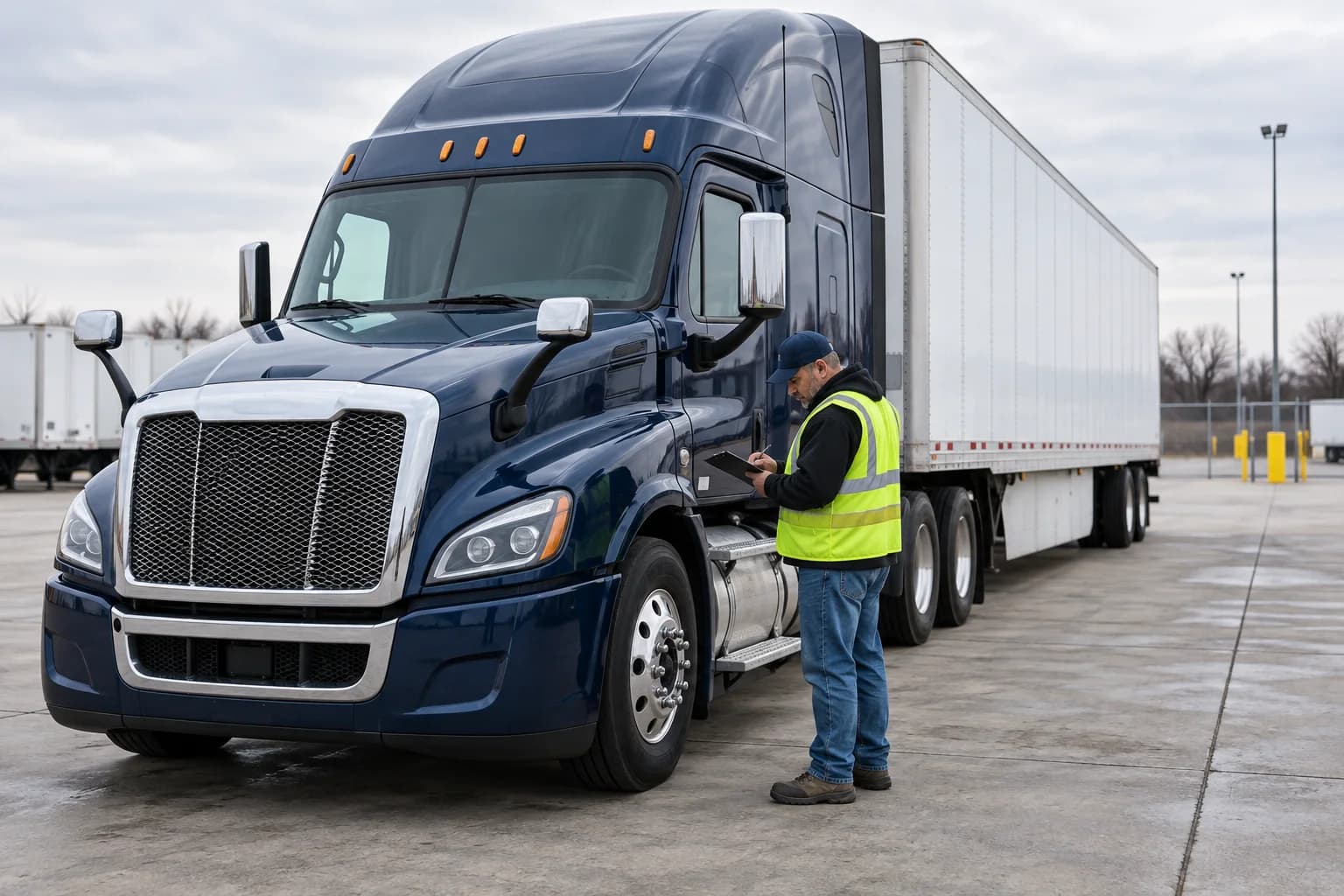
For an injured person or family, the useful first step is to identify both vehicles and ask how the coupling can be preserved for a qualified inspection. Our Fort Wayne truck accident guide explains the broader claim; this article focuses on the connection that keeps tractor and trailer together.
What connection actually failed?
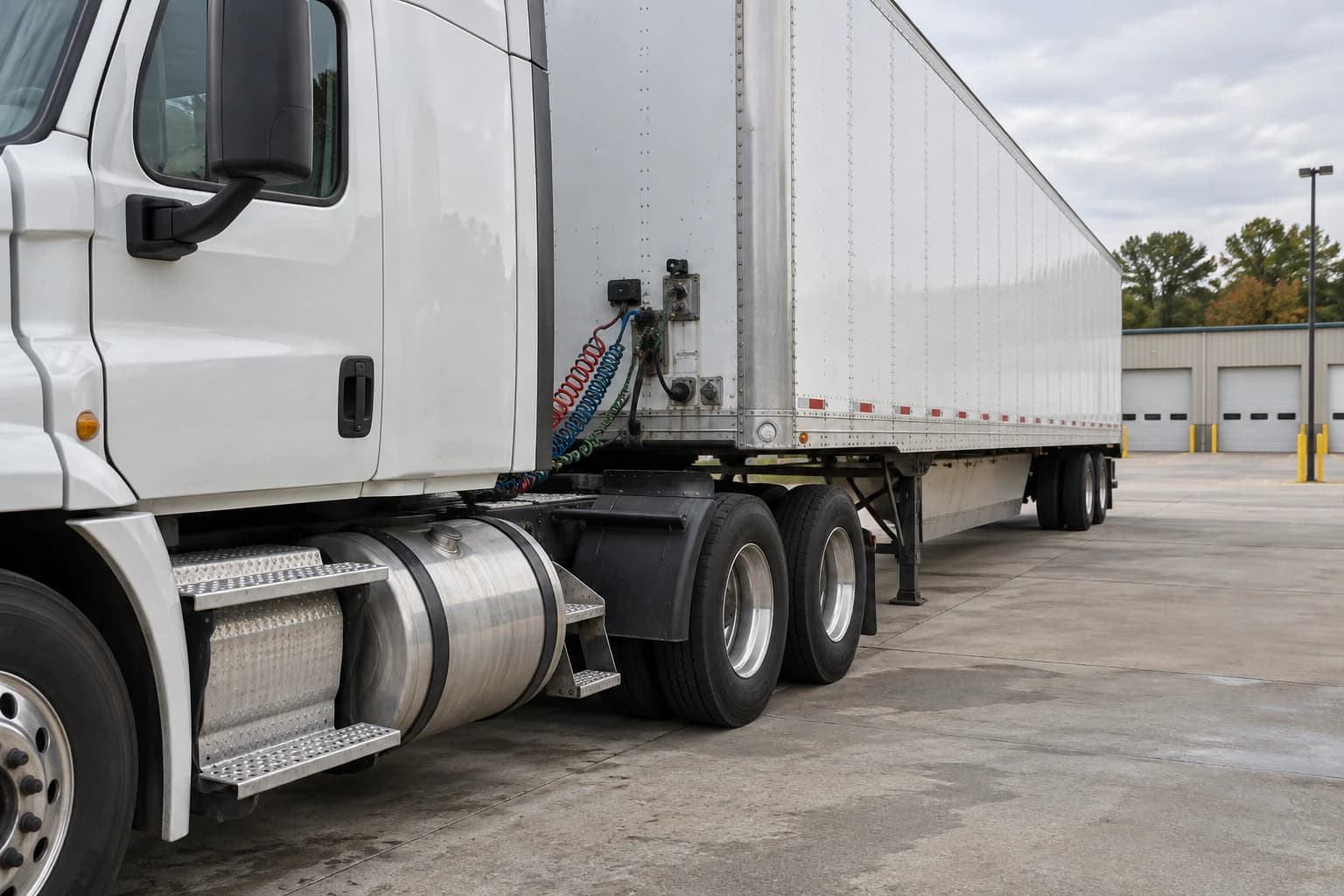
On a typical tractor-semitrailer, the trailer’s kingpin engages the fifth-wheel assembly on the tractor. The locking jaws must close around the kingpin’s shank, and the connection and mounting hardware must be secure. The Indiana BMV commercial driver’s license manual, sections 6 and 11[1], describes the checks for these components.
A trailer sitting too high during coupling may not connect correctly. The BMV manual warns that a gap between the upper and lower fifth wheel can mean the kingpin is resting on top of closed jaws. That is different from a coupling that was properly engaged but later suffered a broken part. The distinction should come from examination of the actual equipment, not a guess based on where the trailer stopped.

| Question | Material to preserve | Why the distinction matters |
|---|---|---|
| Did the kingpin seat and lock? | Kingpin, jaws, latch hardware and original scene photographs | Helps distinguish poor seating from later breakage |
| Did the assembly detach from its mounting? | Mounting plates, brackets, fasteners and surrounding frame | A closed lock does not answer whether its mounting held |
| Was there an existing condition or crash damage? | Broken surfaces, prior photographs, component markings and shop history | A damaged part does not establish when it became damaged |
| Was this a full trailer or a semitrailer? | Whole-vehicle photographs, tow bar or fifth wheel, any converter dolly | Different coupling and backup-device provisions may apply |
This table is an investigation checklist, not a remote diagnosis or a substitute for the equipment manufacturer’s instructions. Its component distinctions follow the federal coupling-device rule, 49 CFR 393.70[2], and the BMV inspection manual.
What inspections matter?
For commercial motor vehicles subject to the federal rule, 49 CFR 392.7[3] prohibits driving unless the driver is satisfied that listed equipment—including coupling devices—is in good working order. 49 CFR 396.13[4] also requires the driver to be satisfied that the vehicle is safe before driving and addresses review of the last inspection report when required. These are actual operating duties, not proof that every trip must produce a particular paper checklist.
The BMV manual describes both a gentle forward pull with the trailer brakes locked to check the connection and a separate visual inspection of the coupling. The visual checks include no gap between the fifth-wheel halves, jaws around the kingpin shank, the locking lever in its locked position and the applicable safety latch. A statement that “the driver did a tug test” does not, by itself, tell you whether those other checks occurred.
These instructions are for trained operators using the correct procedure for their equipment. An injured motorist should not attempt a pull test, move a truck or go under a trailer. Ask the investigator to document the coupling before anyone changes its position.

The carrier’s general inspection and maintenance obligations appear in 49 CFR 396.3[5]. For this kind of crash, the useful records are the ones tied to the actual fifth wheel, kingpin, locking system or mounting work. Our separate guide to truck maintenance logs after an Indiana crash covers the broader records issue.
Which coupling rules apply in Indiana?
Under 49 CFR 393.70(b), fifth-wheel mounting must be secure, and the locking mechanism must prevent separation unless a positive manual release is activated. Readily separable fifth wheels must lock automatically on coupling. The regulation separately addresses full-trailer tow bars and safety devices in subsections (c) and (d). Do not assume the safety-chain provisions for a full trailer describe every conventional fifth-wheel semitrailer.
Indiana also has a towing and coupling statute, IC 9-20-9-8[6]. Read the entire provision: subsection (d) treats a vehicle and its safety equipment that comply with the listed federal standards or their successors as compliant with this section. A claim that every semi needed the same pair of chains overlooks that language and the type of connection involved.
Federal coverage and exceptions also depend on the operation and vehicle. 49 CFR 390.3[7] provides the general scope. An attorney should determine which federal and Indiana provisions apply to the particular combination rather than treating a private utility trailer and an interstate tractor-trailer as legally identical.

Who may be responsible?
Start with roles, not logos. Identify who performed the coupling, who controlled the tractor and trailer, who inspected the connection and who last repaired or replaced the relevant hardware. Then ask what duty each party had and how the alleged failure contributed to the crash. The Indiana Court of Appeals’ discussion in Key v. Hamilton[8] sets out the basic negligence elements; it does not make every participant in a trucking operation liable.
- Driver or person performing the coupling: What connection and inspection steps were actually taken?
- Motor carrier or equipment operator: Who controlled the unit, its inspection and the response to reported problems?
- Repair or installation business: What specific work was performed on the coupling or mounting, and does the condition match that work?
- Component manufacturer: Is there evidence of a product defect, rather than only post-impact damage or incorrect use?
A defective-product theory has its own requirements. Indiana’s Product Liability Act, IC 34-20[9], addresses products placed into commerce in a defective condition unreasonably dangerous and resulting physical harm. Design and warning claims include a reasonable-care requirement, and strict-liability claims against sellers have statutory limits. A broken component is a reason to investigate; it is not an automatic product-liability finding.
The parties and legal theories should follow the evidence. For example, a trailer owner’s name on paperwork does not answer who last connected it. A recent shop invoice does not prove the shop caused a later failure. Obtain the underlying facts before assigning blame.
A coupling-specific preservation checklist
Ask counsel about preserving the following together. This is a practical investigation request, not a statement that every item exists or that a company must retain it forever:
- Both vehicles and the complete connection. Include the fifth wheel, kingpin, jaws, handle, brackets, bolts and any loose fragments. For a different configuration, identify the tow bar, hitch, safety devices and converter dolly.
- Condition before towing. Request original scene photographs, responder photographs, tow instructions and an account of who moved or disconnected anything.
- The last coupling event. Identify the location, time, people involved and any available yard video or dispatch communications.
- Component identity. Preserve manufacturer, model and serial markings, installation information and the instructions for that particular assembly.
- Targeted history. Ask for coupling complaints, inspections, replacements, adjustments and the specific repair orders connected to those parts.
- Movement and custody. Record where each unit and loose component went, who holds it now and whether any work has been proposed.

Ask for a coordinated inspection before cleaning, adjusting, repairing or destructively testing the connection. Experts can consider whether the physical findings support incomplete engagement, wear, breakage or impact damage. Photographs of only the trailer’s final resting place may leave those questions unanswered. These are evidence-preservation recommendations, not instructions to handle the equipment yourself.
If cargo escaped but the trailer stayed attached, that raises a different set of questions. See our guide to improper cargo loading and lost-load crashes. A detached trailer should not be treated as merely a cargo-securement problem.
What families can do safely
At an active crash scene, follow emergency responders’ directions and keep clear of traffic and unstable equipment. Once safe, record the crash location, responding agency and report number if available. Keep photographs you already have in their original form. You do not need to investigate beneath a truck to prepare for a consultation.
- Record identifying numbers for both units, if known.
- Save witness contact details and any original video files.
- Write down where the equipment was taken, without entering a storage yard or approaching it.
- Keep messages from the carrier, tow company or claims representative.
- Bring the police report, photographs and correspondence to the consultation.

For a crash near Fort Wayne or elsewhere in Indiana, Chad Delventhal can review the available information and discuss what additional evidence may be needed. A free consultation provides a chance to discuss next steps.
Common trailer-separation questions
Is the truck driver automatically liable when a trailer detaches?
No. The investigation must identify the relevant conduct or defect and connect it to the injury. Indiana negligence requires duty, breach and proximate causation. The driver’s inspection is one part of that inquiry, not the only possible explanation.
Does a tug test prove the trailer was properly coupled?
Not by itself. Indiana’s CDL manual describes a pull check and a visual coupling inspection as separate steps. The actual locking position, seating and hardware condition still matter.
Must every tractor-trailer have the same safety chains?
No single chain rule should be applied without identifying the combination. The federal rule distinguishes fifth wheels from full-trailer tow bars and safety devices. Indiana’s coupling statute also includes a federal-compliance provision.
What if the trailer has already been towed away?
Keep the tow company’s name and any location information, and ask about preserving the equipment in its current condition. Record any known changes. Do not assume towing means the connection is no longer useful to examine, and do not enter a yard or handle parts without permission.
This article provides general information, not legal advice. Facts and applicable rules vary. Consult a lawyer about your individual situation. Source check: September 16, 2026.
Sources
- Indiana BMV commercial driver’s license manual, sections 6 and 11 (in.gov) ↩
- federal coupling-device rule, 49 CFR 393.70 (ecfr.gov) ↩
- 49 CFR 392.7 (ecfr.gov) ↩
- 49 CFR 396.13 (ecfr.gov) ↩
- 49 CFR 396.3 (ecfr.gov) ↩
- IC 9-20-9-8 (iga.in.gov) ↩
- 49 CFR 390.3 (ecfr.gov) ↩
- Indiana Court of Appeals’ discussion in Key v. Hamilton (public.courts.in.gov) ↩
- Indiana’s Product Liability Act, IC 34-20 (iga.in.gov) ↩