This guide focuses narrowly on the fields that may appear in a passenger-vehicle EDR report. The firm’s broader guide to car black boxes and preserving EDR evidence after an Indiana crash addresses vehicle preservation, retrieval planning, and access in more detail.
Key takeaways
- Part 563 standardizes EDR data only for vehicles within its scope that are equipped with an EDR; it does not require every passenger vehicle to have one.
- The required fields include pre-crash driver inputs, crash-pulse information, restraint-system information, event timing, ignition-cycle information, and a complete-file indicator.
- Some additional fields are required only when the vehicle records them or has the relevant system.
- Under the current rule, speed, accelerator position, and brake status generally cover the five seconds before time zero at two samples per second.
- Part 563 excludes audio and video from the EDR definition.
What is an event data recorder?
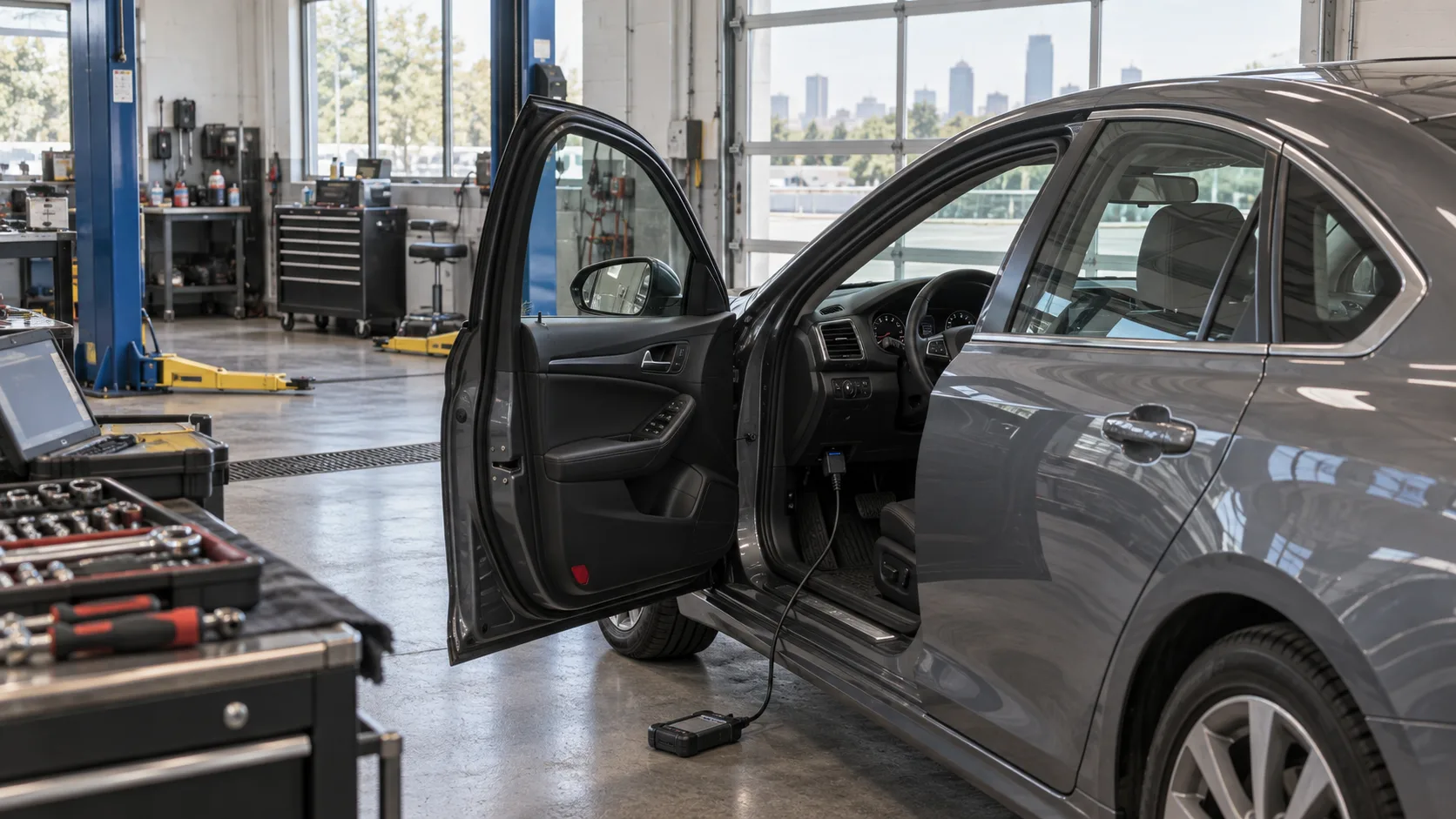
49 CFR 563.5[1] defines an EDR as a device or function in a vehicle that records the vehicle’s dynamic time-series data during the period just before a crash event or during a crash event and makes the data available for retrieval after the crash.
The rule’s scope is narrower than the everyday phrase “black box.” Part 563[2] applies to specified passenger cars and certain light trucks and multipurpose passenger vehicles manufactured on or after September 1, 2012, when the vehicle is equipped with an EDR.
Which EDR fields are required by Part 563?
For a vehicle governed by Part 563 and equipped with an EDR, 49 CFR 563.7(a)[3] requires the data elements listed in Table I, recorded in accordance with the rule’s stated interval, sampling, range, accuracy, and resolution requirements.
| Field group | Examples in Table I | What the field reports |
|---|---|---|
| Pre-crash operation | Indicated speed, accelerator or throttle position, and service-brake status | Values or status before time zero |
| Crash pulse | Longitudinal delta-V, maximum delta-V, and time to maximum delta-V | Recorded change in velocity and timing |
| Restraint systems | Driver safety-belt status, frontal air-bag warning-lamp status, and deployment times | Recorded restraint-system status and timing |
| Event sequence | Time from event 1 to event 2 and number of events | Whether the EDR recorded more than one event and their timing |
| Record context | Ignition cycles at the event and download; complete-file indicator | Cycle counts and whether the recorded file is complete |
The field names have defined meanings. For example, “vehicle speed, indicated” is the speed indicated by a manufacturer-designated subsystem, while “delta-V, longitudinal” is the cumulative change in velocity along the vehicle’s longitudinal axis.
What do common EDR fields describe?
Indicated vehicle speed reports the speed value supplied by the manufacturer-designated subsystem.
Engine throttle, percent full means driver-requested acceleration measured by the throttle-position sensor on the accelerator pedal compared with the fully depressed position. Service-brake status reports whether the brake-pedal detection device was on or off.
Delta-V describes the cumulative change in velocity during the recorded crash interval. Table I separately addresses longitudinal delta-V, maximum delta-V, and the time at which that maximum occurs.
Restraint fields can include driver-belt status, frontal air-bag warning-lamp status, and deployment timing for frontal air bags. These are system-status fields, and Part 563 excludes audio and video.
Event and record fields can show the number of recorded events, time between events, ignition cycles, and whether the complete file was recorded. A report may therefore distinguish a complete record from one marked incomplete.
For comparison with camera evidence, see the guide to dashcam footage after an Indiana crash. Dashcam material and Part 563 EDR data are different evidence types.

Which EDR fields are conditional or optional?
Under 49 CFR 563.7(b), Table II data elements must meet the rule’s specifications when the vehicle records the element or is equipped with the relevant system or sensing capability described in the table.
Examples include lateral delta-V, engine speed, steering input, anti-lock-brake activity, stability-control status, roll angle, right-front-passenger belt status, and deployment timing for side air bags, curtain air bags, and pretensioners.
Related guide: automatic emergency braking and driver-assistance data.

How long is the pre-crash recording window?
As of September 8, 2026, Table I generally specifies that indicated speed, accelerator position, and service-brake status be recorded from five seconds before time zero through time zero at two samples per second.
The 20-second, 10-samples-per-second requirement is a future amendment, not a production phase-in already underway in 2026. Under Table I footnote 4, the 20-second and 10-samples-per-second values phase in for 25 percent of production beginning September 1, 2028, 50 percent beginning September 1, 2029, and 75 percent beginning September 1, 2030. Those table values generally apply to EDR-equipped vehicles manufactured on or after September 1, 2031, while the footnote extends the five-second and two-samples-per-second rule for specified small-volume and limited-line manufacturers until September 1, 2032 and for specified altered and multistage vehicles until September 1, 2033.
The required interval varies by field. Crash-pulse fields use millisecond-scale intervals, while event, ignition-cycle, restraint, and complete-file fields are recorded at the event or before download as specified in Table I.
What does an EDR not record or decide?
Part 563 excludes audio and video from its EDR definition. GPS coordinates are not listed among the required Table I or conditional Table II data elements.
Part 563 states that its purpose is to make EDR data useful for crash investigations and safety-equipment analysis; it does not assign legal fault for a collision. The Indiana car-accident evidence guide describes other categories of records that may be relevant to a claim.
Who owns retained EDR data?
The federal Driver Privacy Act states that information retained by an EDR is the property of the vehicle owner or, for a leased vehicle, the lessee.
The Act generally restricts access by another person unless a listed circumstance applies. Related guide: Indiana EDR preservation and access guide.
Frequently Asked Questions
Does every passenger vehicle have an EDR?
No. Part 563 applies to covered vehicles when they are equipped with an EDR; it does not require every passenger vehicle to contain one.
Does an EDR record vehicle speed?
For a vehicle governed by Part 563 and equipped with an EDR, indicated vehicle speed is a required Table I field. It is the speed value supplied by the manufacturer-designated subsystem.
Does an EDR record audio or video?
No. Part 563 excludes audio and video from the definition of EDR event data.
How many seconds of pre-crash information does an EDR record?
As of September 8, 2026, indicated speed, accelerator position, and brake status generally cover the five seconds before time zero at two samples per second. The 20-second and 10-samples-per-second values phase in at 25 percent of production beginning September 1, 2028, 50 percent beginning September 1, 2029, and 75 percent beginning September 1, 2030; they generally apply beginning September 1, 2031, subject to later dates for specified manufacturers and vehicles.
Does an EDR decide who caused a crash?
No. Part 563 standardizes specified technical data; it does not assign legal fault for a collision.
For broader Indiana claim information, review the Fort Wayne car-accident guide. If you were hurt in a crash and have questions about available evidence, Delventhal Law Office can review the circumstances through a free case evaluation.
This article provides general information, not legal advice. An attorney–client relationship is formed only if the firm and client enter an agreement confirmed by the firm, subject to applicable professional duties.