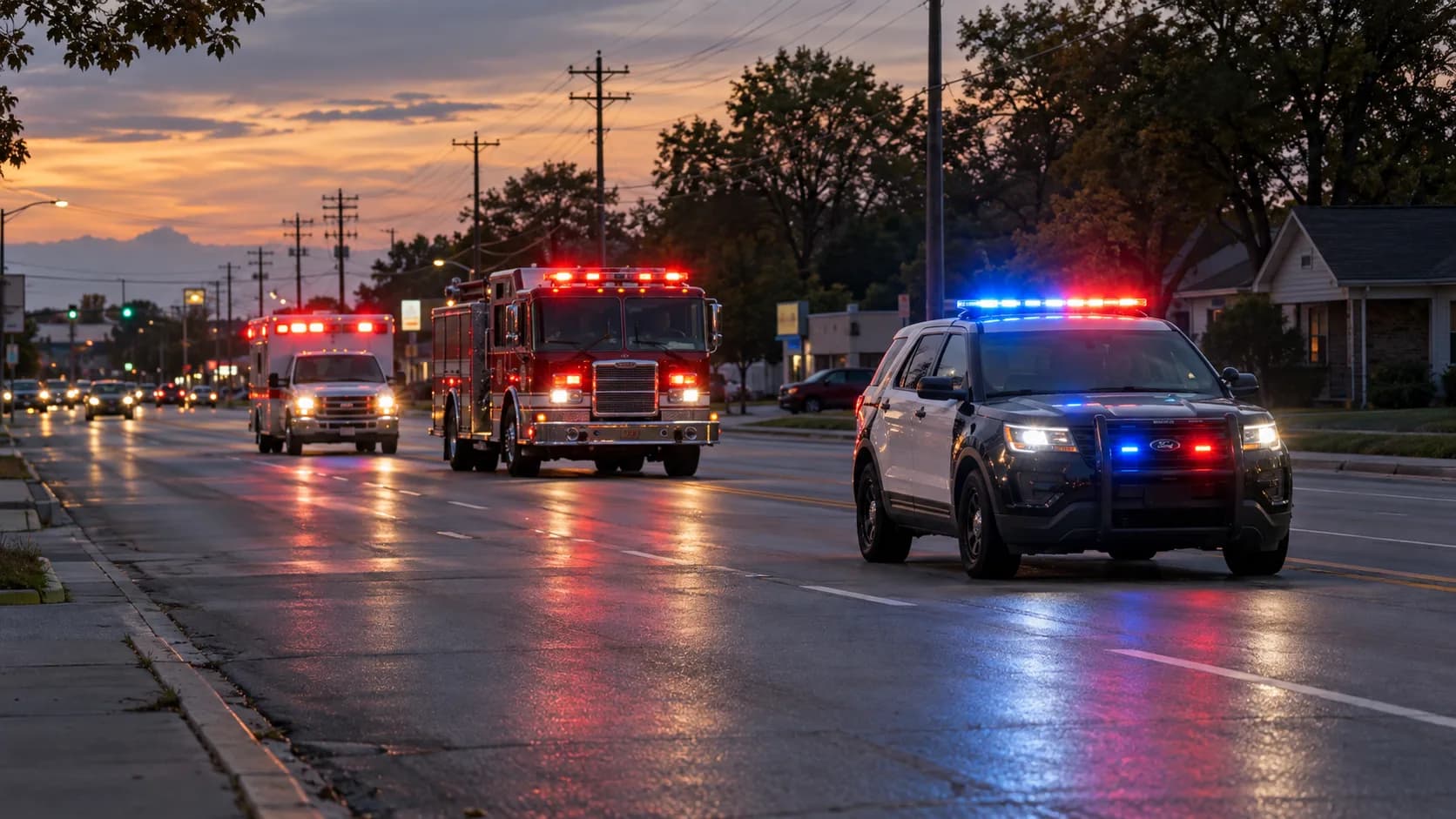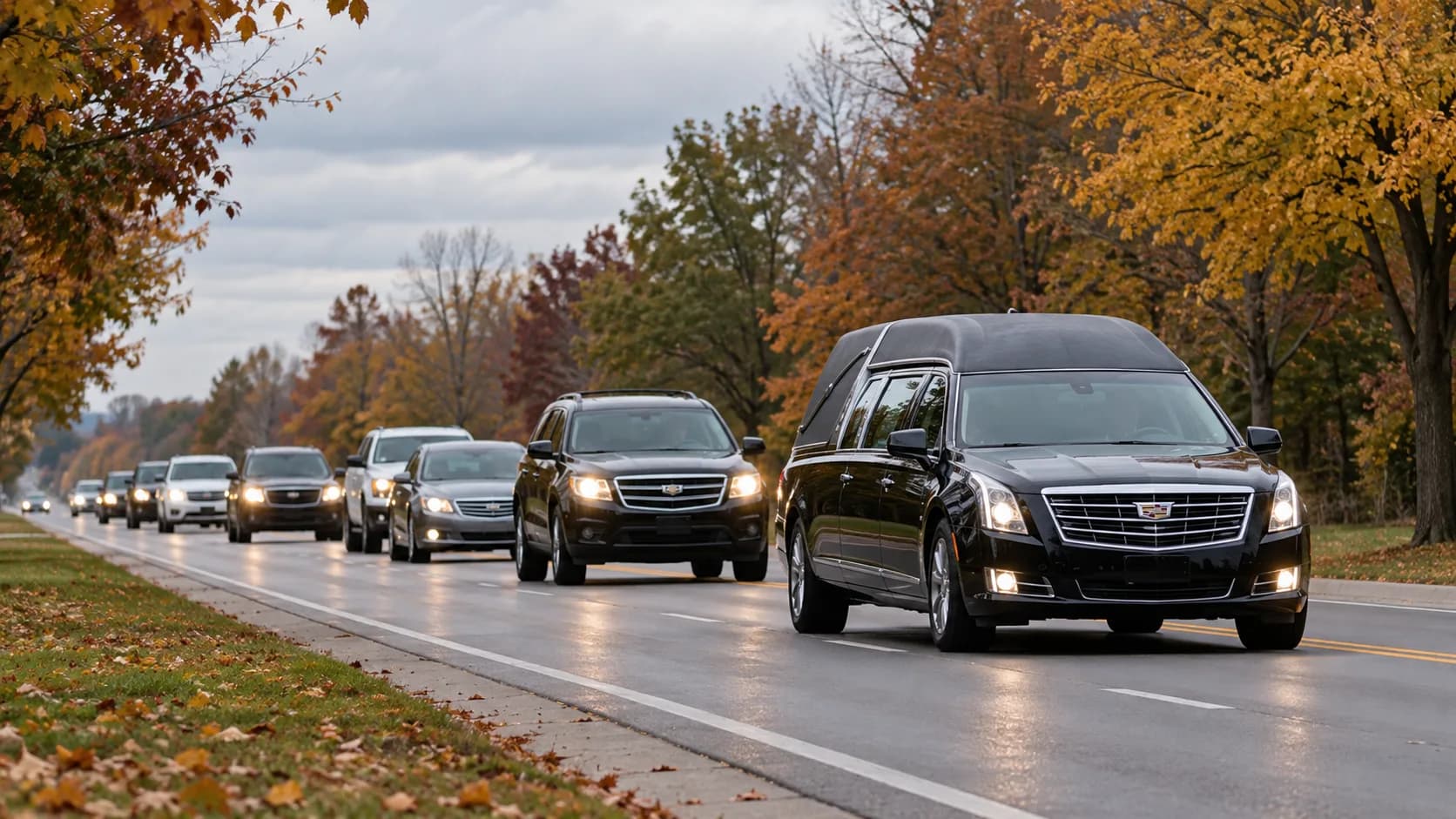
A crash during a funeral procession can add confusion to an already difficult day. Whether you were traveling with the procession or approaching from another direction in Fort Wayne, Allen County, or elsewhere in Indiana, a clear vehicle-by-vehicle record helps separate what you observed from what others later told you.
This guide explains the procession-specific rules and records. Our Fort Wayne car accident guide covers the broader injury-claim process.
- Right-of-way depends on the statutory conditions, not simply a line of cars.
- Procession drivers must use due caution and follow as closely as is practical and safe.
- Do not assume a funeral escort is a police officer.
- Record vehicle order, lighting, witnesses and who may hold relevant video.
Indiana funeral-procession rules
A vehicle with lighted headlights in a funeral procession has the right-of-way at an intersection and may proceed through it if the procession is headed by a lead or funeral escort vehicle displaying alternately flashing red and white, flashing red, or flashing amber lights, or by an authorized emergency vehicle. The exceptions are when an authorized emergency vehicle giving an audible signal requires the right-of-way, or when a police officer directs the procession otherwise. Before assuming the right-of-way, a procession driver must exercise due caution regarding crossing traffic. IC 9-21-13-1[1].
Throughout the procession, drivers must exercise due caution and follow the preceding vehicle as closely as is practical and safe. Participating vehicles must have both headlights and taillights illuminated and may display flashing amber lights. The vehicle immediately following the lead vehicle and the last vehicle may use hazard warning lights. IC 9-21-13-4.5[2].

A driver outside the procession may not drive between its vehicles unless authorized by a traffic officer or operating an authorized emergency vehicle giving an audible signal by siren. A nonparticipant may not join or form a procession with headlights on just to obtain its right-of-way. IC 9-21-13-2[3] and -3.
Funeral pennants, flags, windshield stickers, or the permitted amber light may identify participating vehicles. They are not all mandatory. A driver may pass a procession on its left on a multiple-lane highway if it can be done safely. Violating the chapter is a Class C infraction. IC 9-21-13-5[4] through -7.
Funeral escort vehicles must be clearly marked “funeral escort” on both sides: letters at least five inches high, or two inches for motorcycles. The statute prohibits markings or words that could cause reasonable confusion with police vehicles or law enforcement officers. IC 9-21-13-0.7[5].
As a practical matter, photograph the escort’s markings if safe and note who actually gave any directions. A flashing light by itself does not tell you who was operating the vehicle. These statutory conditions are why an ordinary red-light collision analysis may not answer every question about a procession crash.
How fault is evaluated after a procession collision
The procession’s right-of-way is not a finding that every participating driver acted carefully. The due-caution duties above make crossing traffic, sight lines, vehicle spacing, speed and braking important facts to document. List the funeral home and escort operator as possible information sources, without prejudging their conduct.
When Indiana’s Comparative Fault Act applies, a claimant’s own fault proportionately reduces compensatory damages, and fault greater than 50% of the total fault involved bars recovery. The comparison is not limited to named defendants: it can include properly designated nonparties whose fault contributed to the loss. The Act excludes medical-malpractice actions against qualified providers and tort claims against governmental entities or public employees under Indiana’s Tort Claims Act. IC 34-51-2-1, -2, -5 through -8, and -14 through -16[6].
The government-claim exclusion is important when a police escort was involved. See our Indiana comparative-fault guide for the broader framework. This article does not decide an individual case.

Build a vehicle-by-vehicle evidence packet
The following is a practical organization checklist, not a legally required form or a promise that a particular record exists. Use neutral labels such as “Vehicle A” rather than “at-fault vehicle.” Note your own car’s place in the sequence and the direction each vehicle traveled.
| Question to document | Useful detail | Possible record holder |
|---|---|---|
| Which vehicle led the procession? | Vehicle description, plates, markings and light colors; distinguish an escort from a police vehicle | Funeral home, escort operator, participants |
| Where was each vehicle? | Order in line, lane, direction, gaps, and point of impact; mark estimates as estimates | Drivers, passengers, independent witnesses |
| What lights were visible? | Headlights, taillights, escort lights, flags or stickers; record viewing angle and time | Dashcam owner, photographer, nearby business |
| What happened at the intersection? | Traffic signal, crossing movement, sight obstructions, braking and any directions | Witnesses, responding agency, nearby camera owner |
| Was an emergency vehicle approaching? | Vehicle identity, siren sound, direction and timing; distinguish what you heard from what you inferred | Witnesses, involved agency, dashcam owner |
| What route or instructions were used? | Route sheet, departure time, participant instructions and escort contact information, if available | Funeral home or escort operator |
Example—not an actual case: One witness remembers a green signal, while a passenger remembers the lead vehicle’s flashing amber lights. Preserve both accounts with each person’s location and viewing direction. Do not edit them into a single “agreed” story. A video showing the lead vehicle several seconds before the impact may answer a different question than a photograph of the damaged cars afterward.

For each missing item, list the likely holder, camera location, relevant time range and any contact already made. Tell counsel promptly about recordings that may be overwritten. Do not enter restricted property, access someone else’s account, or assume every traffic camera records video. Keep original files and a backup; mark later notes as later notes.
Practical next steps after the crash
- Address immediate danger. Request emergency assistance for injuries or hazards. Do not stand in active traffic to photograph a procession.
- Record the identifying details. Note the responding agency, report number, directly involved drivers, witnesses, funeral home, and escort operator.
- Preserve your records. Save unedited photographs, video, route messages, repair estimates, bills, and insurance correspondence.
- Separate observations from conclusions. “I saw headlights” is different from “the vehicle legally had priority.” Record what you actually saw or heard.
- Bring what you have to a consultation. Include your timeline and a missing-records list. You can ask for individual advice with an incomplete packet.
Our Indiana crash-report guide explains how to locate a report. A report is one part of the packet; keep the original video, photographs and witness details separately.

This focused guide is a starting point for organizing the facts, not a substitute for individual advice. Tell the attorney if a government vehicle or public employee was involved.

Frequently asked questions
Can a funeral procession go through a red light in Indiana?
A qualifying procession vehicle may proceed through an intersection under IC 9-21-13-1[7] when the headlight and lead-or-escort conditions are met. Its driver must use due caution with crossing traffic. Police directions and an authorized emergency vehicle requiring right-of-way while giving an audible signal are express exceptions.
Can I drive through a gap in a funeral procession?
IC 9-21-13-2[3] prohibits an outside driver from driving between procession vehicles, except when authorized by a traffic officer or when operating an authorized emergency vehicle giving an audible signal by siren.
Do procession vehicles need both headlights and taillights?
Yes. IC 9-21-13-4.5[8] requires both to be illuminated. The same section requires due caution and following the preceding vehicle as closely as is practical and safe; it is not a direction to tailgate.
Does the absence of a funeral flag settle the right-of-way question?
No. Flags and stickers are optional identification methods under IC 9-21-13-5[4]. The intersection rule has its own headlight and lead-or-escort conditions. Record all visible features instead of treating a missing flag as the whole answer.
Does a procession driver automatically avoid fault?
No. Indiana expressly requires due caution. Where the Comparative Fault Act applies, the comparison may include properly designated nonparties, not just named defendants. Governmental tort claims under the Tort Claims Act are excluded from that comparative-fault chapter.
What should I bring to a funeral-procession crash consultation?
Bring the report number, available photos or video, witness contacts, vehicle order, lighting observations, funeral-home and escort details, insurance correspondence, and a list of missing records. Distinguish your observations from estimates and secondhand information.
If you were hurt in a funeral-procession collision, attorney Chad Delventhal can review the available facts and explain possible next steps. Request a free consultation with Delventhal Law Office.
This article is general information about Indiana law and is not legal advice. Reading it does not create an attorney-client relationship, and neither does contacting us.