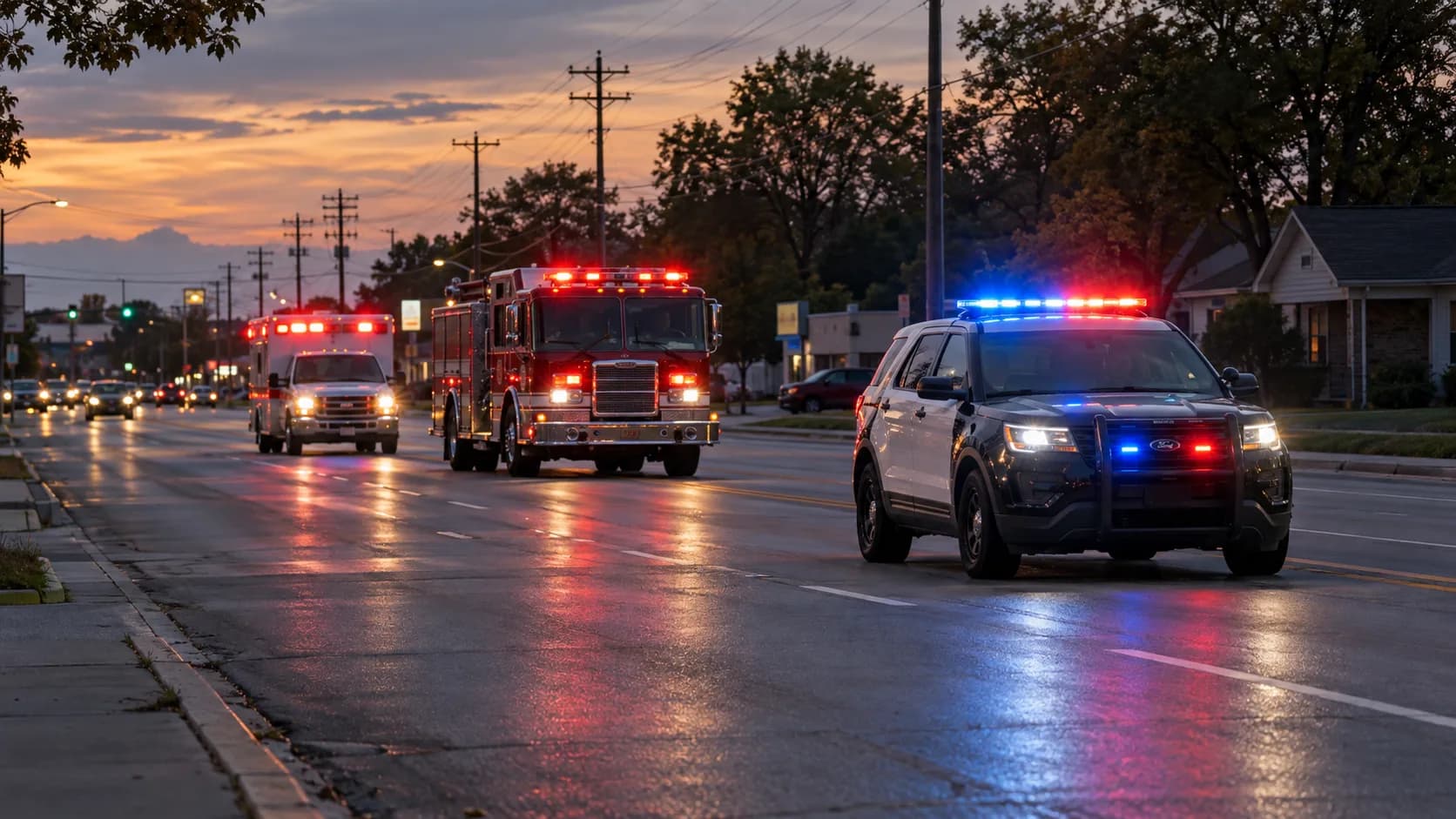
A marked vehicle is a starting point, not a complete answer. The agency investigating the collision may not be the agency that operated the vehicle. An ambulance’s branding may not identify the driver’s employer. Write down what is confirmed, what the paperwork says, and what still needs checking.
This article focuses on identifying records after a specific police, fire, or ambulance collision. For the fuller discussion of driving rules and government claims, read our Indiana emergency-vehicle collision guide. For the wider crash process, see our Fort Wayne car accident page.
Identify the vehicle, operator, and investigating agency
From a safe location, photograph the unit number, license plate, agency or company name, and vehicle damage. Keep the information exchange and ask how to obtain the crash report. Do not enter the road, interfere with responders, or delay urgent care to collect documents.
For a Fort Wayne or Allen County crash, note the exact intersection or road segment, direction of travel, approximate time, and names of every agency appearing on the paperwork. Keep the operating agency and investigating agency in separate fields. If several response vehicles were present, identify which one was actually involved.
| Item | What to record | Avoid this assumption |
|---|---|---|
| Vehicle identity | Unit number, plate, markings, and photographs | All vehicles on scene belong to one agency |
| Operator | Name shown on the exchange, transport paperwork, or correspondence | A logo proves who employed the driver |
| Investigation | Reporting agency, officer, and crash-report number | The investigating agency also operated the vehicle |
| Dispatch event | Any incident or call number supplied to you | The dispatch number and crash-report number are identical |

Make a vehicle-specific records list
The following are investigation leads, not a promise that a particular recording exists or is publicly available. Give the list to counsel so the right custodian and access process can be checked.
Police car: distinguish the assignment from the crash investigation
Keep the cruiser number and department name. Note whether you personally observed a pursuit, an intersection crossing, or another maneuver. Potential leads include the dispatch assignment, in-car video, body-camera footage, nearby cameras, and witnesses. Do not label an event a pursuit based only on the police car’s speed.
If a chase was involved, use our separate Indiana police-pursuit guide for that scenario. This records checklist does not decide the legal effect of a chase.
Fire truck: identify the responding unit and its movement
Record the engine, ladder, rescue, or other unit designation if visible. Describe whether it was entering an intersection, turning, stopped, or leaving the scene. Possible leads include dispatch records, route information, scene photographs, and witness accounts of the truck’s position and warning signals. Keep observations about the truck separate from observations about other responding vehicles.
Ambulance: keep the operator and transport paperwork together
Save the transport paperwork if you were a passenger, along with the operator name, vehicle number, destination, and crash information. Note whether you were inside the ambulance or in another vehicle. Do not infer emergency status from the presence of a patient alone. Questions about care provided during transport fall outside this road-collision checklist.

Build a response timeline without guessing
Use one line per event: your location and signal color, the first warning light or siren you noticed, the response vehicle’s direction, and the point of impact. Mark times and distances as estimates unless a record supplies them. Keep each witness’s account separate from your own.
These details connect to the traffic rules. IC 9-21-1-8[1] provides limited privileges in specified emergency operations, including passing a red signal only after slowing as necessary for safe operation. Its due-regard duty remains in place. Whether a particular driver complied requires the actual facts, not just the vehicle’s label.
The same section requires audible or visual signals as required by law and includes a limited police-vehicle exception concerning front-facing red and blue lights. “I did not hear a siren” is therefore an observation worth documenting, not a complete legal conclusion.
Other drivers also have duties. Under IC 9-21-8-35(a)[2], on the immediate approach of an authorized emergency vehicle giving the specified siren or flashing-light signal, a driver must yield, move parallel and close to the right-hand edge clear of an intersection, and stop until it passes, unless directed otherwise by a law-enforcement officer. Document where you were and what room you had to respond.

Do not confuse the report, recordings, and formal notice
| Task | Purpose | What to keep |
|---|---|---|
| Obtain the crash report | Read the recorded account and identify vehicles, people, and agencies | Request details, report number, and the complete copy received |
| Identify and preserve possible recordings | Ask about relevant dispatch audio, cameras, and vehicle data | Custodian names, requests, responses, and original files |
| Review government tort-claim notice | Address a separate formal requirement for a government claim | Complete notice, attachments, recipient information, and delivery proof |
As a practical safeguard, do not assume that obtaining one document completes all three tasks. A records request is not a substitute for having counsel check formal notice. Keep original videos and photographs; work from copies if you annotate an image. Do not overwrite the original file with a crop or caption.
Check government notice before waiting for every record
For a political subdivision, IC 34-13-3-8[3] generally requires notice within 180 days after the loss to the governing body and, where the section requires it, the political subdivision risk management commission. For the State, section 6 generally requires notice to the attorney general or the state agency involved within 270 days after the loss.
Section 10 specifies the notice’s facts and requested damages, and section 12 requires written notice delivered in person or by registered or certified mail. The chapter also contains an incapacity provision in section 9. Have counsel check the applicable rule and every recipient rather than deciding from a generic calendar.
The Indiana Attorney General’s civil-torts page[4] provides the official notice-of-tort-claim form for claims involving the State and state agencies. It is not a substitute for identifying the right entity in your case. Our government tort-claim notice guide explains that process in more detail.
The notice periods are not the same as the time to file a lawsuit. Do not wait for a complete crash investigation to seek individual advice, and do not assume a possible exception applies to you. If a date may already have passed, bring the documents for review rather than deciding the issue yourself.

Bring a compact, organized folder
- The vehicle and operator identification sheet, including unconfirmed items.
- Your own timeline and separate witness contact information.
- The crash report, exchange sheet, and all incident numbers.
- Original photographs and video, with a note of who supplied each file.
- Dispatch or recording requests and every response received.
- Medical visit records, bills, work notes, pay statements, and repair documents.
- Every formal notice, letter, envelope, and delivery receipt.
For each missing item, write “not yet obtained” rather than filling the gap from memory. Our crash-evidence organizing guide provides broader examples. Bring questions about unclear agency names or conflicting accounts to the consultation.

Frequently Asked Questions
What if I do not know which agency operated the vehicle?
Save the vehicle number, plate, markings, crash exchange, and any business card or incident number. Mark the operator as unconfirmed instead of guessing from the paint scheme.
Should I write that the siren was off if I never heard it?
Write what you personally perceived: when you first heard or saw anything, where you were, and what may have affected your view or hearing. Whether the equipment was operating is a separate question for recordings, witnesses, and other evidence.
What should I keep after an ambulance collision?
Keep the transport paperwork, operator name, vehicle number, crash report information, and any later correspondence. If you were a passenger, distinguish what you observed from what someone later told you.
Does ordering the crash report preserve dispatch audio or video?
Do not assume it does. Identify possible recordings and their custodians separately, keep your own original files, and ask counsel about a targeted preservation request.
Can I use the state tort-claim form for every emergency-vehicle crash?
Do not assume that the state form identifies the correct recipient for a city, county, or private operator. The Attorney General’s civil-torts page provides the form for claims involving the State and state agencies; local-government notice requires its own recipient review.
What are the general government notice periods?
A political-subdivision claim generally requires notice within 180 days after the loss, while a claim against the State generally requires notice within 270 days. Have counsel check the entity, recipients, service, loss date, and any exception; these notice periods are not the same as the time to file a lawsuit.
If you need help identifying the operator and organizing the next steps after an Indiana police, fire, or ambulance collision, Delventhal Law Office offers a free consultation. Bring the records you have; a complete folder is not required to start the conversation.
Primary sources reviewed October 28, 2026.
This article is general information about Indiana law and is not legal advice. Reading it does not create an attorney-client relationship, and neither does contacting us.