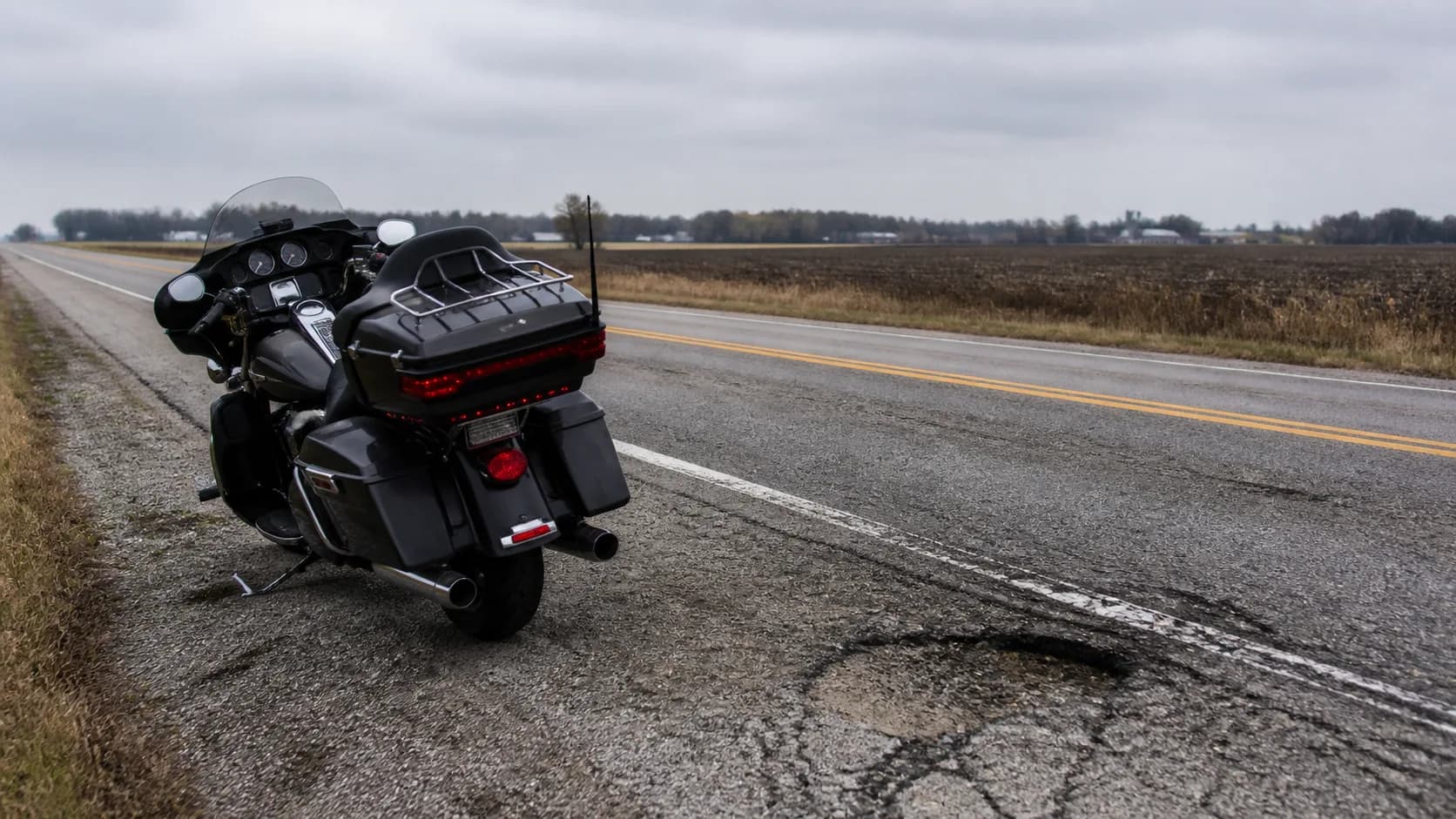

Road rash is sometimes dismissed as a scrape. That description can be dangerously incomplete. When a rider slides across pavement, friction can remove layers of skin, drive grit into the wound, and damage deeper structures. Even after the surface closes, the rider may still be dealing with sensitivity, discoloration, restricted movement, or visible scarring.
This guide explains the medical and claim-documentation issues without graphic images or treatment instructions. It is written for riders and passengers in Fort Wayne, Allen County, and throughout Indiana who need to understand what records matter, how insurers may minimize the injury, and what questions to raise with their own medical professionals. For the broader claim process, start with our Fort Wayne motorcycle accident lawyer resource.
Key takeaways
- Road rash is a friction abrasion or friction burn; depth, contamination, location, and associated injuries matter more than the casual label.
- Some abrasions heal without scarring, while injuries extending into the dermis or deeper tissue may leave permanent changes.
- Medical records should describe size, depth, location, debris, symptoms, treatment, and follow-up—not merely say "abrasion."
- Consistent photographs can document healing, complications, discoloration, and scarring better than one image taken on the crash date.
- Damaged clothing, helmet, gloves, crash photos, and the motorcycle may help explain how the rider contacted the pavement.
- An insurer may focus on how the wound looks months later while ignoring painful care, missed work, restricted activity, and permanent sensitivity or scarring.
What road rash is—and why "just a scrape" can be misleading
Road rash usually occurs when skin moves across a broad, rough surface. The NCBI Bookshelf review of abrasions[1] describes grazed or brush abrasions as friction injuries commonly seen in road-traffic accidents. It also explains that depth varies with the surface and the body's speed, and that deeper abrasions may involve nerves, blood vessels, muscles, tendons, or bone.
That is why two injuries both labeled "road rash" can be very different. One may be limited to the outer skin and heal with conservative care. Another may be contaminated with gravel, cross a joint, require repeated wound care, or leave lasting scar tissue. A rider can also have fractures, sprains, head injury, or internal injury that the dramatic-looking skin injury initially overshadows.
A recent motorcycle-trauma study available through the Journal of Burn Care & Research[2] examined friction burns after motorcycle crashes and emphasized that these wounds are an identifiable part of motorcycle trauma, not merely a cosmetic afterthought. The practical point is simple: the medical record should capture the wound itself and the rest of the crash-related evaluation.
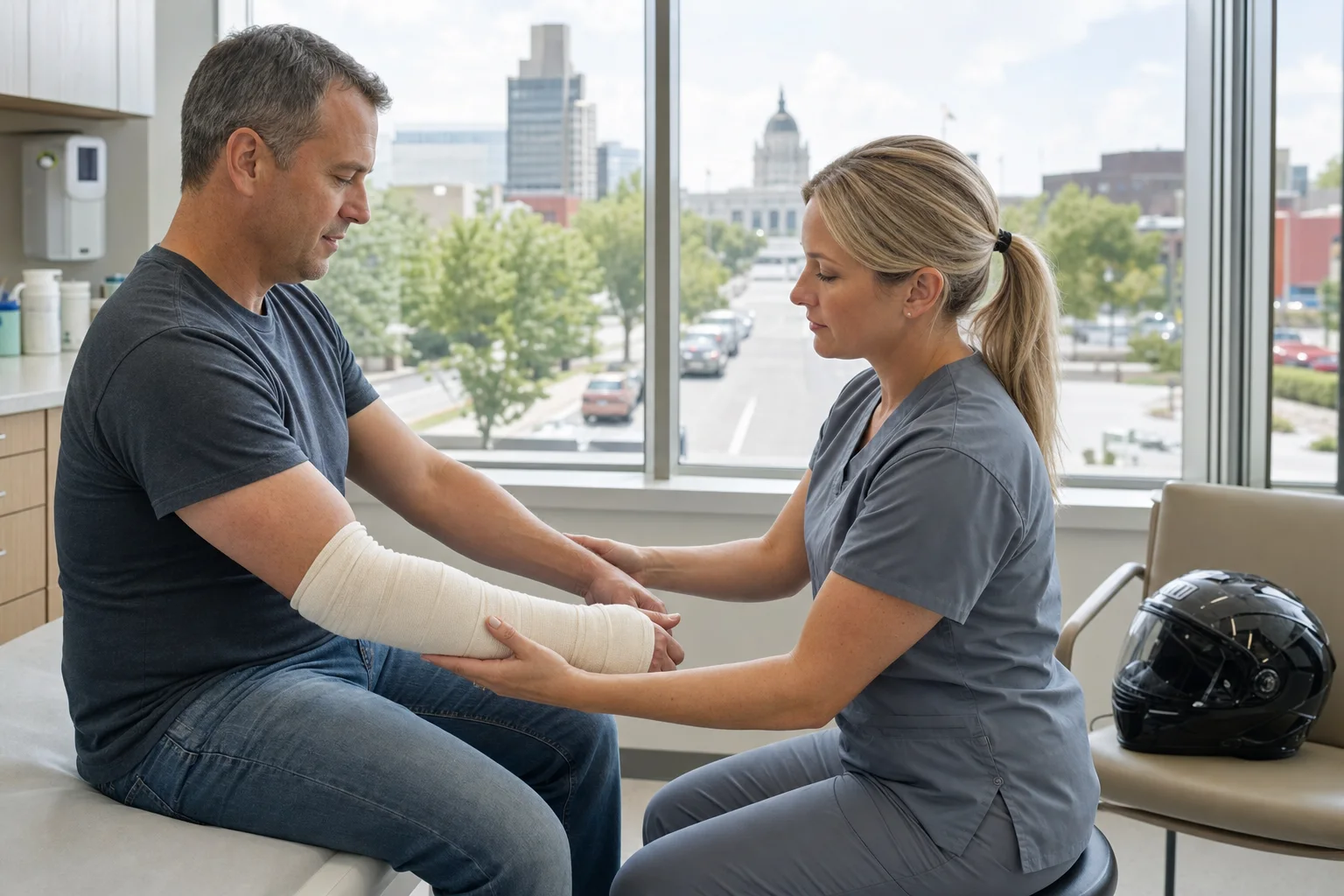
Road-rash severity and documentation table
People often describe road rash as first-, second-, or third-degree. Those labels are used inconsistently outside clinical settings. A safer way to understand the issue is to focus on what tissue is involved, what the medical team observes, and what the injury requires. The table below is educational—not a self-diagnosis tool.
| Medical feature | Why it matters medically | What should be documented |
|---|---|---|
| Shallow abrasion limited mainly to outer skin | May heal without permanent scarring, but contamination and associated injuries still matter | Location, size, cleaning, dressing instructions, pain, tetanus review, and follow-up |
| Injury extending into deeper skin layers | May increase the risk of scarring, pigment change, prolonged pain, or delayed healing | Depth, exposed tissue, debris, debridement, medication, referrals, progress photographs, and scar development |
| Full-thickness or extensive friction injury | May require specialist or surgical care and can affect nerves, movement, or appearance | Specialist findings, procedures, hospitalization, graft or reconstruction discussion, restrictions, future care, and functional impact |
| Wound over a joint, hand, face, or other functionally sensitive area | Location may affect motion, sensation, work tasks, sleep, clothing tolerance, or appearance | Range of motion, sensory findings, work restrictions, therapy, scar location, and daily limitations |
| Embedded pavement material or signs of complication | Foreign material and infection can complicate healing and may worsen scarring | Debris removal, cultures or imaging when ordered, infection findings, additional treatment, and changes in symptoms |
The practical rule: Do not let a claim file reduce a complex wound to the single word "abrasion." The contemporaneous record should show what the clinician actually saw, what care occurred, and how the injury changed over time.
Why medical evaluation matters after a motorcycle slide
The Cleveland Clinic's medically reviewed road-rash guidance[3] notes that smaller, shallow injuries may sometimes be managed without extensive care, while timely professional care can matter for more serious wounds and help address complications such as infection and scarring. The correct level of care depends on the individual injury and belongs to a qualified healthcare provider.
After a motorcycle crash, evaluation can do more than establish that road rash exists. It can identify:
- How large and deep the wound is.
- Whether dirt, glass, gravel, fabric, or other material is embedded.
- Whether sensation, circulation, tendons, muscles, or joint motion may be affected.
- Whether there are lacerations, fractures, head injury, or other trauma.
- What wound care, medication, follow-up, referral, or activity restriction the clinician recommends.
- Whether the patient's tetanus status needs review.
This article cannot tell a particular rider whether an abrasion requires emergency, burn, surgical, or specialty care. Seek medical guidance for the actual wound. If symptoms change, report the change rather than assuming it is part of normal healing.
How to document healing, complications, and permanent scarring
A road-rash claim is unusual because part of the injury may be visible, yet the record can still be incomplete. One dramatic photograph from the day of the crash does not show the full course of healing. One healed photograph months later may make the original injury look minor. A consistent record connects those two points.
Create a respectful photo timeline
When medically appropriate and comfortable, photographs can show the wound's location, scale, healing, discoloration, and scar development. Use consistent lighting and distance when possible. Preserve the original files with their dates rather than only screenshots or edited versions. Do not post the images publicly; social-media posts can create privacy and context problems. Our guide to how social media can affect an Indiana injury claim explains why private preservation is different from public sharing.
Ask whether the medical record is specific
The record should speak for itself. Useful details can include wound dimensions, body location, depth, contamination, sensation, range of motion, pain, treatment, referrals, restrictions, and follow-up observations. If the wound changes, the provider—not the patient—should evaluate and describe what the change means.
Record functional impact, not just pain scores
A brief private log can help preserve concrete details: difficulty sleeping because bedding touches the wound, inability to wear work clothing or protective gear, missed shifts, limits on lifting or joint movement, sensitivity to heat or sunlight, and time spent at appointments. Keep it factual. Do not exaggerate, guess at a diagnosis, or turn the log into advocacy copy.

Consistency matters. Unexplained gaps in care can give an insurer room to argue that the injury resolved or that later complaints are unrelated. Our article on why treatment gaps matter in an Indiana injury claim explains that issue in more detail.
Evidence to preserve after a Fort Wayne motorcycle crash
Road rash can help explain that the rider contacted and traveled across the pavement, but the injury alone does not establish how the crash happened. Preserve the liability evidence and the injury evidence as separate parts of the same file.
- Crash report: The Indiana State Police maintains the state's central crash-report repository[4]. Obtain the report and check names, vehicles, diagram, narrative, and listed witnesses.
- Scene photographs and video: Preserve final positions, debris, gouge marks, skid marks, sight lines, traffic controls, road surface, lighting, and weather.
- Motorcycle and gear: Do not discard or repair the motorcycle, helmet, jacket, pants, gloves, and boots before they are photographed and any necessary inspection is considered.
- Medical records and bills: Keep records from EMS, emergency care, wound care, primary care, specialists, therapy, pharmacy, and scar-related follow-up.
- Witness and camera information: Identify nearby businesses, homes, vehicles, dashcams, helmet cameras, or intersection cameras before footage is overwritten.
- Work and activity records: Preserve wage statements, restrictions, absence records, and contemporaneous proof of activities the injury interrupted.

For a fuller evidence checklist, see what evidence helps prove an Indiana crash claim. Many of the same categories apply to motorcycle crashes, but the motorcycle, gear, and road-surface evidence deserve special attention.
How insurance companies may minimize road rash
An adjuster may not openly deny that the wound existed. The dispute is often about severity, duration, causation, or what the injury changed. Common arguments include:
- "It was superficial." Compare that label with wound depth, debridement, medication, referrals, restrictions, and follow-up records.
- "It healed quickly." Surface closure does not necessarily answer whether there is continuing sensitivity, pigment change, scar tissue, restricted motion, or future evaluation.
- "The scar is barely visible now." A later photograph should be read with the full photo timeline and medical record, not used to erase the painful treatment period.
- "The rider caused the injury by choosing inadequate gear." Gear evidence may be relevant to particular facts, but it does not automatically decide who caused the collision or every resulting loss.
- "The treatment was excessive or unrelated." Contemporaneous provider documentation, referrals, and a consistent history are the best response—not assumptions by the rider or lawyer.
- "There was a treatment gap." Document the reason for any gap, such as appointment availability, referral delay, insurance authorization, transportation, or a provider-directed follow-up schedule.
Motorcyclists may also face broader stereotypes about speed, visibility, experience, or risk-taking. We address those tactics separately in how insurers use motorcycle bias after an Indiana crash.
Losses a road-rash injury claim may need to document
No chart or article can predict the value of a particular injury claim. The relevant losses depend on the crash, medical evidence, fault, insurance coverage, and the person's actual experience. A complete file may need to address:
- Ambulance, emergency, wound-care, specialist, therapy, pharmacy, and follow-up charges.
- Future care discussed by qualified medical professionals, including scar evaluation or procedures when medically supported.
- Lost income, reduced hours, missed overtime, or work restrictions tied to the injury.
- Pain during cleaning, dressing changes, movement, sleep, and ordinary daily activity.
- Permanent scarring, discoloration, sensitivity, numbness, or altered sensation.
- Restricted motion when scar tissue or the wound crosses a joint or functionally important area.
- Effects on clothing, work equipment, recreation, relationships, and confidence that can be described with specific evidence rather than slogans.
- Damage to the motorcycle, helmet, protective gear, phone, and other personal property.

Minimum insurance may be inadequate when a motorcycle crash causes multiple serious injuries. Riders can learn more from our explanation of Indiana motorcycle insurance requirements and optional rider-protective coverage.
Protective gear, helmet arguments, and road-rash myths
Abrasion-resistant clothing, gloves, boots, and other properly fitted gear can reduce exposure to pavement. Protective gear does not make a rider invulnerable, and damaged gear can itself become evidence of force and contact. Preserve it rather than letting an insurer assume what was worn or how it performed.
Helmet use is a different question from road-rash injury to an arm, leg, torso, or hand. An insurer should not use a helmet argument as a shortcut to avoid examining which conduct caused the crash and which equipment could have affected the specific injury. Our article about compensation when an Indiana rider was not wearing a helmet explains why injury-by-injury causation matters. You can use our Indiana car accident settlement calculator to organize the factors that may affect a claim’s value; it is an educational tool, not a promise of any result.

Fort Wayne and Allen County: a practical post-crash sequence
Whether the crash happened on Coliseum Boulevard, Lima Road, Coldwater Road, Illinois Road, I-69, I-469, or a rural Allen County route, evidence can disappear quickly. This sequence keeps the medical and claim issues organized:
- Address safety and medical needs first. Follow the advice of the professionals evaluating the actual injury.
- Secure the crash report and witness information. Do not assume every witness or camera source made it into the report.
- Preserve the motorcycle and gear. Photograph damage before cleaning, repair, salvage, or disposal.
- Build a private photo timeline. Keep originals and dates; avoid public social-media posts.
- Collect complete medical and billing records. Include referrals, wound-care supplies, prescriptions, scar evaluations, restrictions, and missed-work support.
- Do not guess in a recorded statement. If you do not know speed, distance, wound prognosis, or future care, say you do not know rather than estimating.
- Review applicable deadlines early. Different defendants and claim types can create different timing issues. Our Indiana guide explains how long after an accident you may have to file a claim, but advice about a specific deadline requires review of the actual facts.
When legal review can help
Legal review may be especially useful when the wound is extensive, scarring may be permanent, the injury crosses a joint or affects work, multiple policies may apply, fault is disputed, the insurer requests a broad medical release, or the motorcycle and gear may be lost. An attorney can help preserve evidence, obtain complete records, separate medical questions from legal questions, identify coverage, and present the injury's full timeline without substituting legal opinion for medical judgment.
If you were hurt and are not sure what to do next, Delventhal Law Office can review what happened, explain the claim process, and help you identify the records that may matter. You can request a free case evaluation or learn more about attorney Chad Delventhal.
Frequently asked questions
Can road rash be a serious motorcycle injury?
Yes. Some abrasions are shallow, but others extend into deeper tissue, contain embedded debris, cross joints, become complicated, or leave permanent scars and sensory changes. A qualified medical professional should assess the actual wound and associated injuries.
Can permanent scarring be part of an Indiana motorcycle injury claim?
Potentially. The evidence may include the scar's location and appearance, medical opinions, photographs over time, symptoms, functional effects, future-care recommendations, and the effect on the individual's life. No particular scar determines a specific outcome or value.
How often should I photograph road-rash healing?
There is no universal legal schedule. The goal is a consistent, private record that shows meaningful changes without interfering with medical care. Preserve original dated files and follow provider instructions about dressings and wound exposure.
Should I keep damaged motorcycle clothing and gear?
Yes, when it can be stored safely. Photograph and preserve the helmet, jacket, pants, gloves, boots, and motorcycle before cleaning, repair, disposal, or salvage. They may help explain contact points, forces, and what protection was present.
What if the road rash has healed but remains painful or sensitive?
Report continuing or changing symptoms to a qualified healthcare provider. For claim documentation, preserve the follow-up record, photographs, restrictions, and specific daily or work activities affected. Do not self-diagnose the cause of persistent symptoms.
How much is a road-rash claim worth?
There is no responsible average that determines an individual case. Relevant facts can include wound depth and location, treatment, scarring, symptoms, work loss, future care, fault evidence, insurance limits, and other injuries. Any evaluation should be based on the complete record.
This article provides general information about motorcycle injuries and Indiana claims. Reading it does not create an attorney-client relationship, and neither does contacting us. If you do contact us about a possible claim, Indiana Rule of Professional Conduct 1.18 requires us to keep what you tell us confidential whether or not we take the case — but please do not send documents or detailed facts until we have agreed in writing to represent you. Treatment decisions belong to qualified healthcare professionals; legal advice depends on the facts of a specific case.