For broader context, see the firm’s Fort Wayne car accident guide and Chad Delventhal’s attorney profile.
Key takeaways
- A claim against a fleeing driver requires proof of negligence and causation.
- Indiana law does not give police blanket immunity for negligent operation of an emergency vehicle.
- Government notice may be due in 180 or 270 days, depending on the public entity.
- APRA access, recording retention, preservation requests, subpoenas, and discovery are different.
- A work-connected injury may involve workers’ compensation and a third-party claim.
The claim against the fleeing driver
Kaur v. Amazon[1] summarizes Indiana negligence elements as a duty, a breach, and an injury proximately caused by the breach. A claim against a fleeing driver depends on proof of those elements. Route, speed, traffic controls, impacts, photographs, video, and witness accounts may be relevant. That is a practical list, not a court-required checklist.
When a government claim may be possible
Indiana Code § 9-21-1-8[2] gives a properly signaled authorized emergency vehicle limited privileges during a pursuit. It preserves the driver’s duty to drive with due regard for everyone’s safety and does not protect the driver from consequences of reckless disregard for others’ safety.
In Patrick v. Miresso[3], the Indiana Supreme Court held that law-enforcement immunity does not shield liability resulting from breach of that statutory emergency-vehicle duty. Because the officer’s vehicle entered an intersection against a red light and struck the plaintiff’s vehicle, the Court affirmed denial of the defendants’ summary-judgment request; it did not enter judgment for the plaintiff.
In City of Indianapolis v. Earl[4], the Court of Appeals held that law-enforcement immunity was not blanket immunity where the claim concerned continuing a chase without due regard for public safety. On that record, due regard was a totality-of-the-facts question for the factfinder.
In City of Indianapolis v. Estate of Alexander[5], the Court of Appeals applied Patrick and Earl and affirmed a jury verdict supported by evidence about a fourteen-minute pursuit, dangerous speeds, failure to terminate, recordings, reports, and officer testimony. That result rests on its evidentiary record; it does not make every participating agency liable.
Indiana Code § 34-13-3-3[6] contains other governmental immunities. The cited pursuit decisions show why the facts and procedural record matter.
| Question | Why it matters |
|---|---|
| Did a police vehicle strike the injured person? | Patrick involved a direct collision with the officer’s vehicle. |
| Why was continuing the chase allegedly unsafe? | Earl used the totality of the facts. |
| What connects pursuit conduct to the crash? | Alexander reviewed evidence supporting causation. |
| Which entity employed the officer? | The notice recipient and period depend on the entity. |
Indiana Tort Claims Act notice deadlines
Indiana Code § 34-13-3-8[7] generally requires political-subdivision notice within 180 days after the loss. Indiana Code § 34-13-3-6[8] generally requires state or state-agency notice within 270 days after the loss.
Indiana Code § 34-13-3-10[9] specifies required notice content. Notice is not a lawsuit. Indiana Code § 34-11-2-4[10] generally provides two years for an action for injury to person or character, but government notice can be due sooner. See the guides to an Indiana government tort claim notice and public-entity injury claims.
Record access, retention, and preservation
Indiana Code § 5-14-3-5.3[11] generally requires a public agency that creates a law-enforcement recording to retain it for at least 190 days. If the agency receives a written request to inspect or copy during that period, it must generally retain the recording for at least two years after the request. The section has other rules for specified recordings.
Retention does not mean public disclosure follows. Indiana Code § 5-14-3-3[12] governs requests to inspect or copy public records; § 5-14-3-3.3[13] separately addresses requests for law-enforcement recordings; and § 5-14-3-4[14] identifies records that agencies must or may withhold, including investigatory records under subsection (b)(1). An APRA request seeks access to a public record; a preservation request asks that identified material not be destroyed. Neither is a subpoena or civil discovery. Subpoenas and discovery operate under applicable litigation procedures.
A pursuit policy may be requested, but access depends on APRA and any applicable exception. Do not assume an incident review exists or is publicly accessible.
If you were injured while working
Indiana Code § 22-3-2-2[15] addresses accidental injury arising out of and in the course of employment. Indiana Code § 22-3-2-13[16] permits the third-party proceeding described there while compensation is claimed or received, subject to reimbursement, lien, cost-allocation, and settlement-consent provisions. Merely being employed when hurt does not establish the work connection. See the work-vehicle crash guide.
Practical steps
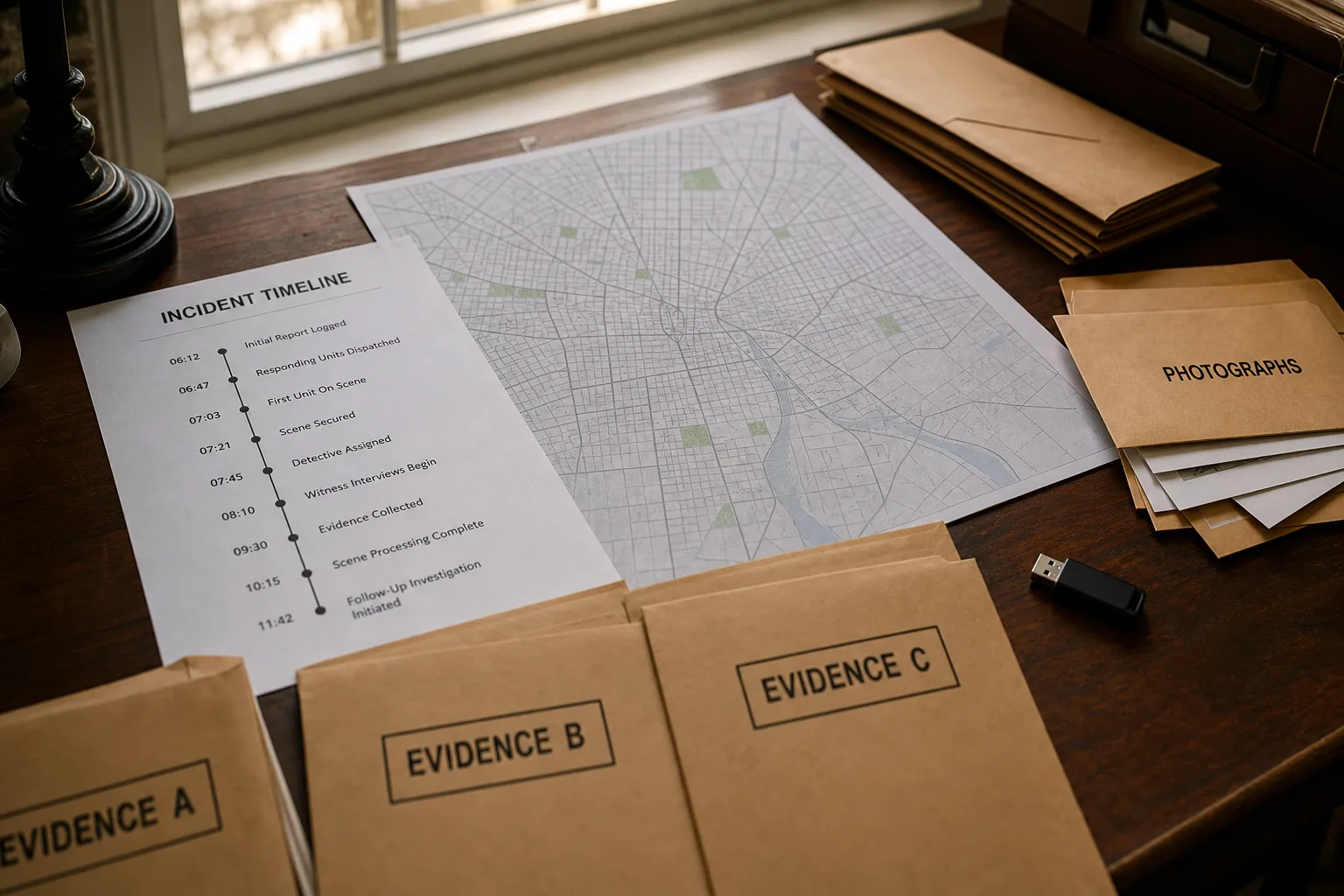
These are organizational suggestions, not a complete evidence list or a statement that every item is available.
- Seek appropriate medical care and keep documents you receive.
- Record the date, time, location, incident number, agencies, vehicles, and known witnesses.
- Keep original photographs, videos, correspondence, and damaged-property information.
- For a work-connected event, report it promptly and retain records already in your possession.
- Check the government-notice question immediately.
- Use the tool suited to the goal: APRA access, preservation, subpoena procedure, or discovery.
Frequently asked questions
Is a police agency automatically liable?
No. Indiana pursuit decisions require case-specific review.
Can I claim against the fleeing driver?
A claim depends on proof of negligence, causation, and damages.
How soon is government notice due?
Indiana generally uses 180 days for a political subdivision and 270 days for the state or a state agency.
How long must a law-enforcement recording be kept?
Indiana Code § 5-14-3-5.3[17] generally requires at least 190 days and at least two years after a qualifying written request received during that period. Retention does not mean disclosure follows.
Can workers’ compensation and a third-party claim overlap?
They may if the injury arose out of and in the course of employment and an outside responsible party caused it.
You may request a case evaluation or review Chad Delventhal’s background. Avoid sending sensitive details until the firm confirms how to proceed.
This article provides general information, not legal advice.
Sources
- Kaur v. Amazon (public.courts.in.gov) ↩
- Indiana Code § 9-21-1-8 (iga.in.gov) ↩
- Patrick v. Miresso (public.courts.in.gov) ↩
- City of Indianapolis v. Earl (public.courts.in.gov) ↩
- City of Indianapolis v. Estate of Alexander (public.courts.in.gov) ↩
- Indiana Code § 34-13-3-3 (iga.in.gov) ↩
- Indiana Code § 34-13-3-8 (iga.in.gov) ↩
- Indiana Code § 34-13-3-6 (iga.in.gov) ↩
- Indiana Code § 34-13-3-10 (iga.in.gov) ↩
- Indiana Code § 34-11-2-4 (iga.in.gov) ↩
- Indiana Code § 5-14-3-5.3 (iga.in.gov) ↩
- Indiana Code § 5-14-3-3 (iga.in.gov) ↩
- § 5-14-3-3.3 (iga.in.gov) ↩
- § 5-14-3-4 (iga.in.gov) ↩
- Indiana Code § 22-3-2-2 (iga.in.gov) ↩
- Indiana Code § 22-3-2-13 (iga.in.gov) ↩
- Indiana Code § 5-14-3-5.3 (iga.in.gov) ↩