A collision with an ambulance, fire engine, or squad car raises questions an ordinary two-car crash does not: was the siren on, how fast was the response, and who actually owns the vehicle. This guide explains the road privileges Indiana grants emergency drivers, the limits built into those privileges, and the special procedure that follows when a government vehicle is involved. For wider context, start with our Fort Wayne car accident guide and our guide to proving an Indiana car accident claim.
Key takeaways
- An emergency driver may pass a red signal or exceed the speed limit only under the conditions listed in IC 9-21-1-8[3].
- The statute never excuses driving without due regard for the safety of all persons.
- A government claim generally requires timely written tort claim notice within 180 days for a political subdivision or 270 days for the state.
- An ordinary road-negligence claim against a purely private ambulance company generally follows the Comparative Fault Act instead of the Tort Claims Act.
- Sirens, lights, speed, and timing can be disputed, so early documentation matters.
What may an emergency-vehicle driver lawfully do?
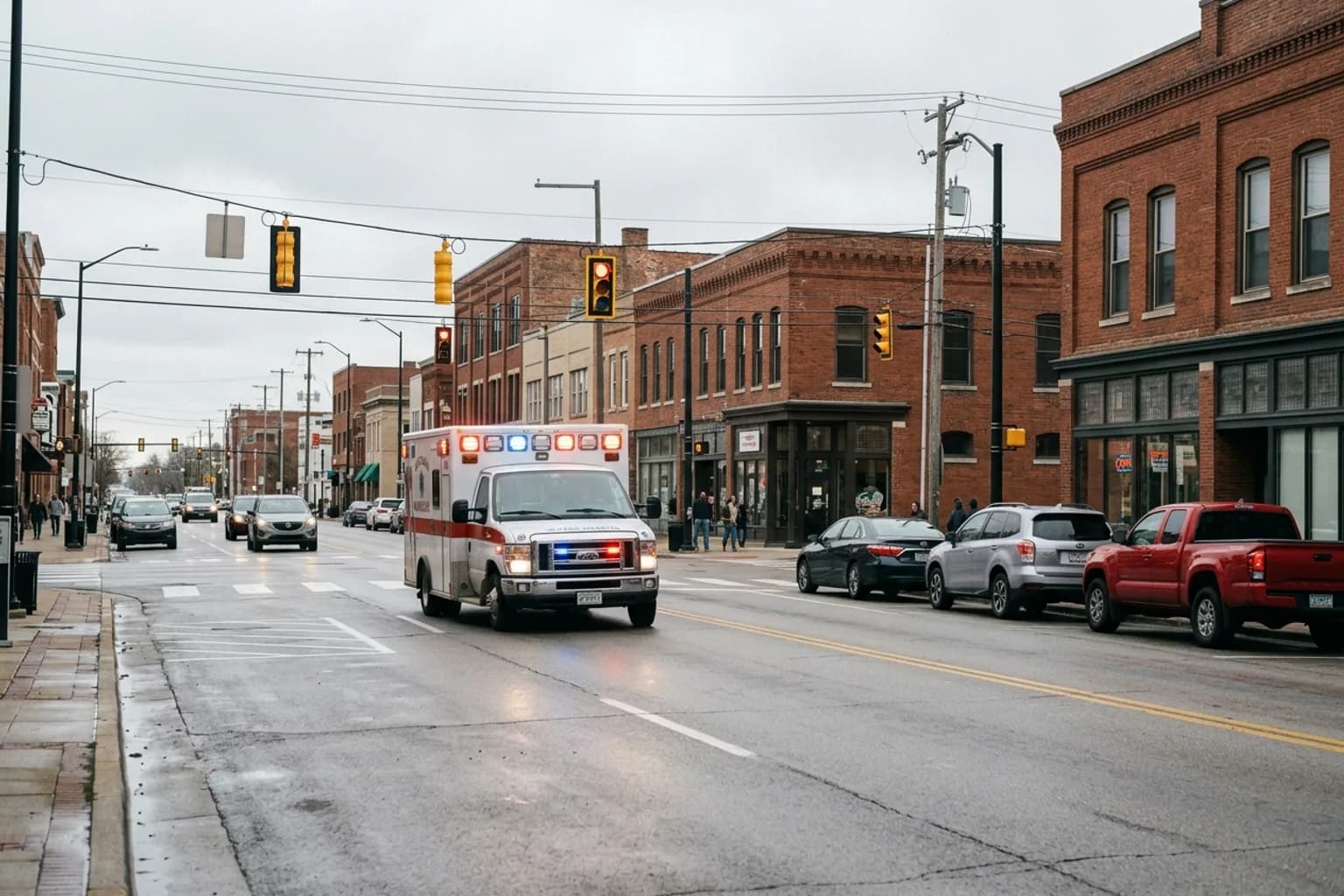
Indiana’s traffic code defines an authorized emergency vehicle to include fire department vehicles, police department vehicles, ambulances, and certain other approved response vehicles under IC 9-13-2-6[4].
When the driver is responding to an emergency call, pursuing an actual or suspected violator of the law, or responding to (but not returning from) a fire alarm, IC 9-21-1-8(b)[1] permits the driver to proceed past a red signal or stop sign after slowing as necessary for safe operation, to exceed the maximum speed limits if doing so does not endanger life or property, to park or stand notwithstanding other rules, and to disregard regulations governing direction of movement or turning.
Those privileges generally apply only while the vehicle is using audible or visual signals as required by law; absence of a siren alone does not settle every case. A police vehicle has a limited exception: it is not required to display red and blue lights visible from the front, under IC 9-21-1-8(c)[1].
Notice what the list does not include: nothing in the section frees the driver from watching out for the people who have not yet heard the siren.
| Privilege while responding | Built-in condition |
|---|---|
| Proceed past a red signal or stop sign | Only after slowing as needed for safe passage |
| Exceed the speed limit | Only where life and property are not endangered |
| Disregard direction-of-movement rules | Signals in use as required by law |
| Park or stand where others may not | The due-regard duty continues at all times |
What does “due regard for the safety of all persons” mean?
The privileges are conditional, and the section says so twice.
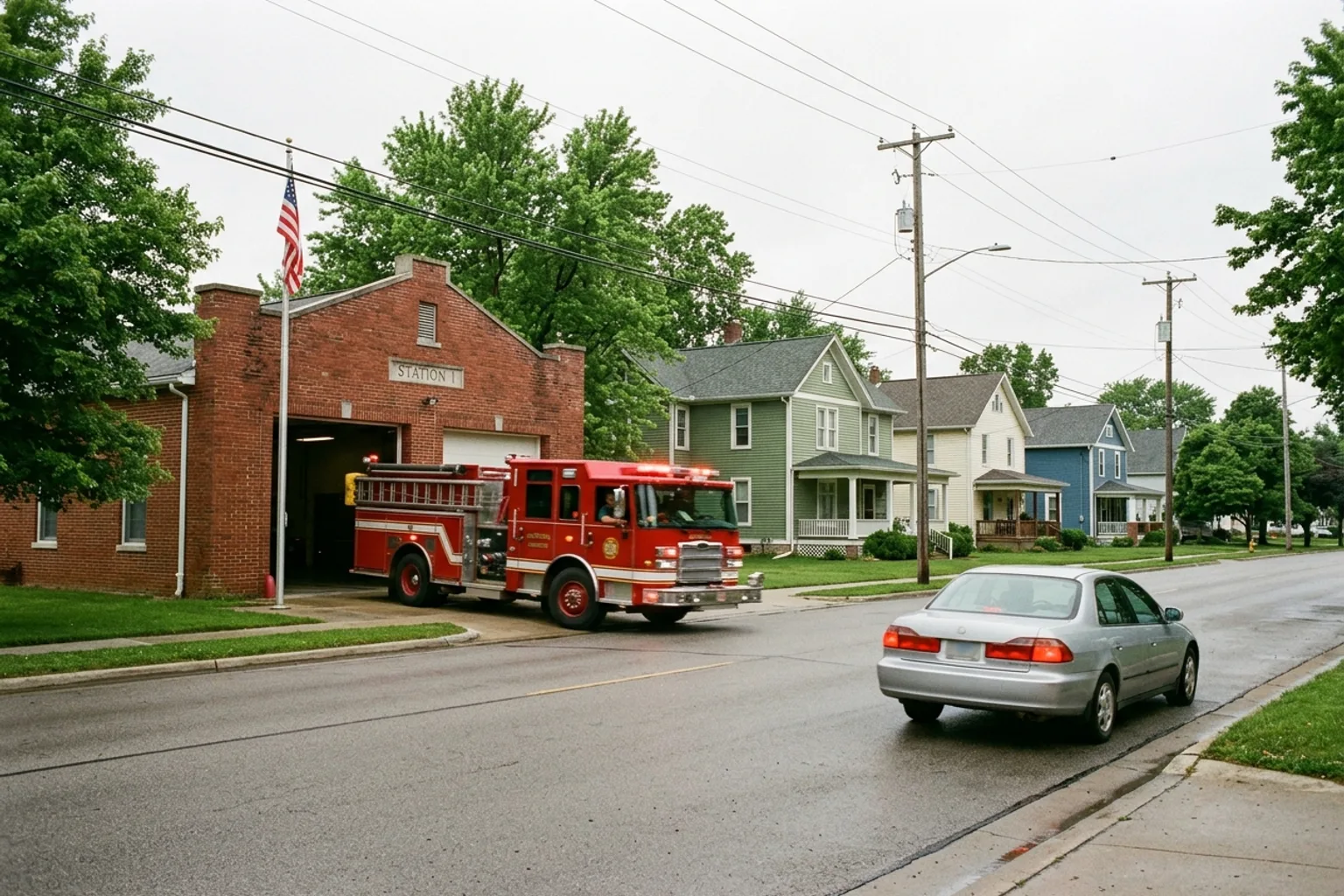
IC 9-21-1-8(d)[1] provides that the section does not relieve the driver from the duty to drive with due regard for the safety of all persons, and does not protect the driver from the consequences of the driver’s reckless disregard for the safety of others.
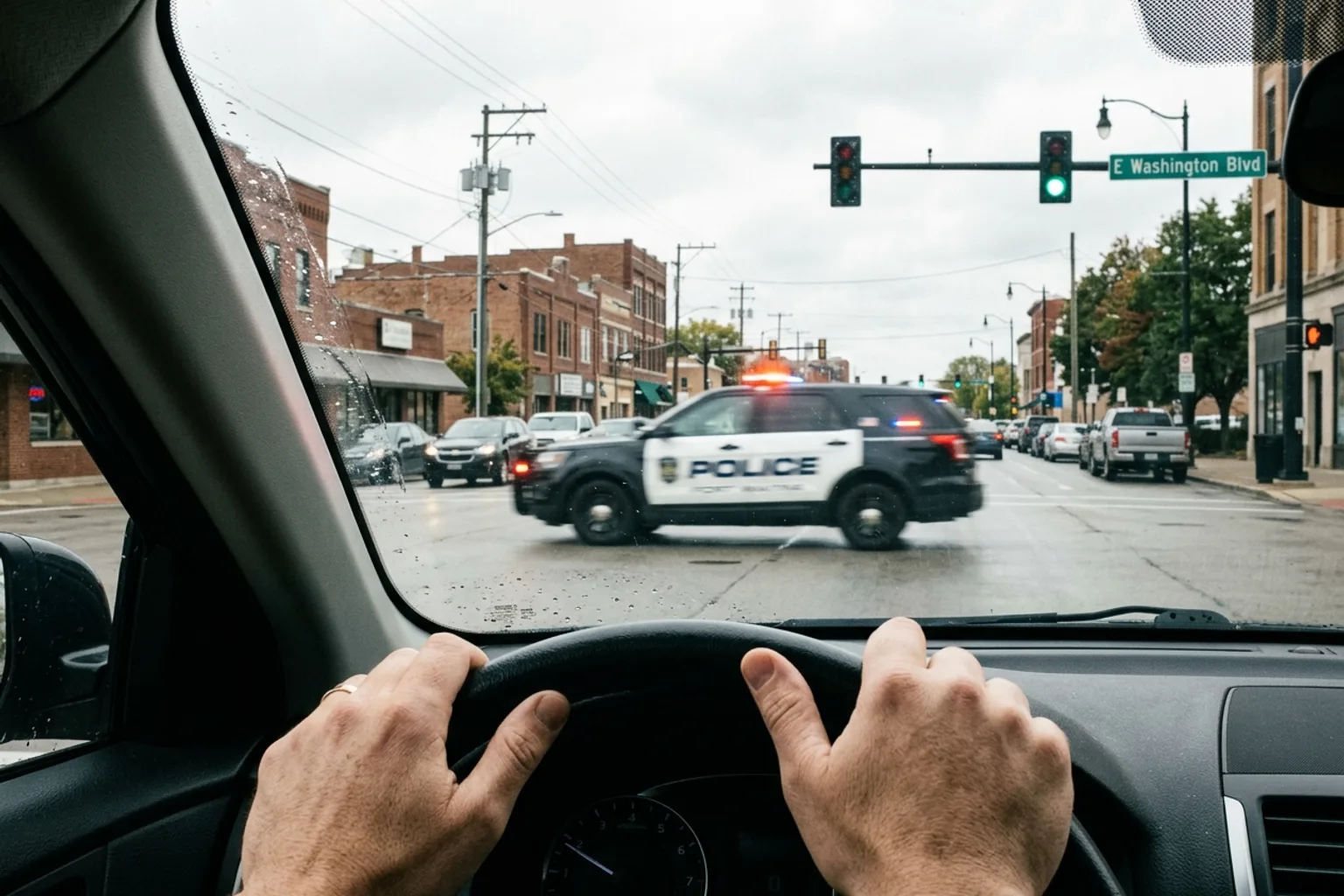
The key question is how the rule applies to the actual approach. It is about seconds and feet: whether the siren was sounding, when the lights came on, how fast the vehicle entered the intersection, whether the driver slowed before crossing against the signal, and what each driver could see.
Useful material may include dispatch timelines, dash-camera video, vehicle data and independent witness accounts. Not every vehicle records each item, and not every record is available to the public. Ask counsel to identify who holds each item and how to preserve it; do not assume a crash-report request preserves all underlying recordings.
Did the yield-and-move-over duties play a role?
Indiana also puts duties on every other driver near a response run. Under IC 9-21-8-35(a)[5], on the immediate approach of an authorized emergency vehicle giving an audible signal by siren or displaying alternately flashing red, red and white, or red and blue lights, unless a law-enforcement officer directs otherwise, other drivers must yield the right-of-way, drive to a position parallel to the right-hand edge or curb clear of any intersection, and stop until the vehicle has passed.
For a stationary emergency vehicle displaying the specified flashing lights, IC 9-21-8-35(b)[3] calls for due caution and a lane change away when safe and possible on a highway with at least four lanes, including at least two traveling in the approaching driver’s direction. If changing lanes is impossible or unsafe, reduce speed to at least ten miles per hour below the posted limit while maintaining a safe speed for conditions. The road configuration matters; the rule is not permission to swerve into opposing traffic.
These duties cut both ways after a crash. The investigating agency will ask whether the injured driver could hear the siren and had room to pull over, and the answer feeds directly into the blame-sharing rules discussed below.
Does it matter who owns the emergency vehicle?
The operator’s legal identity can change both the deadline and the fault rules.
For an agency-operated emergency vehicle, investigate the public entity that employed the driver and whether the driver was acting within the job’s scope. The Indiana Tort Claims Act (IC 34-13-3)[6] supplies special procedures and defenses for covered government claims. The vehicle’s paint scheme alone does not establish the correct defendant.
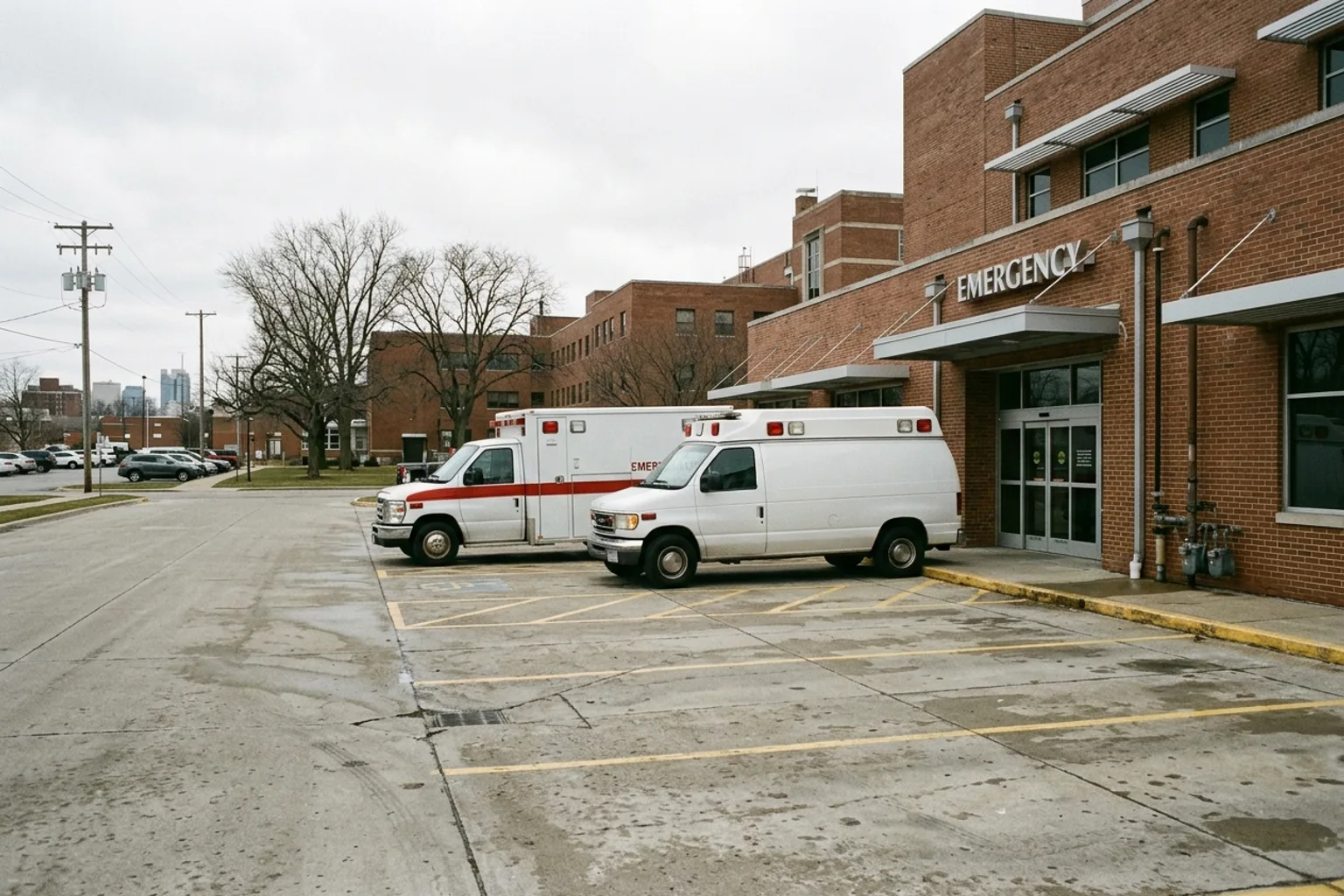
An ambulance may be operated by a public entity, private company or hospital-associated service. An ordinary road-negligence claim against a purely private operator generally falls within the Comparative Fault Act; IC 34-51-2-2[7] excludes government tort claims. A hospital name or private contract does not, by itself, settle legal status. This guide concerns vehicle operation, not claims about medical treatment during transport, which can raise different rules.
Getting this answer wrong is costly, so identifying the owner of the vehicle and the driver’s employer is one of the first jobs in the case.
| Who operated the vehicle | Governing framework | Earliest formal step |
|---|---|---|
| City or county agency (police, fire, local EMS) | Indiana Tort Claims Act with immunity defenses | Generally notice within 180 days; governing body and any additional required statutory recipient |
| State agency (for example, Indiana State Police) | Indiana Tort Claims Act, state-level rules | Tort claim notice to the attorney general or the agency within 270 days |
| Purely private ambulance operator; ordinary road-negligence claim | Ordinary negligence and the Comparative Fault Act | Check the generally two-year lawsuit period and any fact-specific exception |
How does the Indiana Tort Claims Act change the claim?
Check the notice question early, even if the agency’s investigation is still open.
For a political subdivision, IC 34-13-3-8[6] generally requires notice within 180 days after the loss to the governing body and, where required by that section, the Indiana political subdivision risk management commission. Subsection (b) excuses commission notice when the subdivision was not a member of the statutory fund at the time. Have counsel confirm the entity, fund status and every required recipient; sending a letter only to a police officer or insurance adjuster is not a reliable substitute.
A claim against the state is generally barred unless notice is filed with the attorney general or the state agency involved within 270 days after the loss, under IC 34-13-3-6[2].
The notice is not a lawsuit. It is a short and plain statement that must describe the circumstances, the extent of the loss, the time and place, the names of persons involved if known, the amount of damages sought, and the claimant’s residence both at the loss and when filing, under IC 34-13-3-10[8].
The Indiana Attorney General’s civil-torts page[9] publishes the notice-of-tort-claim form used for claims involving the state and its agencies.
The Act contains immunity defenses, but a police driver is not automatically immune simply because the driver was enforcing the law. In Patrick v. Miresso[10], the Indiana Supreme Court rejected law-enforcement immunity for a claim based on breach of the statutory emergency-driving duty. The officer entered against a red light and struck another vehicle; the Court allowed the case to proceed, rather than awarding the injured driver damages. Other defenses and proof of causation still matter.
Written notice must be delivered in person or by registered or certified mail under IC 34-13-3-12[6]. Preserve a complete copy and delivery proof. A police report, records request and formal tort claim notice serve different purposes. The Act includes an incapacity provision in section 9; children, incapacity and uncertain loss dates require individualized deadline review rather than assuming an exception.
If the collision grew out of a police chase, the immunity questions become even more fact-specific. Our guide to injuries during Indiana police pursuits covers that scenario in depth.
Damages are limited too: for a cause of action accruing on or after January 1, 2008, the combined aggregate liability of governmental entities and public employees acting within the scope of employment is limited to $700,000 for injury to or death of one person in one occurrence and $5,000,000 for all persons in that occurrence, and punitive damages are not allowed, under IC 34-13-3-4[11].
For the notice contents, service and later lawsuit process, see our Indiana government tort claim notice guide.

How does shared blame work in these cases?
Indiana runs two different blame-sharing systems, and an emergency-vehicle case can sit on either side of the line.
Against a private defendant, the Comparative Fault Act diminishes the award in proportion to the claimant’s own contributory fault and bars recovery only when the claimant’s fault is greater than the fault of all persons whose fault contributed to the damages, under IC 34-51-2-5 and IC 34-51-2-6[12].
That Act expressly does not apply in any manner to tort claims against governmental entities or public employees, under IC 34-51-2-2[13].
The majority in Davidson v. State (Ind. 2023)[14] confirms that government tort claims remain governed by common-law principles such as contributory negligence. A claimant’s own negligence contributing to the injury can bar a government claim. Mixed cases involving a public agency and a private driver need careful treatment; do not apply the private-defendant percentage rule to every defendant.
In plain terms, a private-defendant case can survive some shared blame, while a government-defendant case may not survive any of it. That is why the yield-and-move-over questions above get examined so closely.
Alongside the notice windows, the lawsuit itself is generally subject to a separate two-year limitation period for injury actions, under IC 34-11-2-4[15].
What should you do after a crash with an emergency vehicle?
Use these steps to organize the immediate response and documents:
- Check on everyone and call 911, even though a response crew is already on scene.
- Ask how to obtain the crash report, and write down the agency name, unit number, and any incident number.
- Get medical care promptly, and keep every bill and record from that care.
- If safe and without entering traffic, photograph vehicle positions, the intersection, traffic signals, debris, and visible damage before the scene clears.
- Write down whether you heard a siren or saw lights, and ask witnesses the same question while memories are fresh.
- Ask an attorney about preservation letters for dispatch audio, camera video, and vehicle data, which are not kept forever.
- Have counsel confirm the government notice recipients and deadline promptly, rather than waiting for a final crash report.
- Speak with an attorney before giving any recorded statement to an adjuster or investigator.
Build a response timeline without guessing
Write one line for each event you personally observed: where your vehicle was, your signal color, the first light or siren you noticed, where the response vehicle entered your view, and the impact location. Mark estimates as estimates. “I did not hear a siren” describes your observation; “the siren was off” is a different conclusion that may need other evidence.
For a Fort Wayne or Allen County incident, record the agency name, vehicle unit number, report number and exact intersection. A neighboring department or private ambulance may have been responding outside its usual area. Keep witness contact details and original dash-camera files with the surrounding footage, not just an edited clip. Ask nearby businesses promptly whether relevant footage exists, without assuming they must provide it.
For example, a green light for your car and a red light for the ambulance do not answer the whole question. The investigation also needs the ambulance’s response status, warning signals, approach speed, slowing and sight lines. An obstructed view can affect what both drivers could perceive. This is an illustrative evidence exercise, not a reconstruction of a reported local crash.

Frequently asked questions
Can I bring a claim if an ambulance hit me while running a red light?
Possibly. The privilege to proceed past a red signal exists only after slowing as necessary for safe operation, and the driver always keeps the duty to drive with due regard for the safety of all persons, under IC 9-21-1-8[1].
What the vehicle did before impact is one part of proving the claim.
Does it matter if the siren and lights were off?
Often, yes. The privileges in IC 9-21-1-8[3] apply only while the vehicle is using audible or visual signals as required by law, apart from a narrow rule about front-facing red and blue lights on police vehicles, under subsection (c)[1].
Whether the required signals were used needs to be checked against the vehicle and circumstances; silence alone is not a complete fault analysis.
What if I was hit during a police chase?
A pursuit claim needs the emergency-driving duty, causation and government defenses evaluated together. IC 34-13-3-3[6], read with the emergency-driving duty, does not supply blanket law-enforcement immunity for negligent emergency driving, as Patrick explains. The linked pursuit guide covers that separate scenario.
The notice windows described above still run while those questions get sorted out.
How long do I have to act?
Depending on the defendants, relevant periods generally include: the 180-day notice window for a political subdivision, the 270-day notice window for the state, and the two-year limitation period for injury suits, under IC 34-13-3-8[2], IC 34-13-3-6[2], and IC 34-11-2-4[15].
Missing a notice window can bar the government claim even when the lawsuit period has time left.
What if the ambulance belongs to a private company?
For an ordinary road-negligence claim against a purely private company, the Tort Claims Act notice rules generally do not govern; the Comparative Fault Act generally applies, per IC 34-51-2-2[13].
Confirming who employed the driver comes first; some services run as public-private partnerships.
Talk through your options
If an emergency vehicle was involved in your crash, the earliest decisions—notice, preservation, and statements—shape everything that follows. Chad Delventhal can review what happened and explain the time limits that may apply to your situation. Our car-accident practice serves Fort Wayne, Allen County, and communities across northeast Indiana. A free consultation can help you understand your options and decide the next step.
General information only, not legal advice. Reading this article does not create an attorney-client relationship. Discuss your specific circumstances privately with an attorney.
The linked legal and official sources were checked on September 12, 2026. References appear below.
Sources
- IC 9-21-1-8(d) (iga.in.gov) ↩
- 180 days for a political subdivision (iga.in.gov) ↩
- IC 9-21-1-8 (iga.in.gov) ↩
- IC 9-13-2-6 (iga.in.gov) ↩
- IC 9-21-8-35(a) (iga.in.gov) ↩
- Indiana Tort Claims Act (IC 34-13-3) (iga.in.gov) ↩
- IC 34-51-2-2 (iga.in.gov) ↩
- IC 34-13-3-10 (iga.in.gov) ↩
- Indiana Attorney General’s civil-torts page (in.gov) ↩
- Patrick v. Miresso (public.courts.in.gov) ↩
- IC 34-13-3-4 (iga.in.gov) ↩
- IC 34-51-2-5 and IC 34-51-2-6 (iga.in.gov) ↩
- IC 34-51-2-2 (iga.in.gov) ↩
- Davidson v. State (Ind. 2023) (public.courts.in.gov) ↩
- IC 34-11-2-4 (iga.in.gov) ↩