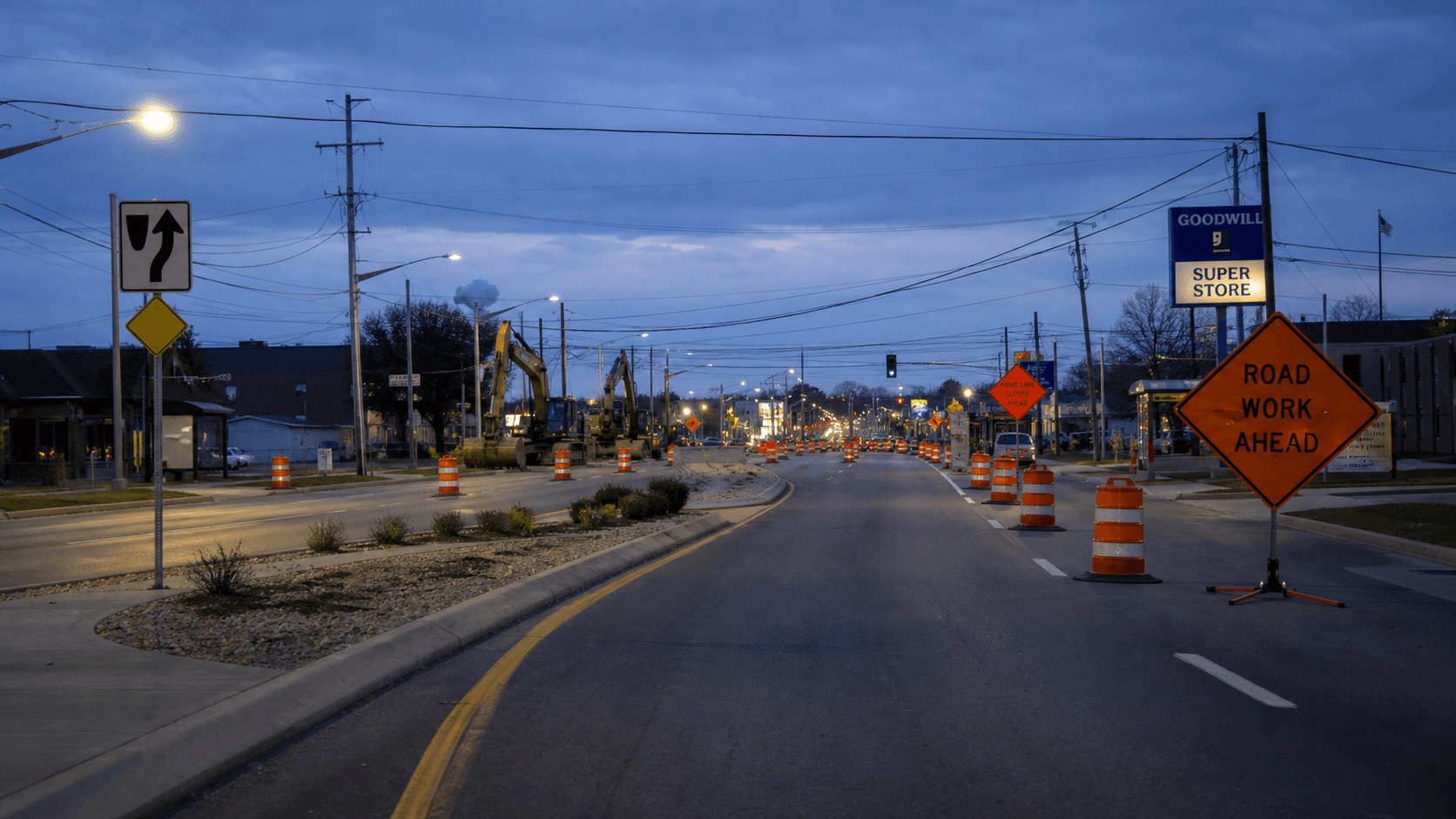
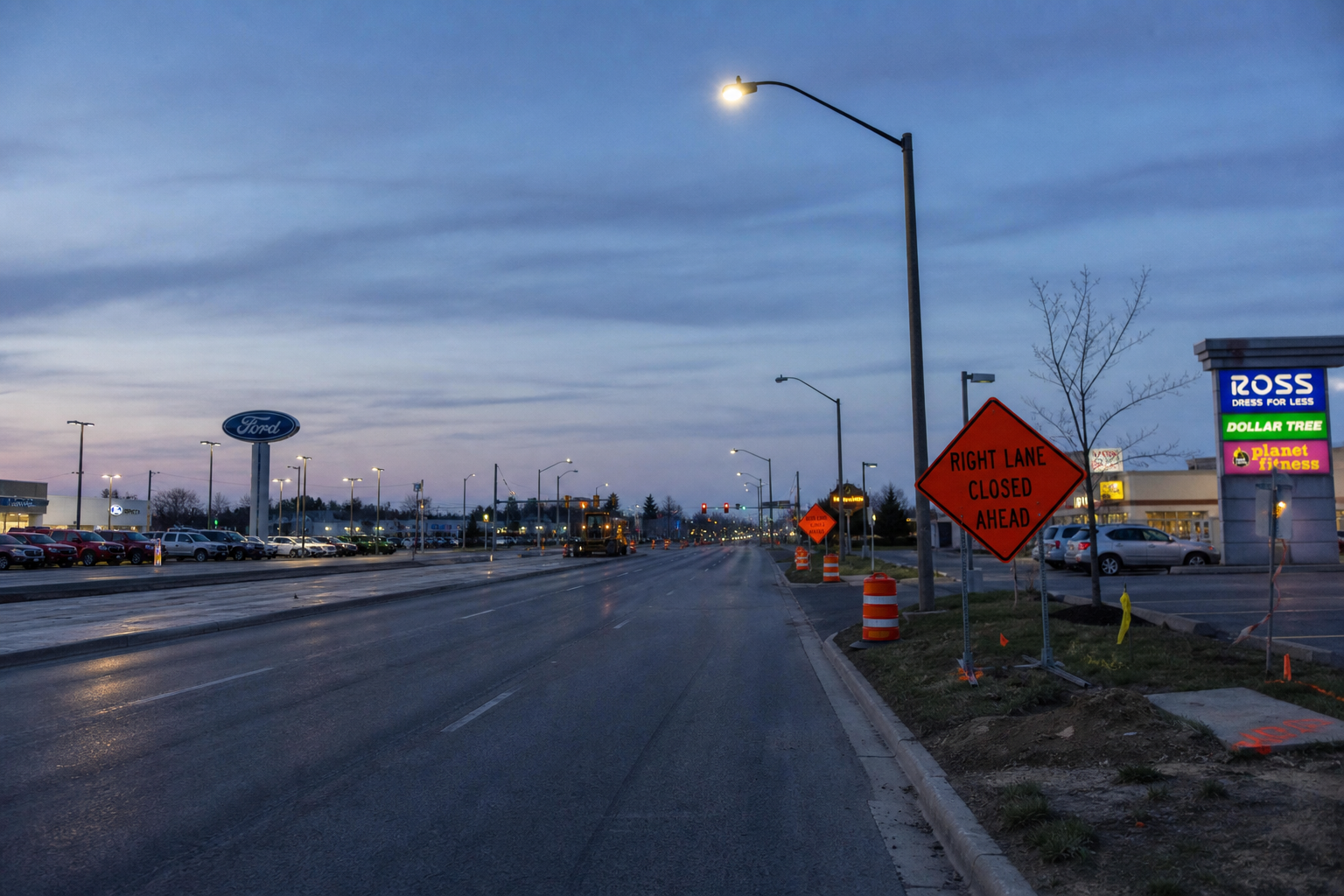
A driver died Friday night on Fort Wayne’s west side after a vehicle collided with construction equipment parked in the center median of West Jefferson Boulevard. WPTA 21Alive[1] and The Journal Gazette[2] reported that the equipment was in the median of the arterial street after dark and within an active work zone.
No public report cited here states why the vehicle left its travel lane. That question remains with the Fort Wayne Police Department’s Fatal Accident Team. No cause has been announced, and no fault has been assigned.
What happened
The crash occurred at approximately 8:30 p.m. on Friday, August 21, 2026, on West Jefferson Boulevard at or near West Main Street, just west of downtown Fort Wayne. The driver was pronounced dead at the scene. The driver had not been identified, and the Allen County Coroner was expected to perform an autopsy and notify the family before releasing a name.
The FWPD Fatal Accident Team, the department’s Air Support Unit, Fort Wayne Fire, and EMS responded. The intersection was closed for roughly four hours. No charges had been filed.
The outlets also reported that the location was within the active Leesburg Road extension and St. Francis Drive corridor project, where lane restrictions were scheduled through Labor Day. A new traffic signal at Jefferson Boulevard and St. Francis Drive and a new roundabout at St. Francis Drive and Main Street were scheduled to begin operating that Friday. These are facts about the corridor, not evidence that the project, a contractor, or a road authority caused the crash.
What should accident victims do next?
If you or someone in your family is hurt in an Indiana work zone, photograph and record the area before it changes. Equipment may be moved, cones repositioned, signs removed, and signals retimed. Images showing equipment placement, lighting, reflective markings, drums, barriers, signs, and sight lines may become important evidence. The practical steps in the first 72 hours after a Fort Wayne crash can help you understand what may disappear quickly.
Find out who was working at the site. A project may involve a prime contractor, subcontractors, an equipment owner or lessor, and a government road authority. None of those parties has been publicly identified in connection with this crash. Project contracts, traffic-control plans, daily logs, and inspection records may show who controlled the work and equipment.
Get appropriate medical care and keep the related records. Request the crash report, and do not allow the vehicle to be destroyed before relevant physical and electronic evidence can be evaluated. This guide explains how to obtain an Indiana police crash report.
Be cautious about a recorded statement before you understand which parties and insurance policies may be involved. Contractors, subcontractors, equipment owners, and government entities may have different interests and may aggressively defend a claim.

Why location matters in an Indiana injury claim
In a work-zone case, the location and temporary layout may be central to the investigation. Where heavy equipment was staged, whether a positive barrier was used, and how the equipment was marked or illuminated after dark may all matter. Traffic-control plans can be compared with photographs and records showing what was actually present.
Responsibility may also depend on who owned the project and controlled traffic. A city street, county road, and state highway can involve different public entities, approval chains, and notice requirements. A corridor project may also involve both public and private parties, so careful investigation is needed before drawing conclusions.
Timing matters when signals, lanes, or intersections are changing. Records may establish when a signal began operating, when a roundabout opened, and what advance warnings were in place. Those records should be requested and preserved rather than guessed at.
Indiana’s comparative fault rule can make this evidence decisive. Under Ind. Code § 34-51-2-6, a claimant who is more than 50% at fault generally recovers nothing when the Comparative Fault Act applies. Whether the work-zone conditions bear any share of responsibility must be decided from evidence, not from the mere fact that equipment was present.
Government claims require separate analysis. Ind. Code § 34-51-2-2 excludes governmental entities from the Comparative Fault Act, so common-law contributory negligence, statutory immunities, and damage caps may apply instead. You can read more about Indiana’s 51% fault rule and why the identity of each potential defendant matters.
Deadlines can be shorter than two years
Indiana generally provides two years for personal injury and wrongful death lawsuits under Ind. Code § 34-11-2-4 and Ind. Code § 34-23-1-1. A claim involving a city, county, or the State can carry a much earlier notice deadline under the Indiana Tort Claims Act: generally 180 days for a political subdivision and 270 days for the State.
Missing the applicable notice deadline can prevent a claim even when the ordinary lawsuit deadline has not passed. The firm’s guide to Indiana government tort claim notices explains why identifying the correct public entity early is important.
Talk to Chad Delventhal about a Fort Wayne work-zone crash
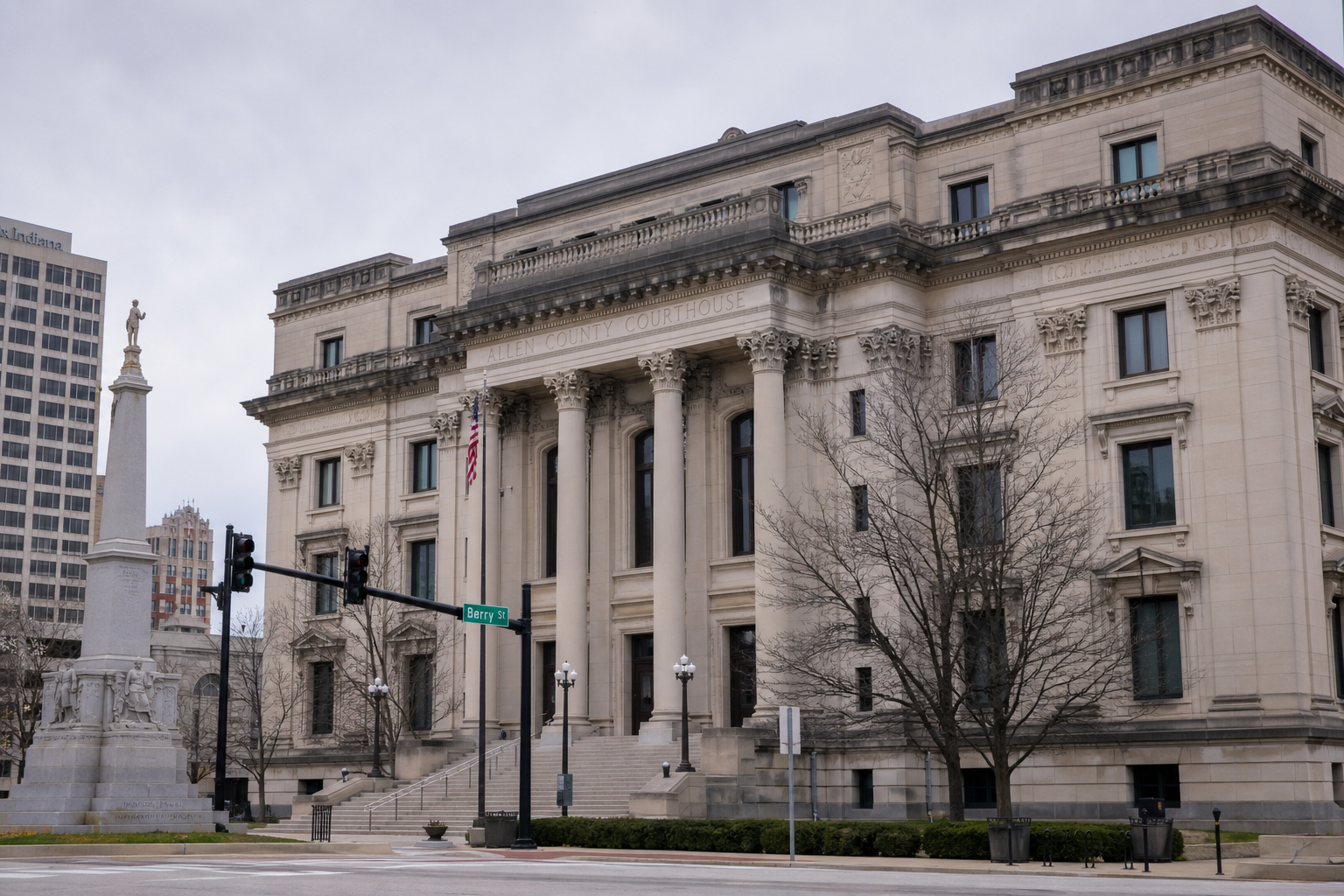
Work-zone cases can be hotly contested because the temporary scene changes quickly and several private or public parties may be involved. Delventhal Law Office represents injured people and grieving families in Fort Wayne, Allen County, and northeast Indiana. The firm can investigate the contractors and road authorities involved, seek preservation of changing evidence, and evaluate the applicable notice and filing deadlines.
If you lost a family member or were hurt in a construction-zone crash, you can request a free case evaluation. There is no attorney fee unless the firm recovers compensation for you.
This post is based on public reporting, the investigation may be ongoing, and nothing here is legal advice or creates an attorney-client relationship.