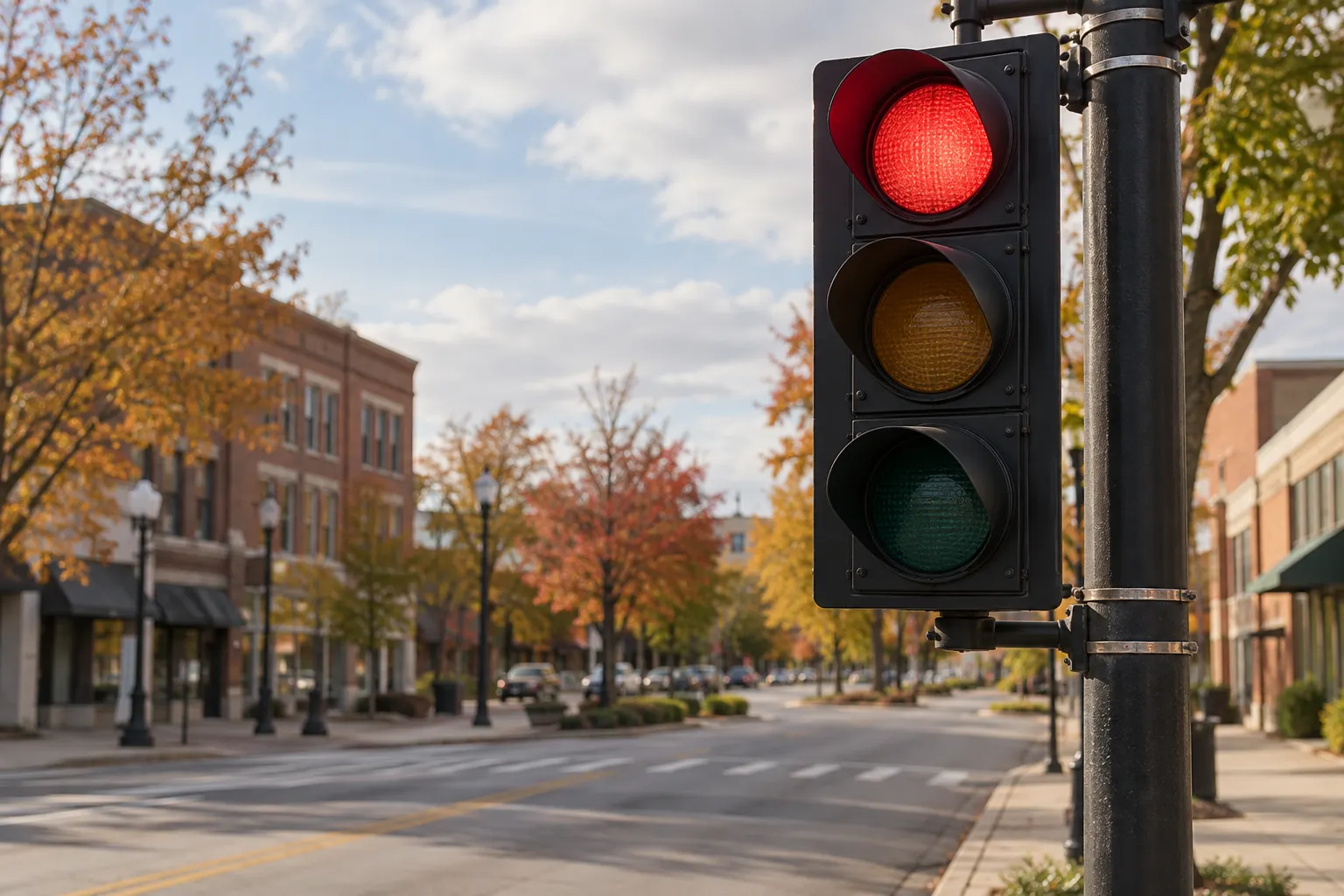
If two drivers remember different light colors, the useful question is not simply “Can someone get the light records?” It is which records, from which signal, for which time? This guide explains how to organize that inquiry. For the legal rules governing the drivers, see our separate guide to Indiana red-light and stop-sign crashes.
Key takeaways
- Separate programmed settings from records of events that actually occurred.
- Identify the intersection, approach, lane, intended movement, and date before requesting records.
- Ask about available logs and their retention; do not assume a universal storage period.
- Keep original timestamps and obtain an explanation of the phase numbers and event codes.
- Compare signal information with the original video and other evidence rather than treating one file as a complete reconstruction.
A timing plan, an event log, and a video answer different questions
The Federal Highway Administration’s explanation of automated traffic signal performance measures[1] distinguishes timing parameters developed and implemented by agencies from high-resolution controller data collected for performance monitoring. In a system with that logging capability, controller inputs and outputs—such as a detector input or a signal-phase change—are recorded with timestamps and event codes.
That distinction matters when reviewing a crash file. A document describing settings is not, by itself, a historical record of every light change. And the existence of a signal controller does not establish that the particular intersection had usable logging, that the relevant file remains available, or that it can be matched to the collision.
| Record | Question to ask | Do not assume |
|---|---|---|
| Timing plan or settings | What settings and operating plan applied on the crash date? | Today’s plan proves every light change on an earlier date. |
| Phase or movement diagram | Which numbered phase corresponds to the vehicle’s approach and movement? | A phase number means the same direction at every intersection. |
| Time-stamped event log, if available | What controller events were logged during the relevant interval? | The file is complete or its clock matches the camera clock. |
| Maintenance or change record, if available | Was a relevant change, complaint, inspection, or repair documented? | A complaint establishes a malfunction or a scheduled task proves completed work. |
| Original video | What vehicle movement or signal face is actually visible? | A camera view shows every lane, signal, or event outside the frame. |
Use the table to organize questions, not to diagnose equipment or decide fault. A qualified reviewer may need several records to interpret the operation. For the separate task of locating recordings, use our traffic-camera, business-surveillance, and doorbell-video guide.

Identify the signal and movement before asking for data
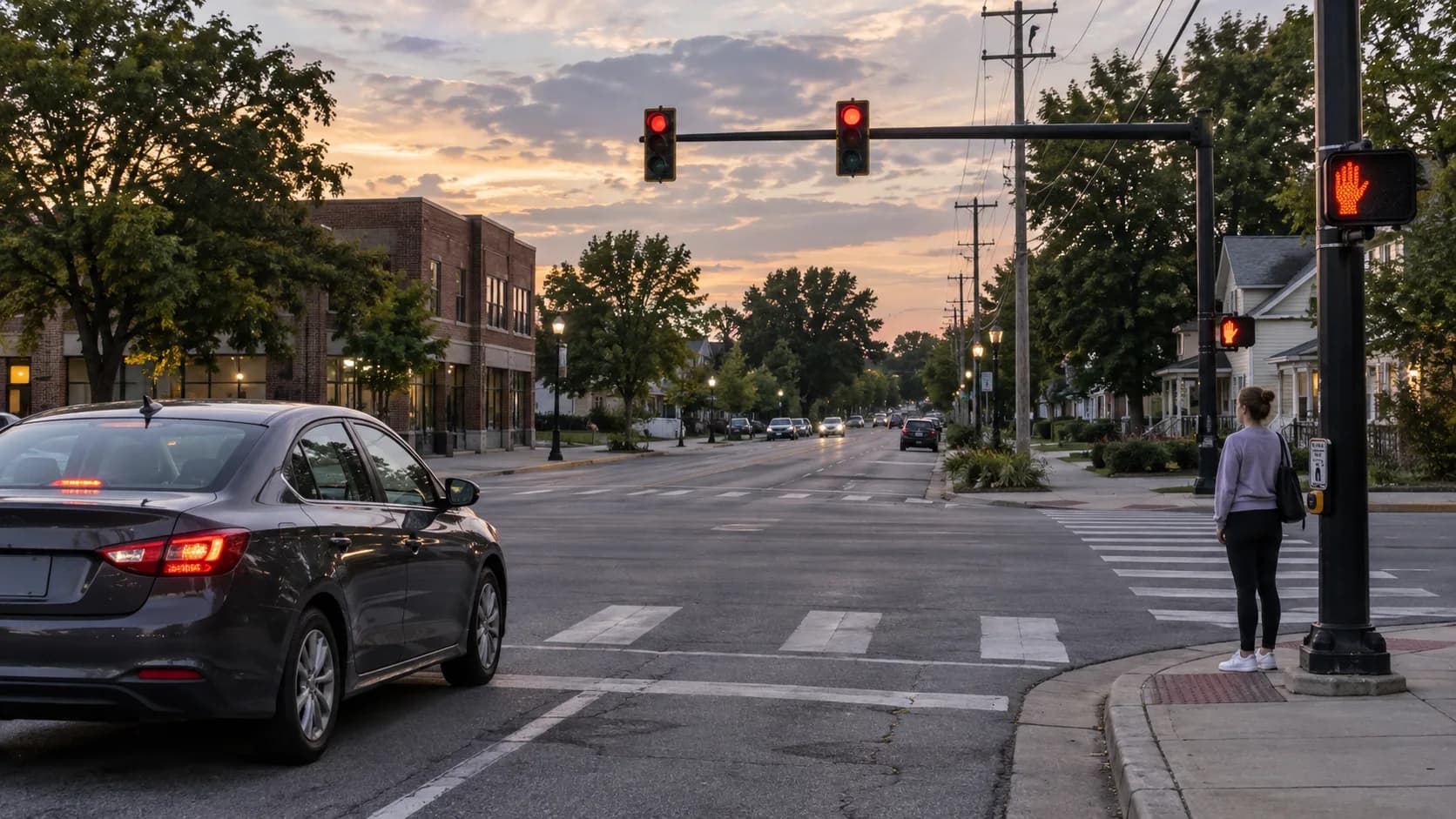
“The light at the intersection” can be too vague for a useful inquiry. Start with the street names and the direction each vehicle traveled. Record whether the vehicle was going straight, turning left, or turning right, and identify the lane as precisely as you can without guessing.
Prepare a simple location sheet with:
- Both intersecting roads, the city or county, and any route numbers.
- The crash date and estimated time, including where that estimate came from.
- Each vehicle’s approach, lane, and intended movement.
- Any safe, existing photographs that show signal faces, arrows, lane markings, and the overall layout.
- The crash-report number and a distinction between what you observed and what someone else reported.
If a record later refers to “phase 2,” keep that label intact and ask for the diagram or explanation connecting it to the actual movement. Do not substitute a direction based on an example from another intersection. Likewise, distinguish a through signal, a turn arrow, and a pedestrian display in your notes.
Do not enter a roadway, open a controller cabinet, or access restricted equipment to obtain an identifier. Existing photos and the road names can be a starting point for asking the responsible office to identify the signal.

What controller logs may contain—and what still needs checking
In the FHWA system description cited above, a high-resolution controller logs an input or output event and its timestamp. Communications move those logs to a server, and software turns the data into performance measures. FHWA also describes different implementation arrangements, including agency-hosted, vendor-integrated, and third-party systems.
The practical implication: ask what the actual system collected and retained. Do not assume every Indiana intersection has the same equipment, files, storage arrangements, or ability to retrieve an earlier interval.
Useful follow-up questions include:
- Was logging enabled for this signal on the relevant date?
- Does the available material cover the requested period, or are there gaps?
- What do the event codes, phase numbers, and detector identifiers mean for this location?
- What time convention does the file use, and is there information about the controller clock?
- Is the result a raw event export, a graph generated from data, or a summary?
- Are there explanatory notes or configuration records needed to interpret the export?
Keep the original file, the covering email, and any legend together. If you receive only a graph, label it as a graph; ask whether the underlying data and explanation are available. These are practical review questions, not a representation that every requested item exists or must be disclosed.

Find the correct Indiana record custodian
INDOT’s description of its responsibilities[2] includes interstate highways, U.S. routes, state roads, and their traffic-control devices. It identifies local cities, counties, and towns as responsible for roadways outside those categories. INDOT also says its district offices handle day-to-day traffic-signal operations.
For a Fort Wayne or Allen County collision, start with the route designation and exact intersection, then confirm who holds the particular signal records. A location described only as “in Fort Wayne” is not enough to choose the recipient. Ask the office to confirm whether it maintains the records or can identify the appropriate custodian.
INDOT’s public-records request page[3] instructs requesters to submit requests in writing with reasonable particularity. It advises against wording such as “any and all,” asks for date ranges and identified senders and recipients when requesting correspondence, and says records are normally provided electronically unless hard copies are requested.
Use the agency’s current process and describe existing records rather than asking the records office to decide who caused the collision. For weather, construction restrictions, and other roadway information outside the signal inquiry, see our Indiana weather and road-records guide.
A focused signal-record request worksheet
This worksheet is a preparation aid for discussing a request with an attorney or records custodian. It is not a subpoena or a statement that a request alone preserves every record. Select the categories that fit the actual question instead of sending a generic demand for everything.
| Worksheet field | Information to supply or clarify |
|---|---|
| Location | Intersection, route names, municipality, and signal identifier if already known. |
| Relevant interval | Date, estimated crash time, time zone if known, and a focused period around the event. Explain uncertainty. |
| Movement | Approach direction, lane, and straight/left/right movement at issue. |
| Configuration | Existing timing plan and phase diagram applicable to that date; relevant documented changes. |
| Event data | Whether controller event logs exist for the interval; available export and code/phase explanation. |
| Specific equipment issue | If relevant, identify the reported problem and request the corresponding existing maintenance or incident records for a defined period. |
| Availability and handling | Who holds the material, what remains available, any stated retention information, and the process for preservation and access. |
A narrowly framed opening might read:
For the signal at [intersection and municipality], I am seeking the existing timing plan and phase diagram applicable on [date], and any available controller event logs for [defined time range]. The movement of interest is [direction, lane, movement]. Please identify the time convention and any available explanation of the event codes. If another office maintains these records, please identify that office if known.
Adapt the wording to the records actually needed and follow any clarification request. Keep the submission, confirmation, responses, and received files together. Ask promptly about availability and preservation without assuming a fixed number of days or that an acknowledgment means the material has been secured.

Match the clocks before building a crash timeline
A signal log and a video can both contain timestamps while still requiring work to compare them. Before placing entries on one timeline, record each source’s original displayed time, time convention, and any known clock explanation. Leave uncertainty visible rather than editing a timestamp to make the accounts agree.
Illustrative example—not a real case: A video displays 8:15:06 when a vehicle reaches a reference point. A signal export lists an event at 8:15:04. Those numbers alone do not establish which happened first in real time. A reviewer still needs to check the clocks, the meaning of the logged event, the relevant movement, and what the video actually shows.
A useful comparison sheet has four columns: original source time, described event, any supported time adjustment, and unresolved question. Keep an unchanged copy of each original alongside the working sheet. Do not present an estimated adjustment as a verified fact.
Signal records are one part of an investigation. They do not identify an unseen vehicle’s position or replace the rest of the evidence. Our car-accident evidence checklist explains the broader file. If you were injured and want help coordinating the records, our Fort Wayne car-accident practice can review the available material and the questions that remain.

Frequently asked questions
Does a signal timing plan prove my light was green?
Not by itself. A timing plan describes settings, while an event log records particular events if the system collected them. The applicable plan, movement, crash time, available logs, and other evidence need to be evaluated together.
Does every Fort Wayne traffic signal keep event logs?
Do not assume that. FHWA describes systems with high-resolution logging, but that does not confirm the equipment, logging status, or retained records at a particular Fort Wayne intersection. Ask the responsible custodian about that signal and date.
Is a signal event log the same as traffic-camera footage?
No. A controller log contains coded events and timestamps; video contains images from a particular viewpoint. A log is not a visual recording of the vehicles, and the existence of either source does not establish that the other is available.
How long are traffic signal records kept?
There is no single retention period established by the sources used here for every signal system. Ask the actual custodian what was created, what remains available, and what preservation process applies. Do not wait on the assumption that a familiar video-storage period also applies to controller data.
Can I use the timing plan in effect today for an earlier crash?
First confirm whether that plan applied on the crash date and whether relevant changes occurred. Label the date of each document. Do not describe a current settings sheet as a verified historical event record.
What should I bring to a consultation about signal records?
Bring the exact intersection, date and estimated time, vehicle directions and movements, report number, original photos or video, and any agency responses or data already received. Keep notes about uncertainty; you do not need to complete a technical reconstruction before asking for help.
Get help organizing the signal evidence
If you were hurt and a traffic-light dispute is complicating your claim, request a free consultation with Delventhal Law Office. We can help identify the missing questions and explain how the available records fit into the investigation.
This article is general information about Indiana law and is not legal advice. Reading it does not create an attorney-client relationship, and neither does contacting us.