Key takeaways
- Indiana rejected the "natural accumulation" defense in 1974. An owner's duty of reasonable care to customers is not reduced because the ice came from the weather.
- There is no rule in Indiana that an owner may wait until a storm ends. The owner is entitled to notice of the ice and a reasonable opportunity to deal with it, and no more.
- Who is responsible depends on who controlled the spot: a store, a landlord, a snow-removal contractor, a homeowner's association or a government body.
- A government entity is immune for a temporary weather condition on a public thoroughfare during the period of reasonable response, and a written tort claim notice is due within 180 days for a city or county.
- If you are found more than 50 percent at fault, you recover nothing. Whether the ice was obvious to you is the main fault argument the other side will make.
- A lawsuit must generally be filed within two years of the fall.
The Indiana rule: reasonable care, not automatic liability
Every winter, people in Fort Wayne fall on ice in store parking lots, apartment walkways and restaurant entrances, and the first question is always the same: is the owner responsible? Indiana answers it with the ordinary negligence standard. A property owner owes a customer or other invited visitor a duty to exercise reasonable care for that visitor's safety while on the premises. The Indiana Supreme Court restated that duty in Rogers v. Martin[1] in 2016, and it applies to ice the same way it applies to a wet floor or a broken step.

Some states follow a "natural accumulation" rule that frees an owner from any duty to clear snow and ice that fell naturally. Indiana does not. In Hammond v. Allegretti, 262 Ind. 82, 311 N.E.2d 821 (1974), the Indiana Supreme Court held that the duty of reasonable care "should in no way be diminished by the presence of natural accumulations of ice and snow," overruled the earlier case that had said otherwise, and left the question of whether the owner used reasonable care to the jury. The Court of Appeals has since described that duty as including the clearing of sidewalks and parking lots of natural accumulations of snow and ice.
Reasonable care is not strict liability. The owner is not an insurer of your safety, and a fall by itself proves nothing. You must show that the owner knew about the ice, or that it had been there long enough that a careful owner would have found it, and that the owner then failed to do what a reasonable owner would have done. Our guide to how Indiana classifies visitors explains why a paying customer is owed more than a trespasser, and our slip, trip and fall page covers how these cases are built.
Can the owner wait until the storm ends?
Not in Indiana. Several states follow what courts call the "Connecticut rule," under which an owner may wait until a storm has ended, plus a reasonable time, before removing snow and ice. In Henderson v. Reid Hospital and Health Care Services, 17 N.E.3d 311 (Ind. Ct. App. 2014), the Indiana Court of Appeals held that this rule "has not been adopted in Indiana jurisprudence" and that "there is no requirement that the storm or weather condition causing the accumulation of snow or ice cease before this duty attaches."
The facts of that case show how close these questions can be. Freezing fog was reported at a Richmond hospital at about 5:55 a.m. A maintenance crew was salting the lots by 6:41 a.m. An employee fell on ice while getting out of her car at about 7:20 a.m. The trial court threw the case out. The Court of Appeals sent it back for trial, because whether the hospital's response over that 85 minutes was reasonable was a question for a jury, not a judge. One judge dissented and would have found the hospital's response reasonable as a matter of law.

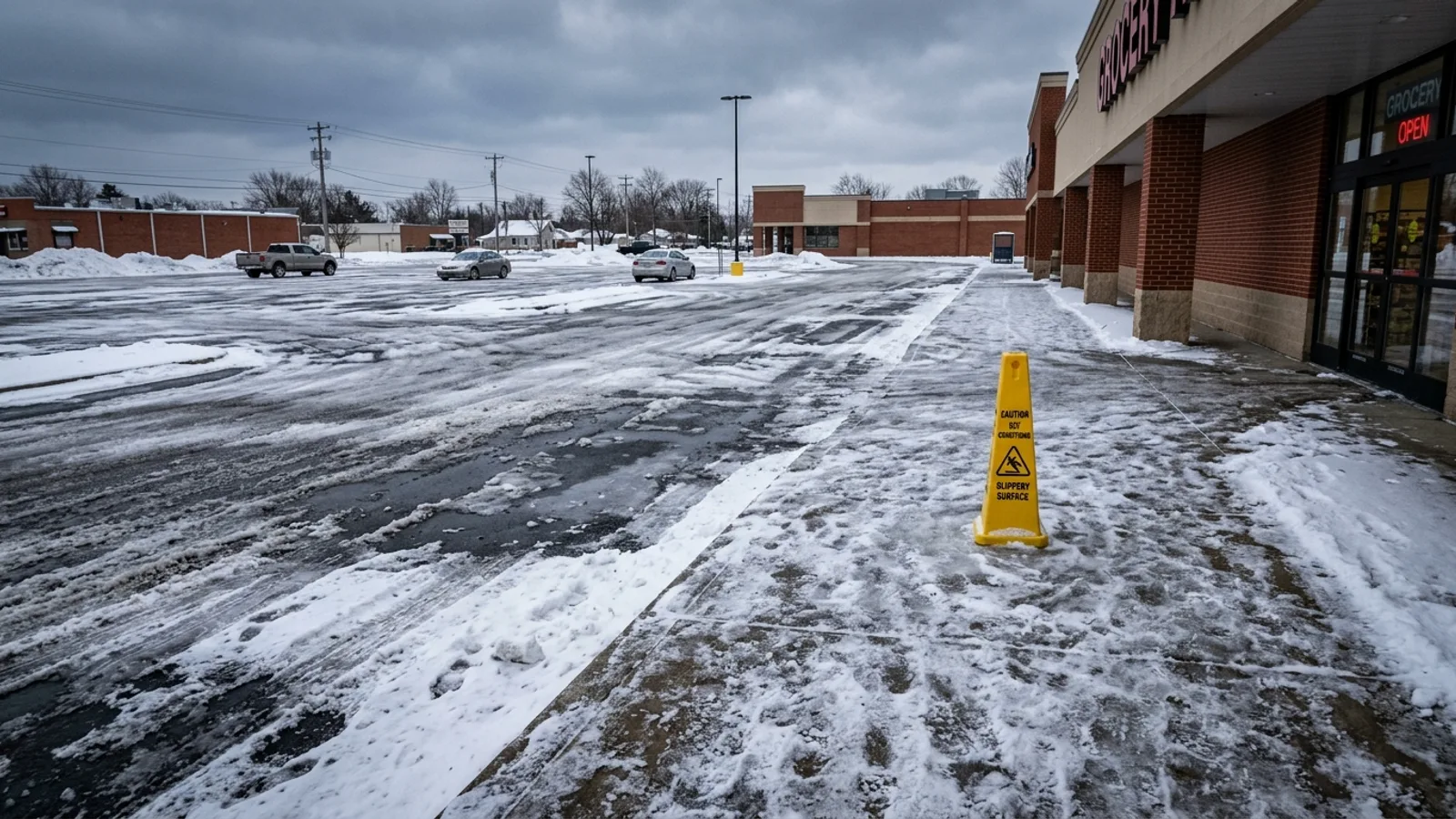
The practical rule that comes out of these cases is this: the owner is entitled to actual or constructive notice of the ice and a reasonable opportunity to remove or treat it. What counts as reasonable depends on the time of day, how busy the property is, what the owner knew about the forecast, what equipment and staff were available, and whether the owner had a snow-removal plan at all. An owner who waits for the storm to end while customers walk across an untreated entrance has not met the Indiana standard. An owner who salted the lot within the hour, on the other hand, may well have.
Who is responsible for the spot where you fell
Liability follows control. The first thing we establish in a winter fall case is who was responsible for maintaining the exact spot where the fall happened, because it is often not the business whose sign is on the door.
- A store, restaurant or office. A business that invites the public in owes the highest duty of care, and that duty covers its entrance, its walkways and the parking areas it controls.
- A landlord. A landlord who keeps control of common areas such as shared stairs, walkways and parking lots owes tenants and their guests reasonable care in maintaining those areas. Inside a tenant's own unit or on a walk the lease assigns to the tenant, the answer may be different, and the lease matters.
- A snow-removal contractor. Many commercial properties hire a contractor to plow and salt. The contract often sets the trigger for service, such as one inch of snow, and whether the contractor had to return for refreeze. A contractor who agreed to treat a lot and did not show up can share responsibility, and the contract and the service logs are among the first documents we request.
- A homeowner's association or property manager. In a condominium or apartment community, the association or the management company usually controls the common walks and lots.
- A city, county, school or the State. Public sidewalks, courthouse steps, school walkways and park paths are governed by the Indiana Tort Claims Act, discussed below.
More than one of these can be responsible at once, and Indiana's comparative fault system lets a jury divide fault among them. That is also why we send preservation letters early: the owner, the contractor and the manager each hold records the others do not.

What reasonable care looks like in a Fort Wayne winter
Because the question is whether the owner acted reasonably, these cases turn on specific facts. The table below lists the facts that most often decide them.
| Fact | Helps your claim when | Hurts your claim when |
|---|---|---|
| Timing | The precipitation ended hours earlier, or the ice was a known refreeze spot, and nothing had been done | The ice formed minutes before the fall and crews were already responding |
| Source of the ice | A downspout, roof drip line or poor drainage created ice the owner should have expected | A thin, even glaze from freezing rain covered the whole area |
| Treatment | No salt or sand was visible, or the lot was plowed but the walk to the door was not | Fresh salt was down and the owner has a log showing when |
| Knowledge | An employee walked past the spot, a customer complained, or the forecast made ice certain | No one had reported the condition and it was not visible from inside |
| Lighting and warning | The area was dark, or ice was hidden under a dusting of snow at a busy entrance | The hazard was in plain view in daylight and marked |
| A plan | The owner had no snow-removal plan, contract or inspection routine | The owner followed a written plan with documented inspections |
Lighting matters more than people expect. An icy walk you could have seen at noon may be a hidden hazard at 6 p.m. in January, and poor lighting is its own basis for owner liability.
Falls on sidewalks, courthouse steps and other public property
Falls on property controlled by a city, county, township, school corporation or the State are governed by the Indiana Tort Claims Act, Indiana Code 34-13-3[2]. Two parts of that law matter in winter.

First, the Act gives a government entity immunity for a loss that results from "the temporary condition of a public thoroughfare or extreme sport area that results from weather." The Indiana Supreme Court has explained that this immunity covers claims arising "during the period of reasonable response" to the weather, and that the period "lasts at least until the condition stops worsening." The entity claiming immunity has to prove it. See Bules v. Marshall County[3] (Ind. 2010). Courts have refused immunity where a school or city had time and opportunity to treat the ice and did not, and have granted it where the condition was still developing when the fall occurred. A condition that persists because of poor design, drainage or maintenance may not be "temporary" at all.
Second, the notice deadlines are short and unforgiving. A claim against a city, county, school or other political subdivision is barred unless a written notice is filed within 180 days after the loss. A claim against the State is barred unless notice is filed within 270 days. Both rules are in Indiana Code 34-13-3[2], at sections 8 and 6. The notice has specific content requirements, and getting it wrong can end a claim before it starts. Our guides to the Indiana tort claim notice and suing a city, county or the State walk through the process.
One more wrinkle for Fort Wayne. The city has the city's sidewalk ordinance[4] that requires owners and occupants to clear the public sidewalk in front of their property each day during winter, and the city takes complaints through 311. An owner's failure to follow that ordinance can be evidence of carelessness in a claim against the owner, but it does not by itself make the owner liable, and it does not shift the government's own duties to the owner.
Your own care: comparative fault and obvious ice
Indiana's Comparative Fault Act applies to winter falls against private owners. Under Indiana Code 34-51-2-6[5], you are barred from recovering anything if your fault is greater than the fault of everyone else who contributed to your injury, meaning more than 50 percent. If your fault is 50 percent or less, your damages are reduced by your share.
The fault argument in nearly every ice case is that you saw, or should have seen, the ice. Indiana courts generally do not hold an owner liable for a danger that was known or obvious to the visitor, unless the owner should have expected the visitor to encounter it anyway, for instance because the icy walk was the only way into the building. Your footwear, your pace, whether you were looking at a phone, and whether you chose an untreated route when a treated one was available all come up. None of these ends a claim on its own, but they are why an honest account of how the fall happened matters from the first conversation.
A special rule for churches
Indiana has a statute that limits the duty of a nonprofit religious organization on premises it owns or controls and uses primarily for worship services. Under Indiana Code 34-31-7-2[6], the organization's duty to a person it has permitted on the premises is only to warn of a hidden danger that a representative actually knows about and to refrain from intentionally harming the person. In 2020 the Indiana Court of Appeals applied that statute to a fall in a snow-covered church parking lot in Indianapolis and ruled for the church, in part because the visitor saw the icy conditions before stepping out of her car. If you fell at a church, the analysis is different from a fall at a store, and the facts about what the church knew and what you saw control.
Evidence to gather in the first 48 hours
Ice melts, lots get salted within the hour, and camera footage is overwritten in days. The evidence that wins these cases has to be collected immediately.

| What to get | Why it matters |
|---|---|
| Photos and video of the exact spot, wide and close, with something for scale | Shows the ice, its extent, the lack of salt, and any drip line or drainage that caused it before the owner treats the area |
| Photos of the surrounding area | Shows whether the rest of the lot was treated while your spot was not, and whether warning cones or mats were out |
| An incident report | Creates the owner's own record of the fall on the day it happened. Ask for a copy. If you left without reporting, see our guide to late-reported store falls |
| Weather records | Hourly observations from the National Weather Service office in Northern Indiana[7] and historical data from NOAA's Climate Data Online[8] fix when precipitation started and stopped and what the temperature did overnight, which settles the "reasonable opportunity" question |
| Witness names and numbers | Independent accounts of the condition and of what employees said or did |
| Your shoes | Keep them unwashed and unworn. Footwear is the first comparative fault argument |
| A preservation letter | Sent by your attorney to the owner, manager and snow contractor, demanding that video, salt logs, contracts and inspection records be kept |
| Medical care the same day | Documents the injury and its cause. Common winter fall injuries are covered in our guide to slip and fall injuries |
Deadlines
A lawsuit for a personal injury in Indiana must generally be filed within two years after the cause of action accrues, under Indiana Code 34-11-2-4[9]. For a fall on government property, the tort claim notice described above is due much sooner, within 180 days for a political subdivision and 270 days for the State, and missing it bars the claim regardless of the two-year rule. Insurance companies know these dates. Do not let an adjuster's ongoing "review" run the clock.
Frequently Asked Questions
Is a property owner automatically liable if I slip on ice in Indiana?
No. The owner is liable only if it failed to use reasonable care, which means it knew or should have known about the ice, had a reasonable chance to treat it, and did not. Indiana does not excuse owners for natural snow and ice, but it does not make them insurers of your safety either.
Does it matter that it was still snowing or sleeting when I fell?
It is a factor, not a defense. Indiana has rejected the rule that an owner may wait until the storm ends. The owner is entitled to notice of the ice and a reasonable opportunity to deal with it. A fall five minutes into a freezing rain is a weak case. A fall at a busy entrance three hours into a storm with no salt down is a different case.
I fell on a city sidewalk in Fort Wayne. Can I sue the city?
Possibly, but the rules are different. The Indiana Tort Claims Act gives the city immunity for a temporary weather condition during a reasonable period of response, and the city must receive a written tort claim notice within 180 days of the fall. The property owner next to the sidewalk may also have duties under the city's sidewalk ordinance. These claims need an attorney's review quickly.
I saw the ice before I fell. Do I still have a claim?
You may. Seeing the ice goes to your share of fault and to whether the owner should have expected people to cross it anyway. If you were more than 50 percent at fault, you cannot recover. If the icy walk was the only way in and the owner had done nothing, a jury can still put most of the fault on the owner.
I fell on the walkway at my apartment complex. Who is responsible?
Usually the landlord or management company that controls the common areas, and sometimes the snow contractor they hired. Check your lease for who was responsible for snow removal, photograph the spot, and report the fall in writing to the office the same day.
How long do I have to bring a claim?
Generally two years from the fall for a lawsuit against a private owner. For a claim against a city, county, school or the State, a written notice is due within 180 or 270 days, and that deadline controls.
Sources
- Indiana Supreme Court, Hammond v. Allegretti, 262 Ind. 82, 311 N.E.2d 821 (1974).
- Indiana Court of Appeals, Henderson v. Reid Hospital and Health Care Services, 17 N.E.3d 311 (Ind. Ct. App. 2014).
- Indiana Supreme Court, Rogers v. Martin, No. 02S05-1603-CT-114 (Ind. Oct. 26, 2016).
- Indiana Supreme Court, Bules v. Marshall County, No. 50S03-1001-CV-57 (Ind. Jan. 27, 2010), quoting Gary Community School Corp. v. Roach-Walker, 917 N.E.2d 1224 (Ind. 2009).
- Indiana Court of Appeals, Henderson v. New Wineskin Ministries Corp., No. 20A-CT-1317 (Ind. Ct. App. Dec. 28, 2020).
- Indiana General Assembly, Indiana Code 34-13-3-3[10], 34-13-3-6 and 34-13-3-8 (Indiana Tort Claims Act), accessed November 9, 2026.
- Indiana General Assembly, Indiana Code 34-51-2-6[11] (Comparative Fault Act), accessed November 9, 2026.
- Indiana General Assembly, Indiana Code 34-11-2-4[12] (limitation of actions), accessed November 9, 2026.
- Indiana General Assembly, Indiana Code 34-31-7-2[13] (nonprofit religious organizations), accessed November 9, 2026.
- City of Fort Wayne sidewalk snow and ice ordinance, as reported by WANE-TV; verify current text with the City Code.
If you were hurt in a fall on snow or ice in Fort Wayne, Allen County or anywhere in northeast Indiana, we will review what happened at no cost and tell you honestly whether the owner's response met the Indiana standard. Request a free case evaluation or contact our Fort Wayne office at (260) 484-6655.
This article provides general information about Indiana law, not legal advice, and reading it or contacting the firm does not by itself create an attorney-client relationship. Court decisions are summarized; the opinions control.
Sources
- Rogers v. Martin (caseclips.courts.in.gov) ↩
- Indiana Code 34-13-3 (iga.in.gov) ↩
- Bules v. Marshall County (caseclips.courts.in.gov) ↩
- the city's sidewalk ordinance (wane.com) ↩
- Indiana Code 34-51-2-6 (iga.in.gov) ↩
- Indiana Code 34-31-7-2 (iga.in.gov) ↩
- National Weather Service office in Northern Indiana (weather.gov) ↩
- NOAA's Climate Data Online (ncei.noaa.gov) ↩
- Indiana Code 34-11-2-4 (iga.in.gov) ↩
- Indiana Code 34-13-3-3 (iga.in.gov) ↩
- Indiana Code 34-51-2-6 (iga.in.gov) ↩
- Indiana Code 34-11-2-4 (iga.in.gov) ↩
- Indiana Code 34-31-7-2 (iga.in.gov) ↩