

If you were hurt on someone else’s property in Fort Wayne or anywhere in Indiana — a slippery grocery aisle, a broken apartment stair, a dark parking lot, a friend’s icy porch — one of the first questions a claim turns on is a legal label most people have never heard of: were you an invitee, a licensee, or a trespasser? That label helps define the duty the property possessor owed you, and the duty helps define whether there is a claim at all. This guide explains what each category means under Indiana law, how the duties compare, and why the classification is rarely the end of the story.
- Three categories. Indiana recognizes invitees, licensees, and trespassers, and the duty owed rises with the category.
- Invitees get the most protection. Store customers, tenants, delivery workers, and invited social guests are usually invitees owed reasonable care.
- Status is decided by the judge. A person’s status on the land, and the duty owed, is generally a question of law for the court — not the jury.
- Classification is not liability. You still have to prove a dangerous condition, notice, causation, and damages, and comparative fault can reduce or bar recovery.
- Public property is different. Falls on city sidewalks, public buildings, or government land trigger short tort-claim notice deadlines and different fault rules.
- Deadlines are unforgiving. Most Indiana injury lawsuits have a two-year filing deadline, and government claims can require notice in as little as 180 days.
What this guide covers
- The three Indiana visitor classifications
- Invitee: the highest duty of care
- Licensee: permission, but a lower duty
- Trespasser: the narrowest duty
- Duty comparison table
- Why classification is not the whole case
- Injuries on public and government property
- Common insurance defenses
- Evidence checklist and next steps
- Frequently asked questions
The three Indiana visitor classifications
Premises liability is a form of negligence. To recover, an injured person generally has to prove a duty, a breach of that duty, and an injury proximately caused by the breach. In Indiana, the duty a landowner or occupier owes depends on the injured person’s status on the land. The Indiana Supreme Court laid out this framework in Burrell v. Meads[1], 569 N.E.2d 637 (Ind. 1991), which remains the leading Indiana case on visitor status.
The practical rule: The more the visit benefits the property owner — or the more the owner has opened the property up to the visitor — the higher the duty the owner owes.
One point surprises many people: your status is usually decided by the judge, not the jury. Under Indiana law, a person’s status on the land, along with the duty owed, is a matter for the court to determine. That makes the facts about why you entered, and whether you had permission, extremely important early in a case. To see how the underlying negligence elements fit together, our explainer on the four proofs of negligence in Indiana is a helpful companion read.

Invitee: the highest duty of care
An invitee is a person invited onto the land in a way that benefits the possessor or is connected to the possessor’s business, or who enters land held open to the public. Indiana recognizes three kinds of invitee: the public invitee, the business visitor, and the social guest. Common examples include:
- A customer shopping at a Fort Wayne grocery store, pharmacy, or retail shop (business visitor).
- A visitor at a public library, park building, or museum open to the public (public invitee).
- A tenant or a tenant’s guest in common areas of an apartment complex.
- A delivery driver, contractor, or service worker there to do business.
- A friend or relative invited to your home — in Indiana, an invited social guest is treated as an invitee.
The landowner owes an invitee a duty of reasonable care. Indiana courts use the Restatement (Second) of Torts § 343 definition adopted in Burrell: a possessor is liable for physical harm from a condition on the land if the possessor knew or by reasonable care would have discovered the condition and realized it was an unreasonable risk, should have expected that visitors would not discover or protect themselves against it, and failed to use reasonable care to protect them. In plain terms, a business must reasonably inspect for hazards, fix them or warn about them, and keep the premises reasonably safe. This is the standard most Fort Wayne slip, trip, and fall claims are built on.
Licensee: permission, but a lower duty
A licensee is someone who is on the land with the possessor’s permission or tolerance but for the licensee’s own purpose — not for the owner’s benefit and not as part of a public invitation. Historically, Indiana treated social guests as licensees, but Burrell moved invited social guests into the invitee category. A licensee today is more often someone who enters for their own convenience with permission that is passive rather than an active invitation — for example, someone allowed to cut across private land, or a person who wanders into a non-public area.
In Indiana: A landowner owes a licensee the duty to refrain from willfully or wantonly injuring the licensee or acting to increase the licensee’s peril, and to warn of hidden (latent) dangers the owner actually knows about. A licensee generally takes the premises as they find them.
The difference between a licensee and an invitee can be subtle, and it can decide a case — which is exactly why it is litigated so often and why the court, not the jury, sorts it out.

Trespasser: the narrowest duty
A trespasser enters or stays on land without any permission or legal right. Indiana has codified the duty owed to trespassers in Indiana Code § 34-31-11[2]. Under IC 34-31-11-3[3], a possessor of land does not owe a duty of care to a trespasser except to refrain from willfully or wantonly injuring the trespasser after the trespasser has been discovered on the property.
There are important exceptions. The best known is the attractive nuisance doctrine, which can make a property owner responsible for injuries to a child trespasser when an artificial condition on the land is especially likely to attract children — think an unfenced pool, a trampoline, or dangerous equipment — and the owner fails to take reasonable steps to protect against the risk. Because children are involved, these cases are handled with special care; our overview for families dealing with a child injured on someone’s property explains more.
Status can also change while you are on the property. A customer who is an invitee in the sales floor of a store can become a licensee or even a trespasser by walking into a clearly marked “Employees Only” back room. That shift can change the duty owed.
Duty comparison table
The table below summarizes the general Indiana framework. It is a starting point, not a verdict — the facts of each case, including exceptions and control of the property, can change the analysis.
| Visitor status | Who it usually describes | General duty owed by the possessor | Fort Wayne example |
|---|---|---|---|
| Invitee | Store customers, tenants, delivery/service workers, invited social guests | Reasonable care — inspect for hazards, fix or warn, keep premises reasonably safe (Restatement § 343) | A shopper slips on an unmarked spill in a supermarket aisle |
| Licensee | People present with mere permission for their own purpose | Refrain from willful/wanton injury; warn of known hidden dangers; visitor takes premises as found | Someone allowed to cut across a private lot is hurt by a concealed hazard the owner knew about |
| Trespasser | People with no permission or legal right to be there | Only refrain from willfully or wantonly injuring after the trespasser is discovered (IC 34-31-11-3[3]) | An adult climbs a fence into a closed construction yard at night |
| Child trespasser | Children drawn onto land by a dangerous artificial condition | Possible liability under the attractive-nuisance exception despite trespasser status | A child enters an unfenced yard and is hurt by an unsecured pool or trampoline |
Why classification is not the whole case
Being classified as an invitee does not automatically mean you win, and being a licensee does not automatically mean you lose. Classification sets the duty. You still have to prove the rest of a negligence case. Several other issues frequently decide Indiana premises claims:
- Control of the property. The duty generally falls on whoever controlled the area where the injury happened — which may be a landlord, a tenant, a property manager, or a maintenance contractor rather than the person you first blame. A defendant who lacked control may owe no duty at all.
- A genuinely dangerous condition. There has to be an unreasonably dangerous condition, not just an ordinary feature of the property.
- Notice. For many hazards, you must show the owner knew about the danger or should have discovered it with reasonable care and had time to address it. This is central in slip-and-fall cases.
- Causation and damages. The hazard must have actually caused your injury, and you must have real damages — medical bills, lost income, and other harm.
A warning sign is a good illustration of how this plays out. A wet-floor sign is evidence that the owner tried to warn, but it does not automatically end a claim — the question is whether the warning was adequate under the circumstances. We break that down in our guide on recovering after an injury when there was a wet floor sign.
Injuries on public and government property
Falls and injuries on public property — a city sidewalk, a county building, a public school, an INDOT right-of-way — follow special rules on top of the visitor-status analysis. Two differences matter most.
First, notice deadlines are short. Under the Indiana Tort Claims Act, a claim against a political subdivision (a city, county, town, or school corporation) is barred unless you file a proper notice within 180 days of the loss (IC 34-13-3-8)[4], and a claim against the State of Indiana requires notice to the Attorney General or the state agency within 270 days (IC 34-13-3-6[5]). Miss the notice and even a strong case can be lost. Our detailed explainer on the Indiana government tort claim notice walks through who to serve and what the notice must contain, and our overview of Indiana accident filing deadlines puts these timelines in context.
Second, the fault rules differ. Indiana’s Comparative Fault Act does not apply to tort claims against governmental entities. That means the older, harsher common-law contributory-negligence rule can apply against a government defendant — and under that rule, even a small share of fault by the injured person can bar recovery entirely. That is a meaningful reason to involve counsel quickly on any public-property injury.

Common insurance defenses
Once a premises claim is made, insurers and defense lawyers often push back on the very facts that set your visitor status and duty. Expect arguments like these:
- “You weren’t really invited there.” Disputing whether you had permission, or arguing you exceeded the scope of your invitation, to push you from invitee toward licensee or trespasser.
- “We didn’t control that area.” Pointing at a different landlord, tenant, or contractor to shift or eliminate the duty.
- “We had no notice.” Arguing the hazard appeared too suddenly for the owner to know about or fix.
- “The danger was open and obvious.” Arguing you should have seen and avoided it. In Indiana this is part of the fault analysis, not an automatic bar.
- Comparative fault. Claiming you were partly to blame — distracted, wearing the wrong shoes, ignoring a warning — to reduce or eliminate your recovery.
Comparative fault is worth understanding because it can reduce a settlement or, past a point, end it. Under Indiana’s modified comparative fault system in IC 34-51-2[6], a claimant who is found more than 50% at fault recovers nothing, and any recovery is reduced by the percentage of fault assigned to the claimant. We explain the mechanics in our guide to Indiana’s 51% fault rule. (That article uses car-accident examples, but the same comparative-fault statute applies to premises cases against private defendants.)

Evidence checklist and next steps
Premises cases are often won or lost on evidence that disappears fast — spills get mopped, ice melts, and surveillance video is overwritten. If you were hurt on someone’s property, these steps help protect both your health and any claim:
- Get medical care promptly and follow through on treatment. Gaps in care become a defense argument.
- Report the injury to the store manager, landlord, or property owner, and ask for a written incident report.
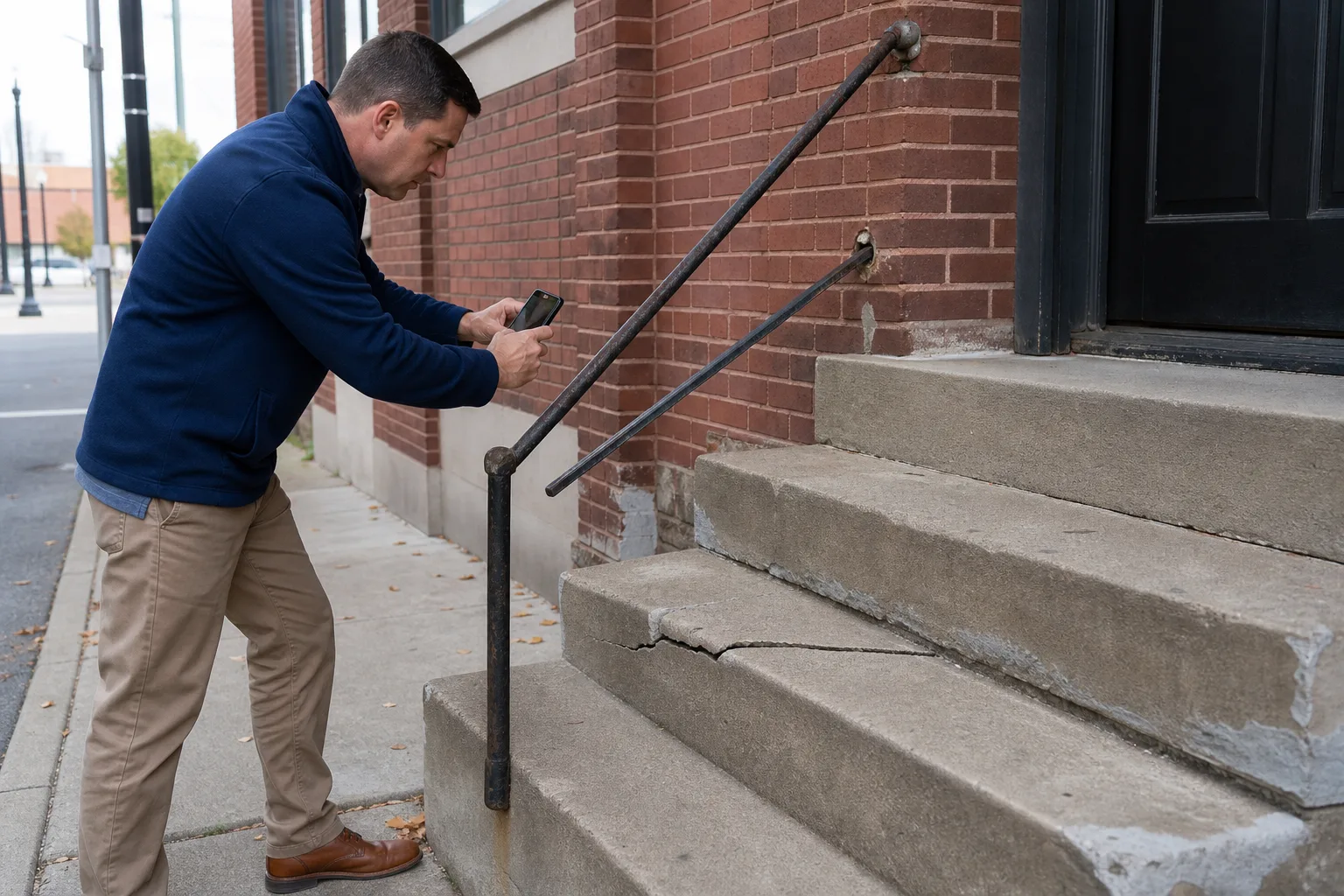
- Photograph the hazard and the surrounding area before it is cleaned or repaired — the spill, the ice, the broken step, the missing handrail, the lighting.
- Note why you were there, who invited or allowed you, and where on the property you were — the facts that fix your visitor status.
- Identify witnesses and get names and contact information.
- Preserve your footwear and clothing as they were.
- Ask that surveillance video be preserved, in writing if possible, before it is automatically deleted.
- Note deadlines. Most Indiana injury lawsuits must be filed within two years (IC 34-11-2-4[7]), and government claims can require notice in 180 or 270 days.
For a deeper look at the underlying legal theory, our Fort Wayne premises liability practice page explains the kinds of unsafe-property cases we handle across Allen County and Indiana.
Frequently asked questions
Does my visitor status alone decide whether I can recover?
No. Your status as an invitee, licensee, or trespasser sets the duty the property possessor owed you, but you still have to prove a dangerous condition, notice, causation, and damages. Comparative fault and control of the property can also change the result. Classification is the starting point, not the finish line.
Is an invited guest in my home an invitee or a licensee in Indiana?
Under Burrell v. Meads, an invited social guest is treated as an invitee owed a duty of reasonable care — a change from the older rule that classified social guests as licensees. The specific facts of the visit still matter, and a court decides status as a matter of law.
Can a trespasser ever recover for an injury in Indiana?
Sometimes. Generally a possessor owes a trespasser only the duty not to willfully or wantonly injure them after discovery (IC 34-31-11-3[3]). But exceptions exist, most notably the attractive-nuisance doctrine, which can allow recovery for a child trespasser hurt by a dangerous artificial condition the owner failed to secure.
Who decides whether I was an invitee, licensee, or trespasser?
In Indiana, a person’s status on the land and the duty owed are generally questions of law for the judge, not the jury. That is why the facts about why you entered and whether you had permission are so important early in a case.
I fell on a city sidewalk. Is that different from falling in a private store?
Yes. Injuries on government property fall under the Indiana Tort Claims Act, which requires a written notice within 180 days for a political subdivision or 270 days for the State, and the Comparative Fault Act does not apply to government defendants, so a stricter contributory-negligence rule can apply. These claims should be reviewed quickly because of the short deadlines.
How long do I have to file an Indiana premises liability claim?
Most Indiana personal injury claims, including premises cases against private property owners, must be filed within two years of the injury under IC 34-11-2-4[7]. Claims involving government property have separate, shorter notice deadlines. Because exceptions and fact-specific rules exist, it is wise to confirm the deadlines that apply to your situation.
Note: Delventhal Law Office also offers an online car accident settlement estimator, but it is built for car-accident claims and does not value a premises-liability case. Property-injury claims turn on duty, control, notice, and fault issues that a general calculator cannot capture, so treat any online estimate as background information only.
If you were hurt on someone’s property
Sorting out whether you were an invitee, licensee, or trespasser — and who controlled the property, whether there was notice, and which deadlines apply — is exactly the kind of analysis that benefits from an early, careful review. If you were injured on unsafe property in Fort Wayne, Allen County, or elsewhere in Indiana and are not sure what to do next, a free consultation with Delventhal Law Office can help you understand your options and the deadlines that may apply. You do not have to figure out the process alone.
This article is general information about Indiana law and is not legal advice. Reading it does not create an attorney-client relationship. Every case is different; for advice about your specific situation, speak with a licensed Indiana attorney.