Key takeaways
- A crash while working may create a workers’ compensation claim and a separate third-party injury claim.
- Workers’ comp may cover authorized medical treatment and wage benefits, but it generally does not pay pain and suffering.
- A third-party claim may exist when someone outside your employer caused or contributed to the crash.
- Workers’ comp liens and reimbursement rights can affect settlement, so the two claims must be coordinated carefully.
- Do not assume the first adjuster who calls is explaining all available claims or insurance coverage.
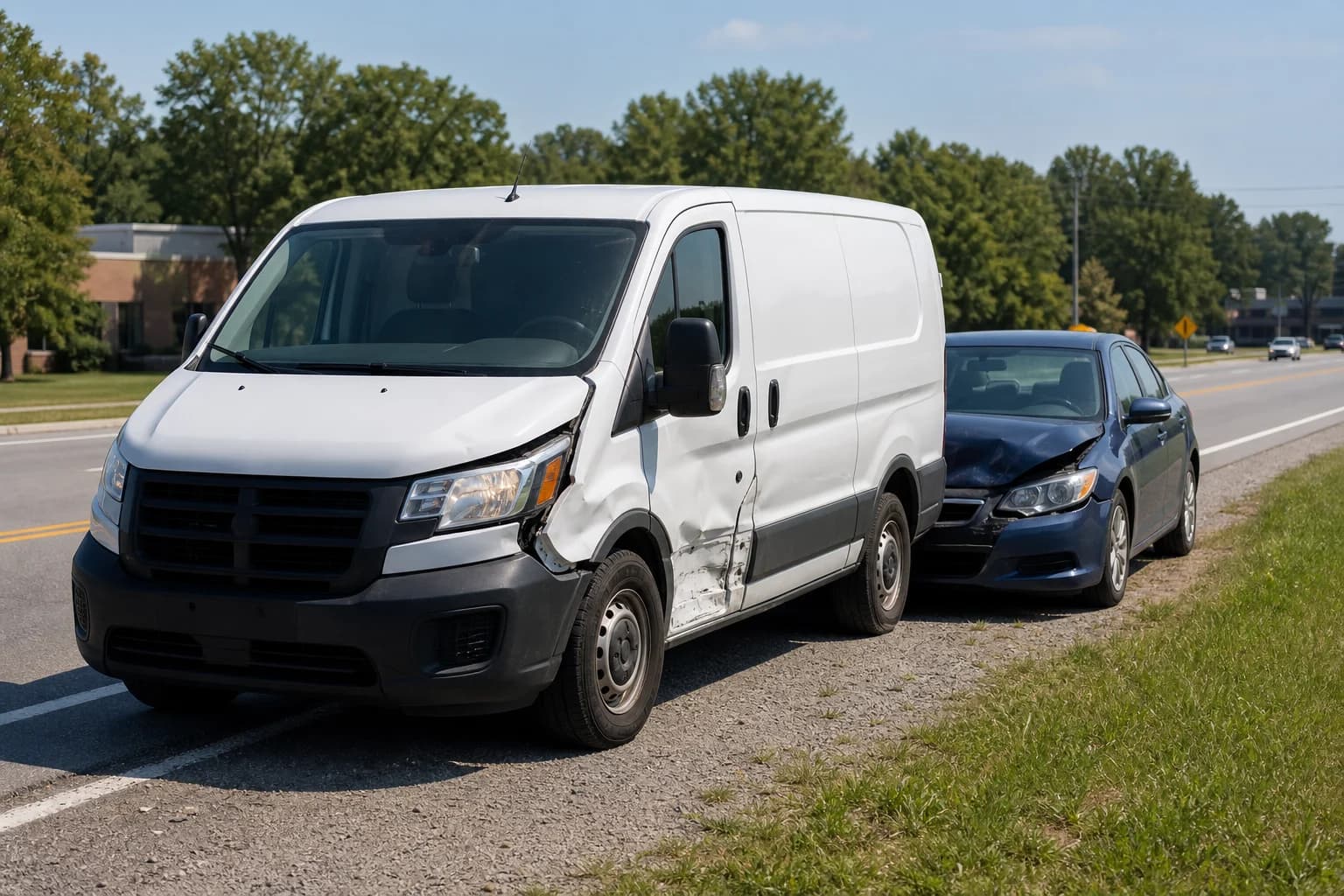
If you were hurt in a vehicle crash while working in Indiana, you may have a workers’ compensation claim and a separate personal injury claim against the at-fault driver or another third party. Workers’ comp can cover medical treatment and wage benefits regardless of fault, but it usually does not pay pain and suffering. A third-party injury claim may allow recovery for damages workers’ comp does not cover.
This issue comes up for delivery drivers, traveling employees, salespeople, home-health workers, construction workers, truck drivers, utility workers, rideshare drivers, and anyone whose job puts them on Indiana roads.
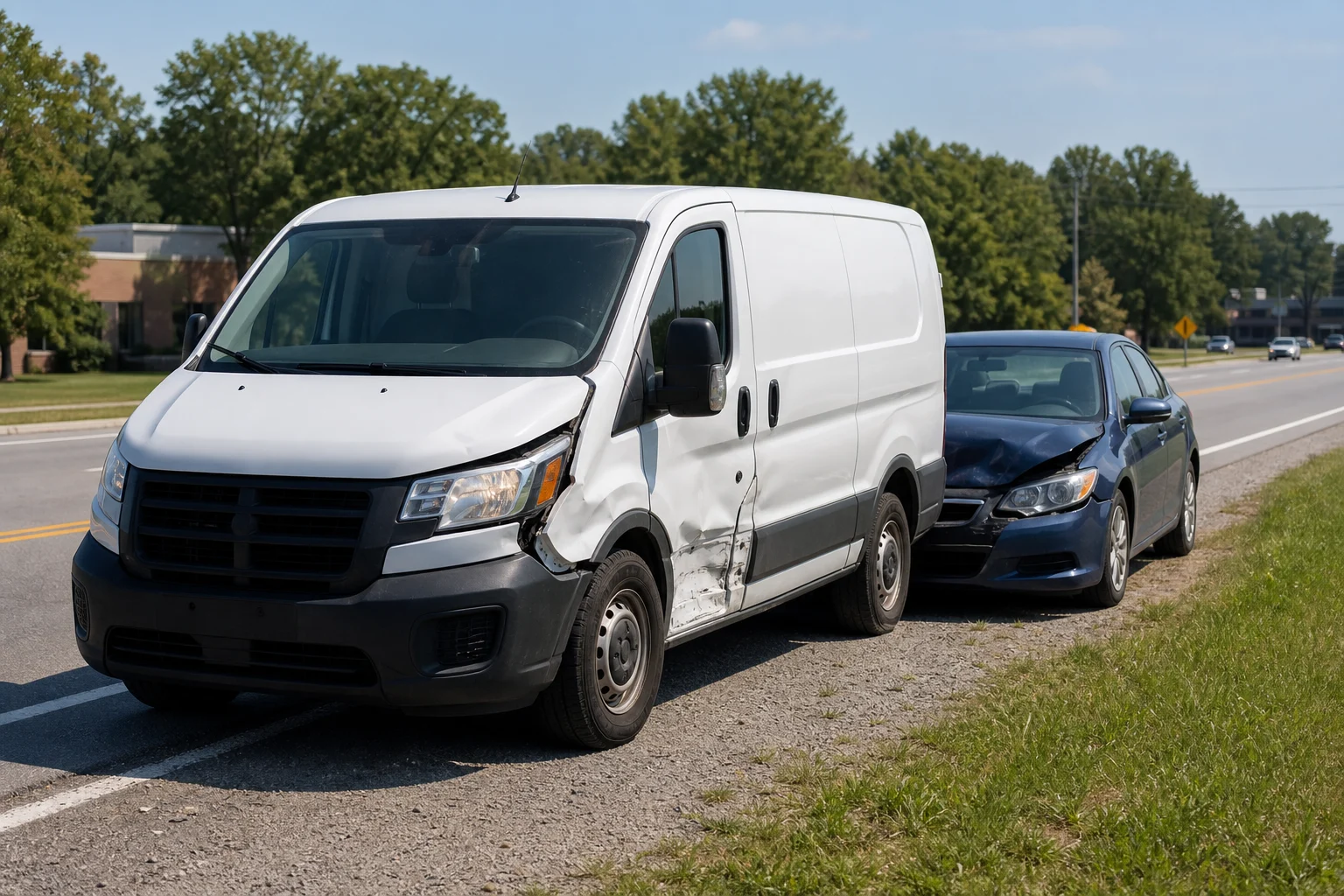
The key question is not just, “Was I working?” The key question is, “Who caused the crash, and what claims are available?”
Why work-vehicle crashes are different

A normal car accident claim usually asks: who caused the crash and what insurance applies?
A work-vehicle crash asks more:
- Were you in the course and scope of employment?
- Did workers’ compensation apply?
- Who caused the crash?
- Was another driver responsible?
- Was a company vehicle involved?
- Were you driving your own vehicle for work?
- Was a commercial policy available?
- Did the crash create both a comp claim and a third-party claim?
- Does the workers’ comp carrier have a lien or reimbursement claim?
Those questions matter because the answer can change the recovery dramatically.
Our workers’ compensation overview explains the benefit system in more detail.
What workers’ compensation may cover
Indiana workers’ compensation generally covers employees injured in the course of employment. In a work-vehicle crash, that may include people driving, riding as a passenger, loading, unloading, traveling between job sites, making deliveries, or performing work errands.
Workers’ comp may cover:
- authorized medical treatment;
- temporary total disability benefits if you are off work;
- temporary partial disability in some reduced-work situations;
- permanent partial impairment benefits if you receive a PPI rating;
- mileage reimbursement for some medical travel;
- future medical care related to the work injury.
Workers’ comp does not usually require proving someone else was negligent. That is one reason it can be so important after a work crash.
But workers’ comp also has limits.
What workers’ comp does not pay
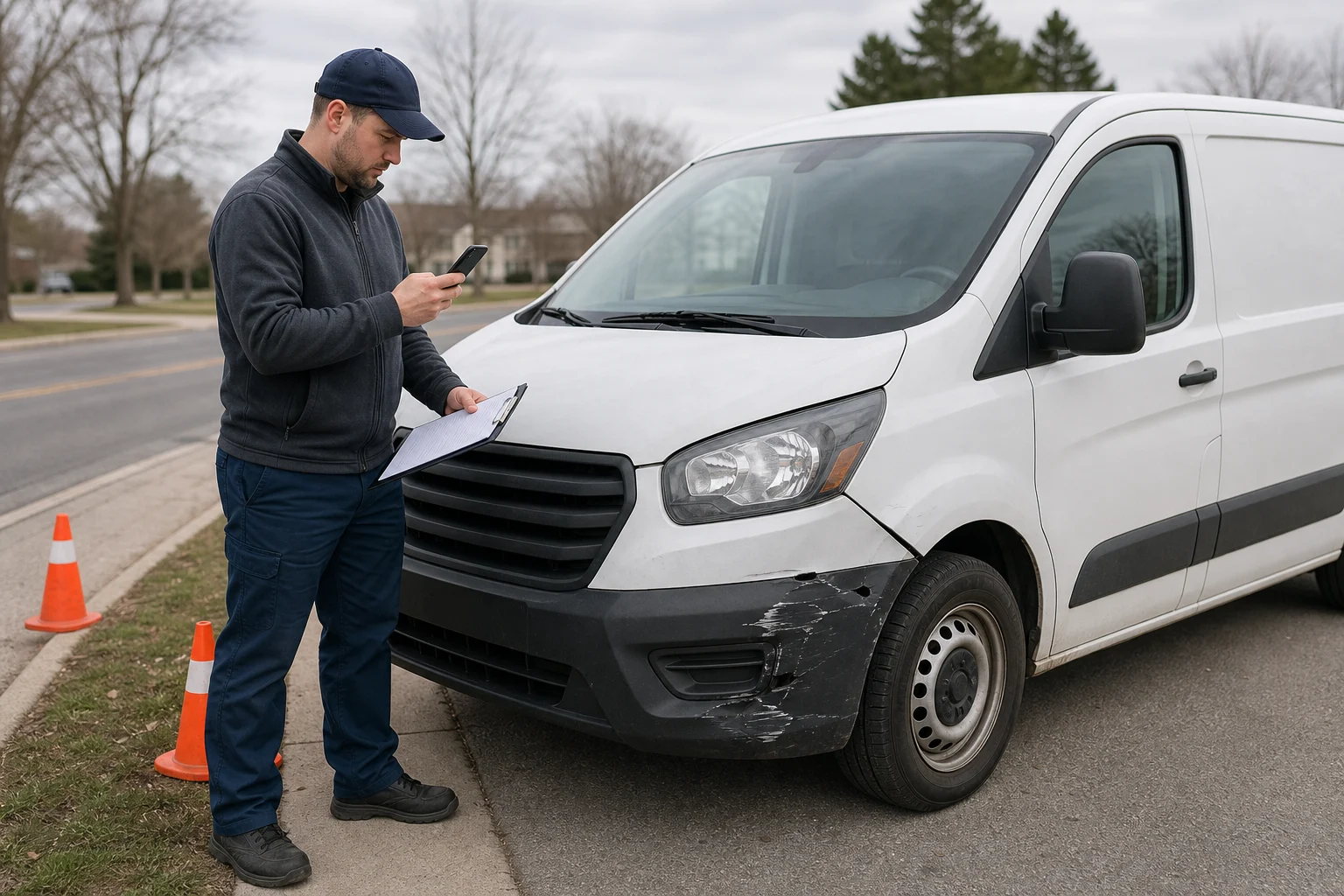
Indiana workers’ compensation generally does not pay for pain and suffering. It also may not fully replace lost income, because wage benefits are limited by statute and formulas. It may not account for the full human impact of a crash.
That is where a third-party claim may matter.
If someone outside your employer caused the crash, you may have a separate personal injury claim against that person or company.
Examples:
- A delivery driver is rear-ended by a distracted driver.
- A construction worker riding between job sites is hit by a red-light runner.
- A home-health worker is struck by an uninsured driver while traveling to a patient.
- A utility worker is hit by a commercial truck.
- A warehouse employee making a work errand is injured by a careless driver.
In those cases, workers’ comp may pay medical and wage benefits, while the third-party claim may pursue pain and suffering, full wage loss, future losses, and other damages.
Our car-accident practice overview explains how the firm evaluates a separate fault-based claim.
What is a third-party claim?
A third-party claim is a claim against someone other than your employer or co-worker whose negligence contributed to the injury.
In a vehicle crash, the third party is often another driver. But it may also be:
- a trucking company;
- a vehicle owner;
- a maintenance company;
- a parts manufacturer;
- a road contractor;
- a property owner;
- another company on a job site.
The third-party claim is separate from workers’ comp, but the two claims interact.
The workers’ comp lien problem

If workers’ comp pays medical bills or wage benefits, the workers’ comp carrier may have a reimbursement interest if you later recover money from the at-fault third party.
That means the settlement must be handled carefully. If liens, reimbursement rights, or credits are ignored, the injured worker can lose money or create problems with future benefits.
This is one reason work-vehicle crashes should not be treated like ordinary fender-benders. The case may involve two insurance systems at once.
At Delventhal Law Office, we look at both sides: the comp benefits and the third-party injury claim. We also look for liens, subrogation issues, medical bills, wage calculations, coverage layers, and deadlines.
We Find What Others Miss.
What to do after a work-vehicle crash
If you are physically able, take these steps:
- Call 911 and report the crash.
- Get medical care.
- Tell the medical provider the crash happened while you were working.
- Report the injury to your employer as soon as possible.
- Ask that a written incident report be prepared.
- Get the crash report information.
- Take photos of vehicles, scene, injuries, road conditions, and company vehicle information.
- Get witness names and phone numbers.
- Keep copies of work restrictions and off-work slips.
- Do not give a recorded statement to the other driver’s insurance company before getting legal advice.
Before responding to an adjuster, review our guide to recorded statements and medical-release requests.
Common insurance problems after a work-vehicle crash
These cases can get messy quickly because multiple insurers may be involved.
You may hear:
- “This is only workers’ comp.”
- “You cannot sue because you were working.”
- “You have to use comp and cannot make a car accident claim.”
- “Your employer’s insurance is handling it.”
- “The other driver’s insurance needs your statement.”
- “Your lost wages are already covered.”
- “You do not have a pain and suffering claim.”
Some of those statements may be partially true in some cases. Some may be wrong. The details matter.
Do not assume the first adjuster who calls is explaining all your rights. That adjuster may only represent one piece of the case.
What if you were driving your own car for work?
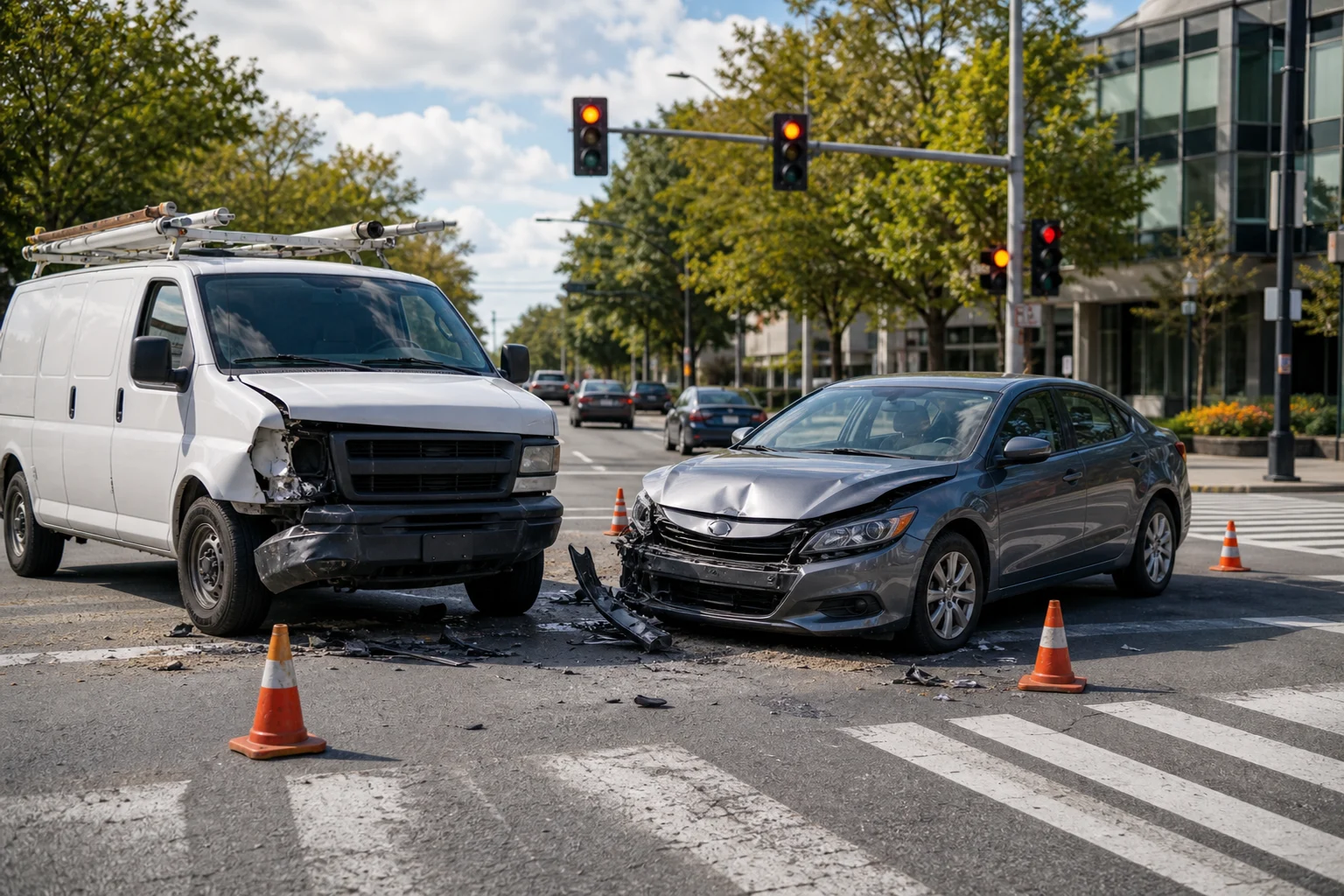
Many people use their own vehicles for work: sales calls, deliveries, errands, home-health visits, client visits, bank runs, job-site travel, and more.
If the crash happened while performing job duties, workers’ compensation may still apply even if the vehicle was personally owned. But coverage questions can become more complicated.
Potential coverage sources may include:
- workers’ compensation insurance;
- the at-fault driver’s liability policy;
- your personal auto policy;
- employer non-owned auto coverage;
- uninsured or underinsured motorist coverage;
- commercial auto coverage;
- umbrella or excess coverage.
Finding every available layer matters.
If liability coverage may be inadequate, see our guide to crashes involving Indiana minimum insurance.
Could UIM coverage apply to a work-vehicle crash?
Underinsured-motorist (UIM) coverage is a contractual insurance issue, separate from workers’ compensation benefits and the fault-based claim against the other driver. A careful review asks three different questions: whether the injured person qualifies as an insured under a particular policy, whether the other vehicle meets Indiana’s statutory underinsured-vehicle test, and—only after those questions are answered—how the policy language and statutory caps affect the amount available.
Do not assume an employer policy or a personal policy covers the crash. Coverage can turn on the named insured, covered-auto and insured definitions, endorsements, exclusions, limits, offsets, other-insurance clauses, and any valid rejection or selection forms. Multiple policies do not automatically stack. Our detailed guides explain Indiana’s statutory UIM eligibility test and how to analyze several potentially applicable auto policies.
Which layers of business coverage must offer UM/UIM
Before any of those questions, business coverage raises an earlier one: whether the policy had to offer UM/UIM at all. Indiana requires insurers to make the coverage available with the auto liability policies the statute governs, unless the named insured rejects it in writing. Commercial umbrella and excess liability policies are treated differently. Under IC 27-7-5-2(d)[1], an insurer is not required to make UM/UIM available in a commercial umbrella or excess liability policy, including one issued to a motor carrier that meets the federal financial-responsibility minimums. An insurer that does offer it may set its own limits, and those limits need not match the umbrella’s liability limits.
A 2026 amendment widened that category. P.L. 86-2026, SEC. 18 added subsection (i), which provides that a policy “that provides coverage in excess of any liability relating to a self-insured retention amount shall be considered a commercial umbrella or excess liability policy under subsection (d).” Employers that keep a self-insured retention and buy coverage above it are common in trucking, construction, and delivery operations. The practical consequence for an injured employee is that a large excess layer sitting above the employer’s retention may carry no UM/UIM at all, and the statute does not require that it do so.
This does not change UM/UIM in an ordinary personal auto policy, and it does not decide whether any particular policy responds to a given crash. It identifies a question to ask early and for each layer separately: was UM/UIM offered, purchased, rejected, or removed by endorsement? That answer comes from the declarations, the endorsements, and any selection or rejection forms—not from how large the layer is.
What Cline v. Everest illustrates about policy limits
In Cline v. Everest National Insurance Company, Court of Appeals Case No. 25A-CT-1976 (May 28, 2026)[2], two employees were seriously injured in their employer’s dump truck. Their status as insureds and the other vehicle’s underinsured status were conceded, so the court addressed the later, distinct question of how much UIM coverage the employer’s policy made available.
The policy had a $1 million per-accident UIM limit and no separate per-person limit. The at-fault driver’s insurer paid $300,000 total—$150,000 to each employee. Because the UIM endorsement reduced its limit by “all sums” paid by or for a legally responsible person, the court affirmed that $700,000 remained collectively under that policy: $1 million minus the total $300,000 liability payment. The decision did not award $700,000 to each employee and did not treat the $1 million UIM limit as additional to the liability payment.
The court distinguished the Lakes eligibility analysis from calculating aggregate benefits under the policy. It explained that Indiana Code § 27-7-5-5(c)[3] caps an individual claimant’s recovery; it does not forbid a policy provision that reduces a per-accident limit by aggregate liability payments when the provision complies with the statute. Cline therefore illustrates why eligibility for UIM coverage and the amount available under a specific contract should not be collapsed into one calculation.
Cline did not decide workers’ compensation lien, reimbursement, credit, or setoff rules. Although the accident happened during employment and the policy quoted a workers’ compensation provision, the appeal decided the UIM policy-limit calculation described above. Workers’ compensation benefits and liens still require their own analysis, apart from third-party liability and contractual UIM coverage.
Documents to obtain for the UIM review
- the employer’s complete commercial auto policy for the crash date, including declarations and every endorsement;
- any personal or household auto policies that might apply, with declarations and endorsements;
- UM/UIM selection or rejection forms and policy-change records;
- the crash report and documents identifying every involved vehicle, owner, driver, and employer;
- the at-fault driver’s declarations, coverage disclosure, settlement correspondence, and proof of every liability payment;
- workers’ compensation payment histories, lien or reimbursement notices, and benefit correspondence, kept separately from the auto-policy calculation;
- medical bills, wage-loss records, and other damages documentation; and
- all reservation-of-rights letters, coverage opinions, releases, and proposed settlement agreements.
What if you caused the crash while working?
If you were injured while working, workers’ compensation may still apply even if you were partly or fully at fault for the crash. Workers’ comp is generally not based on fault the same way a personal injury claim is.
But a third-party personal injury claim against another driver depends on fault. Indiana’s comparative fault rules may reduce or bar recovery if you were mostly responsible.
That is why the crash investigation still matters. Police reports can be incomplete. Witnesses may be missed. Dashcam, surveillance, vehicle damage, and roadway evidence may change the fault analysis.
Learn why a report is only one part of the evidence in our guide to police reports and disputed fault.
What injuries happen in work-vehicle crashes?
Work-vehicle crashes can cause the same injuries as other serious crashes:
- neck and back injuries;
- herniated discs;
- concussions;
- shoulder injuries;
- knee injuries;
- fractures;
- internal injuries;
- chronic pain;
- traumatic brain injuries;
- psychological trauma;
- permanent work restrictions.
For workers, the injury often hits twice: physically and financially. If you cannot drive, lift, bend, stand, climb, or concentrate, you may not be able to do the job you had before.
That makes wage records, restrictions, job descriptions, and PPI ratings especially important. Our Indiana workers’ compensation PPI calculator can help estimate how a rating may translate into statutory weeks and dollars, subject to the facts of the claim.
For more detail, see how an Indiana PPI rating is converted into a statutory benefit.
Why early legal review helps

A work-vehicle crash should be reviewed early because deadlines, evidence, and benefits can overlap.
A lawyer can help:
- protect the workers’ comp claim;
- identify third-party claims;
- preserve crash evidence;
- review available insurance;
- coordinate medical and wage documentation;
- evaluate liens and reimbursement rights;
- prevent recorded-statement mistakes;
- protect future medical benefits;
- determine whether settlement timing creates problems.
The goal is not to complicate the case. The goal is to avoid leaving money, benefits, or rights on the table.
When should you call Delventhal Law Office?
Call if:
- you were hurt in a crash while working;
- you are missing work;
- the comp carrier is delaying treatment;
- another driver caused the crash;
- you are unsure whether you have both claims;
- the other driver’s insurer wants a statement;
- your employer is pressuring you to return before you are ready;
- you received a PPI rating and do not know whether it is fair;
- the medical bills, wage benefits, and insurance calls are becoming overwhelming.
Delventhal Law Office handles both personal injury and workers’ compensation claims. That matters in work-vehicle crash cases because the right answer often sits between both systems.
If you were hurt while driving or riding for work in Indiana, call us. The consultation is free, and there is no fee unless we recover compensation for you.
Frequently Asked Questions
Can I have both workers’ comp and a car accident claim?
Yes. If you were hurt while working and a third party caused the crash, you may have both a workers’ compensation claim and a personal injury claim.
Does workers’ comp pay pain and suffering in Indiana?
Generally, no. Workers’ comp can provide medical and wage benefits, but pain and suffering is usually pursued through a third-party personal injury claim when one exists.
What if I was driving my own car for work?
Workers’ compensation may still apply if you were performing job duties. Coverage can become more complicated because personal auto, employer coverage, UM/UIM, and third-party liability insurance may all need review.
What if workers’ comp already paid my bills?
The comp carrier may have a reimbursement or lien interest if you later recover money from the at-fault third party. That must be evaluated before settlement.
Should I give a statement to the other driver’s insurance company?
Not before getting legal advice. The other driver’s insurer does not represent you and may ask questions that affect both the third-party claim and the workers’ comp claim.
Related DLO resources
- Fort Wayne Workers’ Compensation Attorney
- Fort Wayne Car Accident Attorney
- Fort Wayne Truck Accident Attorney
- Recorded statements and medical releases
- What if the other driver only has minimum insurance?
- Indiana PPI rating calculator
Bottom line
If you were hurt in Indiana and the insurance issues are already getting complicated, Delventhal Law Office can help you protect the claim, document the evidence, and avoid mistakes that give the insurance company leverage. The consultation is free, and there is no fee unless we recover compensation for you.
This page provides general information, not legal advice. Reading it does not create an attorney-client relationship.