
If your vehicle was declared a total loss after a Fort Wayne or Allen County crash, do not review only the headline valuation. As a practical starting point, ask the adjuster for a written breakdown showing vehicle value, sales tax, any deductions, loan payoff, and each fee included or excluded.
Key takeaways
- Indiana Department of Insurance Bulletin 82 directs auto insurers to pay sales tax in addition to the amount paid for a totaled vehicle.
- The sales-tax payment is due with the total-loss payment and is computed on the amount the insurer pays for the vehicle.
- The BMV says a replacement-vehicle purchaser is responsible for obtaining a new title, registration, and license plate.
- If your totaled vehicle had unused Indiana excise tax, you may apply to the BMV for a credit or refund using State Form 55296.
- Practical tip: keep the valuation report, settlement breakdown, title documents, registration receipt, and total-loss letter together.

Does the insurer have to pay sales tax after an Indiana total loss?
Yes. The Indiana Department of Insurance’s Bulletin 82[1] directs insurers writing automobile insurance in Indiana to pay sales tax in addition to the amount paid for a totaled vehicle.
The bulletin says the insurer must pay the sales tax when it pays the vehicle loss, not wait until the claimant purchases another vehicle. It also says the sales tax is computed on the amount the company pays for the totaled vehicle.
For example, the relevant starting figure is the insurer’s payment for the totaled vehicle—not the sticker price of the replacement vehicle you later choose. Request the actual calculation in writing so you can compare it with the valuation and settlement statement.
Who pays title fees and registration costs?
Bulletin 82[1] addresses sales tax and says nothing about replacement title or registration charges. That limited document is not enough to conclude that every Indiana claim must include those fees—or that none can. As a practical next step, ask the adjuster to identify each excluded charge and the specific policy language or legal basis being relied on.
The Indiana BMV’s vehicle-purchase guidance[2] says the purchaser is responsible for obtaining a new certificate of title, registration, and license plate. The same BMV page says plates from sold vehicles may be transferred to a different vehicle owned by the same person. For a totaled vehicle, confirm your transaction’s requirements with the BMV; do not assume the sold-vehicle wording answers every total-loss situation.
The practical distinction is between completing the replacement vehicle’s BMV paperwork and deciding whether a particular fee belongs in the claim payment. The BMV’s purchaser instructions do not, by themselves, decide reimbursement.
How to review an Indiana total-loss settlement
This is a practical checklist, not a list of additional legal payment requirements. Use a written breakdown to compare the separate items:
| Item | Indiana starting point | What to request |
|---|---|---|
| Vehicle value | The insurer’s sales-tax calculation is based on the amount it pays for the totaled vehicle. | Valuation report, comparable vehicles, options list, condition adjustments, and final value. |
| Sales tax | It must be added to the amount paid for the totaled vehicle and paid at the time of settlement. | An itemized sales-tax calculation. |
| Replacement title | The purchaser is responsible for obtaining the replacement vehicle’s certificate of title. | A written explanation of included and excluded title charges. |
| Registration and plate | The BMV places the registration and plate transaction on the purchaser; its cited transfer guidance addresses sold vehicles. | Current BMV transaction options and an itemized receipt. |
| Unused excise tax | A vehicle owner whose vehicle was sold or destroyed may apply for an excise-tax credit or refund. | State Form 55296 and proof of sale, destruction, disposal, or total loss. |
You can also compare the property-damage paperwork with Delventhal Law Office’s guide to what happens when a car is totaled in Indiana and its explanation of betterment deductions in property-damage claims.
Can you recover unused registration-related taxes?
The Indiana BMV’s fees and taxes page[3] says that if a vehicle is sold or destroyed, including through a total loss, its owner may apply for a credit or refund of eligible vehicle excise taxes using State Form 55296.
Eligible categories listed by the BMV include Vehicle Excise Tax, Recreational Vehicle Excise Tax, County Vehicle Excise Tax, and Municipal Vehicle Excise Tax. The BMV accepts proof such as an insurer statement identifying the vehicle as a total loss and including its VIN.
This is a BMV credit-or-refund process, not the same thing as asking the insurer to add a replacement registration fee. Practical tip: save the old registration and total-loss letter before closing the file.
Documents that help you check the numbers
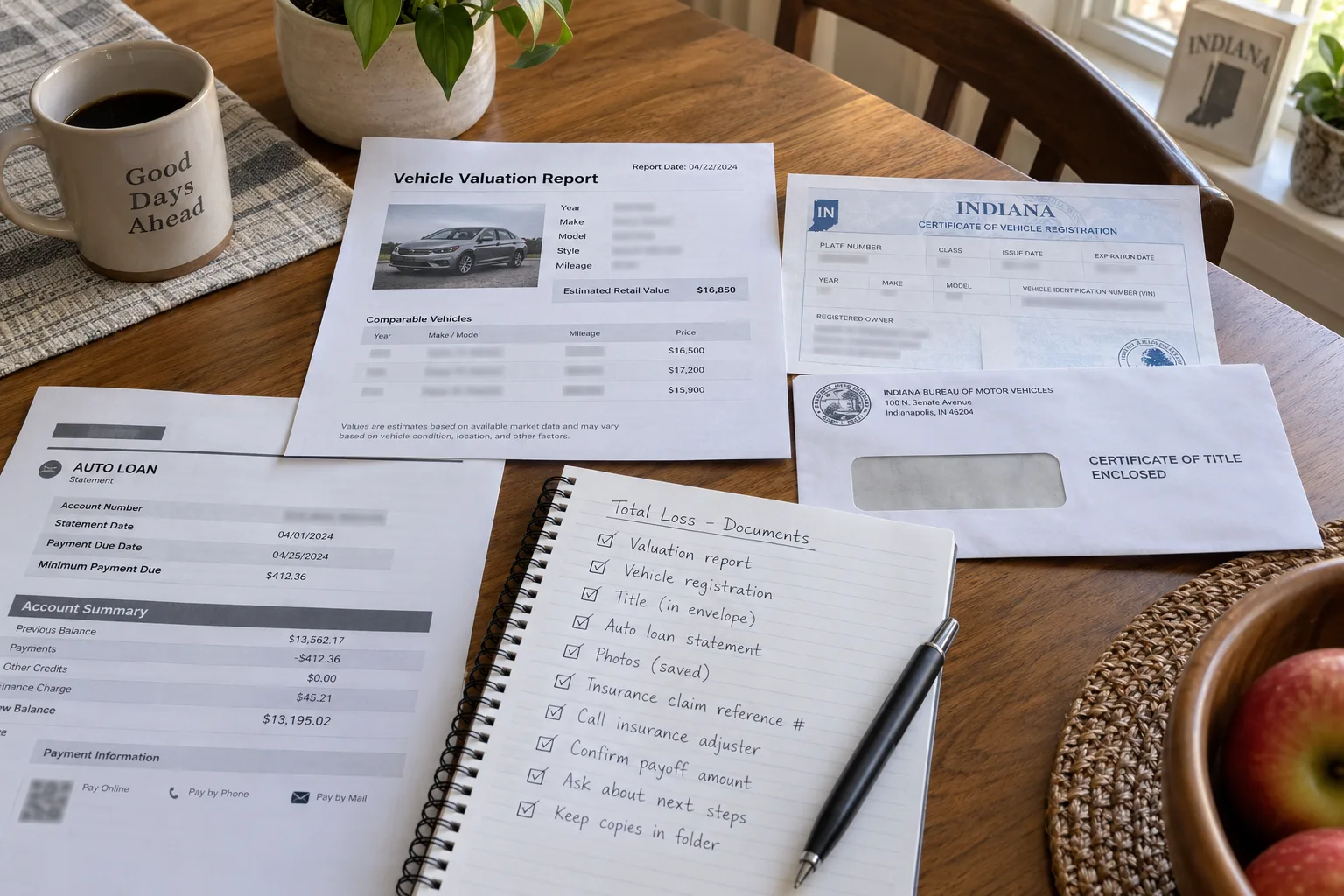
This document checklist is practical preparation advice, not a government-mandated list for every claim:
- The complete valuation report and all comparable-vehicle pages
- The written settlement breakdown
- The declarations page and relevant policy sections
- The vehicle title, registration, and loan payoff statement
- The total-loss letter showing the VIN
- Receipts from the replacement vehicle’s title and registration transactions
- Copies of emails or letters disputing an omitted amount
If you were also hurt in the crash, keep your medical and vehicle paperwork organized separately. The Fort Wayne car accident practice guide explains the broader claim process, while the car-accident settlement calculator can help organize injury-related bills, wage loss, fault, and insurance information.

What if the insurer leaves out sales tax?
Practical next steps: ask the adjuster for the vehicle-value figure, sales-tax calculation, and an explanation of any omission. Attach Bulletin 82[1] when requesting a review of the numbers.
If direct contact does not resolve the issue, the Indiana Department of Insurance accepts consumer complaints involving claim disputes[4]. The Department instructs consumers to contact the insurer, agent, or broker first and to submit supporting documents with a complaint.
IDOI instructs consumers not to send original documents, photographs, or other evidence. Keep the originals and submit copies.
Frequently Asked Questions
Must I buy another vehicle before the insurer pays sales tax?
No. Indiana Department of Insurance Bulletin 82 says sales tax must be paid when the claimant is paid for the totaled vehicle, rather than only after a replacement vehicle is purchased.
What amount is used to calculate the sales tax?
Under Bulletin 82, the sales tax is computed on the amount the insurer pays for the totaled vehicle.
Does Indiana require the insurer to pay the new title fee?
Bulletin 82 expressly addresses sales tax, not replacement title fees. It does not resolve every possible basis for reimbursement. For your transaction, ask for an itemized settlement and a written explanation of the title-fee decision.
Can I transfer my old plate to the replacement vehicle?
The cited Indiana BMV guidance says a plate from a sold vehicle may be transferred to another vehicle owned by the same person. Ask the BMV which transfer requirements apply to your totaled vehicle before assuming the same process applies.
Can I obtain a refund for unused excise tax?
If your vehicle was sold or destroyed, including through a total loss, the Indiana BMV says you may apply for a credit or refund of eligible excise taxes using State Form 55296.

If you were injured in an Indiana crash as well as losing your vehicle, you can contact Delventhal Law Office for a free injury-case evaluation. For a property-damage-only question, the official IDOI and BMV resources above are practical starting points.
This article is general information about Indiana law and is not legal advice. Reading it does not create an attorney-client relationship, and neither does contacting us.