This guide focuses on evidence specific to roundabouts. For the broader claim process, see our Fort Wayne car accident practice page.
Key takeaways
- Separate an entry-yield dispute from a dispute about vehicles already traveling beside one another.
- Record the lane arrows and signs on the actual approach. A rule remembered from another roundabout may describe a different layout.
- Preserve footage showing the approach and movement before contact, not just the impact.
- Large vehicles have a specific Indiana roundabout right-of-way rule that deserves separate attention.
Who must yield when entering an Indiana roundabout?
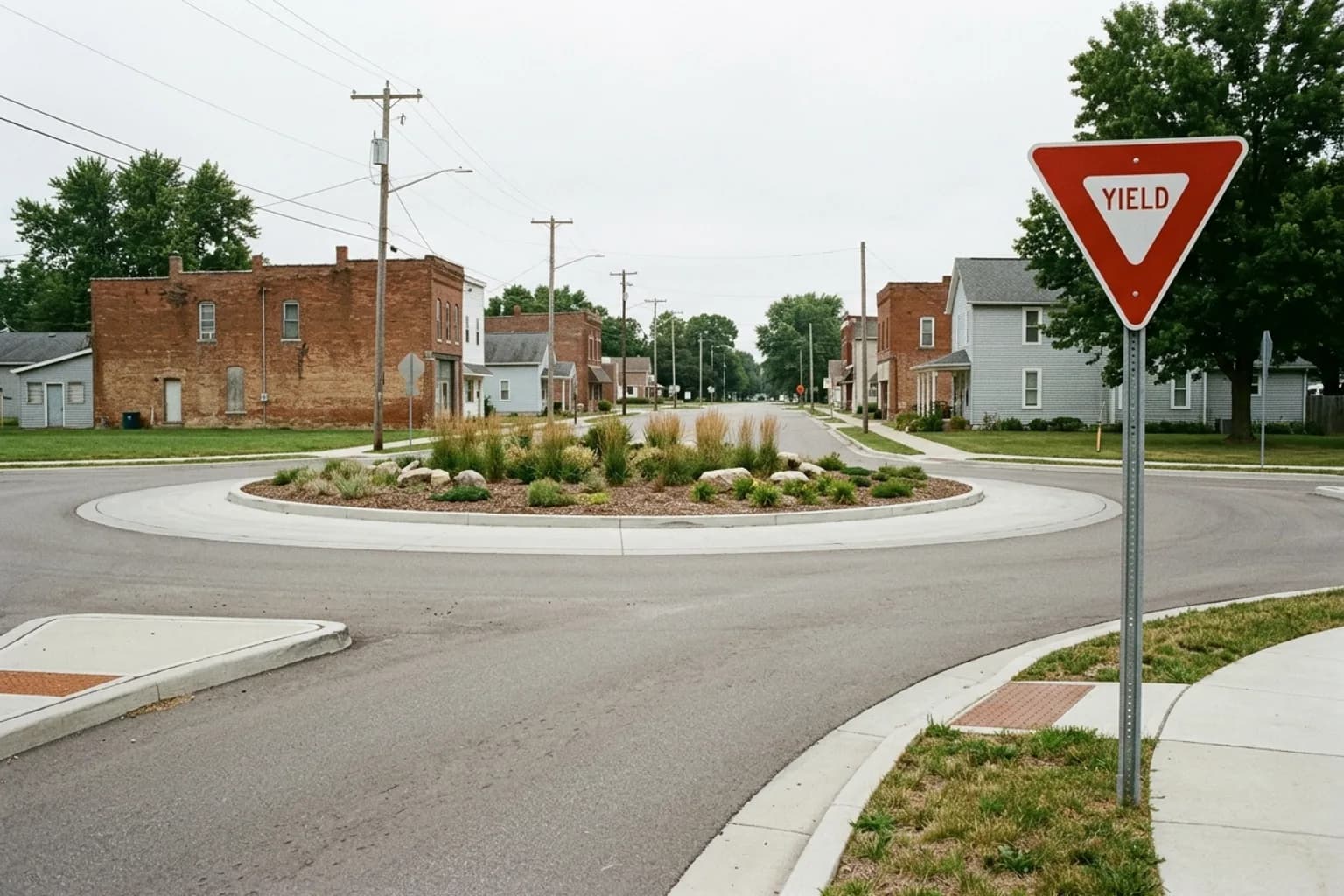
INDOT describes modern roundabouts as having yield-at-entry operation: approaching traffic gives way to circulating traffic. A driver should slow down, observe the available gap, and enter only when appropriate. A yield sign does not require an automatic stop every time, but an apparently open outer lane is not a reason to ignore another vehicle’s circulating path. INDOT explains the approach and entry sequence[1].
IC 9-21-8-33[2] requires a driver approaching a yield sign to slow to a speed reasonable for conditions, or stop when necessary. The driver must yield to a pedestrian lawfully crossing and to a vehicle in the intersection or approaching closely enough to create an immediate hazard. The statute also makes certain collisions after passing a yield sign without stopping prima facie evidence of failure to yield. That is an evidentiary starting point under the specified facts, not a declaration that every collision has only one responsible driver.
Consider a clearly hypothetical example: a sedan enters immediately in front of an SUV already circling the island. The investigation should establish where the SUV was when the sedan crossed the entry, whether the sedan paused, and whether the available footage shows the entire approach. A still photograph taken after both vehicles moved to a parking lot cannot answer those timing questions.
A second example requires a different investigation: one vehicle enters without conflict, travels alongside another vehicle, and the two collide later near an exit. Calling that an “entering-driver crash” may skip the movement that actually brought them together. The useful question is what changed between a safe entry and the contact point.

How do lane selection and exit markings affect fault?
The practical rule: choose a lane using the signs and markings at that roundabout, then follow the marked path. Do not assume every outer lane allows a complete circuit or every inner lane requires an extra lane change before exiting. The Indiana BMV driver’s manual, Chapter 7[3], illustrates roundabout operation, including multilane approaches. A general illustration does not replace the controls installed at the collision location.
Indiana’s current lane rule is IC 9-21-8-11.5[2]. On a roadway divided into two or more clearly marked lanes, a vehicle must remain as nearly as practicable within its lane, and the driver must first determine that a movement out of the lane can be made safely. IC 9-21-4-18[2] also requires obedience to the markings or signs posted under that chapter.
This matters because a lane may curve toward an exit. A driver following that curve is not necessarily “cutting across” another lane. Conversely, a driver who continues around the island across a marked exit path may be departing from the lane’s intended route. To distinguish those possibilities, trace the lane boundaries from the entry to the contact point rather than drawing a perfect circle over an aerial photograph.
Collect three connected views: the advance lane-selection sign, the arrows on the approach, and the lane lines through the disputed exit. Include the direction each photograph faces. If roadwork changed the configuration, record temporary signs and barriers as well. Avoid guessing which permanent markings were visible beneath a temporary traffic arrangement.
A turn signal provides information about a driver’s apparent intention; it does not show the complete vehicle path. INDOT instructs drivers to signal when exiting. Preserve footage of the signal if available, but compare it with the actual movement and the yield and lane duties rather than treating it as permission to cross another vehicle’s path. See INDOT’s exit guidance[1] and the lane-use statute[2].
Our article on Indiana merging and lane-change collisions discusses the broader lane-change issue. Here, the extra step is establishing how the marked lanes travel around the island.

What questions matter for each kind of roundabout collision?
The table is an investigation worksheet, not a fault calculator. Use it to identify the missing observation before accepting either driver’s description.
| Conflict described | Question to resolve | Useful material |
|---|---|---|
| Vehicle enters in front of circulating traffic | Where was each vehicle as the entering vehicle crossed the yield line? | Approach footage, yield-sign view, witness position and timing notes |
| Vehicles touch side-to-side while circulating | Did either vehicle cross a lane boundary, or did a marked lane curve toward an exit? | Continuous footage, lane-line photographs and original damage photos |
| One vehicle exits while another continues around | What movements did each approach lane permit at that exit? | Advance signs, pavement arrows and the complete entry-to-exit path |
| Contact near a large truck | What were the truck’s dimensions and each vehicle’s entry position? | Vehicle identification, dimension records and wide-angle footage |
| Collision behind a waiting vehicle | Was the lead vehicle waiting for circulating traffic or a crossing pedestrian? | Video including the crosswalk and traffic ahead, not just the rear impact |
For a witness, “the blue car was on the inside” is a useful beginning, but it leaves important gaps. Inside relative to what point? Was the witness watching both vehicles before contact? Could a truck or the central landscaping have blocked the view? Record the witness’s own words and contact details; do not coach the person into choosing a fault label.
Does Indiana give large vehicles special roundabout priority?
Yes. IC 9-21-8-10.5[2] applies to vehicles at least 40 feet long or at least 10 feet wide. Drivers approaching or traveling through a roundabout must yield to a vehicle meeting those dimensions that is traveling through at the same time or closely enough to present an immediate hazard, slowing or stopping when necessary.
The statute includes an important limit: a driver already traveling through the roundabout is not required by that subsection to yield to a qualifying large vehicle that is merely approaching it. When two qualifying large vehicles approach or travel through at the same time or in immediate-hazard proximity, the driver on the right yields to the driver on the left. These details make actual dimensions and timing important; “there was a truck” is not the full statutory analysis.
For that reason, preserve the truck or trailer identifiers, its configuration, and any recording that shows whether it was approaching or already circulating. Do not try to measure a truck beside moving traffic or approach its blind spots for photographs. A parked-truck illustration in this article explains the subject visually; it is not evidence of a particular vehicle’s size or conduct.

What should you preserve after a roundabout crash?
Address immediate safety first. If emergency assistance is needed, request it. Photograph only from a safe place; do not stand in circulating lanes or reenact a maneuver. Once safe, this checklist helps keep the roundabout’s layout connected to the account of what happened:
- Name the approach and exit. Record the intersecting roads, direction of travel, entry lane and intended exit. Include nearby landmarks only to orient the route.
- Save the original recording. Keep the full dashcam segment before and after contact. Preserve an unchanged copy and record any apparent clock error rather than editing the timestamp.
- Capture the controls. Photograph advance signs, yield signs, lane arrows, crosswalks and the exit’s lane boundaries. Keep wide views as well as close details.
- Separate observation from reconstruction. Write down what you saw and what you learned later. Label your own sketch as a recollection, not a measured reconstruction.
- Record witnesses and camera locations. Note where each witness stood and which nearby cameras might face the approach. Ask the owner to preserve the relevant time window; do not assume a visible camera recorded it.
- Keep vehicle photographs and correspondence. Save unedited photographs before repairs and organize communications by date so the account can be checked consistently.
A helpful preservation request identifies the date, approximate time, road approach, direction of travel, and a short interval around the event. Ask whether the recipient can preserve a recording even if they cannot immediately provide it. Keep a copy of the request and any response. This is practical organization, not a substitute for formal evidence procedures where those are needed.
The Indiana State Police crash-report resource page[4] directs readers to the state’s electronic report source. Use the report to help organize the investigation, then preserve the underlying photographs, recordings and witness information. Do not assume a report’s description resolves every disputed lane movement. Our Indiana car accident evidence guide provides a broader record checklist.

What if both drivers disagree or share fault?
First ask what specific movement each account alleges. “I had the right of way” is less useful than “I entered from the north in the left approach lane and followed its marked exit path.” Compare the accounts with the same sign photographs and the same continuous video segment. A photograph of side damage alone may leave more than one movement sequence possible.
For claims governed by Indiana’s Comparative Fault Act, IC 34-51-2-5 and 34-51-2-6[5] reduce damages in proportion to the claimant’s fault and bar recovery when that fault is greater than the combined fault of all persons whose fault contributed. The chapter excludes certain claims, including claims under the Indiana Tort Claims Act. Do not apply an ordinary private-driver analysis mechanically to a dispute involving a public defendant.
The roundabout-specific work comes first: identify the controlling entry rule, trace both lanes, and establish the movement that created the conflict. Those observations provide a foundation for reviewing a proposed allocation of fault. Our intersection-collision guide explains other intersection settings; traffic-light timing is not the central question at a typical yield-controlled roundabout.

Frequently asked questions
Is the entering driver always at fault?
No. The entering driver must yield, but the complete sequence matters. A later collision involving movement across marked lanes presents additional questions under Indiana’s lane-use rule. Compare entry timing with the point where the vehicles’ paths actually conflicted.
Can I enter because the outside lane looks clear?
Do not treat that observation alone as enough. INDOT directs entering drivers to yield to circulating traffic. Look at the marked paths and approaching vehicles rather than assuming a vehicle in another circulating lane cannot reach the entry or exit conflict point.
Does missing an exit establish fault?
The missed destination alone does not show the collision sequence. Identify whether the driver followed the permitted lane path or crossed a boundary into another vehicle’s path. The actual signs, markings and safe-movement requirement matter.
What if there is no dashcam video?
Organize the remaining material: advance signs, lane markings, witness observations, original vehicle photographs and each driver’s detailed route description. Record what is unknown rather than filling gaps with a confident reconstruction.
If you were hurt and the dispute turns on a yield line, lane boundary or exit path, Delventhal Law Office can review those records and explain your options in a free consultation. Bring the route details and original files, including material that may not fit your first impression.
This article is general information, not legal advice. Reading it does not create an attorney-client relationship, and neither does contacting us. If you do contact us about a possible claim, Indiana Rule of Professional Conduct 1.18 requires us to keep what you tell us confidential whether or not we take the case — but please do not send documents or detailed facts until we have agreed in writing to represent you. The photographs are original illustrative scenes, not records of an actual crash. Legal sources were checked September 12, 2026.