
Were you one of those 9,143 crashes? Statistics describe risk; your case will be decided by evidence. Talk to a Fort Wayne car accident attorney about your specific situation — preservation of evidence, the medical record, and Indiana's comparative-fault analysis matter from day one. Free consultation: (260) 484-6655.
Fort Wayne traffic feels normal until the day it is not. A quick slowdown on Coliseum. A left-turn crash on Jefferson. A rear-end collision near Glenbrook. A driver glancing down for one second on I-69. Most crashes are over in seconds, but the bills, pain, missed work, and insurance problems can last for months.
The numbers show why that matters. Fort Wayne does not have a few occasional wrecks. It has thousands of police-reported collisions every year, and the same local corridors show up again and again because traffic volume, commuting patterns, commercial routes, and driver behavior all overlap here.
This guide breaks down the latest Fort Wayne and Allen County crash statistics, what the data says about risk, and what an injured person should do after becoming part of those numbers.
Key takeaways
- Fort Wayne recorded 9,143 collisions in 2023.
- Allen County recorded 12,698 total collisions in 2023.
- Fort Wayne made up about 72% of Allen County's reported crashes.
- Indiana had 217,605 total collisions in 2023, with 928 traffic deaths and 47,552 non-fatal injuries.
- Most crashes are property-damage-only, but even "minor" collisions can cause delayed neck, back, shoulder, concussion, and soft-tissue symptoms.
- Crash reports matter, but they are not the whole case. Photos, medical records, witness information, vehicle damage, and insurance conduct can all affect the claim.
- Indiana's comparative fault rule can reduce or bar recovery if fault is disputed, so evidence preservation matters early.
How many car accidents happen in Fort Wayne each year?
Fort Wayne had 9,143 police-reported traffic collisions in 2023. That is roughly:
| Fort Wayne crash statistic | 2023 number |
|---|---|
| Total Fort Wayne collisions | 9,143 |
| Average per month | 762 |
| Average per week | 176 |
| Average per day | 25 |
That does not mean exactly 25 crashes happen every day. Weather, school schedules, holiday travel, construction season, and rush-hour patterns all change the risk. But as a practical average, Fort Wayne drivers are living with about two dozen reported crashes per day.
The countywide picture is larger:
| Allen County crash statistic | 2023 number |
|---|---|
| Fort Wayne collisions | 9,143 |
| New Haven collisions | 263 |
| Huntertown collisions | 150 |
| Unincorporated Allen County collisions | 3,025 |
| Allen County total collisions | 12,698 |
The most important takeaway is concentration. Fort Wayne accounted for about 72% of all Allen County collisions in 2023. That makes sense. Fort Wayne has the county's densest traffic, highest number of signalized intersections, major shopping and employment centers, and several high-volume corridors feeding traffic into and out of the city.
Where does the data come from?
Indiana crash statistics are not guesses. The Indiana Criminal Justice Institute explains that Indiana uses the Automated Reporting Information Exchange System (ARIES) for crash reports submitted by law enforcement. Indiana law requires an officer to investigate, and report, crashes involving injury, death, or property damage of at least $2,500.
For this article, the main data sources are:
- Indiana Criminal Justice Institute, Crash Statistics[1]
- Indiana Criminal Justice Institute / Indiana University Public Policy Institute, 2023 County Profiles[2]
- Indiana Criminal Justice Institute / Indiana University Public Policy Institute, 2023 Indiana Crash Facts[3]
- Indiana crash-reporting statute, Indiana Code § 9-26-2-1[4]
That matters because insurance companies often talk about crashes as isolated events. The data shows something different: Fort Wayne crashes are part of a predictable local traffic pattern.
Fort Wayne compared with Allen County
Fort Wayne is the center of Allen County's crash problem, but it is not the whole problem.

Some of the most serious cases happen outside the city limits on higher-speed roads. Rural and suburban crashes may involve fewer vehicles and less congestion, but they often happen at higher speeds, with longer emergency-response distances and fewer physical barriers between lanes.
That difference matters legally. A low-speed rear-end crash on a city street may involve disputed medical causation: "Was the impact hard enough to cause the injury?" A rural or highway crash may involve reconstruction questions: speed, sightlines, road design, commercial vehicle data, or whether a driver had enough time to react.
For injured people, the lesson is simple: do not assume the crash report alone captures the full picture. The report is the starting point, not the whole case.
Indiana's statewide crash numbers put Fort Wayne in context
The statewide numbers show how large the problem is beyond Allen County. In 2023, Indiana reported:
| Indiana crash statistic | 2023 number |
|---|---|
| Total collisions | 217,605 |
| Traffic deaths | 928 |
| Non-fatal injuries | 47,552 |
Those numbers come from the 2023 Indiana Crash Facts report. The same report notes that Indiana's 2023 traffic fatality rate was 13.5 deaths per 100,000 population, a slight decline from 2022 but still a serious public-safety issue.
One detail in the state report is especially important: fatal crashes are not distributed the same way as non-fatal injuries. A large share of non-fatal injuries occur in urban areas, but severe and fatal outcomes often increase on suburban, exurban, and rural roads. In plain English: city driving creates a lot of crashes; higher-speed roads can turn fewer crashes into worse outcomes.
What causes most Fort Wayne crashes?
The local data does not always tell the full human story, but the patterns are familiar to anyone who drives here. Most Fort Wayne crashes involve one or more of these factors:
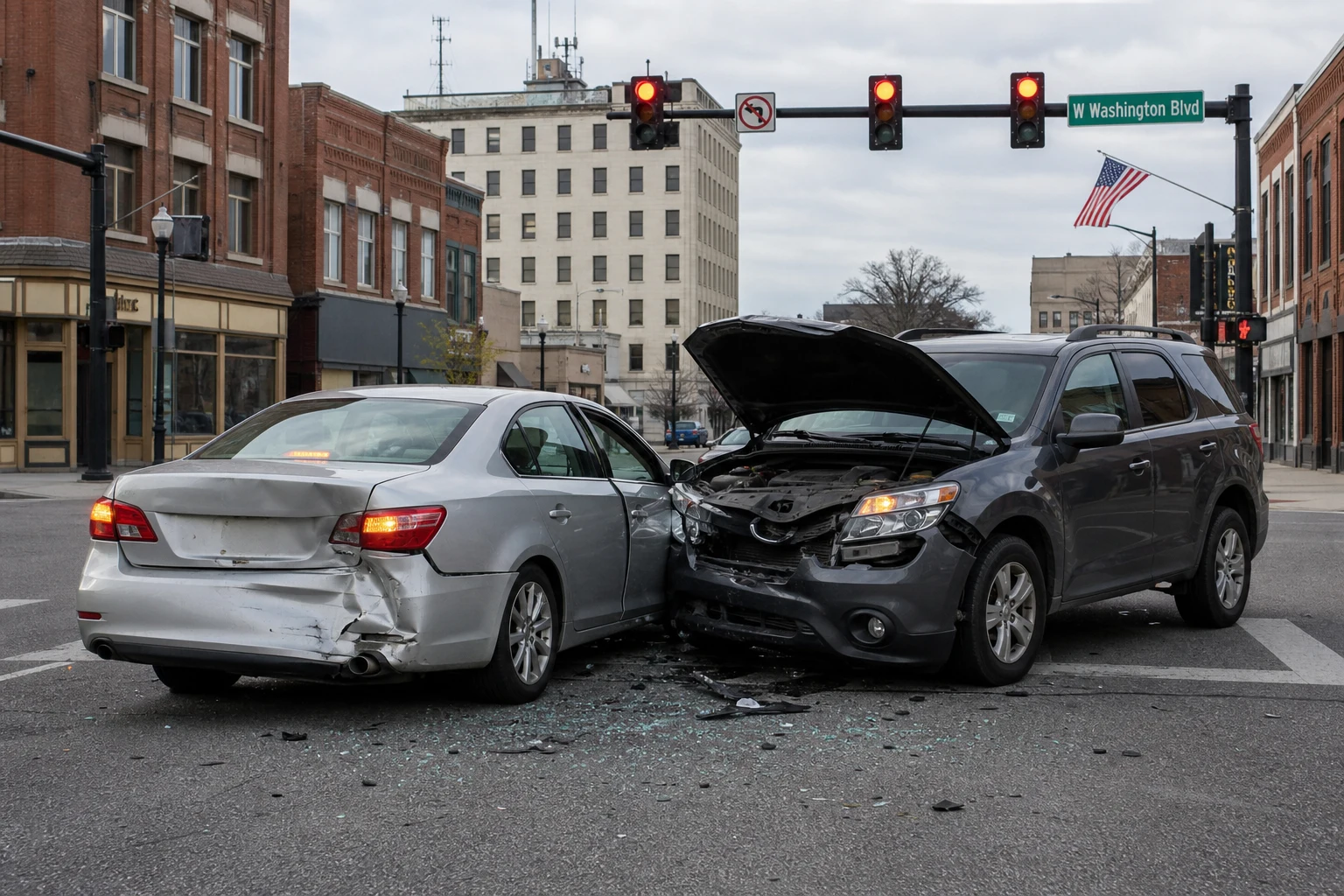
1. Following too closely
Rear-end collisions are common because Fort Wayne traffic often moves in waves: accelerate, brake, repeat. Coliseum Boulevard, Lima Road, Coldwater Road, Jefferson Boulevard, Illinois Road, and Clinton Street all create conditions where one distracted moment can become a chain reaction.
2. Driver distraction
Phones are the obvious problem, but distraction also includes navigation screens, eating, reaching into the passenger seat, talking to passengers, or trying to read temporary construction signs while traffic is moving. For more on this issue, see our guide to texting and driving in Indiana.
3. Failure to yield
Left turns, parking-lot exits, uncontrolled intersections, and yellow-light decisions generate many disputed cases. These crashes often turn on details: signal timing, lane position, witness statements, dashcam footage, and damage patterns.
4. Speed too fast for conditions
Speed does not always mean driving over the posted limit. Indiana drivers can be going "too fast" for snow, rain, fog, traffic congestion, construction zones, or limited visibility even when they are technically under the speed limit.
5. Impairment and fatigue
Alcohol and drug impairment remain major issues statewide, especially in fatal crashes. Drowsy driving is another under-discussed risk because it is harder to prove after the fact. We have written separately about drowsy driving and knowing when to pull over.
Why "property damage only" does not always mean "no injury"
Most crashes in Indiana are property-damage-only on paper. That does not always mean no one was hurt.
There are several reasons injury numbers can be undercounted:
- Pain may not peak until the next day.
- Concussion symptoms may be subtle at first.
- Neck and back injuries may worsen over several days.
- People sometimes decline EMS because they are embarrassed, worried about cost, or focused on getting home.
- The crash report only captures what was known at the scene.
This is why delayed symptoms matter. If you feel worse after a crash, get medical care and be clear with the provider about when the symptoms started and how the crash happened. We cover this issue more fully in late-appearing car accident injuries and why low-impact crashes can still cause serious pain. You can use our Indiana car accident settlement calculator to organize the factors that may affect a claim’s value; it is an educational tool, not a promise of any result.
What the statistics mean after you are hurt
Statistics are useful, but your case will not be decided by countywide averages. It will be decided by evidence.

After a Fort Wayne crash, the important questions usually become:
- Who had the right of way?
- Were there witnesses?
- Did anyone take photos or video?
- Did the police report identify a contributing factor?
- Did symptoms start right away or develop later?
- Did you get medical care quickly?
- What did the insurance company do with the claim?
- Was any fault assigned to you?
- Were there multiple vehicles, commercial vehicles, or government entities involved?
That is where a local crash case becomes more than a number.
Indiana comparative fault: why the percentage matters
Indiana uses a modified comparative fault system. Under Indiana Code § 34-51-2-6[5], an injured person can generally recover damages if their fault is not greater than the fault of the person they are making a claim against. If the injured person is partly at fault, their recovery can be reduced by that percentage. If they are more than 50% at fault, recovery can be barred.
That is why a disputed crash should be treated carefully from the beginning. A few details can move the fault percentage:
| Evidence | Why it can matter |
|---|---|
| Scene photos | Show lane positions, debris, vehicle resting points, traffic signs, and weather |
| Vehicle damage photos | Help confirm angle and force of impact |
| Witness names | Preserve neutral observations before memories fade |
| Dashcam/video | Can resolve right-of-way and timing disputes |
| Medical records | Connect injury complaints to the crash timeline |
| Repair estimate/total-loss file | Helps evaluate impact severity and vehicle damage |
| 911/police records | May show immediate complaints, admissions, or scene conditions |
The insurance company knows this. It may use small uncertainty to push more fault onto the injured person. That is why you should preserve evidence before it disappears.
What should you do after a Fort Wayne car accident?
If you are in a crash, use this practical checklist.
1. Call 911 and report injuries
If anyone is hurt, if vehicles are blocking traffic, or if there is significant property damage, call law enforcement. A police report can become important later when the insurance company starts asking what happened.
2. Get medical care early
Do not wait weeks hoping symptoms disappear. Waiting gives the insurance company an argument that the crash did not cause the injury. If you have neck pain, back pain, headaches, numbness, dizziness, shoulder pain, abdominal pain, or worsening symptoms, get checked.
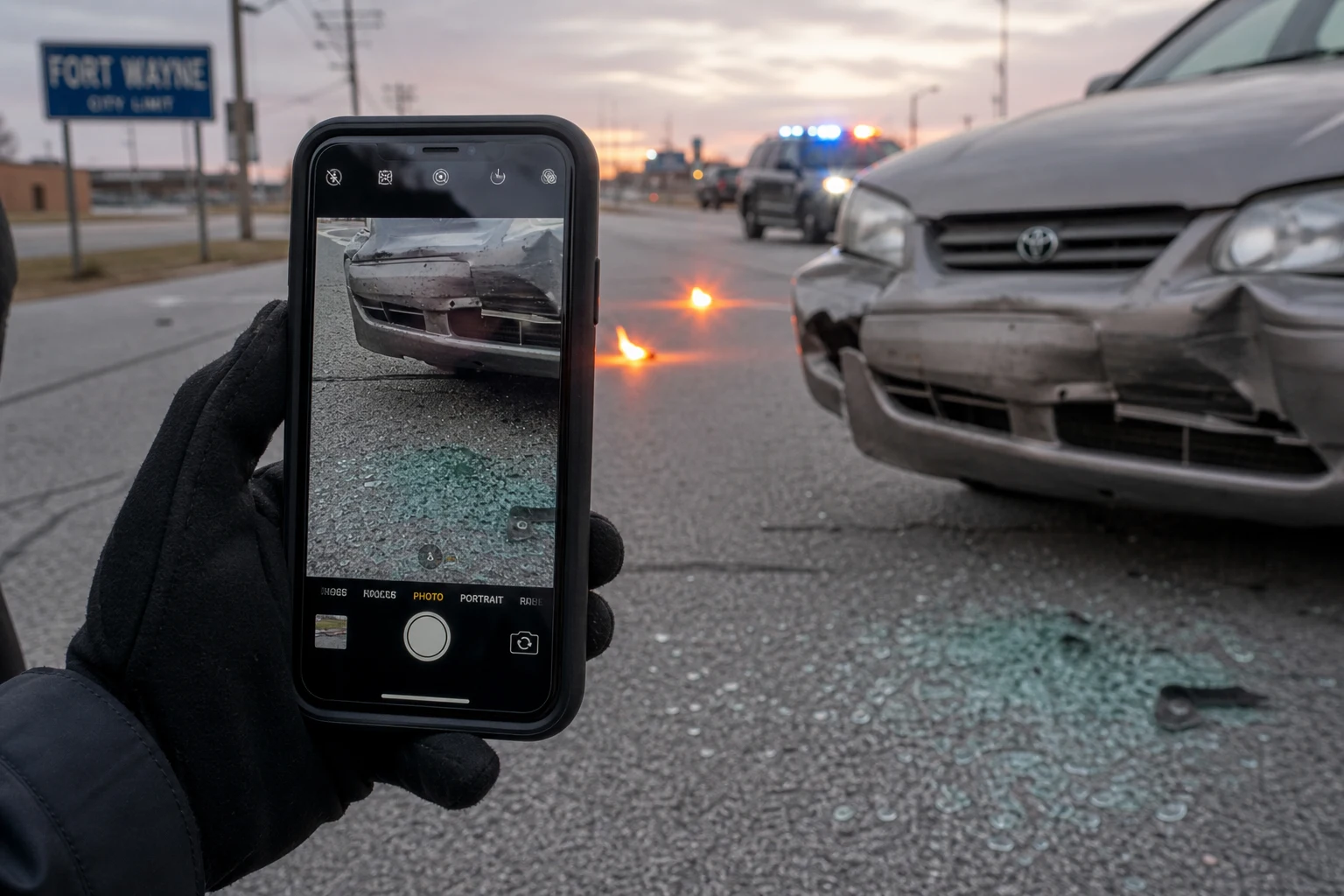
3. Photograph everything safely
If you can do so without putting yourself in danger, take photos of:
- all vehicles involved;
- close-up and wide-angle damage;
- license plates;
- road signs and traffic signals;
- skid marks, debris, and fluid trails;
- weather and lighting;
- injuries or visible bruising;
- insurance cards and driver information.
4. Identify witnesses
Witnesses disappear quickly. If someone saw the crash, get their name and phone number.
5. Be careful with recorded statements
You may have duties to cooperate with your own insurance company. The other driver's insurance company is different. Their job is to protect their insured and reduce exposure. If you are hurt or fault is disputed, consider getting legal advice before giving a recorded statement.
6. Know the deadline
Many Indiana personal-injury claims have a two-year statute of limitations under Indiana Code § 34-11-2-4[6]. Some cases have shorter notice deadlines, especially if a government entity may be involved. For a deeper deadline overview, read how long you have to file an auto accident claim in Indiana. If a government body or employee may be involved, review our Indiana government tort claim notice guide, because notice deadlines can be much shorter than the ordinary injury filing period.
When should you talk to a Fort Wayne car accident attorney?
You do not need a lawyer for every fender-bender. But you should consider talking to one if:
- you went to the ER, urgent care, or a doctor;
- symptoms are continuing or getting worse;
- you missed work;
- your vehicle was totaled;
- fault is disputed;
- the other driver was uninsured or underinsured;
- a commercial vehicle was involved;
- a child, pedestrian, bicyclist, or motorcyclist was hurt;
- the insurance company wants a recorded statement;
- medical bills are stacking up;
- you are being blamed for a crash you did not cause.
A consultation does not mean you are filing a lawsuit. It means you are learning the rules before the insurance company uses them against you.
For local guidance, see our pages for a Fort Wayne car accident attorney and Fort Wayne personal injury lawyer.
Frequently asked questions about Fort Wayne car accident statistics
How many car accidents happen in Fort Wayne each year?
Fort Wayne had 9,143 police-reported collisions in 2023. That equals about 25 reported crashes per day on average.
How many crashes happen in Allen County?
Allen County had 12,698 total reported collisions in 2023. Fort Wayne accounted for about 72% of that total.
Are Fort Wayne crashes increasing or decreasing?
The 2023 number was lower than some prior-year baselines discussed in local crash data, but Fort Wayne still experiences more than 9,000 reported collisions per year. A small year-to-year decline does not change the practical reality that crashes are a daily occurrence.
What are the most common causes of Fort Wayne crashes?
Common causes include following too closely, driver distraction, failure to yield, unsafe speed for conditions, impairment, fatigue, and poor decisions at intersections.
Does a police report prove who is legally at fault?
Not always. A crash report is important evidence, but it is not the final legal answer. Insurance companies, attorneys, judges, and juries may consider photos, video, witness statements, medical records, vehicle damage, and other evidence.
What if I did not feel hurt until the day after the crash?
Delayed pain is common. Neck, back, shoulder, headache, concussion, and soft-tissue symptoms may develop after adrenaline wears off. Get medical care and document the symptoms.
How long do I have to bring a car accident claim in Indiana?
Many Indiana injury claims have a two-year deadline, but shorter notice rules may apply in some cases, especially cases involving government entities. Do not wait if injuries are serious or fault is disputed.
Bottom line
Fort Wayne's crash numbers are not abstract. In 2023, the city had more than 9,100 reported collisions — about 25 per day. If you were hurt in one of them, the statistics may explain the risk, but evidence will determine your claim.
Delventhal Law Office helps injured people in Fort Wayne, Allen County, and throughout Indiana understand the insurance process, preserve evidence, and pursue the compensation available under Indiana law.
If you were hurt in a crash, call (260) 484-6655 or use the free case evaluation form to talk directly with our office.