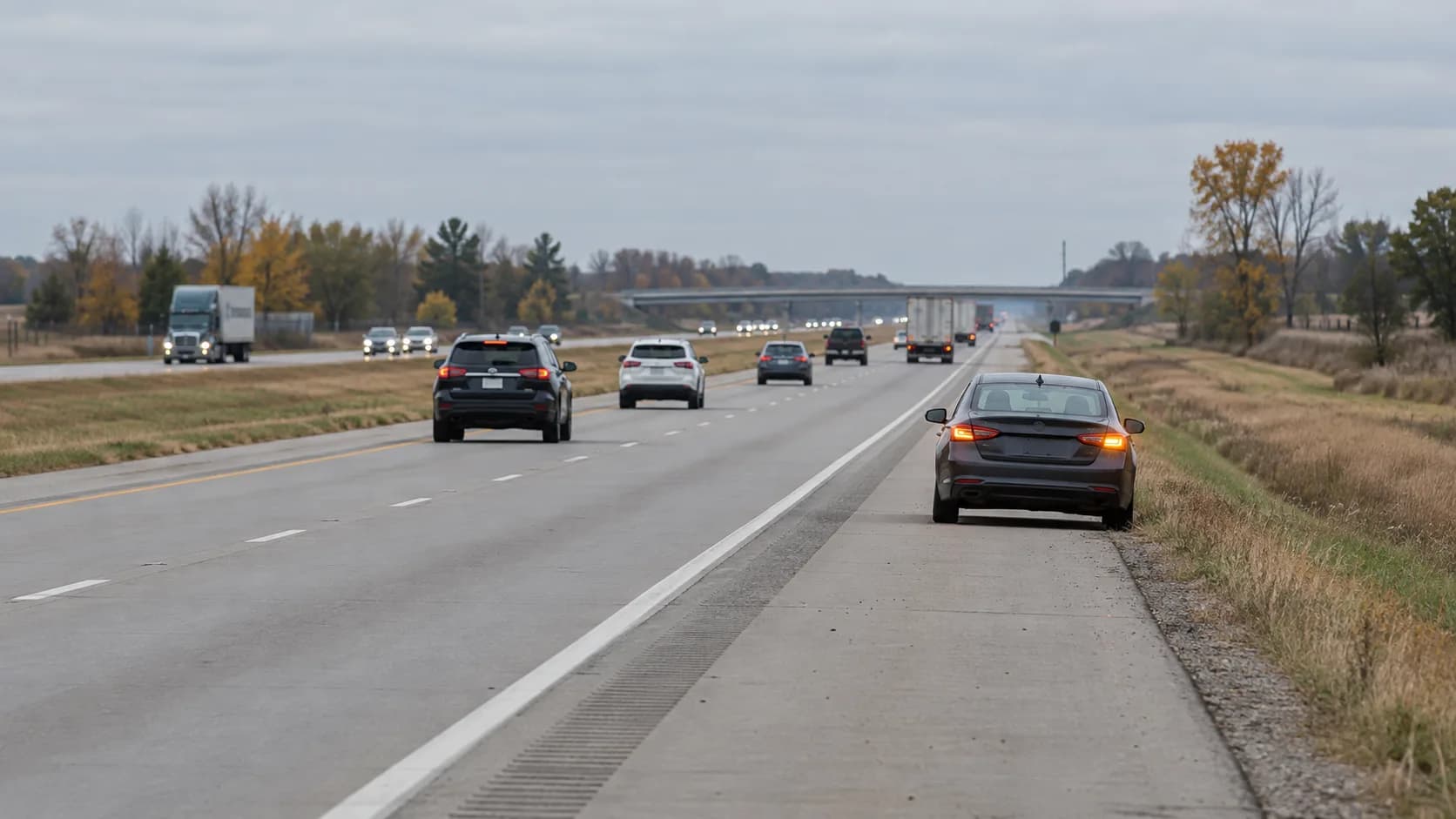
This article is about that clock. How Indiana law sets it, where the narrow exceptions live, where the deadline trap kills cases (it is government defendants, almost every time), and how to protect your right to recover long before the calendar runs out.
The Indiana Statute of Limitations: Two Years From the Crash

Indiana’s general statute of limitations for personal injury sits in IC § 34-11-2-4[1]. Two years. The clock starts on the date of the crash. It applies to claims for bodily injury, emotional distress tied to that injury, and (with separate code support at IC § 34-23-1-1[2]) wrongful-death actions when a family member dies from crash injuries. Property damage to your vehicle is also two years under IC § 34-11-2-7[3].
The two-year limit applies to filing a lawsuit. Not to filing an insurance claim. Not to negotiating with the adjuster. Those run on their own schedules. If you settle with the insurance carrier in the first six months, the statute never matters. If you do not settle and the insurer drags things out, the statute is the only thing standing between you and a recovery, and once it expires, no judge in Indiana can save the case.
Why Two Years Vanishes Faster Than You Think

Two years sounds like plenty. It is not. Here is how it actually plays out for a serious injury claim in Allen County:
- Months 1–3: Police report finalized, ambulance and ER bills arrive, MRI scheduled, you start physical therapy.
- Months 3–9: You either get better or you don’t. Surgeons may want to wait six months before recommending a procedure. Insurance reviews drag.
- Months 9–14: Medical stabilization (called “maximum medical improvement”) means the doctors can finally state what your long-term prognosis is, which is the only point at which a fair settlement value can be calculated.
- Months 14–18: Your attorney drafts a demand letter with every record, bill, and expert report. The insurer takes thirty to sixty days to respond. Then come the rounds of counter-offers.
- Months 18–24: If the carrier will not pay fair value, your lawyer files suit. If they file at month 23, they are doing it on fumes.
That is the optimistic version. Add a missed appointment, a delayed surgery, or a stalled insurance adjuster, and the two-year window closes around you faster than you can plan for. The carriers count on this. Their incentive is to wait you out.
Three Exceptions That Bend the Indiana Clock
Indiana law recognizes three meaningful exceptions to the two-year rule. Each one is narrower than people assume.
1. The discovery rule (delayed injury onset)
The Indiana Supreme Court applies a discovery rule in personal-injury cases (see Wehling v. Citizens National Bank, 586 N.E.2d 840 (Ind. 1992) and its progeny). The clock does not begin when you could have known about your injury; it begins when you knew, or in the exercise of ordinary diligence should have known, that you were injured and that the injury was caused by the wrongful act of another. In auto-accident cases, this usually means the date of the crash, because the injury and cause are obvious. The exception matters in low-impact crashes where pain surfaces weeks later, or in cases where a head injury is misdiagnosed and the true diagnosis arrives months down the road.
2. Minors and the tolling rule

If the injured person was under eighteen on the date of the crash, the statute of limitations is tolled (paused) under IC § 34-11-6-1[4]. The two-year clock does not start running until the child’s eighteenth birthday. A six-year-old hurt in a Lyft crash in Fort Wayne has, in effect, until age twenty to file. This protects children whose parents may not have the resources, time, or knowledge to pursue a claim during their childhood. It does not protect adults who fail to act on a minor child’s behalf when statute issues come up before the child turns eighteen, so parents should still seek counsel early.
3. Legal disability and mental incapacity
Indiana also tolls the statute for adults under a legal disability, including those who are mentally incapacitated at the time of the crash (also in IC § 34-11-6-1[4]). Once the disability is removed (the person regains capacity, becomes lucid, or otherwise becomes able to bring a claim), the two-year clock starts. This exception is narrow and fact-intensive; it does not apply to short-term confusion, the haze of pain medication, or the simple stress of recovery.
The Government-Defendant Trap: Indiana Tort Claims Act

Here is where most missed-deadline cases die. If a government employee or vehicle caused your crash, the two-year filing deadline is not your real deadline. The Indiana Tort Claims Act[5] requires a written Notice of Tort Claim long before suit is filed. Our guide to Indiana government tort claim notices explains who must receive the notice and what information it must contain:
- 180 days from the date of the incident, if the defendant is a political subdivision (a city, county, township, or local agency, including the City of Fort Wayne or Allen County). See IC § 34-13-3-8[6].
- 270 days from the date of the incident, if the defendant is the State of Indiana or a state agency (including INDOT, Indiana State Police, and state university employees on duty). See IC § 34-13-3-6[7].
If you skip the notice, your case can be dismissed even though the regular two-year statute has not run. The notice has technical content requirements (description of the loss, the time and place, the names of any government employees involved, the amount of damages sought) and must be served on a specific official. Common scenarios where this trap closes: a Fort Wayne sanitation truck T-bones you at an intersection. An Allen County sheriff’s deputy rear-ends you on US-24 while not in pursuit. An INDOT plow drifts into your lane on I-69 near Auburn. A school bus driver in Huntington runs a stop sign. In each of these, the 180-day or 270-day notice clock is shorter than your medical recovery and ticks before you have even hired an attorney. You can use our Indiana car accident settlement calculator to organize the factors that may affect a claim’s value; it is an educational tool, not a promise of any result.
What Happens If You Miss the Deadline

If the statute of limitations expires before suit is filed, the defendant’s lawyer will file a motion to dismiss under Indiana Trial Rule 12(B)(6) or for summary judgment under Rule 56. The court will grant it as a matter of law. There is no appeal that fixes a missed statute. There is no “but I had a good reason” argument that brings the case back. The legal door is closed.
The carrier knows this. Insurance adjusters track filing deadlines on every claim they handle, and an adjuster who has run a Fort Wayne case to month twenty-three is not negotiating in good faith. They are betting the claimant will let the clock expire. Many do, especially unrepresented claimants who do not realize how close they are.
It is also worth knowing what does not stop the clock. Mailing a demand letter does not stop it. Filing an insurance claim does not stop it. Negotiating with the adjuster does not stop it. The only event that stops it is filing a complaint in court (or, for government defendants, properly serving a Notice of Tort Claim within the shorter window).
The 90 / 30 / Now Timeline (What to Do, When)
If you have been hurt in a Fort Wayne or Allen County car accident and you want to keep your options open, this is the timeline a personal-injury attorney would have you follow. None of it requires hiring a lawyer first; all of it preserves your ability to do so later.
Right now (Day 0):
- Get the police report number. The Fort Wayne Police Department crash report should be requested through crashdocs.org[8] for Indiana crashes.
- Photograph everything: the vehicles, the scene, the road, the weather, your visible injuries, the inside of your car. Save them to cloud storage, not just your phone.
- Do not give a recorded statement to the other driver’s insurer. You are not required to. Politely decline until you have spoken with counsel.
- Do not sign a medical-records release until you understand what is being released and to whom.
Within 30 days:
- See a doctor even if you feel mostly fine. Symptoms (especially soft-tissue, concussion, and disc-related) commonly delay. Document everything in writing with a healthcare provider so the insurance company cannot later argue you invented the injury.
- Keep a simple injury journal: pain level (1–10), missed work, things you cannot do that you could do before. This becomes evidence later.
- Talk with a Fort Wayne car accident attorney for a free consultation. You are not committing to hire; you are getting information.
Within 90 days:
- Make a decision about representation, especially if injuries are serious, fault is disputed, or any government vehicle was involved (because of the 180-day notice trap above).
- Preserve the wrecked vehicle if possible until counsel approves release.
- Confirm whether you have underinsured or uninsured motorist coverage on your own policy. In Indiana these benefits often matter more than the at-fault driver’s liability limits.
How Delventhal Law Office Builds Your Case Before the Clock Runs
Most personal-injury firms in Fort Wayne file suit late in the two-year window, when negotiations stall and the deadline forces their hand. At Delventhal Law Office, the approach is the opposite: build the case as if it will be filed early, then negotiate from strength. That means evidence preservation in the first weeks, not the last months. It means depositions of the other driver and the responding officer well before the carrier has time to coach memories. It means working with treating doctors to get clear, written prognoses, not vague boilerplate.
It also means we do not run our own clients to the deadline. Our internal target is to file or settle by month twelve to fifteen, leaving a buffer for the unexpected. The carriers know which Fort Wayne firms wait and which file early, and that reputation shifts how aggressively they will negotiate from the first call.
If a government defendant is involved (a city plow, a county vehicle, an INDOT driver), we move on the Notice of Tort Claim within the first thirty days. That window is too short to take chances with.

Every case at Delventhal Law Office is handled by Chad directly, not handed off to a paralegal funnel. Indiana State Bar, admitted 2008. Hundreds of Fort Wayne, Allen County, DeKalb, Whitley, and Adams County injury claims. One direct line to your attorney, twenty-four hours a day, seven days a week.
FAQs About Indiana Auto Accident Filing Deadlines
When does the two-year clock start?
It starts on the date of the crash for almost every auto-accident claim in Indiana. The narrow exception is the discovery rule, which can shift the start date if the injury was not reasonably discoverable at the time. In practice, almost all car-crash injuries trigger the clock on day one.
Does filing an insurance claim stop the statute of limitations?
No. Submitting a claim to the at-fault driver’s insurer (or your own carrier) does not toll the statute. The only event that stops the clock is filing a complaint in court within the deadline.
What if I was hurt by a Fort Wayne city employee or vehicle?
You need to serve a written Notice of Tort Claim on the political subdivision within 180 days. Failure to do so means even a perfect case at month 700 cannot be brought. This is the most common way valid Fort Wayne injury claims get extinguished.
What if my child was the one injured?
The two-year clock is tolled until the child turns eighteen. That said, evidence decays, witnesses move, and police-report retention is finite. Talk with an attorney early so the case can be preserved even if it is not filed for years.
I’m past the two-year mark. Is there anything I can do?
Probably not, but the analysis depends on whether any tolling exception applied. A short, free consultation with a Fort Wayne car accident attorney can tell you in twenty minutes whether the case is closed or whether one of the narrow exceptions might apply.
Talk to a Fort Wayne Car Accident Attorney Before the Clock Runs Out
The Indiana statute of limitations is unforgiving. The Tort Claims Act notice is worse. Both exist precisely because defendants benefit when claimants wait. The way to beat the clock is not to race it; it is to start the case early, build the evidence while it is fresh, and put yourself in the position where the carrier’s only choice is to pay fair value.
If you were hurt in a crash anywhere in Allen County, DeKalb County, Whitley County, Adams County, or Indiana, talk to Delventhal Law Office before another month goes off the clock. The consultation is free, no obligation, and you are talking to Chad directly, not a screener. Call (260) 484-6655 or contact us online to schedule a free case evaluation.