This guide helps Indiana motorists organize an animal-collision account for a policy discussion or consultation with a Fort Wayne car-accident attorney. It is not an individual claim assessment.
Indiana DNR reports more than 15,000 deer-vehicle collisions reported annually to the Indiana Department of Transportation. Indiana DNR deer-collision data[2]
- Distinguish what you saw from what a witness told you.
- Record whether the vehicle actually touched the animal.
- Describe each vehicle’s movement and each impact separately.
- For an escaped domestic animal, identify the keeper and possible escape route without entering private property.
- Keep vehicle-repair paperwork separate from bills and missed-work records.
Separate the animal encounter from later impacts
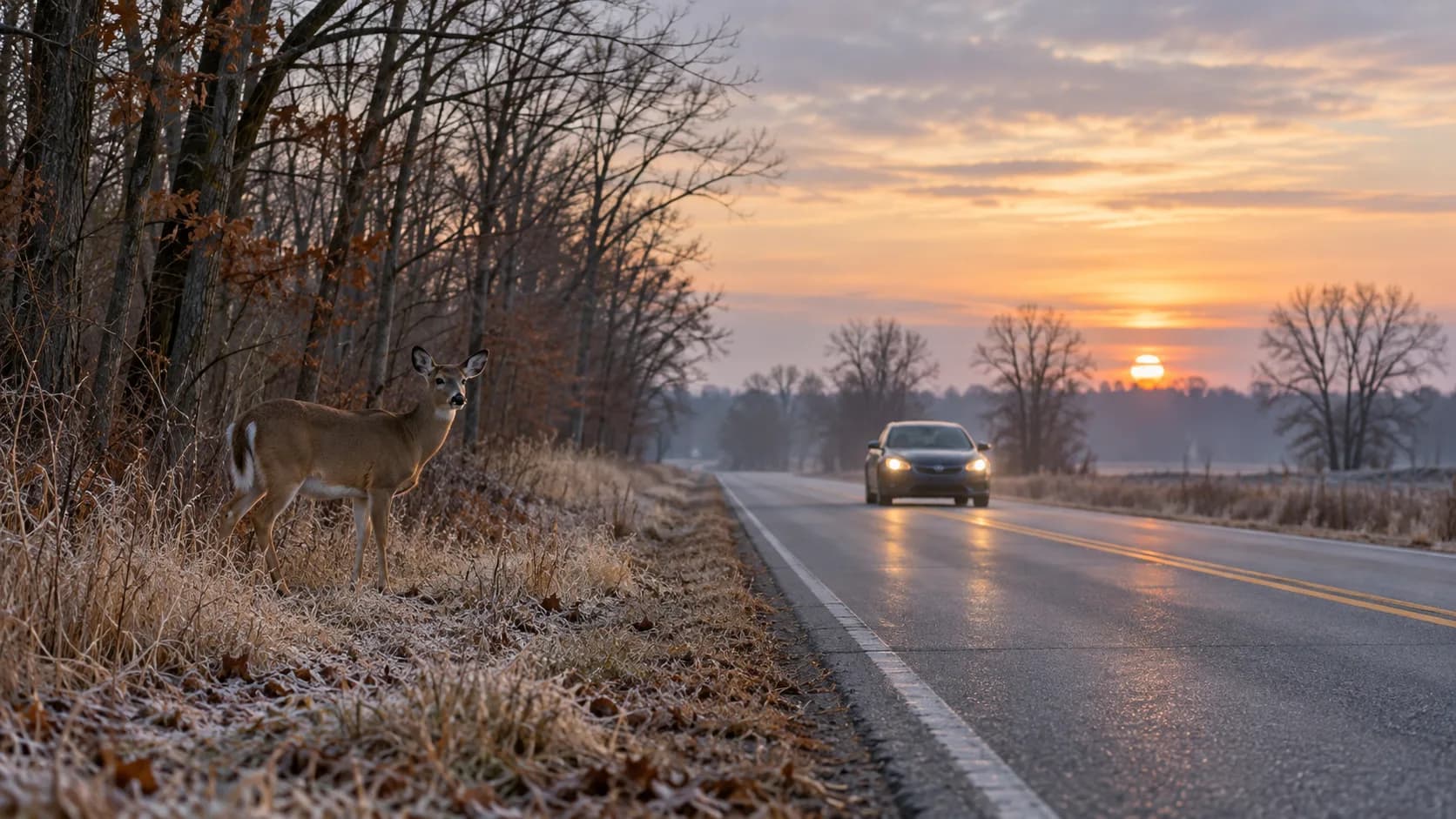
A deer crossing the road, a car leaving its lane, and a following vehicle striking that car are different parts of the same event. Write them in order. “Animal crash” is a useful description, but it leaves unanswered whether there was direct animal contact, an avoidance maneuver, or a secondary impact.
Safety first: Indiana State Police advises motorists who strike a deer not to touch it, to remain in the car, check that occupants are safe, and call police for a crash report. A frightened or wounded deer can cause serious injury. Indiana State Police deer-crash guidance[3] Follow emergency responders’ instructions; do not step into traffic to collect evidence.
When you are somewhere safe, make a short chronology: direction of travel, where the animal first appeared, what each vehicle did, what struck what, and where the vehicles stopped. Use “approximately” for uncertain distances or times. Do not fill gaps with assumptions.
Illustrative example—not a client case: A driver brakes after seeing a deer. Another car then strikes the rear of the first car. Keep the deer sighting and the rear impact as separate entries. A witness who saw only the impact may not know what happened before it.

When another person belongs in the investigation
The following are investigation leads, not findings against anyone:
- Another vehicle: note lane position, following distance, signals, braking, and the sequence of impacts. Save footage showing the approach, not only the moment of contact.
- A loose domestic animal: note its description, any visible identification, the reported owner or keeper, and the location of a gate or fence opening. Mark an owner’s identity as unconfirmed unless you have confirmed it.
- A roadway concern: identify the exact road, travel direction, nearest intersection, and the particular obstruction or barrier you observed. Keep any prior report number or agency response you already have.
- A company vehicle: record the business name, unit number, plate, and driver information. A logo alone is not a complete account of who was using the vehicle.
For livestock or a pet, ask who had control of the animal and what is actually known about its escape. A nearby house, a damaged fence, or a rumor of earlier escapes is a lead to check, not a substitute for verified facts. Do not chase the animal, handle it, alter a gate, or remove someone else’s property.
Horse-drawn traffic presents separate questions; our horse and buggy collision guide addresses that setting. This article does not repeat the buggy equipment rules.
The Comparative Fault Act does not apply to tort claims against governmental entities or public employees under the Indiana Tort Claims Act. IC 34-51-2-2 A roadway concern therefore calls for a separate review, not an automatic application of the ordinary private-party percentage rule below.

Animal-collision evidence worksheet
This is an organizational worksheet, not a legally required checklist. Record only what you can safely and lawfully observe or already possess. An attorney can discuss appropriate requests for material held by someone else.
| Event or question | What to record | Uncertainty to label |
|---|---|---|
| Animal contact | Animal description, impact location, damage photographs, and the animal’s direction of travel. | Did you see contact or infer it afterward? |
| Avoidance maneuver | Lane, braking or steering sequence, and full dashcam recording if available. | Which movements did you personally observe? |
| Secondary impact | Vehicle positions, impact points, plate numbers, witness contacts, and report number. | Did the witness see the approach or only the final impact? |
| Escaped animal | Keeper information, gate or fence location, and the source of any prior-escape report. | Was the opening present before the crash or noticed afterward? |
| Roadway concern | Road name, direction, nearby intersection, specific condition, and existing agency correspondence. | Who controls that location, and is that confirmed? |
| Personal records | Bills, receipts, appointment records, work-status notes, and employer absence records. | Which dates or amounts still need confirmation? |
Keep original photo and video files, with a backup. Identify nearby cameras without assuming you can access them. Discuss preservation before repair or disposal of your own damaged property; do not delay necessary safety measures. For broader preparation, use our car-accident evidence guide.

Animal contact and insurance questions
As a general insurance explanation, the Iowa Insurance Division describes comprehensive coverage as the relevant protection for animal strikes and collision coverage as protection for damage from hitting another vehicle or object, subject to deductibles. Iowa Insurance Division animal-collision overview[4] This describes common policy categories; it is not a ruling on your Indiana contract or a promise of payment.
Indiana’s Department of Insurance separately describes collision, comprehensive, medical-payments, and liability coverage. Medical payments pays medical bills incurred by the insured and usually passengers, up to policy limits, for injuries while riding in, entering, or getting out of the car. Towing and rental coverage may also be available. Indiana Department of Insurance auto-policy overview[5]
Practical questions to put in your claim notes:
- Which policy provision is being applied to the documented sequence?
- What deductible and limit does that provision contain?
- Are the vehicle-damage and personal-expense requests being handled separately?
- What documents are requested, and when?
- What written explanation supports a denial or partial payment?
Bring the declarations page, full policy, endorsements, claim correspondence, and any written explanation to a consultation. Do not change your factual account to fit a policy label. If another car was involved, identify its driver and policy information as a separate part of the file.

Indiana fault rules and time limits
For claims governed by Indiana’s Comparative Fault Act, a claimant’s share of fault proportionately reduces compensatory damages. Recovery is barred when the claimant’s fault exceeds 50% of the total fault. The jury considers defendants and qualifying nonparties, not only the people named as defendants. IC 34-51-2-5 through -8[6]
The Act excludes medical-malpractice actions against qualified healthcare providers as well as Tort Claims Act cases against governmental entities or public employees. IC 34-51-2-1 and -2 Do not use this brief overview to calculate an award or decide a disputed percentage.
IC 34-11-2-4[7](a) generally requires an action for personal injury or injury to personal property to begin within two years after the cause of action accrues. IC 34-11-2-4(a)[8] The accrual date and any exception need individual review. An insurance discussion is not the filing of a lawsuit.
Government claims have separate, shorter notice requirements: IC 34-13-3-6[9] generally requires state-claim notice within 270 days after the loss, while IC 34-13-3-8[10] generally requires political-subdivision notice within 180 days. The statutes specify recipients and exceptions, including provisions for incapacity. IC 34-13-3-6 through -9[11] These are notice periods, not substitutes for the lawsuit period. Our Indiana tort-claim notice guide explains the process in more detail. Have the particular parties, dates, and delivery requirements checked rather than relying on a crash report as the notice.

Frequently asked questions
What if I never actually hit the deer?
Record that clearly. Describe the animal sighting, your maneuver, and what your vehicle actually struck. Preserve any recording or witness account that shows the sequence, and avoid describing inferred contact as something you saw.
Does the animal’s presence settle who was at fault?
No automatic percentage follows from this guide. In a claim governed by the Comparative Fault Act, causal relation is required and fault is allocated among the relevant persons. The animal’s presence does not replace that analysis. IC 34-51-2-3 and -7
What should I record about a loose cow, horse, or pet?
Record the description, reported keeper, visible identification, possible escape route, and who supplied each detail. Keep unverified information labeled as unverified. Do not enter private land or approach an injured animal to investigate.
Does comprehensive insurance generally address a direct animal strike?
Yes, the Iowa Insurance Division’s general explanation identifies comprehensive coverage for animal strikes and collision coverage for striking another vehicle or object. Your actual policy and facts still need review; that agency overview is not an Indiana coverage determination. Iowa Insurance Division coverage explanation
Should I call police after a deer strike?
Indiana State Police advises remaining in the car, checking occupants, not touching the deer, and calling police for a crash report. Follow emergency instructions and do not expose yourself to traffic to take photographs. Indiana State Police after-crash guidance
What should I bring to a consultation?
Bring the event chronology, crash report or report number, original photographs and footage, witness contacts, policy documents, written claim decisions, bills, and absence records. Explain what you do not know. Do not send sensitive documents through social media or a public comment.
Prepare for a consultation
When another vehicle, an escaped animal, or a roadway concern is part of the account, Chad Delventhal can review the available information and identify what needs further investigation. You can request a free consultation without guessing who should be named in a claim.
This article is general information about Indiana law and is not legal advice. Reading it does not create an attorney-client relationship, and neither does contacting us. Every case depends on its facts. Do not send sensitive documents until the firm provides an appropriate method.
Sources
- IC 34-51-2-3 (iga.in.gov) ↩
- Indiana DNR deer-collision data (in.gov) ↩
- Indiana State Police deer-crash guidance (in.gov) ↩
- Iowa Insurance Division animal-collision overview (iid.iowa.gov) ↩
- Indiana Department of Insurance auto-policy overview (in.gov) ↩
- IC 34-51-2-5 through -8 (iga.in.gov) ↩
- IC 34-11-2-4 (iga.in.gov) ↩
- IC 34-11-2-4(a) (iga.in.gov) ↩
- IC 34-13-3-6 (iga.in.gov) ↩
- IC 34-13-3-8 (iga.in.gov) ↩
- IC 34-13-3-6 through -9 (iga.in.gov) ↩