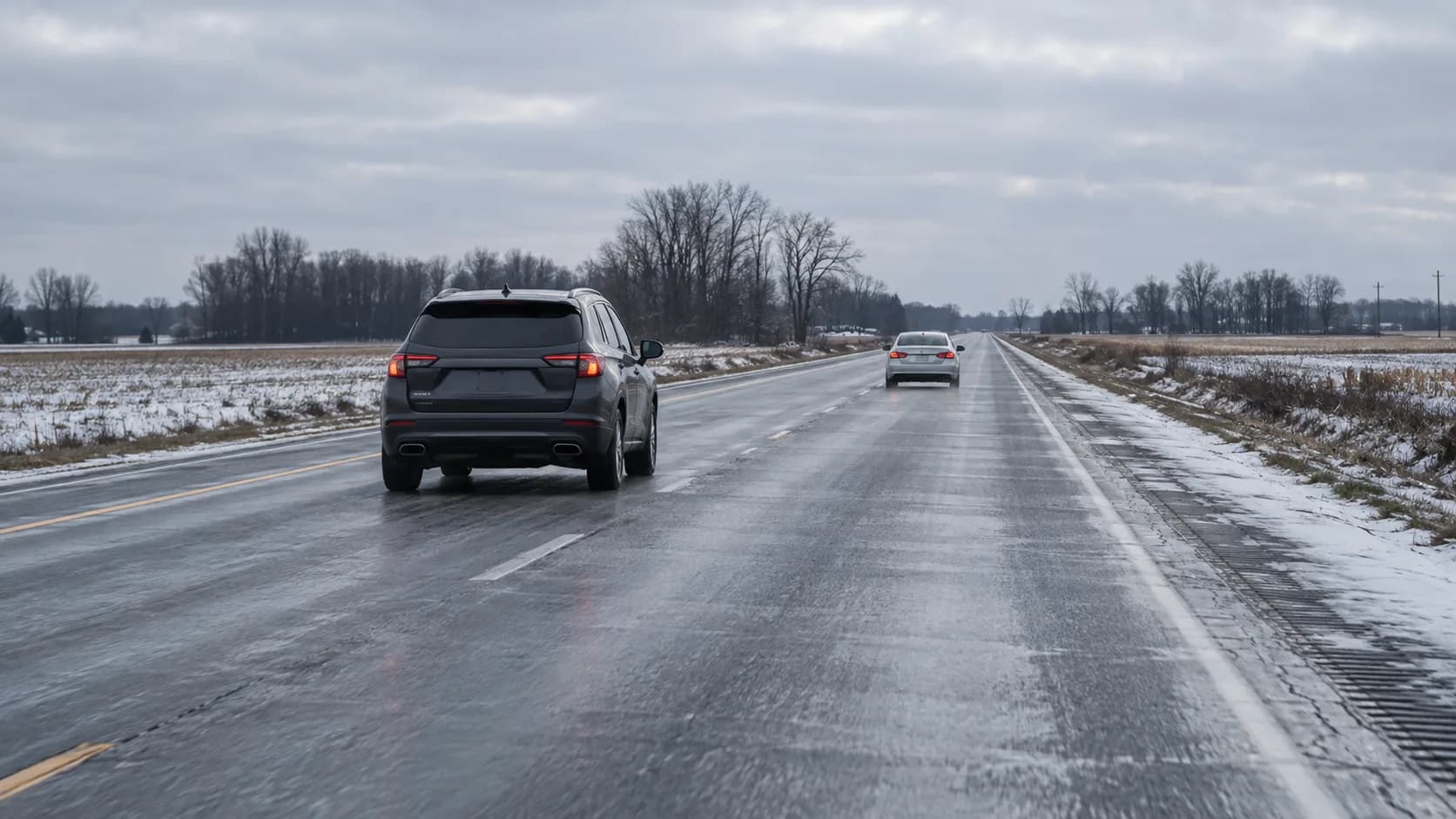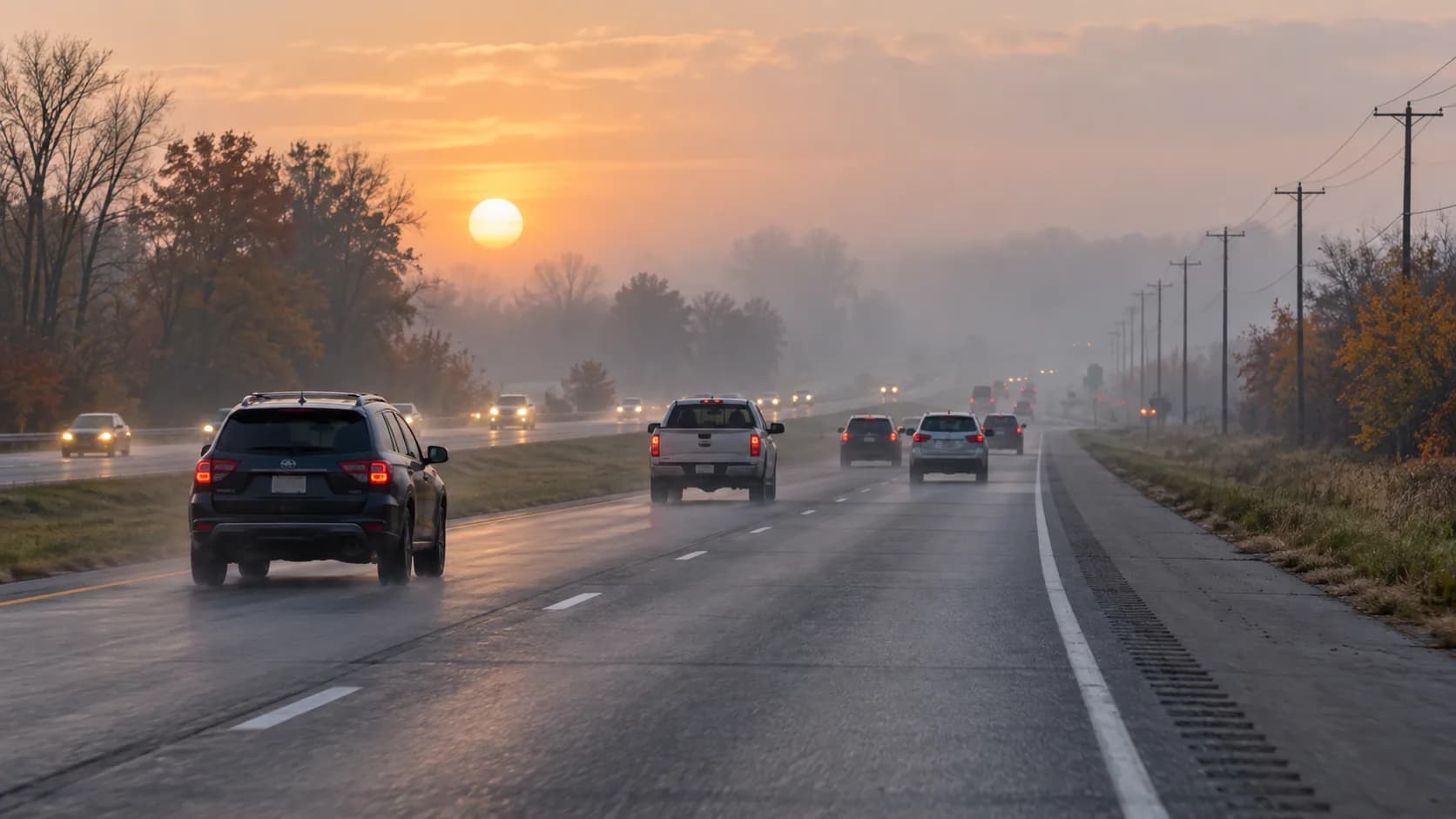
Sun glare on an east–west Fort Wayne street, dense fog on an Allen County road, smoke crossing a highway, or dust near a construction area can leave a driver with little time to react. If a collision follows, the central question is usually not whether visibility was bad. It is whether each driver responded reasonably to the conditions.
- Drivers must adjust their speed when weather, road, traffic, or visibility conditions create a hazard.
- Indiana’s lighting law generally requires headlamps and other required lights from sunset to sunrise and when people and vehicles cannot be clearly seen 500 feet ahead because of insufficient light or atmospheric conditions.
- The Indiana Bureau of Motor Vehicles advises drivers to reduce speed and use low beams in fog.
- Photos, video, witness accounts, weather information, vehicle data, and an accurate timeline can help explain what each driver could see.
- For claims governed by Indiana’s Comparative Fault Act, shared fault can reduce or prevent recovery; government tort claims are excluded from that Act.
Legal sources checked October 23, 2026. Official links below identify the relevant sections and PDF pages; practical checklists are suggestions, not legal requirements.
Poor visibility is not an automatic defense
Saying “I could not see” does not, by itself, resolve responsibility for a collision. Indiana’s speed statute requires a motorist to drive at a reasonable and prudent speed under the conditions and to reduce speed when weather or highway conditions create a special hazard.
That rule matters because a posted speed limit is not a promise that the posted speed is safe in every condition. A driver approaching a bank of fog, heavy smoke, blinding sunrise, or blowing dust may need to slow down enough to respond to traffic within the visible roadway.
Responsibility remains fact-specific. Practical questions to discuss with an attorney include the driver’s speed, following distance, lighting, lane position, braking, route familiarity, and reaction after visibility deteriorated. These are investigation suggestions, not a statutory checklist. For a broader explanation, see our guide to evaluating fault after a crash.

Indiana driving rules that matter when visibility drops
Reasonable speed for the conditions
Indiana Code 9-21-5-1[1] requires a driver to use a reasonable and prudent speed, considering actual and potential hazards, and to control speed as necessary to avoid a collision.
Indiana Code 9-21-5-4[2] requires an appropriate reduction in speed when a special hazard exists because of weather or highway conditions.
Headlight requirements
Indiana Code 9-21-7-2[3] generally requires vehicles on a highway to display lighted headlamps and other required lighting from sunset to sunrise and when insufficient light or unfavorable atmospheric conditions prevent people and vehicles from being clearly discernible 500 feet ahead. The section includes equipment-specific exceptions and refers separately to parked-vehicle rules.
The Indiana BMV Driver’s Manual[4] advises reduced speed and low-beam headlights in fog.
The National Weather Service[5] also recommends slowing down, increasing following distance, and using low-beam headlights when driving in fog.

How sun glare, fog, smoke, and dust can affect a crash
Sun glare
Low morning or evening sun can obscure a traffic signal, pedestrian, stopped vehicle, or turning driver. After a crash, note the exact time, direction of travel, road grade, tree cover, buildings, windshield condition, and whether a visor or sunglasses were in use.
Fog
Fog can conceal stopped traffic and make distance difficult to judge. The Indiana BMV advises drivers to proceed cautiously at reduced speeds, use low beams, and carefully pull off the road when visibility is reduced to nearly zero.
Smoke, dust, and other obstructions
Smoke from a fire, blowing field dust, construction dust, heavy precipitation, or spray from other vehicles can interrupt an otherwise clear view. Document where the reduced-visibility area began, whether warning signs or emergency vehicles were present, and whether traffic slowed before entering it.
A visibility problem may also combine with another crash pattern, such as unsafe following distance, a sudden lane change, or a stopped vehicle. Our Indiana car-accident evidence guide explains how different records can fit together.

Evidence checklist for a poor-visibility crash
This practical checklist focuses on the driver’s sightline and response, not on assigning fault from the weather alone. Record what you actually observed; mark estimates and unknowns. Never stand in a travel lane or recreate hazardous driving to obtain a photograph.
| Visibility question | Details to preserve | Limit to keep in mind |
|---|---|---|
| Was glare in this driver’s line of sight? | Exact time, compass direction, road grade, windshield condition, visor position, and original photographs | An opposite-facing driver or a photograph taken later may show a different view. |
| Where did fog, smoke, or dust begin? | Approach landmarks, witness positions, video, and the sequence before visibility changed | A nearby weather observation does not establish the view through this windshield. |
| How did the driver respond? | Recollections of braking, spacing, lane changes, lights, and traffic ahead; preserve relevant video and vehicle data | Do not turn an uncertain distance or speed estimate into an exact number. |
| Could approaching drivers see stopped traffic? | Positions of vehicles, warning devices, road curvature, and each witness’s approach direction | Conditions after an impact may differ from conditions before it. |
| What changed before documentation? | Elapsed time, moving fog or smoke, emergency lighting, moved vehicles, and camera settings if known | A clear later photograph does not disprove an earlier obstruction; a photograph also may not reproduce human vision. |
For finding official observations and road records, use our weather and road-records guide. Keep those records alongside firsthand observations; identify which details came from which source.
If video may exist, use the steps in our guide to preserving traffic-camera and business-surveillance footage. If a vehicle may contain electronic crash information, read about preserving passenger-vehicle event data.
What to do after a poor-visibility crash
- Move out of danger if you can. Secondary impacts are a concern when approaching drivers cannot see the crash scene.
- Call 911 and report the visibility hazard. Identify fog, smoke, dust, glare, stopped traffic, fire, or debris as specifically as you can.
- Seek appropriate medical attention. Tell your medical provider how you feel and follow their instructions.
- Photograph the viewing conditions safely. Capture the driver’s approach, not only the vehicle damage.
- Exchange information and identify witnesses. Avoid arguing about fault at the roadside.
- Save original digital files. Do not trim, filter, or overwrite potentially useful photographs or recordings.
You can find a broader post-crash checklist in our guide to the early days after a Fort Wayne car accident.

Comparative fault and filing deadlines
For claims governed by Indiana’s Comparative Fault Act, IC 34-51-2-5 and -6[6] reduce damages for the claimant’s contributory fault and bar recovery when that share exceeds 50 percent. This is not a universal rule for every defendant. IC 34-51-2-1 and -2[7] exclude specified claims, including tort claims against governmental entities or public employees under the Tort Claims Act and medical-malpractice actions against qualified health care providers.
In a hypothetical example, one driver may have entered dense fog too fast while another was stopped partly in a travel lane without visible lighting. The evidence must be evaluated before assigning percentages; the weather condition alone does not decide fault.
IC 34-11-2-4(a)[8] generally requires a personal-injury action to be filed within two years after the cause of action accrues. Accrual and exceptions require case-specific review.
Government claims can require notice much earlier: IC 34-13-3-6[9] addresses state claims and IC 34-13-3-8[9] addresses political-subdivision claims. These notice requirements are separate from filing a lawsuit and have their own exceptions and service rules. Ask an attorney promptly which filing and notice requirements apply to your situation.
If you are organizing the financial parts of a claim, the Fort Wayne car-accident settlement calculator can help you list bills, wage loss, fault questions, and available insurance without predicting a result.

Frequently Asked Questions
Is a driver automatically at fault for hitting someone because of sun glare?
No. Fault depends on the full circumstances, but sun glare does not automatically excuse a collision. Indiana’s reasonable-speed rule requires drivers to account for actual and potential hazards.
Does Indiana require headlights in fog?
Generally, yes: IC 9-21-7-2[10] requires headlamps and other required lights when people and vehicles cannot be clearly seen 500 feet ahead because of insufficient light or unfavorable atmospheric conditions, subject to its exceptions.
Should a driver use high beams in dense fog?
No. The Indiana BMV advises low beams in fog; the National Weather Service explains that high beams cause glare, making it harder to see the road ahead.
Can weather information help after a crash?
Time- and location-specific weather information can help document reported conditions, but it should be considered with scene photographs, witness accounts, video, and other evidence.
Can both drivers share responsibility?
Yes. In claims governed by the Comparative Fault Act, the claimant’s fault reduces damages and a share greater than 50 percent bars recovery. The Act excludes government tort claims and certain other actions; different rules may apply.
How long do I have to file an Indiana injury lawsuit?
IC 34-11-2-4[11](a) generally provides two years after a personal-injury cause of action accrues. Exceptions and separate government-claim notice requirements can change what must be done and when. Ask an attorney which timing rules apply to your situation.
Discuss the visibility questions with an attorney
If poor visibility contributed to your Indiana crash, our Fort Wayne car-accident team can help identify which sightline, lighting, and driver-response facts need investigation. Request a free consultation to discuss the available records and your next step with Delventhal Law Office.
This article is general information about Indiana law and is not legal advice. Reading it does not create an attorney-client relationship, and neither does contacting us.
Sources
- Indiana Code 9-21-5-1 (iga.in.gov) ↩
- Indiana Code 9-21-5-4 (iga.in.gov) ↩
- Indiana Code 9-21-7-2 (iga.in.gov) ↩
- Indiana BMV Driver’s Manual (in.gov) ↩
- National Weather Service (weather.gov) ↩
- IC 34-51-2-5 and -6 (iga.in.gov) ↩
- IC 34-51-2-1 and -2 (iga.in.gov) ↩
- IC 34-11-2-4(a) (iga.in.gov) ↩
- IC 34-13-3-6 (iga.in.gov) ↩
- IC 9-21-7-2 (iga.in.gov) ↩
- IC 34-11-2-4 (iga.in.gov) ↩