
After a Fort Wayne or Allen County crash, start by separating the records you want: the 911 call, dispatch-center audio, and police body-camera or vehicle-camera footage. This guide focuses on requesting those police-held and dispatch-held records. For broader help, visit our Indiana accident-attorney guide. For the wider evidence picture, see our Indiana crash-evidence guide.
Key takeaways
- Identify the recording and the public agency that holds it.
- Specify whether you want to view footage or obtain a copy.
- Keep the agency’s reply and any reasons for withholding or redaction.
- Track retention, access and courtroom use as distinct questions.
Which recording are you requesting?
The current definition in IC 5-14-3-2(l)[3] is specific: a “law enforcement recording” captures law-enforcement activity on a device provided to or used by an officer in the scope of duty and designed to be worn by an officer or attached to the officer’s transportation. A call-center recording does not qualify merely because police responded.
| Record sought | Starting point | Key distinction |
|---|---|---|
| 911 / E-911 call or dispatch-center audio | Ordinary public-record access and applicable exceptions | Confirm the custodian and how the recording was made |
| Officer body-camera / vehicle-camera recording | Special statutory recording provisions, if the definition is met | Requester-specific inspection and general inspection/copying follow distinct paths |
Under IC 5-14-3-3(a)[4], public records generally may be inspected and copied during regular agency business hours, subject to the exceptions in section 4. Section 4(a) and (b)[5] distinguish mandatory withholding from discretionary withholding. Section 4(a) records may not be disclosed unless a statute specifically requires access or a court orders access under discovery rules.
For ordinary records, section 4(b)(1) permits withholding of law-enforcement investigatory records; section 2(j) defines those as information compiled during a criminal investigation. The same section 4(b)(1) expressly separates statutory law-enforcement recordings from that category. A 911 or dispatch request therefore requires checking the agency, record and actual exception—not assuming that every call is open or every police-held item is investigatory.
When an ordinary public record contains both disclosable and nondisclosable material, IC 5-14-3-6(a)[6] requires the agency to separate the disclosable portion and make it available.
Body-camera footage: viewing and copying
The special right to inspect
Under IC 5-14-3-5.1(a)[7], qualifying requestors include a person depicted in the recording and a person who suffered personal injury or property loss if the depicted events are relevant to that loss. The section also covers crime victims and specified relatives, estate representatives, representatives of incapacitated people, and people connected to property whose interior is shown, under its stated conditions.
For a qualifying requestor who submits the required written request, section 5.1(b) requires at least two opportunities to inspect, with the requestor’s attorney allowed to attend. Any applicable airport-approval condition must also be satisfied. Neither the requestor nor the attorney may copy or record the footage during that inspection. This is a viewing right, not an automatic right to take a file home.
Before that inspection, section 5.1(c)–(d) requires obscuring information covered by section 4(a) and permits obscuring identifying information about undercover officers or confidential informants. Only those categories may be obscured for this special inspection.
The general inspection-or-copy path
For the general public, IC 5-14-3-5.2(a)[8] requires inspection or copying unless a listed ground applies. Those grounds include the applicable airport restriction or a case-specific finding of significant risk of substantial harm, likely fair-trial prejudice, an effect on an ongoing criminal investigation as specified in the statute, or disclosure that would not serve the public interest. The ongoing-investigation ground still exists here despite the section 4(b)(1) distinction.
Section 5.2(e) has broader redaction rules for this path: required obscuring includes section 4(a) information and listed depictions such as death, serious bodily injury, nudity, people reasonably believed to be under eighteen, and personal medical information. Crime-victim, witness and reporting-person information must be obscured when the agency makes the specified safety finding. It may also obscure undercover-officer and confidential-informant identifiers and information within section 4(b)(2)–(26).
A focused request checklist
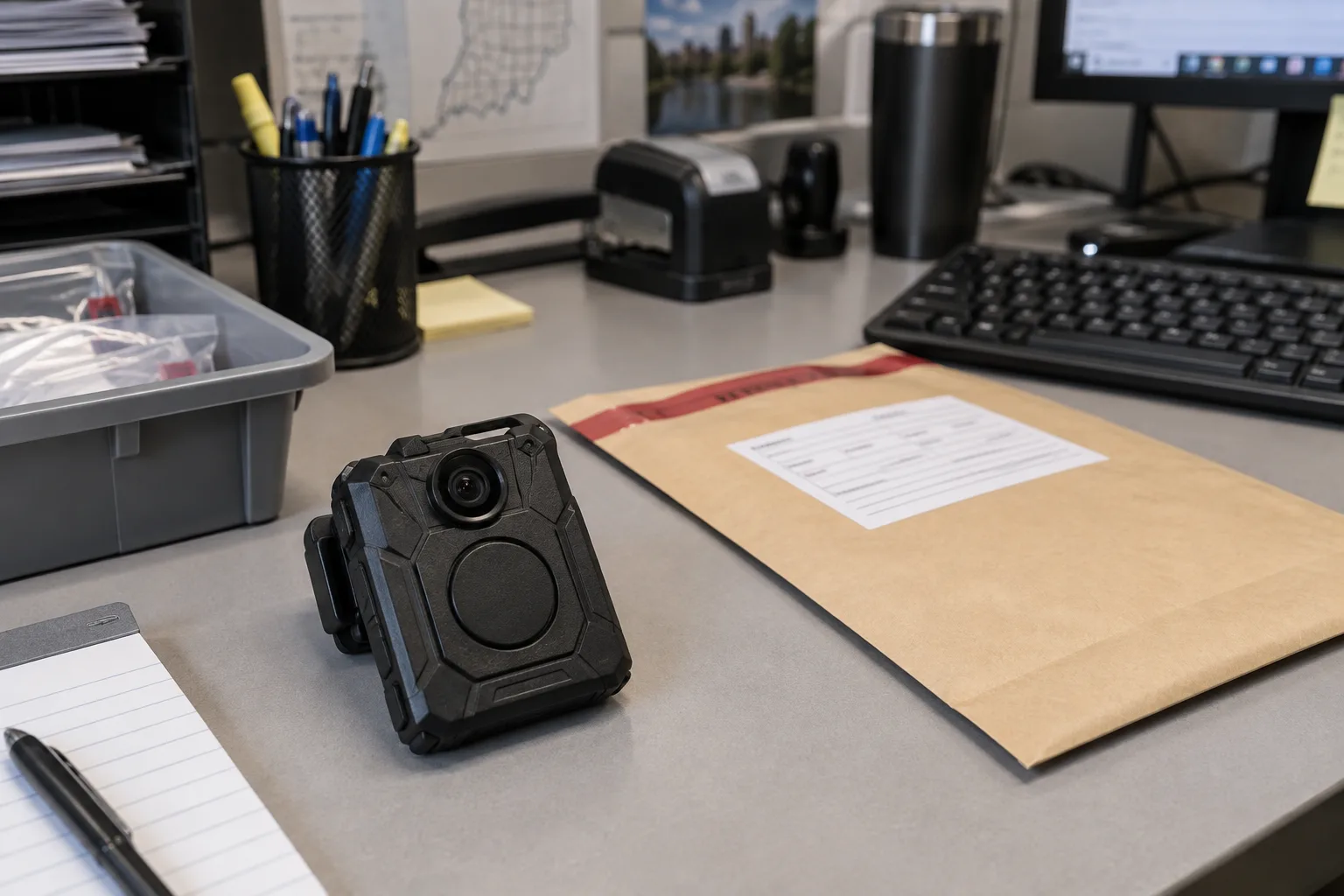
A request to inspect or copy a statutory law-enforcement recording must be written. IC 5-14-3-3(i) requires all three identifiers: the date and approximate time, the specific location, and the name of at least one directly involved person other than an officer. For other public records, section 3(a) requires reasonable particularity and lets the agency require its written form.
Optional preparation checklist: Use the list below to organize your request. Use it as a practical organization tool.
- Name each record: 911 call, dispatch audio, body-camera footage, or vehicle-camera footage.
- Gather the date, approximate time, location, incident number, and involved person’s name. An officer’s name alone does not supply the non-officer identifier described above.
- Specify whether you seek inspection, a copy, or both; explain any qualifying connection for special inspection.
- Ask which agency holds each item and follow that agency’s current submission instructions.
- Keep the submission receipt, reply, requested fees and any download instructions. Ask for clarification about missing identifiers or an unclear request status.
The Fort Wayne Police Department’s current records page[9] directs police-report and law-enforcement-recording requests to the city’s Next Request site and says a valid email is required. For a call or dispatch recording, ask the receiving records office to confirm the correct custodian rather than assuming one request reaches every involved agency.

Response timing and a denied request
A response clock is not a delivery promise. IC 5-14-3-3(b) requires production within a reasonable time when the request is not denied. Section 9[10] addresses when a denial occurs and how it can be challenged. Its current subsection (c) provides that denial of a request for copies sent by mail, fax, or the section 3.3 electronic portal does not occur until seven days after agency receipt. That is not a seven-day deadline to deliver the files.
For an initially written request, section 9(d) requires a written or faxed denial stating the specific exemption and the responsible person’s name and title or position. In its current section 3.3[11], APRA also permits an agency to decline to respond to suspected scraping, phishing or specified electronic-security risks, with notice to the Public Access Counselor within seven days after receiving the request.
In PAC advisory opinion 25-FC-006 (October 30, 2025)[12], the counselor criticized the Delaware County Sheriff’s failure to identify specific reasons for denying the requested bodycam and E-911 records in a particular murder investigation. That advisory example should not be treated as a universal rule that all 911 calls fall within the body-camera statute.
The court route also depends on the request. A denial of special inspection under section 5.1 is appealed under section 9; qualifying requestors need not first obtain a PAC response and may be eligible for fees if they prevail.
A denial under section 5.2(a) may instead be challenged by petition in the circuit or superior court of the county where the recording was made. The court considers the decision anew, with the statute allocating proof of the airport condition and withholding grounds. Section 5.2(c) excludes attorney-fee and litigation-expense awards for obtaining that order and excludes section 9.5 penalties; subsection (f) calls for an expedited ruling, ordinarily within thirty days unless extraordinary circumstances prevent it. A petition does not assure disclosure.
Bring the actual request and denial to an attorney before choosing a court procedure. Keep the wording of the agency’s explanation intact.
Records clocks are not claim clocks. If a city, county, school corporation, or the State or one of its employees may be responsible for the injury itself, a separate and much shorter written notice deadline can apply under the Indiana Tort Claims Act, and it runs whether or not a records request is still pending. See our guide to the Indiana government tort claim notice.
Retention and preservation
For recordings that meet the statutory definition, IC 5-14-3-5.3(a)–(b)[13] requires unaltered, unobscured retention for at least 190 days by non-state public agencies and at least 280 days by the state or a state agency, subject to the longer-retention provisions. These are not universal retention periods for all 911 or dispatch-center audio.
Under section 5.3(c)(1), a person qualifying as a section 5.1(a) requestor may give written notice to retain the recording no more than 180 days after recording for a non-state agency, or 270 days for a state agency. A timely qualifying notice requires retention for at least two years after the recording date; the agency may not demand a reason. The notice windows are different from the ordinary minimum retention periods.
Section 5.3(c)(2) separately requires at least two years of retention after the recording date when a formal or informal complaint about depicted law-enforcement activity is filed with the agency less than 180 days after recording for a non-state agency, or less than 270 days for a state agency. If used in a criminal, civil or administrative proceeding, subsection (c)(3) requires retention until final disposition of all appeals and order from the court.
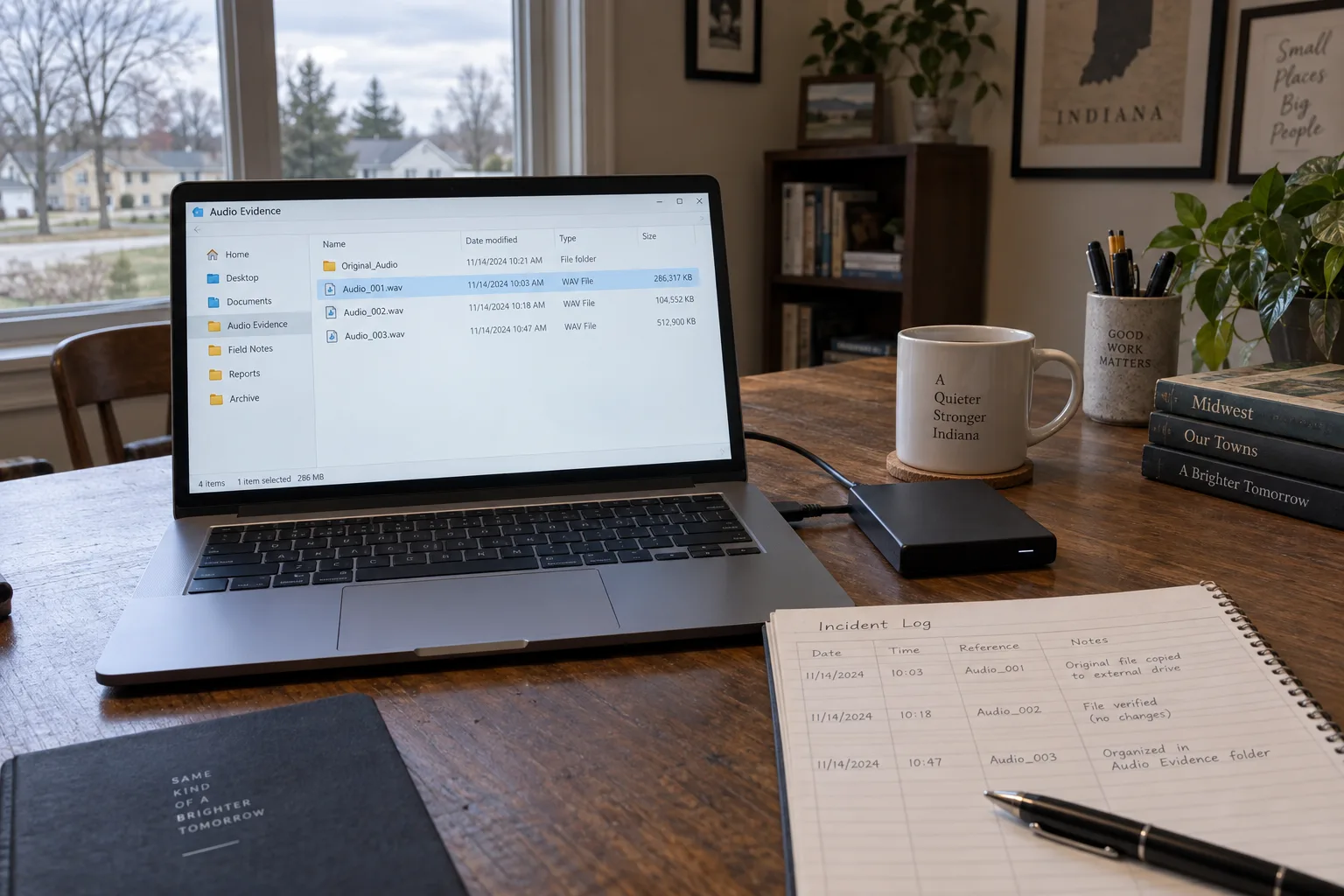
Optional organization steps: Ask about the applicable retention schedule and send a specific retention request promptly. Keep a copy of what you sent. Do not assume a generic letter meets the statutory conditions. If you receive files, keep an untouched copy, the original filename, available metadata and the delivery correspondence; use a duplicate for notes or clips.
For privately held and traffic-system footage, use the companion traffic-camera, business-surveillance and doorbell-video guide. Its camera-search focus complements this public-agency access guide.
Using a recording in court
Under Indiana Evidence Rule 901[14], the person offering an item must produce enough evidence to support a finding that it is what they claim. A knowledgeable witness, voice identification, or evidence about a recording process are among the rule’s examples; receiving a download is not itself a substitute for that foundation.
Indiana Evidence Rule 801[15] defines hearsay as a statement made outside the current testimony and offered to prove what it asserts, with specified exclusions. A statement within a recording can therefore raise a separate hearsay issue.
Indiana Evidence Rule 802[16] bars hearsay unless the rules or other law provide otherwise.
Indiana Evidence Rule 803[17] includes a present-sense-impression exception for a statement describing or explaining an event, condition or transaction while or immediately after perceiving it, and an excited-utterance exception for a statement about a startling event made under the stress it caused. A 911 label alone does not establish either exception.
For a writing or recorded statement, Indiana Evidence Rule 106[18] allows the adverse party to require another part or another writing or recorded statement to be introduced at the same time when fairness calls for considering them together.
Indiana Evidence Rule 403[19] also permits exclusion when probative value is substantially outweighed by specified dangers, including unfair prejudice, confusion or misleading the jury.
For a discussion with counsel, note the exact timestamp you want reviewed and the question it raises. Consider the wider context before relying on a short clip or a caller’s first account.

Frequently asked questions
Are all Indiana 911 calls open to the public?
No blanket answer fits every record. Section 3(a) provides general public-record access subject to section 4 exceptions. The custodian, the contents and the recording’s statutory classification must be checked.
Can I view body-camera footage if I was injured?
You can qualify for special inspection under section 5.1(a)(5) when you suffered a loss due to personal injury and the depicted events are relevant to that loss. The written-request and other conditions described above still apply; special inspection does not include copying or recording during the viewing.
Does preserving footage also give me access?
Retention under section 5.3 keeps qualifying recordings for the required period. It does not replace the separate inspection and copying rules in section 5.1 and section 5.2.
Does an agency copy automatically become evidence in court?
No. Indiana Evidence Rule 402 preserves other legal limits on admissibility, and Indiana Evidence Rule 901 requires an adequate basis to authenticate the item. Recorded statements may also present the hearsay questions discussed above.
Discuss a request or denial
If you are unsure which recording to seek or how to understand a denial, Chad Delventhal can discuss your options. Our car-accident practice serves people in Allen County and across Indiana. Bring the incident details, your requests, and the agency’s replies to a free case evaluation.
General information only, not legal advice. Reading this article does not establish representation. Discuss your circumstances privately with an attorney.
The linked legal and official sources were checked on September 10, 2026. References appear below.
Sources
- Indiana Evidence Rule 401 (rules.incourts.gov) ↩
- Indiana Evidence Rule 402 (rules.incourts.gov) ↩
- IC 5-14-3-2(l) (iga.in.gov) ↩
- IC 5-14-3-3(a) (iga.in.gov) ↩
- Section 4(a) and (b) (iga.in.gov) ↩
- IC 5-14-3-6(a) (iga.in.gov) ↩
- IC 5-14-3-5.1(a) (iga.in.gov) ↩
- IC 5-14-3-5.2(a) (iga.in.gov) ↩
- Fort Wayne Police Department’s current records page (cityoffortwayne.in.gov) ↩
- Section 9 (iga.in.gov) ↩
- section 3.3 (iga.in.gov) ↩
- PAC advisory opinion 25-FC-006 (October 30, 2025) (in.gov) ↩
- IC 5-14-3-5.3(a)–(b) (iga.in.gov) ↩
- Indiana Evidence Rule 901 (rules.incourts.gov) ↩
- Indiana Evidence Rule 801 (rules.incourts.gov) ↩
- Indiana Evidence Rule 802 (rules.incourts.gov) ↩
- Indiana Evidence Rule 803 (rules.incourts.gov) ↩
- Indiana Evidence Rule 106 (rules.incourts.gov) ↩
- Indiana Evidence Rule 403 (rules.incourts.gov) ↩