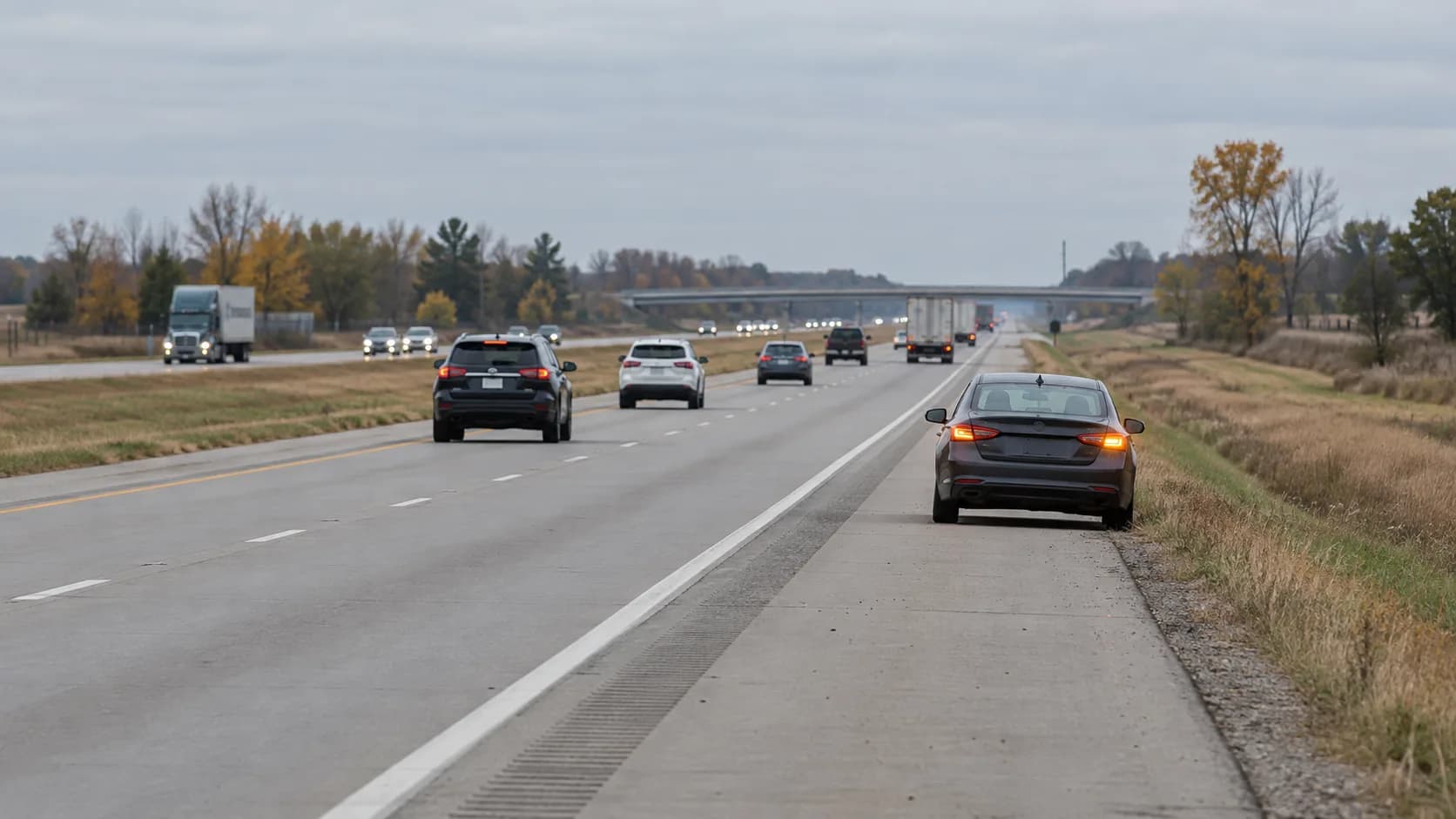
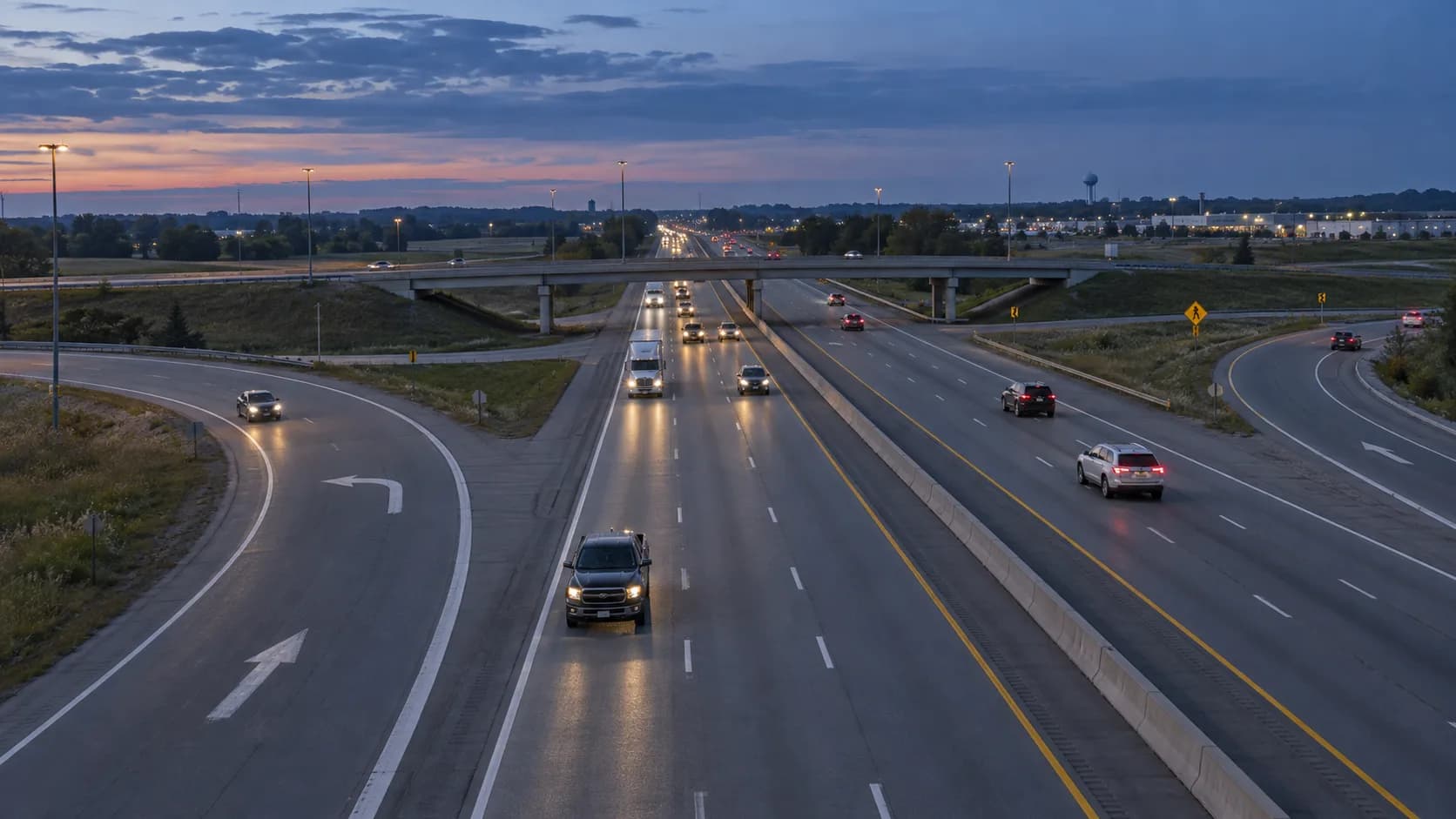
A wrong-way collision can leave you with urgent questions: What proves how the other vehicle entered the roadway? Which policy may cover the loss? Does reckless or impaired conduct justify punitive damages? This guide explains how to organize those questions after a crash in Fort Wayne, Allen County, or elsewhere in Indiana.
- Document the approach route, not just the point of impact.
- Keep original video, witness contact details, photographs, and vehicle information together.
- Separate the crash investigation, policy review, and any request for punitive damages.
- Ask for individual review of filing dates and any government involvement.
What counts as a wrong-way crash in Indiana?
section 9-21-8-2(a) generally requires travel on the right half of a sufficiently wide roadway. Its exceptions concern lawful passing, a right half closed for construction or repair, specified three-lane roads, and designated, signposted one-way roads. A generic obstruction is not the wording of this section. Indiana Code 9-21-8-2[1].
A wrong-way event may begin at an interstate ramp, divided highway crossover, one-way street, median opening, or ordinary two-lane road. The useful question is not only where the impact occurred, but how each vehicle reached that location.
That distinction can direct the investigation toward ramp markings, traffic-control devices, lighting, construction changes, the driver’s route, and observations made before impact. For more about the broader claim process, see Delventhal Law Office’s Fort Wayne car accident guide.

Evidence that can explain a wrong-way collision
Begin with evidence that fixes time, location, direction of travel, and vehicle movement. Preserve original files instead of relying only on screenshots or social-media copies.
| Evidence | What to preserve or request | Why it may help |
|---|---|---|
| Scene material | Wide and close photographs, lane arrows, signs, ramp geometry, debris, marks, and vehicle resting positions | It can document the roadway layout and physical aftermath before conditions change. |
| Video | Dashcam files and footage from nearby homes, businesses, traffic systems, or vehicles | It may show approach direction, vehicle movement, lighting, or timing. |
| Witness information | Names, contact details, location, direction faced, and the witness’s own words | It can preserve independent observations before memories fade. |
| Vehicle evidence | Damage photographs, repair estimates, inspection records, and the unrepaired vehicle when inspection may be needed | Damage and electronic information may assist a qualified reconstruction analysis. |
| Official records | Crash report, dispatch material, 911 records, citations, and later investigation supplements | These records can identify participants, witnesses, reported observations, and investigative steps. |
The Indiana State Police maintains the central repository of Indiana crash reports and provides electronic reports through BuyCrash for a fee. ISP: Crash reports[2].
NHTSA describes an event data recorder as recording technical vehicle and occupant information for seconds before, during, and after a crash. That description does not include audio or video recording. NHTSA: Event Data Recorder[3].
Practical tip: keep the original video and physical scene material too. Keep the technical download alongside the rest of the investigation.
Practical preservation tip: ask about inspection before authorizing repairs, sale, or salvage of a vehicle that may matter to the investigation. Delventhal’s guides to evidence in an Indiana car accident claim and passenger-vehicle EDR data provide more focused checklists.

Which insurance may apply after a wrong-way crash?
For your consultation, gather declarations pages, complete policies, endorsements, rejection forms, and claim correspondence for each potentially involved vehicle or household.
Bodily-injury liability coverage pays, up to policy limits, for injuries to other people caused with the insured vehicle. IDOI: Auto policy protection[4].
Medical-payments coverage pays covered medical bills for the insured and usually passengers, up to policy limits, for injuries while riding in, entering, or getting out of the car. IDOI: Medical payments.
Collision coverage pays for damage to the insured car caused by collision or upset, subject to a deductible. IDOI: Collision coverage.
For auto policies within its scope, section 27-7-5-2 requires UM/UIM protection unless rejected in writing by a named insured. The section has specific exceptions for certain commercial coverage and umbrella or excess policies; do not assume every policy follows the ordinary auto-policy rule. Indiana Code 27-7-5-2(a)–(i)[5].
UM/UIM coverage depends on the policy and statutory requirements, including insured status and whether the other vehicle meets the applicable uninsured or underinsured definition. Indiana Code 27-7-5-4[6].
If the wrong-way driver fled, save identifying details and bring your own policies to the consultation. For further reading, see our Fort Wayne UM/UIM guide.

Can a wrong-way crash support punitive damages?
Before punitive damages may be recovered, the claimant must establish all facts relied upon to support them by clear and convincing evidence. Indiana Code 34-51-3-2[7].
Indiana case law distinguishes malicious, fraudulent, oppressive, or grossly negligent conduct from mere negligence or an honest error of judgment. A federal court applying Indiana law summarizes that distinction and the Indiana Supreme Court’s Yost decision; the crash label alone does not resolve the question. Harrison Manufacturing damages decision, pages 5–7[8].
section 34-51-3-4 caps a punitive award at the greater of three times compensatory damages or $50,000. That ceiling is not an automatic award or a settlement multiplier. section 34-51-3-4.
When a punitive award is paid, the clerk distributes 25% to the person awarded punitive damages and 75% to the state’s violent crime victims compensation fund. Indiana Code 34-51-3-6(b)–(c)[9].
Organize observations separately from guesses about the driver’s reasons for entering the roadway. Potentially relevant material may include toxicology results, admissions, video, phone records obtained through lawful process, prior route information, dispatch recordings, and witness observations. Keep track of where each item came from; ask your attorney what further investigation is appropriate.

How shared fault and filing deadlines affect the claim
For claims covered by Indiana’s Comparative Fault Act, claimant fault proportionately reduces compensatory damages, and fault greater than 50% bars recovery. Government tort claims under section 34-13-3 are excluded from that Act. Indiana Code 34-51-2-2 and 34-51-2-5 through -7[10].
As a practical matter, document speed observations, lookout, evasive action, vehicle position, and any other event that preceded impact. That makes neutral evidence important even when the initial facts seem obvious. Read more about Indiana’s comparative-fault rule.
section 34-11-2-4(a) generally requires an action for personal injury to be filed within two years after the cause of action accrues. Indiana Code 34-11-2-4(a)[11].
Government involvement can bring separate, earlier notice requirements under section 34-13-3-6 and -8. Have an attorney review the defendants, dates, and applicable exceptions rather than using this general summary to calculate a filing deadline. Indiana Code 34-13-3-6 and -8[12].
For a separate way to organize the financial questions, Delventhal’s Fort Wayne car accident settlement calculator is an educational tool for organizing those factors, not a prediction of a result.
A practical evidence and insurance checklist
- Prioritize safety and request emergency assistance when needed.
- Photograph the roadway, lane arrows, signs, ramps, vehicle positions, and visible damage if you can do so safely.
- Identify witnesses and ask where they were and what they personally observed.
- Save original dashcam, phone, navigation, and photograph files without editing them.
- Ask nearby property owners promptly about video and the system’s retention settings.
- Obtain the crash report and check names, vehicles, insurance entries, roadway description, and diagram for factual errors.
- Keep claim correspondence, claim numbers, policy documents, bills, and receipts together.
- Do not permit destruction or salvage of a potentially important vehicle before asking whether an inspection is needed.
- Write down unanswered questions for an attorney without posting confidential details publicly.
The Indiana Department of Insurance advises filing claims promptly, providing complete and correct information, and keeping copies and records of correspondence and conversations. IDOI: Insurance claim tips[13].

Wrong-way route and timestamp worksheet
Use this original consultation worksheet to separate what you personally saw from what someone later told you. It is an organizing aid, not a crash reconstruction.
| Checkpoint | Record | Uncertainty to flag |
|---|---|---|
| First observation | Time, road, nearest ramp or intersection, travel direction, and your vantage point | Did you see the entry maneuver or only the vehicle afterward? |
| Route to impact | Entrance, lane arrows, median openings, available original video, and witness locations | Which part of the route is missing from the footage? |
| Clock comparison | Phone time, dashcam timestamp, dispatch time, and each time zone | Was the dashcam clock set correctly? Keep the original; note any offset separately. |
| Records contact | Person or business contacted, date, response, and any stated deletion schedule | Was footage actually saved, or was a request merely received? |
For an I-69 or I-469 crash near Fort Wayne, record the direction, nearest exit, and which side of the interchange you mean instead of writing only “the interstate.” For a downtown one-way street, record the block and cross street. Do not return to an unsafe roadway to complete this worksheet.
Frequently asked questions
Is a wrong-way driver always entirely at fault?
No automatic percentage follows from the label. For claims covered by Indiana’s Comparative Fault Act, the factfinder evaluates contributing fault; government tort claims are excluded from that Act.
Does wrong-way driving automatically justify punitive damages?
No. Indiana requires clear and convincing proof of the facts supporting punitive damages, and case law distinguishes qualifying misconduct from mere negligence or an honest mistake.
Does the injured person receive the whole punitive award?
No. When a punitive award is paid, section 34-51-3-6 directs 25% to the person awarded punitive damages and 75% to the state fund.
What if the other driver has no insurance?
Your own UM protection may be relevant, but the policy, insured status, written rejection, and statutory requirements must be reviewed. Indiana’s UM/UIM statute contains exceptions for certain policies.
Can seat-belt nonuse affect the claim?
It is not comparative fault under section 9-19-10-7(a). For claims accruing after June 30, 2024, the statute permits mitigation evidence for plaintiffs at least 15 when the claim accrued, with the defendant bearing the stated proof burden.
How long do I have to file an injury lawsuit?
The general Indiana personal-injury period is two years after accrual under section 34-11-2-4(a). Government notice requirements and other case-specific rules require individual review; this article does not calculate your deadline.
Discuss your next steps
If you were injured in a wrong-way crash and want help sorting the evidence, policies, and next steps, Delventhal Law Office can review the available information and explain your options in a free consultation.
This article is general information about Indiana law and is not legal advice. Reading it does not create an attorney-client relationship, and neither does contacting us.
Sources checked October 16, 2026. General educational information, not an assessment of any particular claim.
Sources
- Indiana Code 9-21-8-2 (iga.in.gov) ↩
- ISP: Crash reports (in.gov) ↩
- NHTSA: Event Data Recorder (nhtsa.gov) ↩
- IDOI: Auto policy protection (in.gov) ↩
- Indiana Code 27-7-5-2(a)–(i) (iga.in.gov) ↩
- Indiana Code 27-7-5-4 (iga.in.gov) ↩
- Indiana Code 34-51-3-2 (iga.in.gov) ↩
- Harrison Manufacturing damages decision, pages 5–7 (govinfo.gov) ↩
- Indiana Code 34-51-3-6(b)–(c) (iga.in.gov) ↩
- Indiana Code 34-51-2-2 and 34-51-2-5 through -7 (iga.in.gov) ↩
- Indiana Code 34-11-2-4(a) (iga.in.gov) ↩
- Indiana Code 34-13-3-6 and -8 (iga.in.gov) ↩
- IDOI: Insurance claim tips (in.gov) ↩