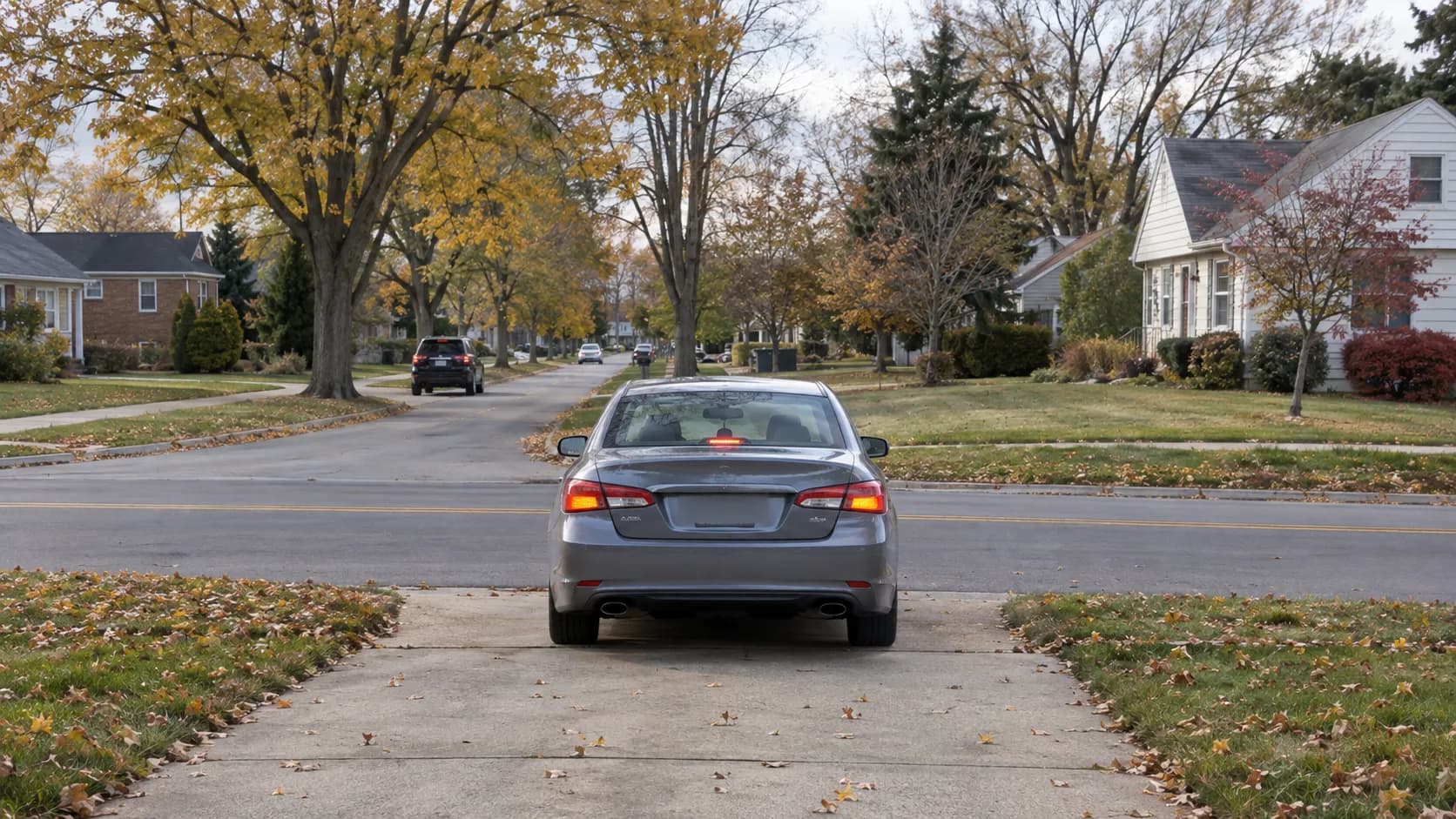
A driveway collision may look straightforward, but its outcome can depend on vehicle positions, sight lines, speed, signals, and the timing of each driver’s actions. This guide explains how to organize those facts after a crash in Fort Wayne, Allen County, or elsewhere in Indiana. For help with an injury claim, our Fort Wayne car accident page explains the firm’s services, including failure-to-yield collisions.
Key takeaways
- Indiana’s private-driveway rule requires a driver entering or crossing a highway from a private road or driveway to yield to all vehicles approaching on the highway.
- For ordinary private-driver claims governed by Indiana’s Comparative Fault Act, shared fault can reduce an injured person’s recovery by that person’s percentage of fault and bars recovery when the person’s fault is greater than 50%.
- An Indiana action for injury to a person generally must be commenced within two years after the cause of action accrues, although a different rule may apply in some situations.

What does Indiana law require when leaving a private drive?
Indiana Code 9-21-8-34[1] requires a person driving a vehicle about to enter or cross a highway from a private road or driveway to yield the right-of-way to all vehicles approaching on the highway. This is the driveway rule—not the different rule for a left turn at an intersection. Section 34 does not limit its wording to vehicles that present an “immediate hazard.”
There is also a separate sidewalk duty. Under IC 9-21-8-42[2], a driver emerging from an alley, driveway, or building within a business or residence district must stop immediately before driving onto the sidewalk or into the sidewalk area extending across the driveway. Stopping at the sidewalk does not replace the duty to yield to approaching highway traffic.
For a Fort Wayne residential driveway or an Allen County business entrance, document where the vehicle was relative to the sidewalk, curb, shoulder, and each travel lane. The following are practical observation prompts, not a formula that assigns fault.
| Issue | What to examine | Why it matters |
|---|---|---|
| Entry from the private drive | Vehicle position, direction of travel, and point of impact | Helps reconstruct when the vehicle entered the roadway |
| Approaching traffic | Lane, speed evidence, braking, lighting, and available sight distance | Helps evaluate whether either driver could have avoided the collision |
| Visibility | Parked vehicles, vegetation, signs, weather, darkness, and driveway grade | Helps document what each driver could see |
| Independent records | Doorbell video, business cameras, dashcam files, and witness contact details | Helps test the drivers’ competing accounts |

Can the roadway driver share fault?
Yes, in an ordinary private-driver negligence case governed by Indiana’s Comparative Fault Act. IC 34-51-2-5 through -8[3] provides that a claimant’s fault reduces compensatory damages proportionately and that fault greater than 50% bars recovery. At exactly 50%, the claimant is not barred by that threshold, but recovery is reduced. Fault can also be assigned to nonparties, affecting the amount recoverable from named defendants.
Examples of questions to investigate include whether the roadway driver was speeding, looking away, or changing lanes while the other driver entered. An allegation alone does not establish a percentage. IC 34-51-2-3[4] requires a causal connection between fault and the injury; a driving mistake that did not contribute is not a basis for simply guessing a share of responsibility.
Government-claim caution: IC 34-51-2-2 excludes tort claims against governmental entities or public employees under the Indiana Tort Claims Act. Do not apply the ordinary private-driver 51% framework to those claims without separate legal review.
Practical suggestion: if a claim letter assigns you a percentage of fault, request the supporting facts. Our guide to Indiana’s 51% fault rule explains the comparative-fault framework in more detail.

What evidence should you preserve?
These are practical preservation suggestions. Put safety and emergency care first; do not stand in traffic or enter someone else’s property to collect evidence.
Start with material that shows the scene as it existed when the crash happened:
- Photograph the driveway, roadway, vehicle resting positions, damage, skid or tire marks, signs, lane markings, lighting, and anything blocking the view.
- Save the original dashcam file and request nearby doorbell or business video promptly.
- Write down witness names, phone numbers, and where each witness was standing or driving.
- Keep the insurance information, repair estimates, towing records, medical bills, wage records, and all claim correspondence together.
- Record the date, time, weather, and direction each vehicle was traveling without guessing about facts you did not observe.
The Indiana State Police maintains the state’s central repository of crash reports[5] and makes electronic reports available through its designated service. You can also review our guide to obtaining an Indiana crash report and our broader car-accident evidence checklist.
A driveway observation worksheet
Use one row per travel lane, including a bike lane or turn lane if present. Separate what you personally observed from what someone later told you.
| Record | Useful detail | Avoid assuming |
|---|---|---|
| Vehicle path | Forward or backing; left or right turn; lane entered; where contact occurred | Damage to one corner alone proves the entire sequence |
| View from the driveway | Photo position and height; parked cars, hedge, sign, grade; near lane versus far lane | A photo taken later shows the original obstruction |
| Approaching traffic | Direction, lane, visible braking, original video and camera location | A witness’s “fast” estimate is a measured speed |
| Someone waved a driver out | Who signaled, what gesture was seen, which lanes that person could see | The gesture establishes that every lane was clear |
| Timing and changes | Time of crash and photos; vehicles moved; lighting or weather changed | A later reenactment is footage of the collision |
Keep original files and a separate copy for annotations. A short note saying “unknown” is more useful than filling a gap with a guess. Bring this worksheet, your report number, photographs, witness contacts, and claim correspondence to a consultation.
Avoid quick assumptions about fault
Describe what happened accurately, but do not guess about speed, distance, or legal responsibility. Preserve the information first; the accounts can then be compared with physical and electronic evidence.

What should you do after a private-drive collision?
- Stop and remain at the scene. Follow emergency responders’ directions. The BMV advises against moving the vehicle when the crash involves injury, death, entrapment, or hazardous materials.
- Call for emergency help when someone may be hurt.
- Exchange identifying and insurance information.
- Photograph the scene before vehicles, debris, or visibility conditions change, when it is safe to do so.
- For your records, save copies of claim forms and correspondence.
- Seek appropriate medical attention for health concerns instead of relying on an insurance adjuster’s opinion.
The electronic Indiana Driver’s Manual[6] includes the BMV’s current accident and emergency guidance. For additional preparation steps, see our Fort Wayne post-crash checklist.
Organize the insurance claim
Keep a simple log of calls, claim numbers, document requests, and responses. If injuries are involved, separate the vehicle-damage documents from medical, wage, and injury records.

How long do you have to act?
Under Indiana Code 34-11-2-4[7], an action for injury to a person generally must be commenced within two years after the cause of action accrues. Record the collision date and seek individual review early; the general rule does not calculate the filing date for your situation.
If a potential claim involves a governmental entity or public employee, separate, earlier notice requirements may apply under IC 34-13-3-6 and -8[8]. Seek individual legal review promptly; an insurance claim is not a substitute for filing a required lawsuit or government notice.
Frequently Asked Questions
Is the driver leaving the driveway automatically at fault?
No. Indiana law requires that driver to yield to roadway traffic, but fault in a civil claim depends on the conduct that contributed to the collision and the supporting evidence.
What if the roadway driver was speeding?
Evidence that the roadway driver was speeding may support an allocation of comparative fault if that conduct contributed to the collision or injury. The entering driver’s duty to yield still remains part of the analysis.
Does the same rule apply when someone backs out of a driveway?
Yes. The private-driveway yield rule applies when a vehicle is about to enter or cross the highway from the driveway; it does not exempt vehicles moving in reverse.
What if a hedge or parked vehicle blocked the driveway view?
Record the obstruction and where each driver could see approaching traffic. The driveway yield statute contains no blocked-view exception. Photograph the obstruction from a safe location and identify who reported it; preserve those facts for individual review.
What if the insurer blames me?
As a practical next step, ask the claims contact which observations support the stated percentage. Organize the response alongside photographs, original video, witness contacts, and your driveway worksheet.
Does stopping before the sidewalk satisfy the driveway yield rule?
No. The sidewalk stop requirement and the highway yield requirement explained above are separate duties. Stopping before a sidewalk does not give a driver priority over approaching highway traffic.
If you were hurt in a private-drive collision and want to discuss your options, request a free consultation with Delventhal Law Office. Bring your driveway worksheet and records so the discussion can focus on what happened.
This article is general information about Indiana law and is not legal advice. Reading it does not create an attorney-client relationship, and neither does contacting us.
Sources
- Indiana Code 9-21-8-34 (iga.in.gov) ↩
- IC 9-21-8-42 (iga.in.gov) ↩
- IC 34-51-2-5 through -8 (iga.in.gov) ↩
- IC 34-51-2-3 (iga.in.gov) ↩
- Indiana State Police maintains the state’s central repository of crash reports (in.gov) ↩
- Indiana Driver’s Manual (in.gov) ↩
- Indiana Code 34-11-2-4 (iga.in.gov) ↩
- IC 34-13-3-6 and -8 (iga.in.gov) ↩