Key takeaways
- Start with the law-enforcement agency named on the report and identify the exact field that is wrong.
- Provide documents that verify the replacement information instead of asking for a general rewrite.
- A correction request for objective data is different from disagreeing with an officer’s opinion.
- Insurance information shown to an officer is not transmitted to the BMV; the insurer must submit the Certificate of Compliance electronically after a BMV request.
- The BMV says the certificate must be received and processed within 90 days after it mails the request, or driving privileges will be suspended.
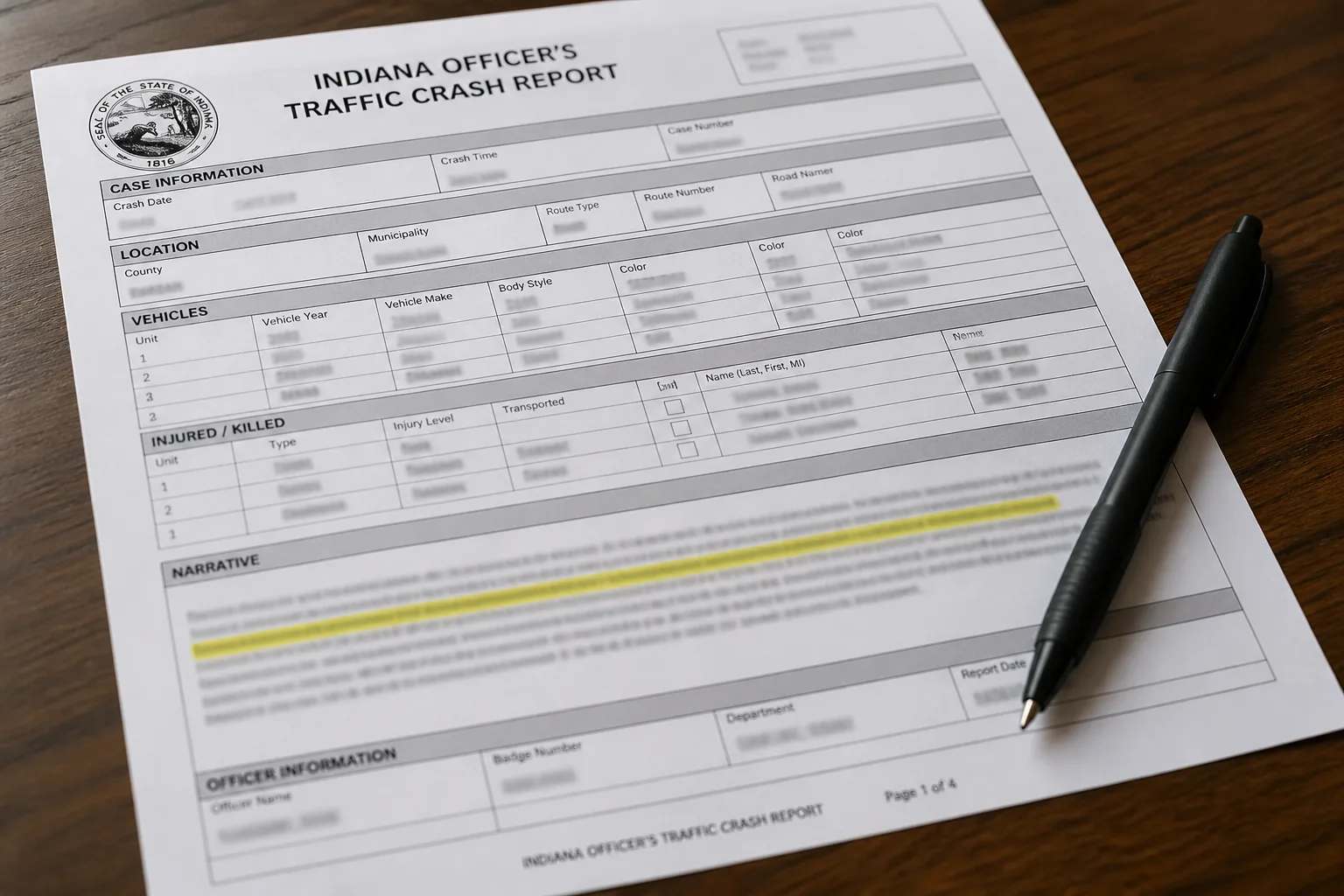
What an Indiana crash report is
Indiana Code 9-26-2[1] requires a law-enforcement officer to investigate a crash that results in injury, death, or property damage of at least $2,500, and to send a written report of each crash investigated to the Indiana State Police. The Indiana Criminal Justice Institute[2] explains that Indiana Officer’s Standard Crash Reports are submitted through the Automated Reporting Information Exchange System, or ARIES.
If you still need a copy, see our guide to obtaining an Indiana crash report.
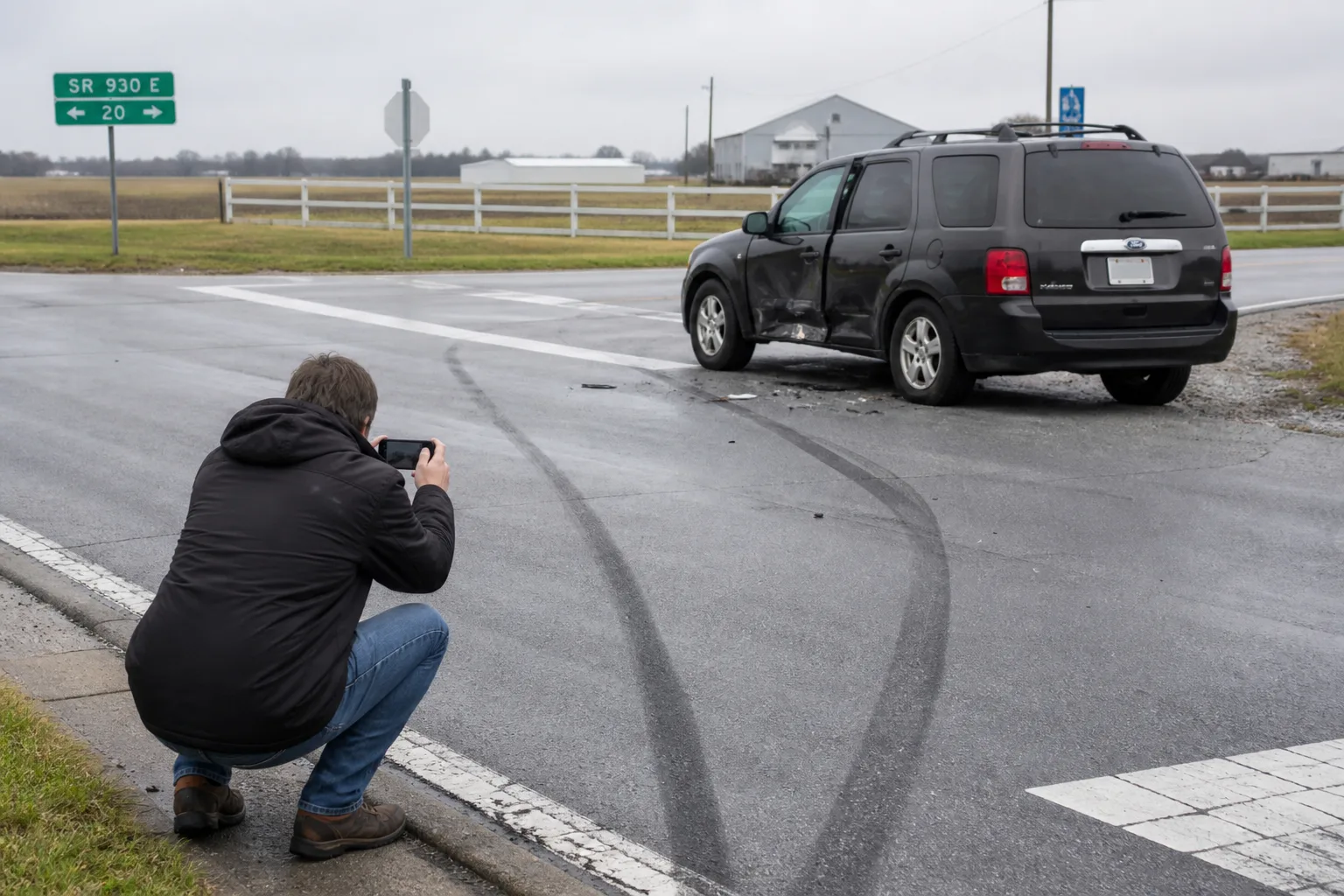
Is the problem a factual mismatch or a disputed opinion?
| Report item | Useful supporting material | Request |
|---|---|---|
| Name, address, or date of birth | Driver’s license or government record | Correct the identifying field |
| Plate, VIN, make, or model | Registration, title, or vehicle photograph | Correct the vehicle field |
| Policy details | Policy declarations or insurance card effective on the crash date | Correct the insurance field |
| Location or direction of travel | Scene photographs, map, video, or measurements | Correct or supplement the factual entry |
| Officer or witness opinion | Independent video, photographs, or witness information | Ask whether the agency will add a supplemental statement |
Keep the request narrow. Point to the field, state the proposed replacement, and attach the record that supports it. If the disagreement concerns an opinion rather than objective data, ask whether the agency permits a supplemental statement instead of demanding that the original narrative be erased.
How to request a factual correction
- Identify the investigating agency. Use the department and officer information shown on the report.
- Describe one mismatch at a time. Quote the current entry and state the requested replacement.
- Attach verification. Use a license, registration, insurance record, photograph, video, map, or other document that directly addresses the field.
- Ask about the agency’s amendment process. The agency may correct the report or add a supplemental report or statement.
- Save the response. Keep the request, attachments, amendment, and any confirmation that the revised information was transmitted.

How do you fix a crash-report mismatch that threatens BMV suspension?
The Indiana BMV’s proof-of-financial-responsibility guidance[3] says insurance information shown to a police officer at the scene is not sent to the BMV. If the BMV requires proof after an incident, it mails a request and the driver must ask the insurer to submit a Certificate of Compliance electronically.
The BMV says the Certificate of Compliance must be received and processed within 90 days after the request is mailed. If it is not received and processed within that period, the BMV will suspend the driver’s privileges.
The BMV’s electronic-insurance FAQ[4] explains that a submission may fail when the vehicle information supplied by the court or reporting officer does not match the information supplied by the insurer.
BMV mismatch workflow
- Compare the BMV notice, crash report, policy record, plate, VIN, and accident date.
- If the insurer’s submission contains the wrong information, ask the insurer to correct and resubmit it.
- If the crash report contains the wrong information, contact the reporting officer and request an amended report.
- After the amended information reaches the BMV record, ask the insurer to submit the Certificate of Compliance again.
- Keep the receipt page, but also verify that the BMV processed the certificate; the BMV warns that a successful submission page confirms receipt, not that the requirement has been fulfilled.
This workflow corrects matching data for BMV insurance verification. It does not ask the officer to change a disputed opinion about how the collision occurred.
What a corrected report does not decide
A correction fixes the record. It does not decide who was at fault. Insurers often read the crash report when they evaluate a claim, which is one reason to fix objective errors. But if a case goes to trial, fault is decided on the evidence, and the officer's report is usually not that evidence: Indiana Rule of Evidence 803(8)(B)(i)[5] does not let investigative reports by police in under the public-records exception to the hearsay rule, except when offered by the accused in a criminal case. The officer may still testify about what the officer personally observed, and photographs, video, witnesses, and vehicle data are judged on their own. The judge decides what comes in.
So when the problem is the officer's narrative or a fault notation rather than a wrong plate or name, the usual remedy is evidence, not an amendment. See what to do if the police report says you were partly at fault and whether an Indiana police crash report can be used as evidence in court.
Crash-report and BMV correction checklist
- Complete crash report and report number
- BMV notice and mailing date
- Driver’s license and current contact information
- Registration, plate number, VIN, make, and model
- Insurance card and policy declarations effective on the incident date
- Photographs, video, map, or witness information tied to the disputed field
- Agency amendment or supplemental report
- BMV processing status after electronic submission
For broader crash evidence questions, see our Indiana car-accident evidence guide and our Fort Wayne car accident lawyer guide.

Frequently Asked Questions
Can I ask for an Indiana crash report to be changed?
Yes. Contact the investigating officer or agency, identify the exact factual mismatch, and provide a document that supports the requested correction. Ask whether the agency will amend the report or add a supplement.
Does insurance shown to the officer go to the BMV?
No. The BMV says insurance information shown to the officer is not transmitted to the BMV. When the BMV requests proof, the insurer must submit the Certificate of Compliance electronically.
How long does the BMV allow for a Certificate of Compliance?
The BMV says the certificate must be received and processed within 90 days after it mails the request, or driving privileges will be suspended.
What if the insurer and crash report show different vehicle information?
Correct the source that is wrong. The insurer can correct and resubmit its information. If the report is wrong, request an amended report from the reporting officer; after the BMV record is updated, ask the insurer to resubmit.
Is a factual correction the same as changing the officer’s opinion?
No. A BMV matching problem concerns objective data such as the incident date or vehicle. A disputed opinion about how the crash happened is a different issue.
Will correcting the report change who is found at fault?
Not by itself. A correction fixes objective information. Insurers may read the report, but fault in a lawsuit is decided on the evidence, and police investigative reports are generally kept out of the public-records exception to the hearsay rule.
Get help reviewing a crash-report mismatch
Delventhal Law Office can review the report, BMV notice, and supporting documents and help identify the next step. Request a free case evaluation to discuss the specific facts.
This article provides general information, not legal advice. Reading it does not create an attorney–client relationship.