Use the sections below as an organizational guide. They do not decide whether a particular person qualifies under a particular contract.
- For a case arising from a permittee’s use, Indiana Code 27-8-9-7[1] makes the owner’s coverage primary only when the vehicle was operated with the owner’s permission and within the scope of that permission. For a case arising from the owner’s use, the statute makes the owner’s policy primary for a passenger’s claim.
- The Indiana Department of Insurance describes liability, medical-payments, collision, comprehensive, uninsured-motorist, and underinsured-motorist coverage as distinct auto-insurance categories.
- Indiana Code 27-7-5-2[2] generally requires covered automobile liability policies to make uninsured- and underinsured-motorist coverage available, subject to statutory exceptions and written rejection rules.
- For organization, collect declarations pages, complete forms, and endorsements.
Build a document map
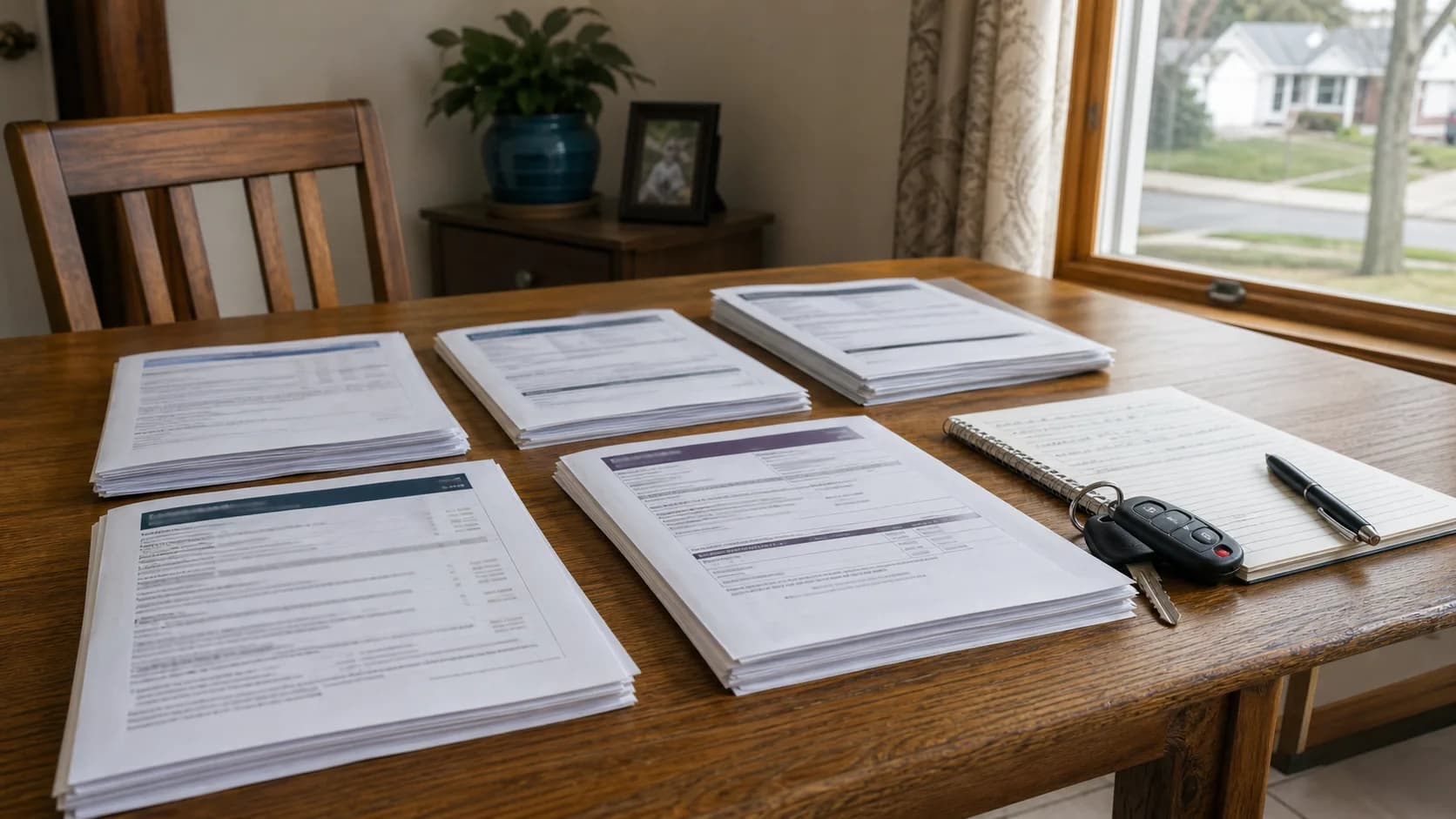
As a practical first step, list the vehicles, drivers, owners, household contracts, employers, and companies connected to the crash. Then request the documents shown below.
| Possible document set | What to request | Question to investigate |
|---|---|---|
| Documents for the occupied vehicle | Declarations, complete forms, and endorsements | Which categories and limits appear? |
| Documents for another involved vehicle | Company name and claim information | Who and what vehicle are named? |
| Your household documents | Declarations, complete forms, and any UM/UIM rejection | How does the contract define an insured? |
| Employer or commercial documents | Contract identification and claim contact | Was a driver or vehicle being used for work? |
| Definitions, exclusions, other-insurance, and exhaustion sections | Complete contract | Which clause applies to the people, vehicles, and claimed loss? |

Understand the coverage categories
The Indiana Department of Insurance auto-insurance guide[3] describes liability coverage as paying, up to the policy limit, for bodily injury and property damage caused by the insured.
The same official guide describes medical-payments coverage as paying covered medical bills for the insured and usually passengers, up to the policy limit, when they are injured while riding in, entering, or leaving the vehicle.
The guide separately describes uninsured- and underinsured-motorist coverage as allowing an insured to collect covered damages from the insured’s own company when a qualifying loss occurs.
For related background, see our medical-bill overview and the educational claim organizer.

The statutory passenger-priority rule
For a case arising from a permittee’s use, Indiana Code 27-8-9-7[1] makes the owner’s coverage primary only when the vehicle was operated with the owner’s permission and within the scope of that permission.
For a case arising from the owner’s use, the same statute makes the owner’s policy primary for a passenger’s claim.
For a qualifying permittee-use case, subsection (c) requires exhaustion of the owner’s policy before the permittee may recover under other motor-vehicle coverage available to the permittee. For a qualifying owner-use passenger claim, subsection (e) requires exhaustion of the coverage available to the passenger under the owner’s policy before the passenger may recover under other motor-vehicle coverage available to the passenger.
Section 27-8-9-7 expressly yields to the exceptions in Indiana Code 27-8-9-10[4] and 27-8-9-11. Those sections address specified garage-liability and bailee situations, so section 7 is not a universal priority rule.
For practical passenger-specific information, visit our Indiana passenger injury guide.

Indiana’s UM and UIM statutes
Indiana Code 27-7-5-2[2] generally requires uninsured- and underinsured-motorist coverage to be made available in limits at least equal to the bodily-injury liability limits, subject to statutory exceptions and written rejection rules. The statute also states that underinsured-motorist coverage may not be provided in limits below $50,000.
The statute permits a named insured to reject both coverages or, when the coverages are offered separately, to reject either one in writing. This guide is a starting checklist, not an answer for a specific contract. Contract-specific headings and clauses must be read in their full context.
Indiana Code 27-7-5-4[5] supplies statutory definitions used for uninsured- and underinsured-motorist coverage.
For related context, see our UM/UIM guide and uninsured-driver guide.

Documents to collect
The following is an organizational checklist, not a statement that every item exists in every matter:
- Declarations pages effective on the crash date
- Complete forms and endorsements
- Any written UM/UIM rejection
- Claim numbers and contact information
- The crash report and vehicle-ownership records
- Dated correspondence and decision letters
- Employer or vehicle-use records when work activity is involved
Keep the original files and make a dated working copy. For organization, keep the declarations pages, complete forms, and endorsements together.
When a dispute remains
The Indiana Department of Insurance complaint page[6] says consumers should first try to resolve a problem by contacting the company, agent, or broker.
The same page permits a written consumer complaint when the issue is not resolved satisfactorily and asks the consumer to provide supporting documentation.
For organization, save dated correspondence and write down claim numbers and contact names.

Frequently Asked Questions
Can more than one coverage category appear after one crash?
Yes. The Indiana Department of Insurance identifies liability, medical-payments, uninsured-motorist, and underinsured-motorist coverage as separate auto-insurance categories.
Can I add all listed limits together?
This article does not offer a universal yes-or-no rule. A case-specific review should start with complete documents.
Which coverage is primary for a passenger’s claim?
For a case arising from a permittee’s authorized use, Indiana Code 27-8-9-7[1] makes the owner’s coverage primary. For a case arising from the owner’s use, the statute makes the owner’s policy primary for a passenger’s claim.
Should I review my own documents?
As an organizational step, include your own declarations and complete forms in the document set.
What can I do after an unresolved company dispute?
IDOI says to contact the company, agent, or broker first. If the issue is not resolved satisfactorily, its complaint page permits a written consumer complaint with supporting documents.
If you have questions about which documents to review, you may contact Delventhal Law Office to discuss whether the firm can assist.
This article provides general information, not legal advice. The Scope of Indiana’s Rules of Professional Conduct[7] explains that whether an attorney-client relationship exists can depend on the circumstances and may be a question of fact. Indiana Rule of Professional Conduct 1.18[8] addresses duties relating to prospective clients. Contacting the firm does not necessarily mean that the firm represents you.
Sources
- Indiana Code 27-8-9-7 (iga.in.gov) ↩
- Indiana Code 27-7-5-2 (iga.in.gov) ↩
- Indiana Department of Insurance auto-insurance guide (in.gov) ↩
- Indiana Code 27-8-9-10 (iga.in.gov) ↩
- Indiana Code 27-7-5-4 (iga.in.gov) ↩
- Indiana Department of Insurance complaint page (in.gov) ↩
- Scope of Indiana’s Rules of Professional Conduct (rules.incourts.gov) ↩
- Indiana Rule of Professional Conduct 1.18 (rules.incourts.gov) ↩