
For someone hurt in a Fort Wayne car accident or another Indiana incident, the letter turns a collection of records into an organized explanation of what happened and what resolution is requested. It can begin focused settlement discussions, but sending it does not guarantee payment or require the recipient to agree.
Key takeaways
- Use the checklist below to organize the facts, supporting documents, requested amount, and response instructions.
- Check the package for accurate dates, consistent totals, and readable supporting documents.
- The recipient may accept the demand, reject it, request more information, or make a counteroffer.
- A demand sent to an adjuster is not a complaint filed with a court; track the court process separately.
- Indiana Evidence Rule 408 generally limits the use of compromise offers and negotiation statements to prove or disprove the validity or amount of a disputed claim, but the rule permits some other uses.

What does a personal injury demand letter do?
A demand letter gives the adjuster, responsible party, or defense representative a written account of the claim and a proposed settlement. In an injury matter, it typically connects the incident, the claimed responsibility, the resulting harm, and the requested payment.
The letter is part of negotiation rather than a court judgment. Indiana's official insurance guidance tells consumers not to rush into a settlement and to be prepared to negotiate when an initial offer is inadequate; it also recommends seeking professional advice when the fairness of a settlement is uncertain. You can review those recommendations in the Indiana Department of Insurance claim tips[1].
If your claim arose from a vehicle collision, the demand should fit within the broader claim strategy described by Delventhal Law Office's Fort Wayne car accident practice. You can also use the firm's car-accident settlement calculator as an educational way to organize bills, wage information, and other case details before discussing the claim.
What does a demand letter usually include?
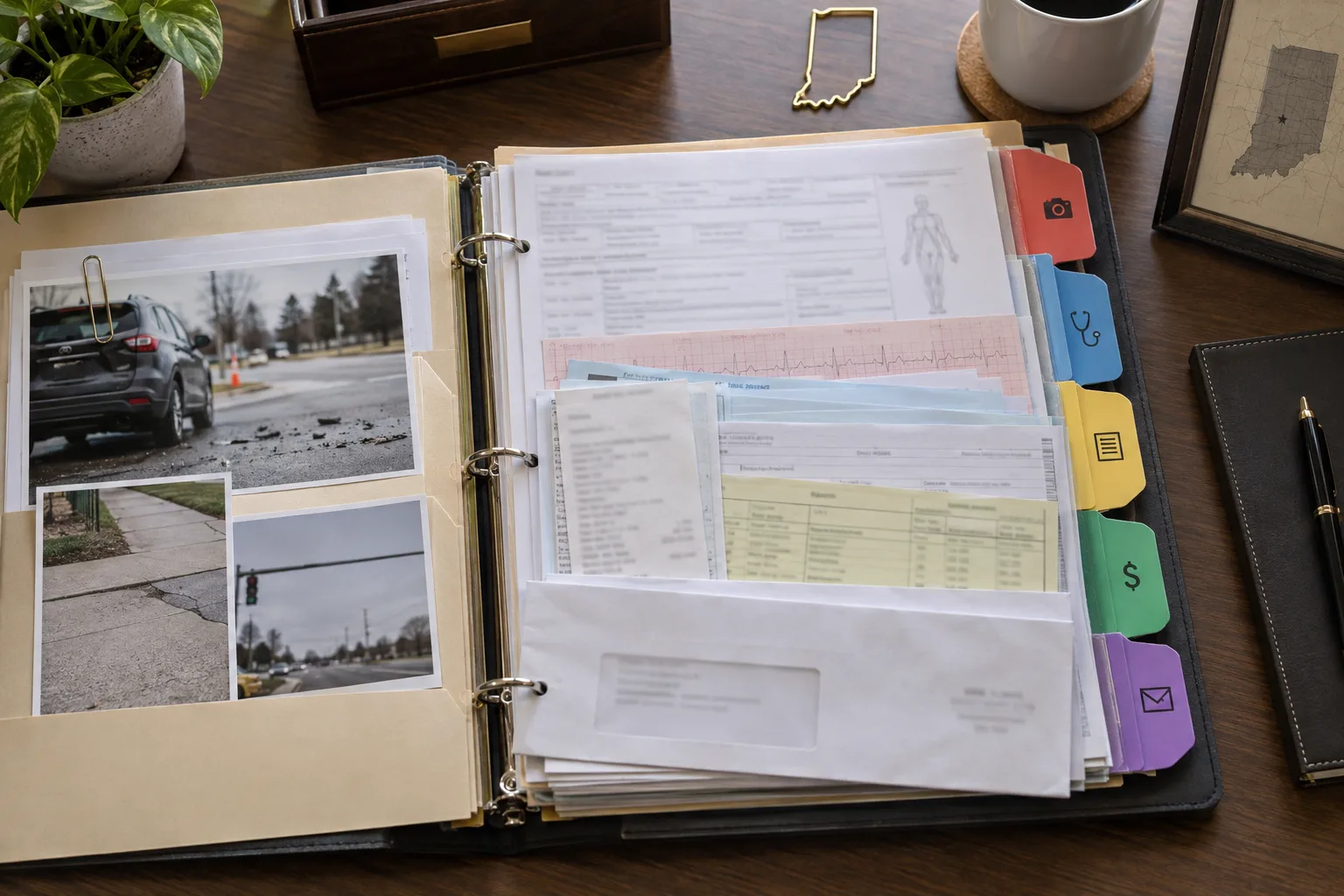
The following is a practical organizational checklist, not a legally required form or an agency-mandated list. Choose the materials that explain this particular claim, and identify information that is still missing.
| Part of the package | What it communicates | Useful supporting material |
|---|---|---|
| Incident summary | Where and how the event occurred | Crash report, photographs, video, diagram, and witness information |
| Responsibility explanation | Why the recipient is claimed to be legally responsible | Applicable records, statements, photographs, and other incident evidence |
| Care summary | Dated visits, evaluations, and provider notes | Relevant medical records, bills, and provider information |
| Financial-loss summary | The amounts claimed for expenses and income loss | Invoices, receipts, wage records, and employer verification |
| Settlement proposal | The amount and terms requested to resolve the claim | A clear calculation or explanation tied to the supplied records |
| Response information | Where and how the recipient should respond | Claim number, contact details, delivery information, and a copy of the letter |
A demand should distinguish documented facts from estimates and explain how each requested category relates to the incident. For a deeper evidence checklist, see what evidence helps prove an Indiana car accident claim.
How should you build the evidence package?
Start by arranging records in a simple order: incident evidence, medical documentation, expenses, income records, insurance correspondence, and the requested resolution. Use page labels or an enclosure list so the reader can find each supporting item.
The Indiana Department of Insurance claim tips linked above recommend complete and correct information, copies of correspondence, and a record of contacts, time, and expenses. These are general consumer recommendations, not a prescribed demand-package format.
- Check names, dates, totals, claim numbers, and attachment labels for accuracy.
- Keep the original records and send readable copies unless a trustworthy recipient specifically requires another format.
- Save the final letter, every enclosure, and proof showing when and where the package was delivered.
- Ask counsel which records are relevant and how to transmit sensitive material securely; do not alter original records or omit relevant context.

What happens after a demand letter is sent?
The recipient may accept the proposal, deny the claim, ask for additional records, dispute parts of the demand, or respond with a counteroffer. A counteroffer is another negotiation position, not a requirement that you accept it.
As a practical review step, compare the response with your records and list the points still in dispute. IDOI recommends asking for an itemized explanation of an auto or homeowners claim settlement offer. Its separate advice about a written denial and specific policy language concerns disagreements over the policy. Policy guidance should not be confused with a decision about someone else’s responsibility for the incident.
Keep copies of each response and a dated contact log. Keep the file organized as discussions continue, and ask counsel about unresolved issues.
You may also find it helpful to review what to consider before accepting a first settlement offer.
Are demand letters confidential or inadmissible?
Do not assume that every sentence in every demand letter is automatically confidential or unusable for every purpose. Indiana Evidence Rule 408[2] generally bars compromise offers and negotiation statements when offered to prove or disprove the validity or amount of a disputed claim, or to impeach by a prior inconsistent statement or contradiction. It permits other purposes, such as proving bias or negating a contention of undue delay.
Rule 408 is an evidence rule, not a blanket confidentiality promise. Its text addresses a disputed claim and the purpose for which the evidence is offered. Keep factual descriptions accurate and avoid exaggeration.

Common mistakes to avoid
- Sending the package before checking whether important records or supporting documents are still missing.
- Using inconsistent dates, totals, or descriptions that do not match the attached records.
- Demanding a figure without explaining the evidence and losses on which it is based.
- Proposing terms without asking counsel what they would resolve.
- Assuming you can wait for a reply before checking the court-filing requirements with counsel.
A demand package and a lawsuit are different steps. Indiana Trial Rule 3[3] describes commencement of a civil action through filing a complaint or equivalent document with the court, paying the filing fee or filing a fee-waiver order, and supplying complaint and summons copies when service is required. Mailing a demand to an adjuster is not that court filing.
The result in Weist v. Dawn, decided January 21, 2014[4], also shows why blanket deadline statements can be misleading. The claimant filed after the applicable limitation period. The Court of Appeals affirmed judgment for State Farm under the direct-action rule, but reversed judgment for the driver, Dawn, and remanded. Accepting the claimant’s version of events for summary-judgment purposes, the court found factual disputes about whether the insurer’s promises and course of conduct reasonably induced his delay.
That was not a ruling that the claimant had won his injury case or that negotiations automatically extended his deadline. It allowed a factfinder to decide the equitable-estoppel issue—whether the driver could rely on the limitations defense in those circumstances. Do not plan around obtaining that exception. Have counsel check the applicable deadline independently of the demand, and promptly preserve communications if you believe an adjuster induced you to wait.
If you are unsure whether the claim is ready for a demand, the consultation checklist in what to bring to a first personal injury consultation can help you organize the records and questions that matter.

Frequently Asked Questions
Can I write my own demand letter?
You can start by organizing your own account and documents. In Weist, the claimant prepared a demand himself using language from an online form, but later said he did not understand its reference to the statute of limitations. That is a useful reason to ask for a legal review rather than copying unfamiliar terms.
Is a demand letter the same as filing a lawsuit?
No. A letter sent to an adjuster is not a complaint filed with the court under Indiana Trial Rule 3. Ask counsel about the procedures and timing for your particular claim rather than relying on a form letter.
What if the requested response date passes?
Save proof of delivery, confirm that the correct person received the package, and record any follow-up. Ask counsel how to proceed while separately checking the court-filing timeline. Do not use your requested reply date to calculate the court-filing date.
What should I check before proposing an amount?
Reconcile the totals with the enclosures, identify any estimates, and ask counsel to review the proposed terms and what an acceptance would mean. A demand is not merely a worksheet; be deliberate about the proposal you send.
Can I complain to the Indiana Department of Insurance?
The IDOI consumer-complaint page[5] explains the agency’s process and jurisdiction. For that process, it requests supporting documents and says not to send originals. An IDOI complaint is a different process from filing a court action under Trial Rule 3; discuss both with counsel if a filing deadline may be approaching.
If you were injured in Indiana and want help deciding whether your records are ready for a demand, Delventhal Law Office can review the situation, explain the process, and help you consider the next step through a free case evaluation.
This article is general information about Indiana law and is not legal advice. Reading it does not create an attorney-client relationship, and neither does contacting us.