
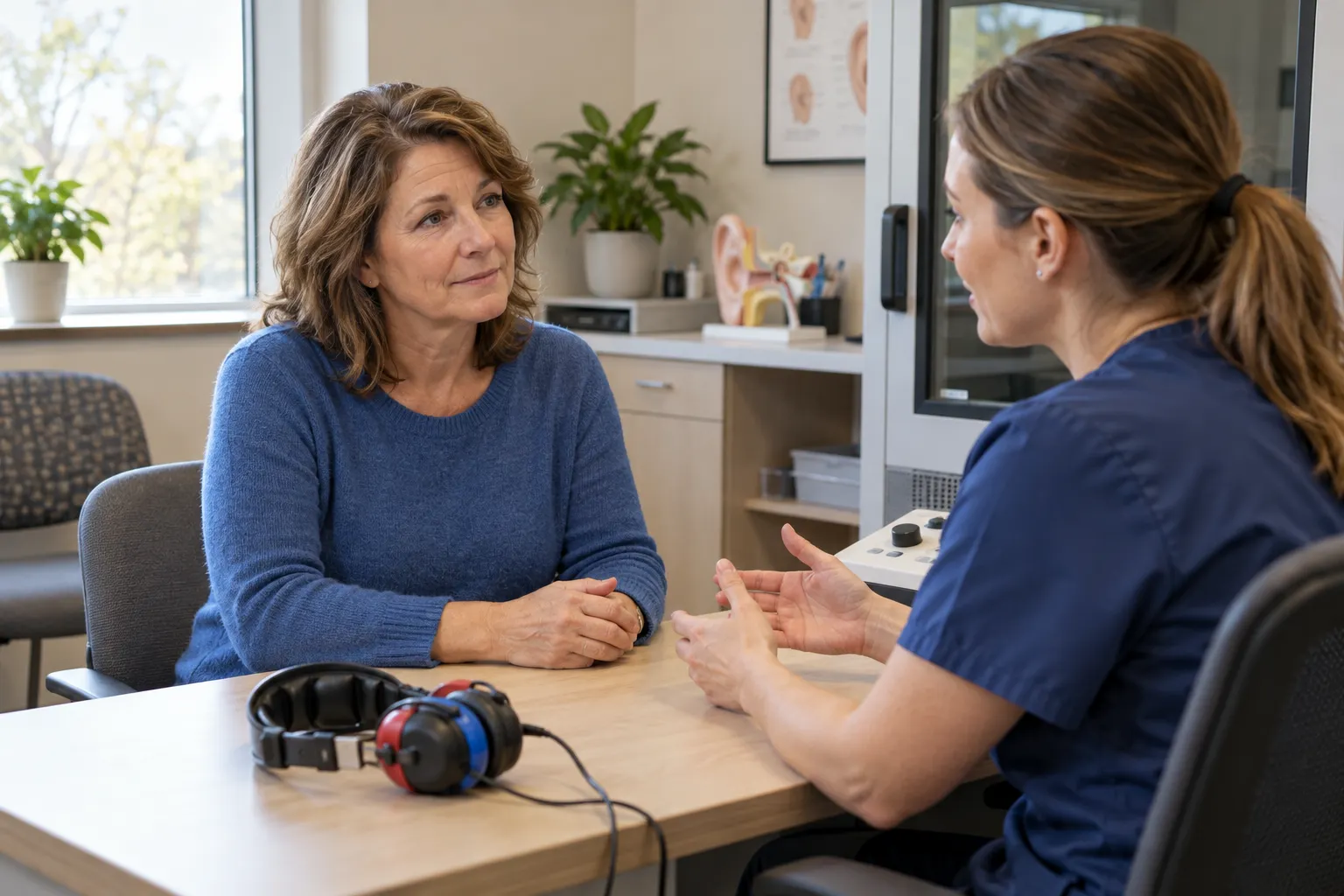
A conversation may become harder to follow. A quiet room may no longer feel quiet. Those are useful details to tell a healthcare professional, even when there is no visible injury. This guide focuses on hearing-related evaluation and documentation after a crash—not a general head-injury or claim-value overview. For the broader claim process, see our Fort Wayne car accident legal-services page.
Key takeaways
- Do not wait to build an insurance file before getting help for sudden hearing loss.
- Tinnitus describes a perceived sound; it does not identify its cause.
- Tell the clinician about both new symptoms and earlier hearing problems, noise exposure, and medications.
- Keep hearing-test reports, visit notes, recommendations, and a specific symptom timeline together.
- Separate what you personally noticed from what a clinician diagnosed or concluded.
When hearing changes are urgent
The National Institute on Deafness and Other Communication Disorders (NIDCD), part of NIH, says that sudden deafness symptoms are a medical emergency and should be assessed by a doctor immediately[1]. A sudden loss can occur all at once or over a few days, frequently in one ear. Ear fullness, dizziness, or ringing may occur along with it. Do not assume a new sudden hearing loss is just earwax or that it will settle after the crash.
Medical care comes first. Do not wait for an adjuster's response, an appointment with a lawyer, or completion of the worksheet below. A clinician should decide the appropriate examination and treatment. This article cannot determine whether your hearing change is sudden sensorineural hearing loss or another condition.

Ringing in the ears and hearing loss are different descriptions
NIDCD defines tinnitus as hearing sound without an external sound source[2]. It can sound like ringing, buzzing, roaring, hissing, or clicking. It may affect one ear, both ears, or seem to be in the head, and may be intermittent or constant. Some people find it affects sleep, concentration, or mood.
Difficulty hearing another person and perceiving a ringing sound are different things to describe, even when both happen together. NIDCD says hearing loss is strongly associated with tinnitus, but it also identifies other possible contributors, including medications, earwax or infection, jaw problems, and head or neck injuries. Ringing alone should not be labeled a concussion, a ruptured eardrum, or permanent hearing damage without an appropriate medical assessment.
The agency's separate noise-induced hearing-loss guidance[3] explains that a brief, intense sound or repeated loud exposure can damage hearing, and that loud noise can also cause tinnitus. That is general medical information. It does not establish the sound exposure in a particular collision or show that an airbag caused a particular person's symptoms.
Describe what you actually remember: where you were seated, whether an airbag deployed, whether you recall a head impact, and when you first noticed a change. Do not estimate a decibel level or copy a diagnosis from an online article. For broader head-injury questions, read our separate guide to head-injury evaluation after a Fort Wayne crash.
What a hearing evaluation may involve
NIDCD describes a tinnitus evaluation beginning with a medical history and an examination for issues such as earwax or fluid from an infection. A primary-care clinician may refer someone to an ear, nose, and throat physician (ENT), who examines the head, neck, and ears, or to an audiologist, who measures hearing and evaluates tinnitus. Imaging may be considered in some circumstances, particularly pulsating tinnitus; it is not a test this article can prescribe.
For an appointment, make it easier to distinguish your experience from an interpretation of it:
- Describe the sound: use your own words, such as buzzing or ringing, rather than trying to match a diagnosis.
- Identify the side and pattern: left, right, both, uncertain; constant, occasional, or noticed during particular activities.
- Explain hearing changes separately: for example, needing a person to repeat a sentence or noticing a difference using the phone.
- Give the actual timing: when you first noticed the symptom, when you reported it, and whether the timing is uncertain.
- Bring history: earlier hearing tests, relevant visit notes, and an accurate medication list if available.
Those are preparation suggestions, not a diagnostic checklist. Ask the provider to explain what each test does and does not show. Keep the written report and recommendations rather than relying on your memory of a verbal summary.

Build an honest before-and-after history
Because the NIH guidance identifies multiple possible contributors to tinnitus, an account limited to “the crash happened, then I noticed ringing” leaves important questions unanswered. The sequence matters to the history, but the sequence alone is not a medical conclusion about cause.
Write down any earlier ringing, known hearing loss, hearing-aid use, ear treatment, or workplace and recreational noise exposure. If you had an earlier hearing test, note where and approximately when it took place. Tell the treating clinician about changes in medications, too; let the clinician assess their relevance rather than stopping or changing a medication based on this article.
Then describe what is new or different: a sound in an ear that had not bothered you before, a change in an existing symptom, or a particular conversation that became difficult to follow. “I am not sure when it started” is better than supplying a date you cannot support.
Hypothetical example: A driver had occasional ringing before a crash but now notices it during evening conversations. A useful note distinguishes the prior episodes from the new pattern, identifies when the difference was first noticed, and records what the clinician said. It does not turn the change into an unsupported statement that the crash caused permanent damage.

A hearing-change worksheet you can bring to an appointment
Use this as a simple organizational aid, not a medical scoring system. Record a brief entry when something changes or affects an activity. Note improvement and symptom-free periods as accurately as difficult days. Do not recreate old entries as though you wrote them at the time.
| Record | Useful detail | Keep the distinction clear |
|---|---|---|
| Date and time noticed | First noticed after dinner; exact onset unknown | When noticed is not necessarily when a condition began. |
| Sound and location | Intermittent buzzing in the left ear | Describe the experience, not a guessed diagnosis. |
| Conversation or activity | Asked a coworker to repeat a telephone instruction | Use a concrete example instead of “cannot hear anything.” |
| Sleep or concentration | Ringing noticed while trying to fall asleep | Do not attribute every sleep problem to one cause. |
| Baseline and changes | Similar episodes before the crash, now noticed more often | Include earlier symptoms and improvement, not just worsening. |
| Care and records | Visit date, provider, test report, follow-up recommendation | Keep your observation separate from the clinician's findings. |
A family member can keep a separate note about what they personally observed—for example, a request to repeat a question. They should not adopt your symptoms as their own observations or write a medical opinion. Keep personal notes and records private rather than posting them publicly.

Which records should you organize after an Indiana crash?
For an initial discussion with a clinician or attorney, consider organizing the following items. This is a practical preparation list, not a statement that every item is legally required or will establish a claim:
- Medical timeline: emergency or urgent-care notes, primary-care visits, ENT and audiology reports, recommendations, and follow-up dates.
- Earlier records: hearing tests, relevant treatment history, and information about previous symptoms or hearing devices.
- Expenses and activity changes: itemized bills, receipts, appointment-related absences, and concrete notes about tasks that changed. Keep actual expenses separate from estimates.
- Crash information: report number, photographs you already have, and the basic event chronology. Do not infer a medical diagnosis from vehicle damage.
- Communications: relevant appointment messages and claim correspondence, with dates and the original wording preserved.
For a Fort Wayne or Allen County collision, identify the reporting agency and report number when available. The Indiana State Police crash-report page[4] explains that ISP maintains Indiana's central crash-report repository and that electronic reports are available through BuyCrash for a fee. A crash report is an event record, not a substitute for a hearing evaluation. Our broader car-accident evidence guide addresses other records without repeating this hearing-specific checklist.
Organizing records can make a consultation more focused, but a folder full of documents is not a promise of payment. Keep open questions open: what the medical findings mean, whether there is support for a connection to the crash, and which issues need further professional review.

Questions to ask about ongoing symptoms
NIDCD says tinnitus may improve or go away, but can also persist or worsen. There is no recovery timeline this article can predict for an individual reader. The agency describes management options such as sound therapies, hearing aids for people who also have hearing loss, and behavioral therapies. Appropriate options depend on the evaluation; the purpose here is to prepare questions, not select treatment.
- What findings do we have so far, and what remains uncertain?
- Do I need a hearing evaluation or another referral?
- What changes should prompt me to contact you sooner?
- How should I describe problems with conversation, sleep, or concentration?
- What follow-up do you recommend, and can I have the instructions in writing?
Care decisions belong with the treating professional. If hearing problems affect work or driving, ask that professional about individualized guidance rather than relying on a generic internet rule.
Frequently asked questions
Should I wait if my hearing suddenly drops after a crash?
No. NIDCD treats sudden deafness symptoms as a medical emergency and advises seeing a doctor immediately. Do not wait for an insurance response or a legal consultation. A clinician must evaluate the cause and appropriate treatment.
Does tinnitus always sound like ringing in both ears?
No. NIDCD describes sounds such as buzzing, roaring, hissing, or clicking, in one ear, both ears, or the head. Symptoms may come and go or be constant. Describe your own experience rather than trying to match someone else's symptoms.
Does ringing prove that the crash caused an ear or brain injury?
No. Tinnitus has several possible contributors, including noise, head or neck injury, medications, and ear conditions. The timing is part of the medical history, but it is not a stand-alone diagnosis or an individual causation opinion.
What is the difference between an ENT visit and an audiology evaluation?
NIDCD describes the ENT physician as evaluating the head, neck, and ears, and the audiologist as measuring hearing and evaluating tinnitus. Your treating clinician can explain which referrals or tests fit your symptoms.
Should I mention ringing or hearing problems I had before the collision?
Yes. Give the clinician an accurate history of earlier symptoms, hearing tests, noise exposure, and medications. Explain what changed and what did not. Do not omit relevant history or guess at an onset date.
How long will tinnitus last after a car accident?
There is no single recovery timeline for every person. NIDCD says tinnitus may improve or go away, but it can persist or worsen. Ask your clinician about your findings, management options, and follow-up rather than relying on a predicted duration online.
Your next step
Put medical needs first. Once you have addressed them, an organized hearing history can help you explain what changed without overstating what is known. If you have questions about an Indiana car-accident claim, Delventhal Law Office can discuss the records and issues at a free case evaluation. Bring the information you already have; you do not need to have every answer before asking for help.
Source review: Medical information was checked against NIDCD/NIH's Tinnitus, Sudden Deafness, and Noise-Induced Hearing Loss pages; crash-report access was checked against Indiana State Police. Accessed October 18, 2026. Linked references appear below. The worksheet and preparation lists are editorial organizational tools, not agency-prescribed legal requirements.
This article is educational, not medical advice. A healthcare professional should evaluate symptoms and recommend care.
This article is general information about Indiana law and is not legal advice. Reading it does not create an attorney-client relationship, and neither does contacting us.
Sources
- sudden deafness symptoms are a medical emergency and should be assessed by a doctor immediately (nidcd.nih.gov) ↩
- NIDCD defines tinnitus as hearing sound without an external sound source (nidcd.nih.gov) ↩
- noise-induced hearing-loss guidance (nidcd.nih.gov) ↩
- Indiana State Police crash-report page (in.gov) ↩