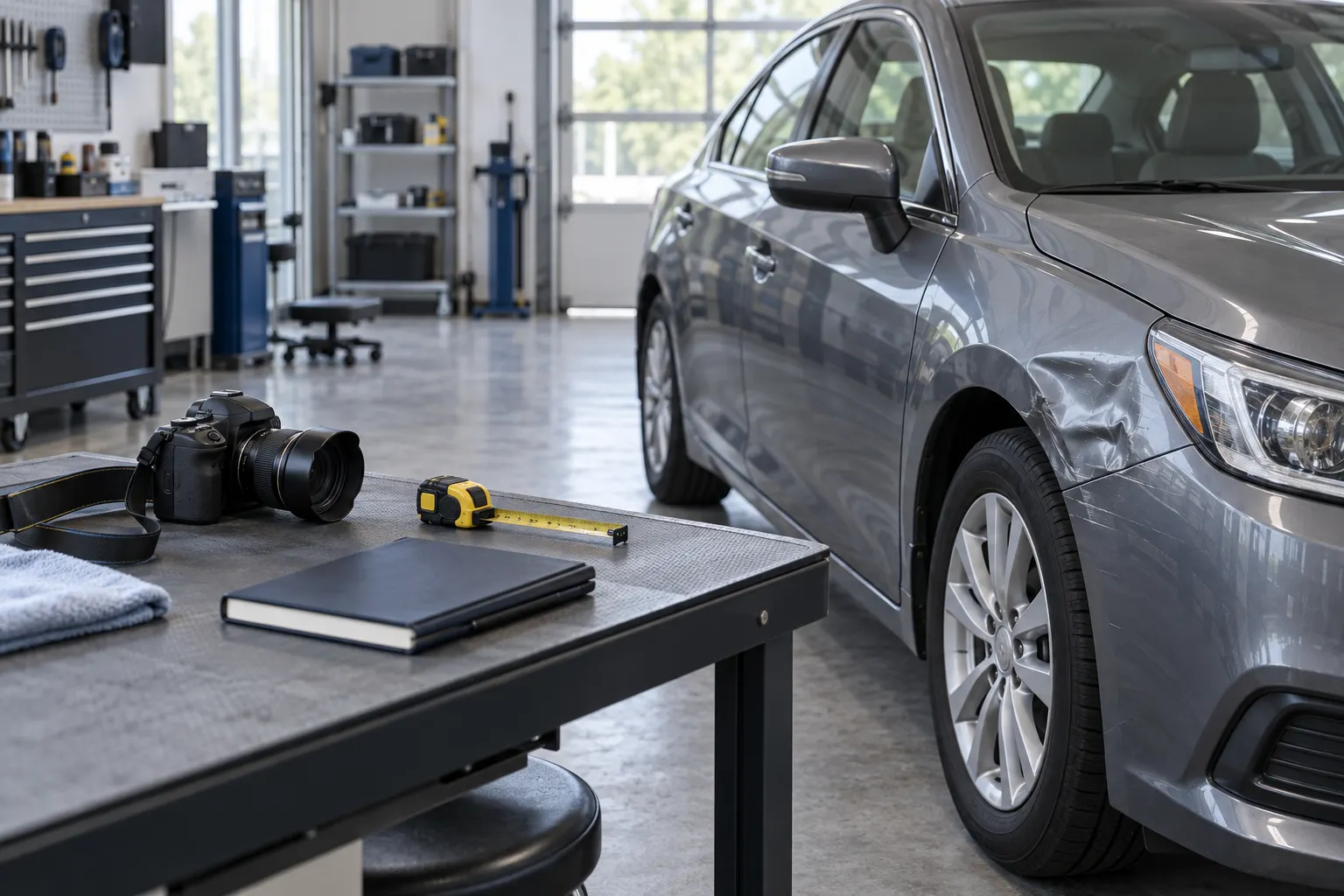
If two drivers describe the same collision differently, start by separating what a photograph actually shows from what someone thinks it means. This guide explains those physical clues and the questions to ask about them. For the larger claim-documentation checklist, see what evidence helps prove an Indiana car accident claim. If you need help reviewing a disputed collision, our Fort Wayne car accident attorney page explains how Delventhal Law Office can help.
Key takeaways
- Photograph a clue in its surroundings, not only as a close-up.
- Do not assume every tire mark or broken part came from your crash.
- Distinguish the original scene from conditions after vehicles, debris, or traffic have moved.
- A repair price is not a speed measurement or a medical diagnosis.
- Preserve original files and leave roadway measurements and technical conclusions to qualified investigators.

Skid marks and other tire marks: start with identification
A useful first question is not “How fast was the driver going?” It is “What made this mark, and how do we know it belongs to this collision?” A photograph of a dark line should not automatically be labeled a braking skid. Its shape, surface, location, and connection to the involved vehicle need examination.
The National Highway Traffic Safety Administration’s Special Crash Investigations program[1] describes collecting skid and yaw marks, inspecting vehicles, taking photographs, and combining those observations with interviews and official records. That approach matters: the mark is one input in a larger investigation, not a stand-alone answer.
When reviewing photographs with an investigator, useful questions include:
- Can the mark be traced to an involved vehicle, rather than older traffic?
- Is the full mark visible, including its beginning and end?
- Does the image show its position relative to a lane line, curb, or other fixed reference?
- Was it documented before or after towing and scene cleanup?
- What additional measurements would be needed before offering a speed or movement opinion?
Do not turn a photograph into a speed calculation. If someone offers a speed estimate, ask what measurements, surface information, method, and assumptions support it. An unscaled image may help locate a question without supplying the information needed to answer it. Likewise, a photograph showing no obvious tire mark should not be treated as a complete record of the driver’s braking.
Broken glass is a clue, not an exact impact marker
Treat the location of glass, plastic, or a detached part as an observation to investigate—not an automatic point-of-impact marker. Ask when the picture was taken, whether anyone moved the material, and whether the part can be associated with either vehicle. A photograph after cleanup may document a collection of debris rather than its original distribution.
Record scratches or gouges in the pavement and visible fluid trails in the same careful way. Instead of writing “impact happened here,” write “scrape visible beside the lane line in photograph 12.” An investigator can then compare that observation with vehicle damage, scene measurements, and other records. NHTSA’s Crash Investigation Sampling System[2] uses multiple sources, including scene evidence, vehicle examinations, and interviews, to develop a detailed picture of a crash.
Do not walk into traffic, pick up sharp pieces, handle leaking material, or interfere with emergency responders to preserve a clue. Tell the investigating officer about something you noticed from a safe location. Document what you can safely observe; professional collection and scene control are separate tasks.

Reading dents, scrapes, and damaged parts carefully
Damage photographs can help frame questions about where vehicles contacted each other and how the damage relates to the described collision. Useful images show the whole vehicle, its damaged side, and closer views of individual contact areas. One tightly cropped dent leaves out the vehicle orientation and surrounding details.
NHTSA’s crash-investigation programs photograph and measure vehicles rather than relying only on repair bills. CISS also identifies medical records as its primary source for information about the nature and severity of injuries. These are different kinds of evidence serving different questions.
Keep three questions separate: What damage is visible? What physical analysis does that damage support? What injuries does the medical evidence document? Do not assume an expensive estimate establishes high speed, or that limited visible damage rules out an injury. A photograph is not a medical evaluation, and a repair estimate should not be presented as a reconstruction calculation.
Also identify what is known about earlier damage, repair activity, and when each photograph was taken. Do not clean, scrape, or take apart a damaged area to make it easier to photograph. If a vehicle is about to be repaired or disposed of and its condition is disputed, discuss inspection arrangements promptly with counsel. Our guide to repair work and crash-evidence preservation addresses that separate issue.

Physical clues: possible use and the missing context
Use this table to organize questions, not to diagnose the collision yourself.
| Observation | Question it may help investigate | Context still needed |
|---|---|---|
| A dark or curved tire mark | Where did a vehicle travel, and what movement might the mark reflect? | Identification of the mark, association with a vehicle, full extent, measurements, and surface conditions. |
| Glass or vehicle parts | How does their documented location fit the proposed collision sequence? | Whether the material belongs to this crash and whether traffic, responders, or cleanup changed its position. |
| Pavement scrapes or fluid trails | Can the observation be connected with a damaged component or vehicle path? | Timing, source, scene measurements, and comparison with the vehicle. |
| Dents, scrapes, or apparent material transfer | Do the vehicles’ contact areas fit the account being offered? | Views of both vehicles, actual inspection where appropriate, earlier damage, and other possible contacts. |
| Vehicles shown at rest | Where were the vehicles when the image was made? | Whether they had already been moved and how that location relates to the original collision. |
A photo and observation worksheet you can actually use
If you already have photographs or video, organize them before adding conclusions. Keep the original files; make a separate working copy for arrows, circles, or notes. Do not use filters, generative editing, or enhancement to fill in a detail that the original does not show.
- Identify the file. Give it a simple reference such as “Photo 12,” and note who supplied it.
- Record timing honestly. Write the known or approximate capture time. If you only know when someone sent it, say that instead.
- Describe the view. Note the direction, lane, curb, sign, building, or other recognizable reference visible in the image.
- Write only the observation. For example: “Dark curved mark beside the white line; part of the mark is outside the frame.”
- List scene changes. Note any known movement of cars, towing, cleanup, or later return to the location. Mark uncertainty as unknown.
- Add a question. For example: “Can this mark be connected to either vehicle?” Keep it separate from the observation.
Copyable entry: File/reference: ____. Supplied by: ____. Capture time or timing uncertainty: ____. View/location: ____. What is visible: ____. Known scene changes: ____. Question for the investigator: ____.
If you are considering new photographs, safety comes first. Do not return to a travel lane, stand on a highway shoulder, move a vehicle, or recreate the crash to obtain a better angle. Later photographs should be clearly labeled as later photographs, not presented as the original scene.

Comparing physical clues with competing accounts
Hypothetical example: Two drivers disagree about the lane in which their cars touched. A photograph shows loose plastic near a lane line, but it was taken after the cars were towed. That image alone does not resolve the dispute. The next questions are whether the plastic was moved, whether earlier photographs exist, and whether the vehicles’ damage and other evidence fit either account.
A useful review keeps the conclusion no stronger than its supporting information. Ask the person interpreting the evidence to identify which details were measured, which came from photographs, and which were assumed. Ask what alternative explanation was considered and what missing information could change the opinion.
Video, witness observations, or vehicle records may supply context that a single physical clue lacks. Those sources have their own limits. Our separate guide explains what a passenger vehicle’s event data recorder may contain; it should not be confused with interpreting a roadway photograph.
Finding the Indiana crash report and related records
The Indiana State Police crash-report page[3] identifies ISP as the central repository for Indiana crash reports and directs the public to BuyCrash for electronic reports for a fee. Keep the report number and the name of the investigating agency with your photographs.
For a Fort Wayne or Allen County crash, identify the agency that actually investigated the collision rather than assuming which department holds the records. Ask what scene photographs, diagrams, or supplemental materials exist and how a request should be made. Do not assume purchasing the basic report also provides every photograph or investigator’s measurement. Availability and access need to be checked with the record holder.
Bring the report, original image files, your observation worksheet, and the vehicle’s current location to a consultation. Those materials help define what is known, what remains uncertain, and whether a specialized inspection would add useful information. You do not need to arrive with your own reconstruction theory.

Frequently asked questions
Can skid marks prove the other driver’s exact speed?
Not from a casual photograph alone. A speed opinion needs an appropriate method, reliable measurements, relevant conditions, and stated assumptions. Ask which inputs support the estimate and what uncertainty remains.
Does the absence of visible tire marks prove the driver never braked?
No. A photograph without a visible mark is not a complete record of vehicle operation. Note what the image shows and ask whether other observations or vehicle data can address braking; do not turn a missing visual clue into a definite conclusion.
Does a pile of broken glass identify the impact point?
Not by itself. Establish when the photograph was taken, whether the material belongs to the involved vehicles, and whether its position changed. An investigator should compare it with the rest of the scene and vehicle evidence.
Can a repair estimate tell me how severe my injuries are?
A repair estimate addresses vehicle work, not a medical assessment. Keep damage documentation and medical documentation together for review, but do not substitute the repair price for evidence about a person’s injuries or a measured crash analysis.
Are photographs taken after cleanup still useful?
They can still document what was visible at that later time. Label them accurately, record known changes, and avoid presenting moved vehicles or collected debris as original positions. Earlier images or other records may provide missing context.
Should I draw arrows on my crash photographs?
Keep the original files unchanged. If arrows or labels help explain what you noticed, add them only to a separate working copy and identify it as annotated. Preserve the source and timing information, including anything you do not know.
Get help separating the evidence from the assumptions
If you were injured and the accounts of the crash conflict, Delventhal Law Office can review the information you have and discuss what additional investigation may be useful. Call (260) 484-6655 or request a free case evaluation. The goal is a clearer understanding of the evidence—not a conclusion based on one photograph.
This article is general information about Indiana law and is not legal advice. Reading it does not create an attorney-client relationship, and neither does contacting us.