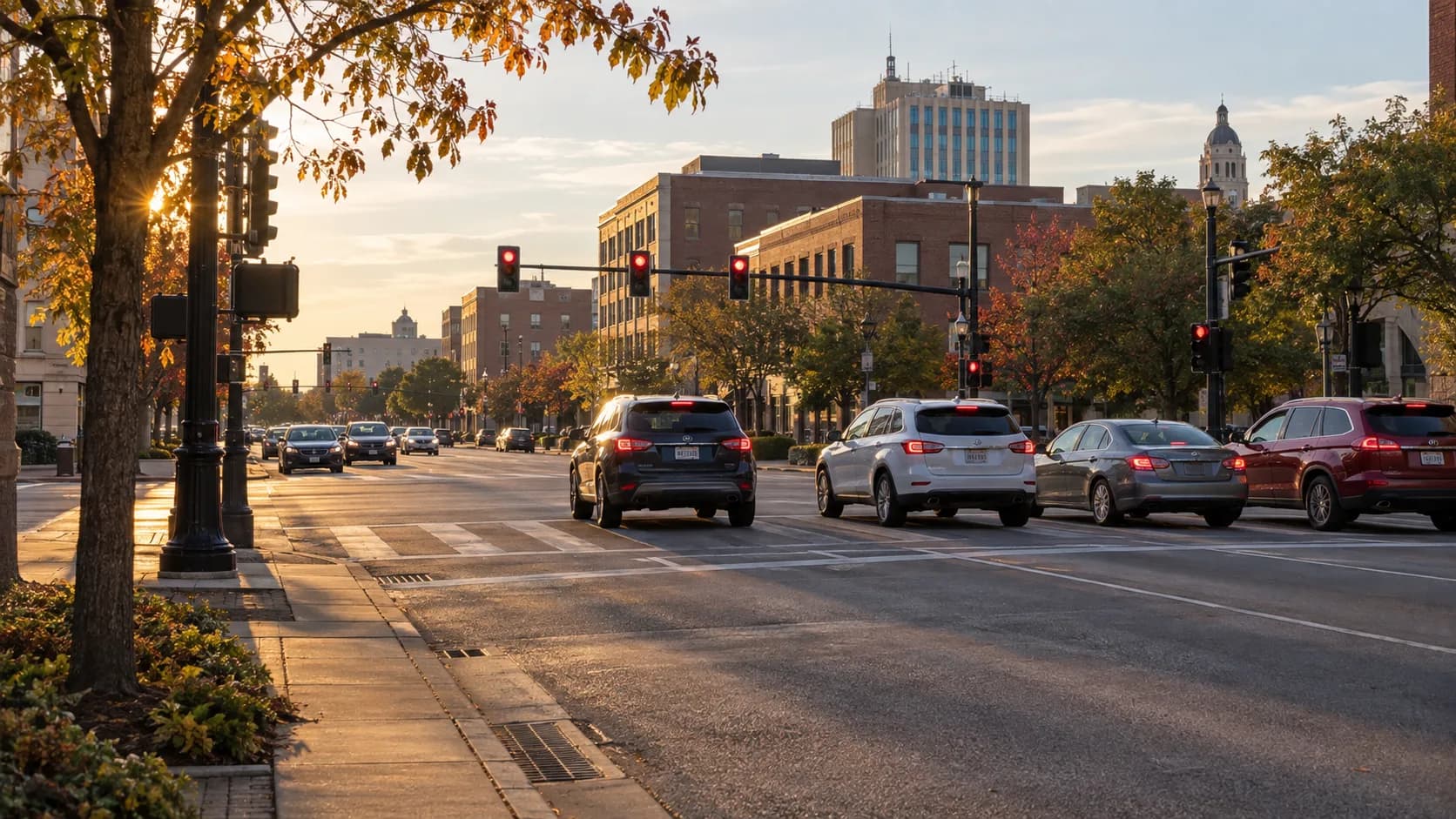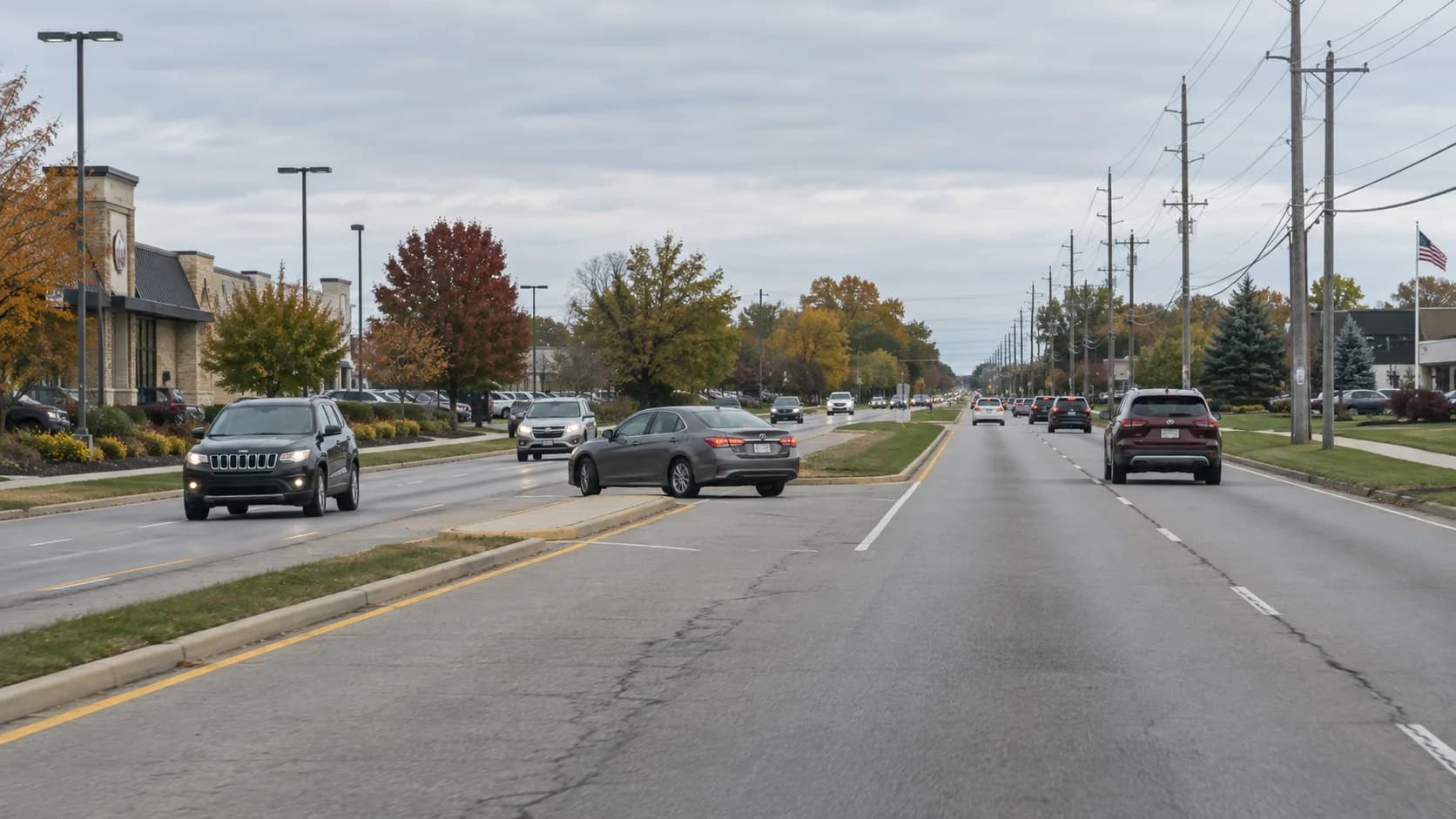
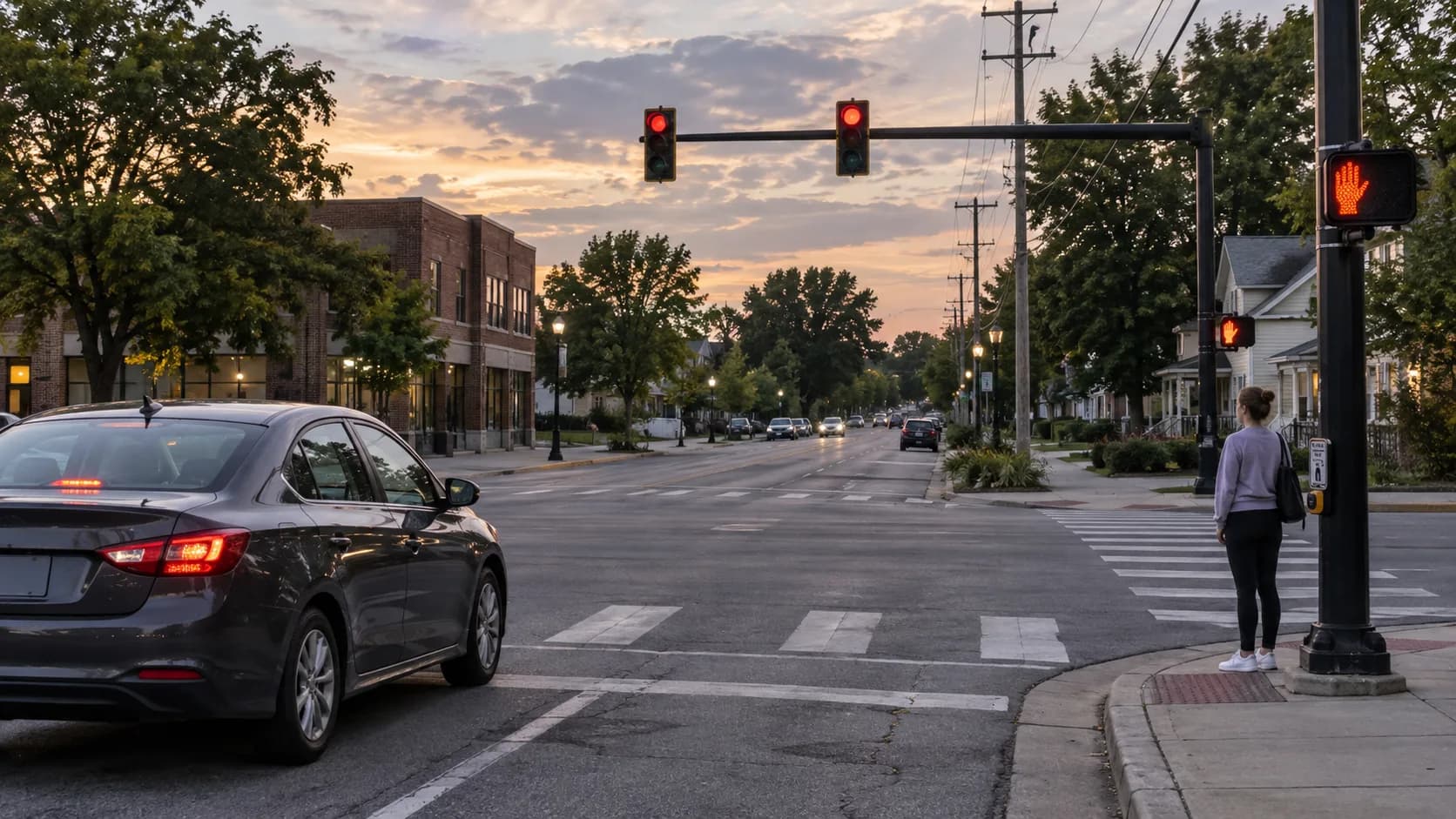
A right turn on red is a permitted movement—not an automatic right of way. After a crash, the signal, signs, crosswalk, vehicle paths, visibility, video, and witness accounts can help show what happened.
- A driver must stop before making a permitted right turn on red.
- A driver making the turn must yield to pedestrians lawfully within an adjacent crosswalk and to other traffic using the intersection.
- A posted sign can prohibit a right turn on red.
- For ordinary private-driver negligence claims covered by Indiana’s Comparative Fault Act, claimant fault reduces damages, and fault greater than 50% bars recovery. Government tort claims are excluded from that chapter.
What is Indiana’s right-turn-on-red rule?
Under Indiana Code 9-21-3-7(b)(3) (official PDF, page 400)[1], traffic facing a steady red signal must stop at the marked stop line, before the near-side crosswalk if there is no marked stop line, or before entering the intersection if there is no crosswalk. Unless a sign prohibits the movement, a driver who has completely stopped may cautiously enter the intersection to turn right.
The statute also requires the turning driver to yield to pedestrians lawfully within an adjacent crosswalk and to other traffic using the intersection. The current Indiana Driver’s Manual[2] similarly instructs drivers to stop, check for vehicles and pedestrians in or about to enter the turn path, and confirm that no “No Turn on Red” sign is present.
Practical distinction: Stopping, checking for a prohibiting sign, and yielding are separate questions. A driver who stopped still needs to yield before turning. For broader traffic-control questions, see our Indiana red-light and stop-sign crash guide.

How do right-turn-on-red crashes happen?
Illustrative scenario, not a reported local crash: A driver stops, looks left for a gap, then begins turning while a pedestrian approaches from the right. To understand that scenario, separate what was visible from the driver’s stopping position from what was visible when the vehicle began moving. Do not assume that a witness who saw the car stop also saw the crosswalk at the moment of contact.
For a collision with another vehicle, organize the same questions around each lane: where the vehicles were, what each controlling signal displayed, whether the turning driver stopped, and what could be seen before the turn. These are our preparation questions, not conclusions about a particular event.
People hurt while walking can find additional claim information in Delventhal Law Office’s guide to Fort Wayne pedestrian accidents. Drivers and passengers can review the firm’s Fort Wayne car-accident resource.

Who may be at fault after a right-turn-on-red crash?
Begin with the sequence, not an assumed percentage: Write down the stopping point, any turn restriction, the crosswalk used, and each person’s direction of travel. Our broader intersection-collision guide addresses the surrounding fault questions.
For ordinary negligence claims against private drivers governed by Indiana’s Comparative Fault Act, IC 34-51-2-5 through -8 (official PDF, pages 617–618)[3] distinguish two rules. Section 5 reduces compensatory damages proportionately for the claimant’s fault. Section 6 addresses the recovery bar, and sections 7 and 8 expressly direct a defense verdict when the claimant’s fault exceeds 50%. The allocation can include nonparties, which can affect what is recoverable from named defendants.
That is not a rule for every injury claim. IC 34-51-2-1 and -2 (official PDF, page 616)[4] exclude certain medical-malpractice actions and tort claims against governmental entities or public employees under the Indiana Tort Claims Act. A crash involving a government vehicle needs separate legal review; do not assume the private-driver calculation applies.
For more detail on the general calculation, read our explanation of Indiana’s comparative-fault rule. An allegation of fault is not itself a final allocation.

Evidence that can clarify the turn
Our practical preparation checklist: Organize material that may show the signal phase, road users’ positions, and available sight lines. The table is not a statement of legal evidence requirements. Do not enter traffic or take unsafe steps to collect anything.
| Question | Evidence to look for | Why it helps |
|---|---|---|
| Did the driver stop? | Video covering the approach and pause, witnesses who actually saw the stop, and photographs locating the stop line | May help establish the movement immediately before the turn |
| Was the turn prohibited? | Photographs of the driver’s approach, lane-specific signs, signal head, and any wording limiting a restriction by time | Preserves the traffic controls visible from the driver’s lane |
| Where was the pedestrian or vehicle? | Crosswalk photographs, debris, vehicle damage, clothing or bicycle damage, and witness accounts | May help reconstruct paths and the point of contact |
| Could the parties see each other? | Day-and-time photographs, lighting records, vegetation, parked vehicles, construction barriers, and weather records | Documents possible sight-line conditions |
| Is electronic evidence available? | Original dashcam files, nearby business video, doorbell video, and phone photographs | Lets you retain an unedited original and ask the owner whether additional footage exists |
Do not crop, annotate, or repeatedly export the only copy of a video. Preserve the original file and note who obtained it, when it was obtained, and the device or system that created it. The firm’s guide to evidence in an Indiana car-accident claim offers a broader records checklist.

What should you do after this kind of crash?
Call 911 when emergency assistance is needed and follow responder instructions. The Indiana Driver’s Manual, chapter 8 (printed page 58)[5] directs drivers to stop and remain at the scene, exchange identifying information, and provide reasonable assistance as directed by law enforcement, medical personnel or a 911 operator. Its vehicle-movement guidance says not to move the vehicle when the collision involves hazardous materials or results in injury, death or entrapment. Follow the instructions for the actual situation at the scene.
After immediate safety needs, these recordkeeping suggestions can help prepare for a consultation:
- Photograph the full intersection only from safe locations, including the approach, signs, stop line, crosswalk and obstructions.
- Collect witness names and contact details. Ask what each person personally saw, rather than asking them to assign fault.
- Ask nearby camera owners whether footage exists and whether they can preserve the relevant time window. Do not assume every traffic camera records or stores video.
- Save the crash-report number, insurance correspondence, original photographs, repair documents, medical paperwork and records of missed work.
- Separate observations from estimates. Label later photographs with the actual date; do not present later lighting or signs as proof of conditions at the crash time.
A right-turn observation worksheet for your consultation
For a Fort Wayne or Allen County intersection, write both road names, the approach direction, date and approximate time. Sketch the driver’s lane, stop line, near-side crosswalk, intended turn and the other road user’s path. Mark the exact signal face or pedestrian display you could see; a green light facing one approach does not describe every signal at the intersection.
Use three columns: what I saw; what someone else reported; what remains unknown. Did the vehicle pause behind the line or farther forward? Which crosswalk was the pedestrian using? Did your view continue from the stop through the impact, or was part of it obstructed? Was a sign readable from that lane? If you do not know, leave it unknown. This worksheet organizes observations; it does not determine legal fault.
You can also use the Fort Wayne car-accident settlement calculator as an organizational worksheet.
How long do you have to file an Indiana injury lawsuit?
Indiana Code 34-11-2-4(a) (official PDF, page 75)[6] generally requires an action for injury to a person or character to be commenced within two years after the cause of action accrues. Government claims can have separate, earlier notice requirements under IC 34-13-3-6 and -8 (official PDF, pages 108–109)[7]. Ask counsel to check the parties, accrual, exceptions and notice requirements; this summary does not resolve your individual situation.

Frequently Asked Questions
Is a right turn on red legal in Indiana?
Indiana generally permits a right turn on red after a complete stop. A driver facing a steady red signal may cautiously turn right unless a sign prohibits the movement, but the driver must yield to pedestrians lawfully within an adjacent crosswalk and to other traffic using the intersection.
Does a driver have to stop before turning right on red?
Indiana Code 9-21-3-7[8] requires a complete stop before a permitted right turn on red.
Who has the right of way when a pedestrian is in the crosswalk?
A driver turning on red must yield to a pedestrian lawfully within an adjacent crosswalk.
What if there is a “No Turn on Red” sign?
The driver may not use the statutory right-turn-on-red permission when a sign prohibits that turn.
What should I bring to a consultation if no ticket was issued?
Bring the crash-report number, original photographs and video, witness contacts, and notes about the stop, turn restriction and crosswalk. Tell the attorney whether any citation was issued. These are preparation suggestions, not conclusions about your case.
What if a business or traffic camera may have recorded the crash?
Identify the camera, location, likely time window, and owner as soon as practical, then make a clear preservation request. Keep a copy of the request and any response.
If you would like to talk through what happened, learn about attorney Chad Delventhal or request a free consultation with Delventhal Law Office.
This article is general information about Indiana law and is not legal advice. Reading it does not create an attorney-client relationship, and contacting us alone does not create that relationship. Please do not post private medical or claim details in public comments.
Sources
- Indiana Code 9-21-3-7(b)(3) (official PDF, page 400) (iga.in.gov) ↩
- Indiana Driver’s Manual (in.gov) ↩
- IC 34-51-2-5 through -8 (official PDF, pages 617–618) (iga.in.gov) ↩
- IC 34-51-2-1 and -2 (official PDF, page 616) (iga.in.gov) ↩
- Indiana Driver’s Manual, chapter 8 (printed page 58) (in.gov) ↩
- Indiana Code 34-11-2-4(a) (official PDF, page 75) (iga.in.gov) ↩
- IC 34-13-3-6 and -8 (official PDF, pages 108–109) (iga.in.gov) ↩
- Indiana Code 9-21-3-7 (iga.in.gov) ↩