
Key takeaways
- Truck accident claims may involve more than the driver’s last mistake before impact.
- A motor carrier may be responsible for hiring an unsafe driver, failing to investigate prior safety history, failing to train the driver, or keeping a dangerous driver on the road.
- Federal trucking rules require driver applications, prior driving-history inquiries, safety-performance investigations, annual driving-record reviews, and driver qualification files.
- Important records can include driver qualification files, training records, motor vehicle records, crash history, dispatch communications, safety policies, and company discipline records.
- These records should be preserved quickly after a serious Indiana truck crash.
When a semi-truck causes a serious crash, the first focus is usually on the driver. Was the driver speeding? Distracted? Tired? Following too closely? Driving too fast for the weather? Those questions matter, but they are not the end of the investigation.
In many Indiana truck accident cases, the deeper question is how that driver ended up behind the wheel of an 80,000-pound commercial vehicle in the first place. Did the company check the driver’s background? Did it review prior crashes or violations? Did it provide meaningful training? Did it ignore warning signs? Did it supervise the driver after problems appeared?
That is where negligent hiring, negligent training, negligent retention, and negligent supervision become important. A serious truck crash may have roots inside the company’s hiring office, safety department, dispatch system, or training program long before the collision.
Delventhal Law Office investigates serious truck accidents in Fort Wayne and throughout Indiana. If you need help after a semi-truck crash, start with our Fort Wayne truck accident attorney page, or call (260) 484-6655 for a free consultation.
What is negligent hiring in a truck accident case?
Negligent hiring means a company hired a driver it knew, or should have known, was unsafe for the job. In a trucking case, that may involve a driver with a history of crashes, license problems, serious traffic violations, drug or alcohol issues, medical certification problems, or prior safety-performance concerns.
It can also involve a company that failed to perform the required checks. A trucking company cannot simply accept a driver’s word and look away from obvious safety risks. Commercial driving is safety-sensitive work. The hiring process matters because the public shares the road with the driver after the company makes that decision.
What is negligent training?
Negligent training focuses on whether the company properly prepared the driver for the work. A driver may have a CDL and still need company-specific training on equipment, routes, cargo, backing procedures, hours-of-service compliance, pre-trip inspections, post-accident procedures, winter driving, mountain driving, hazardous conditions, or company safety policies.
Training issues can matter when a driver mishandles a curve, jackknifes, fails to inspect brakes or tires, misjudges stopping distance, backs into traffic, fails to secure cargo, or violates company procedures. The question is not just whether the driver made a mistake. The question is whether the company set that driver up to fail.
Federal rules require driver applications and safety-history checks
Federal trucking regulations create important paper trails. Under 49 C.F.R. § 391.21[2], a driver application must include information such as licensing, experience, prior accidents, traffic violations, license suspensions or revocations, and employment history. That application can become a key exhibit if the company ignored or failed to follow up on safety concerns.
Motor carriers must also make certain investigations and inquiries. 49 C.F.R. § 391.23[3] requires inquiries into motor vehicle records and investigations of safety-performance history with DOT-regulated employers. Those rules are designed to help carriers identify unsafe drivers before they are placed on the road.

The driver qualification file may be one of the most important records
Commercial carriers must maintain driver qualification files. 49 C.F.R. § 391.51[4] lists records that may belong in those files, including the driver application, motor vehicle records, road test documentation or accepted equivalents, annual driving-record review notes, and medical certification information.
In a negligent hiring or training case, the driver qualification file can answer critical questions:
- Did the company obtain the required motor vehicle records?
- Did the driver disclose prior crashes, violations, or license problems?
- Were prior employers contacted about safety performance?
- Did the company document a good-faith effort to investigate the driver’s background?
- Was the driver medically qualified?
- Was the driver road-tested or properly accepted as qualified?
- Were annual reviews completed after the driver was hired?
If the file is incomplete, inconsistent, or missing important documents, that can become evidence that the company’s safety system failed.
Annual driving-record reviews can show ignored warning signs
Negligent retention and supervision often involve what happened after the driver was hired. A driver may begin with a clean record and later develop problems. The company may learn about crashes, violations, complaints, log violations, inspection issues, or unsafe habits and fail to act.
49 C.F.R. § 391.25[5] requires motor carriers to make annual inquiries and reviews of each driver’s driving record. The rule says carriers must consider evidence of violations and accident records, and must give great weight to violations such as speeding, reckless driving, and operating under the influence that indicate disregard for public safety.
If a trucking company had repeated chances to catch a problem and did nothing, that can become a central liability issue.

Training records can show whether the company took safety seriously
Training evidence may include orientation materials, safety manuals, road-test records, ride-along evaluations, remedial training, winter-driving materials, cargo-securement training, equipment-specific instruction, and records of safety meetings.
Those records can also show what the company did not do. If a driver was assigned unfamiliar equipment or dangerous routes without meaningful instruction, if training consisted of a signature on a checklist, or if the company ignored repeated unsafe behavior, the training program may become an important part of the claim.
This is especially true when the crash involves predictable truck-specific risks: stopping distance, blind spots, wide turns, backing, fatigue, brake checks, load securement, or poor weather.
The company’s duty does not end with paperwork
Federal rules also recognize that a motor carrier must require observance of driver regulations. 49 C.F.R. § 390.11[6] provides that when a driver duty or prohibition exists under covered regulations, the motor carrier has a duty to require the driver to observe it.
That is important because a company cannot treat safety rules as the driver’s problem alone. If the company uses unsafe schedules, ignores log violations, fails to discipline unsafe driving, rewards speed over safety, or keeps a risky driver on the road, company responsibility may be broader than the driver’s conduct at the scene.
What evidence should be preserved?
In a negligent hiring or training truck case, preservation should happen quickly. Relevant evidence may include:
- Driver qualification file.
- Employment application and prior employer responses.
- Motor vehicle records and annual review notes.
- Road test records, CDL verification, and medical certification records.
- Training manuals, orientation records, and safety meeting records.
- Dispatch messages, delivery schedules, and driver communications.
- Prior crashes, inspection violations, complaints, and discipline records.
- ELD data, GPS data, maintenance records, and post-crash inspection records.
- Company safety policies, audit records, and retention policies.
How negligent hiring changes the value and direction of a truck case
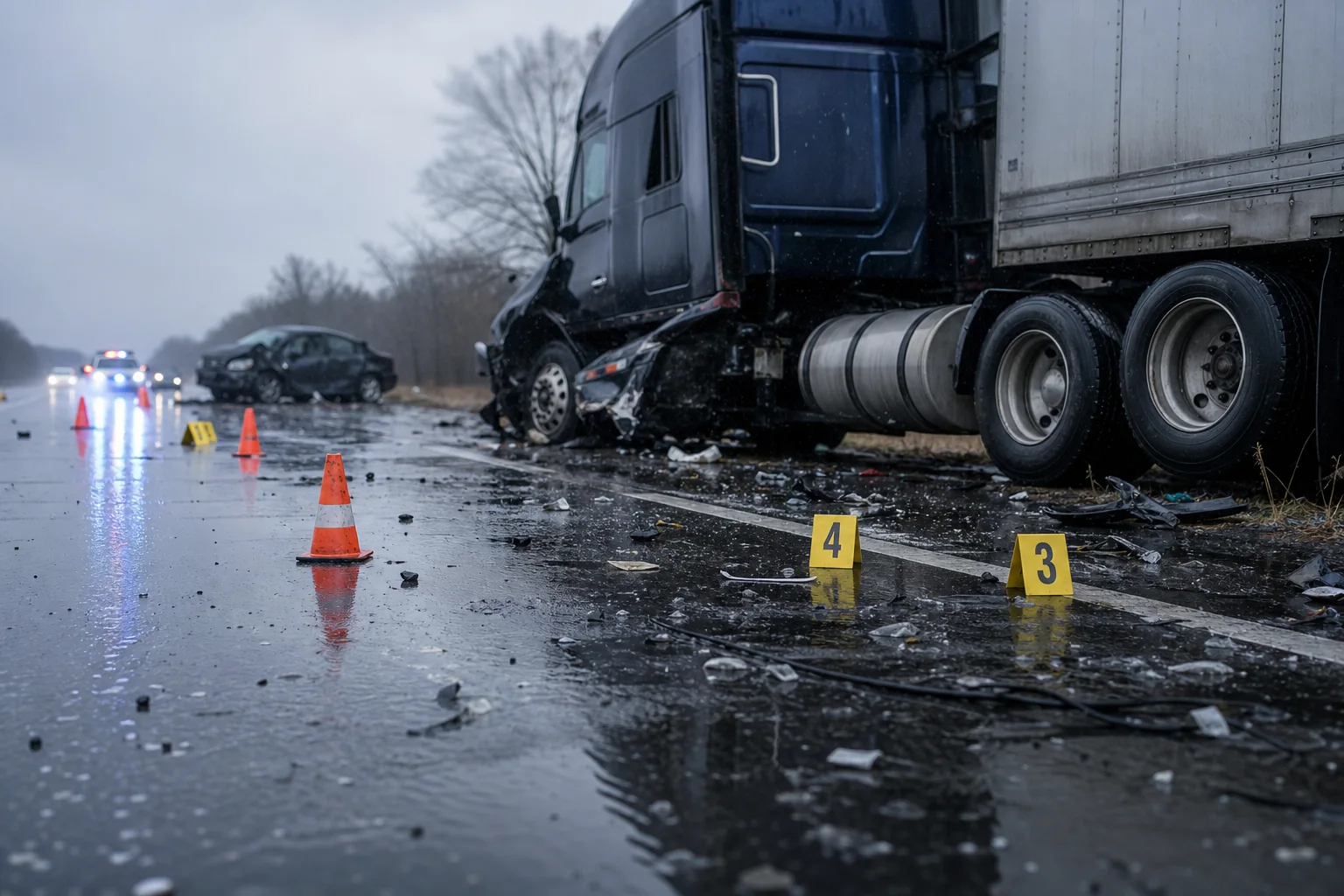
Negligent hiring and training evidence can change a truck accident case in several ways. It may identify additional theories of liability. It may show that the crash was preventable. It may support a claim against the company directly, not just the driver. It may also reveal additional insurance coverage, corporate defendants, or safety practices that explain why the crash happened.
These issues connect closely with broader truck accident responsibility. For a companion overview, read Who Is Legally Responsible in an Indiana Truck Accident?
And if the crash involved severe injuries, limited insurance, or disputed fault, related issues may include minimum insurance limits, uninsured drivers, or what happens if the police report says you are partly at fault.
How long do you have to act?
Most Indiana personal injury claims are subject to a two-year deadline under Indiana Code § 34-11-2-4[7]. Shorter notice rules may apply in some cases, and evidence-preservation deadlines can become urgent long before the statute of limitations expires.
Truck company records may be retained under federal rules for specific time periods, but that does not mean an injured person should wait. The safer approach is to send preservation demands early and investigate while records, witnesses, vehicles, and electronic data are still available.

Talk to a Fort Wayne truck accident lawyer
If you were hurt in a semi-truck crash, do not assume the case starts and ends with the driver listed on the police report. The trucking company’s hiring, training, supervision, and retention decisions may be critical.
Delventhal Law Office helps injured people in Fort Wayne and throughout Indiana after serious truck and commercial vehicle crashes. Call (260) 484-6655 or contact us online for a free consultation.
There is no fee unless we recover for you.
Frequently asked questions
What is negligent hiring in a truck accident case?
Negligent hiring means the trucking company hired a driver it knew, or should have known, was unsafe. This may involve prior crashes, serious violations, license issues, drug or alcohol history, medical qualification problems, or failure to perform required background checks.
What records show whether a trucking company hired safely?
Important records may include the driver qualification file, employment application, motor vehicle records, prior employer responses, safety-performance history, road test records, medical certification records, and annual driving-record reviews.
Can a trucking company be responsible even if the driver caused the crash?
Yes. The driver may be responsible for the driving mistake, but the trucking company may also be responsible for negligent hiring, training, supervision, retention, dispatch pressure, or failure to enforce safety rules.
Why do training records matter after a truck crash?
Training records can show whether the driver was prepared for the vehicle, cargo, route, weather, inspection duties, and safety procedures involved. Missing or weak training may support a direct claim against the company.
Should I wait for the police report before investigating hiring and training issues?
No. The police report may be helpful, but it usually does not include the company’s hiring file, training records, driver qualification file, dispatch communications, or safety policies. Those records should be preserved as early as possible.