

You slipped on a wet floor in a Fort Wayne grocery store, a Coliseum-area restaurant, or a public building in Allen County — and now the claims adjuster keeps repeating the same line: "There was a wet floor sign, so we're not responsible." That sentence is meant to end the conversation. Under Indiana law, it usually does not.
This guide explains what a warning sign actually means for an Indiana premises-liability claim, when a sign is not enough, how comparative fault works, what insurers argue, and what evidence protects your case. It is general information about Indiana law, not legal advice about your specific fall.
Key takeaways
- A wet floor sign is a piece of evidence, not a legal shield. Indiana law asks whether the property owner used reasonable care under all the circumstances — not simply whether a sign existed somewhere in the building.
- Indiana owes its highest duty of care to invitees — customers and other people invited onto business property. That duty comes from Burrell v. Meads[1] and Restatement (Second) of Torts § 343.
- A sign can be inadequate if it was hidden, knocked over, placed after you already fell, positioned on the wrong side of the spill, or gave no real chance to choose a safe path.
- Even if you share some blame, Indiana's modified comparative fault rule lets you recover unless your fault is greater than 50%. Your recovery is reduced by your percentage.
- Most Indiana injury claims must be filed within two years, and claims against a city, county, or other government entity require a much earlier written notice.
- Prompt medical care and fast evidence preservation (surveillance video, incident report, photos, witnesses) often decide these cases.
If a government body or employee may be involved, review our Indiana government tort claim notice guide, because notice deadlines can be much shorter than the ordinary injury filing period.
What Indiana law actually requires of property owners
Indiana premises-liability law does not make a business an insurer of your safety, and it does not make a business automatically liable just because you were hurt on its floor. Instead, the law looks at the relationship between you and the property owner and asks whether the owner acted reasonably.
Indiana recognizes three categories of visitors, and a paying customer or invited guest is almost always an invitee — the category owed the greatest protection. In Burrell v. Meads[1], the Indiana Supreme Court adopted the Restatement (Second) of Torts § 343 standard. Under that standard, a landowner can be liable for a dangerous condition on the property only if the owner (a) knew about it or should have discovered it and realized it created an unreasonable risk, (b) should have expected that visitors would not discover or protect themselves against it, and (c) failed to use reasonable care to protect them.
Notice the second element. It contemplates situations where a visitor does not realize the danger or fails to protect against it — exactly the kind of dispute a wet floor sign raises. A sign is one way an owner can try to satisfy the "reasonable care" element, but it is only effective if it genuinely warned you and gave you a fair chance to avoid the hazard.
Was the warning actually adequate?
The core question is rarely "was there a sign?" It is "was the warning reasonable under the circumstances?" A folded yellow cone tucked behind an endcap, facing away from the aisle you walked down, is not the same as a clearly visible barrier placed directly in your path. Courts and juries look at real details.
| Factor | Points toward an adequate warning | Points toward an inadequate warning |
|---|---|---|
| Visibility | Bright, upright sign in clear sightline as you approach | Knocked over, faded, blocked by displays, or behind you |
| Placement | Positioned to block or flank the actual wet area | On the far side of the spill, or nowhere near the water |
| Timing | Set out before the hazard existed and stayed up | Placed only after you fell, or removed too early |
| Route alternatives | A reasonable dry path was available and marked | The only path to products/exit ran through the hazard |
| Scope of hazard | Sign matched the size and location of the wet area | Spill spread well beyond the small area the sign covered |
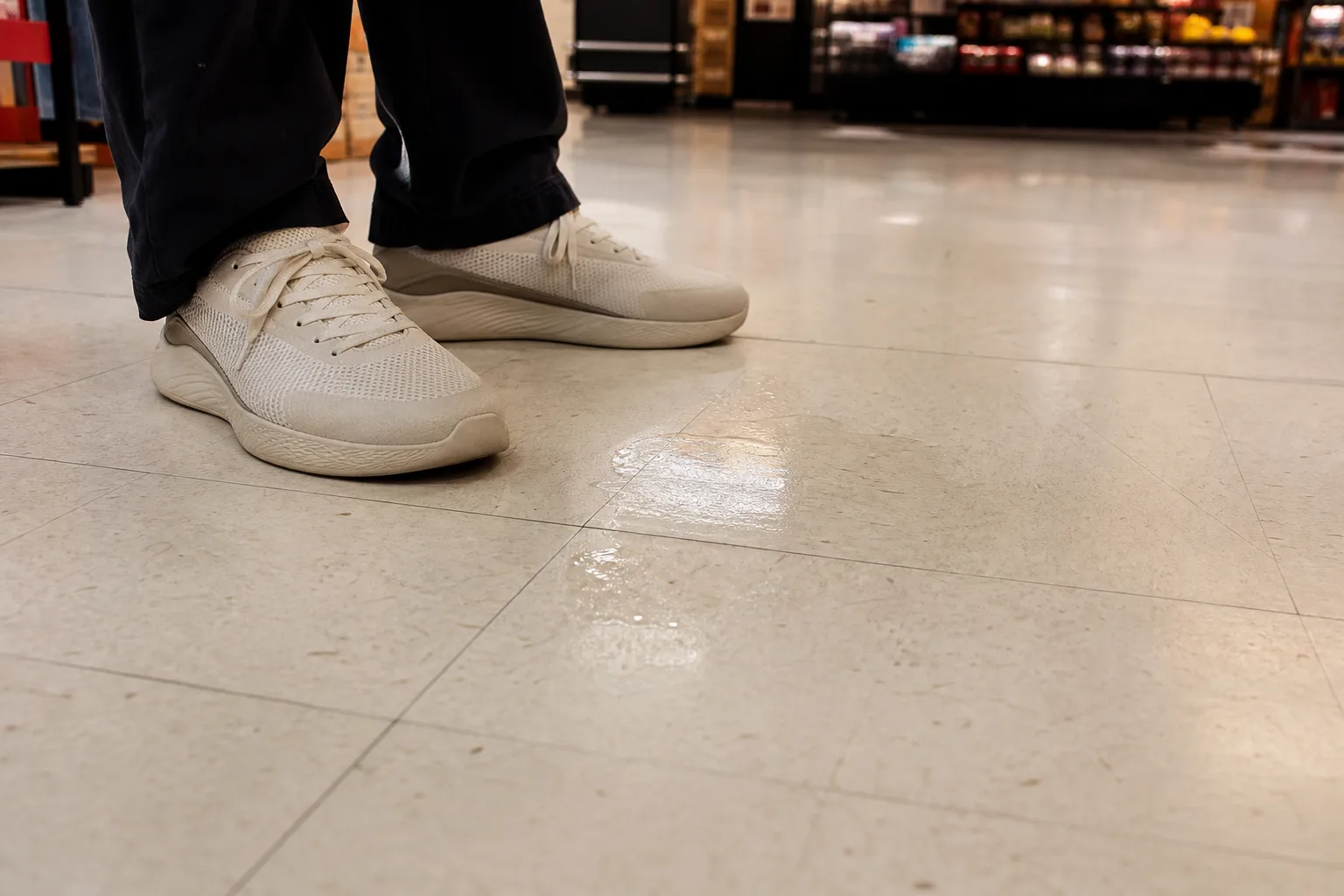
| Nature of the danger | Water was visible and obvious on the floor | Clear liquid on light tile, glare, or a slick invisible film |
An honest look at these factors often shows that a sign existed but did little to protect anyone. That is why a wet floor sign, standing alone, does not end an Indiana slip, trip, and fall claim.

Notice: did the business know or should it have known?
Ironically, a wet floor sign can actually help your claim on one of the hardest issues in these cases: notice. To recover, you generally must show the business had actual notice (it knew about the hazard) or constructive notice (the condition existed long enough that a reasonable business should have found and addressed it).
If an employee placed the sign, the business plainly knew the floor was wet. The real question becomes whether it did enough after learning of the danger — mopping, blocking the area, roping it off, or stationing someone there — rather than leaving a single cone and moving on. When there is no sign at all, notice can be much harder to prove, which is why surveillance footage and cleaning logs matter so much.
Comparative fault: how a sign can reduce, not erase, recovery
Indiana follows a modified comparative fault system under the Indiana Comparative Fault Act. Under Indiana Code § 34-51-2-6[2], a claimant is barred from recovery only if the claimant's contributory fault is greater than the combined fault of everyone who caused the harm — in practice, greater than 50%. If your share is 50% or less, you can still recover, but your damages are reduced by your percentage of fault. You can use our Indiana car accident settlement calculator to organize the factors that may affect a claim’s value; it is an educational tool, not a promise of any result.
This is where the sign really lives in your case. The insurance company will argue the sign makes the fall mostly your fault. But a jury can weigh everything: a poorly placed sign, a clear liquid on light tile, a distracting store display, a crowded aisle, or a spill that spread past the warning. The result might be 0% on you, or 20%, or 40% — and at any of those numbers you can still recover something. We walk through how this math plays out in our explainer on Indiana's 51% fault rule.
Indiana courts sometimes reduce or deny recovery when a hazard was truly "open and obvious," but that is not an automatic defense. If the owner could still foresee that someone might be harmed despite an obvious danger, liability can remain. These outcomes are fact-specific and often decided by a jury rather than thrown out early.

Insurance defenses you should expect
Understanding the playbook helps you avoid handing the adjuster easy points. After a wet-floor fall, expect some combination of these arguments:
- "The sign was adequate." Countered by photos and video showing where the sign actually was.
- "The danger was open and obvious." Countered by lighting conditions, clear liquid, glare, and the absence of a reasonable alternate route.
- "We had no notice of the spill." A sign undercuts this; cleaning logs and video address it directly.
- "You were distracted or on your phone." A fault argument, not a complete bar — and stores expect customers to look at products and displays.
- "Your footwear was unsafe." Rarely decisive by itself.
- "You waited to report or to get treatment." Delay and gaps in treatment are used to question whether you were really hurt.
Because adjusters look for admissions, be cautious about giving a recorded statement before you understand your rights. Our guide on recorded statements explains the risks, and the same cautions apply to premises claims.
Why prompt medical care and documentation matter
Falls are not minor by default. According to the Centers for Disease Control and Prevention[3], nearly one million older adults are hospitalized every year because of a fall, most often from a head injury or a hip fracture. Younger people are hardly immune — wrist fractures, shoulder tears, spinal injuries, and concussions are common after a hard floor impact.
Some symptoms are delayed. The CDC notes that concussion signs[4] can appear hours or days later, so a normal first appearance does not mean you are uninjured. Prompt evaluation does two things: it protects your health, and it creates a medical record that ties the injury to the fall. This is general health information, not medical advice for your situation — if you are hurt, get evaluated by a qualified provider.

Evidence to preserve after a fall
Premises evidence disappears fast. The floor gets mopped, the cone gets moved, and surveillance systems often record over footage within days or weeks. Acting quickly — and asking a lawyer to send preservation letters — can make or break a claim.
| What to capture | Why it matters | When |
|---|---|---|
| Photos/video of the wet area and the sign's exact position | Shows whether the warning was visible and well placed | Immediately, before cleanup |
| The store incident report (ask for a copy) | Documents notice, time, and the store's own account | Same day |
| Names and numbers of witnesses and employees | Witness statements corroborate conditions | Before people leave |
| Your footwear and clothing (unwashed) | Rebuts "unsafe shoes" and shows the liquid | Preserve, don't clean |
| Surveillance video request/preservation letter | Video often shows the spill's age and the sign's timing | Within days — before it's overwritten |
| Medical records and receipts | Proves injury, causation, and damages | Ongoing |

Indiana deadlines you cannot ignore
Indiana sets firm time limits, and premises claims are no exception.
- Two-year general deadline. Most personal-injury claims in Indiana must be filed within two years of the injury under Indiana Code § 34-11-2-4[5]. Miss it, and the claim is usually barred regardless of how strong it was.
- Government property is different. If you fell in a public building, city park facility, library, or other government-owned property, the Indiana Tort Claims Act (Indiana Code § 34-13-3[5]) requires a written tort claim notice long before the two-year mark — generally within 180 days for a city or county entity and 270 days for the state. These deadlines are short and unforgiving.
For a fuller walkthrough, see our guide on how long you have to file a claim in Indiana.
Frequently Asked Questions
Does a wet floor sign automatically block my Indiana claim?
No. A sign is evidence a business will use, but Indiana law asks whether the owner used reasonable care overall and whether the warning was actually adequate. A hidden, misplaced, or late sign may do little to protect the business.
Can I recover if the fall was partly my fault?
Often yes. Under Indiana Code § 34-51-2-6[2], you are barred only if your fault is greater than 50%. At 50% or less you can recover, reduced by your share of fault.
What if the water was open and obvious?
Indiana treats "open and obvious" as a factor in comparative fault, not an automatic bar. If the owner could still foresee harm despite an obvious hazard, liability may remain. These questions are fact-specific.
I didn't report the fall right away. Is my claim over?
Not necessarily, but delay makes proof harder and gives insurers an argument. Report as soon as you can, preserve evidence, and be aware of the two-year deadline and the much shorter notice deadlines for government property.
Do I need a lawyer for a wet-floor slip and fall?
Not every case requires one, but premises claims turn on evidence that disappears quickly and on defenses built around the sign. A Fort Wayne premises-liability attorney can send preservation letters, request surveillance video, and evaluate comparative fault before the record is lost.
Talk with a Fort Wayne premises-liability attorney
If you were hurt in a slip-and-fall in Fort Wayne or anywhere in Allen County and are not sure whether the wet floor sign ends your claim, you do not have to sort it out alone. Chad Delventhal and Delventhal Law Office can review what happened, explain the deadlines that may apply, help preserve surveillance video and incident reports, and help you decide the next step. A free consultation costs nothing and creates no obligation.
This article is general information about Indiana law and is not legal or medical advice. Reading it does not create an attorney-client relationship, and neither does contacting us. If you do contact us about a possible claim, Indiana Rule of Professional Conduct 1.18 requires us to keep what you tell us confidential whether or not we take the case — but please do not send documents or detailed facts until we have agreed in writing to represent you. For advice about your specific situation, speak with a licensed Indiana attorney.