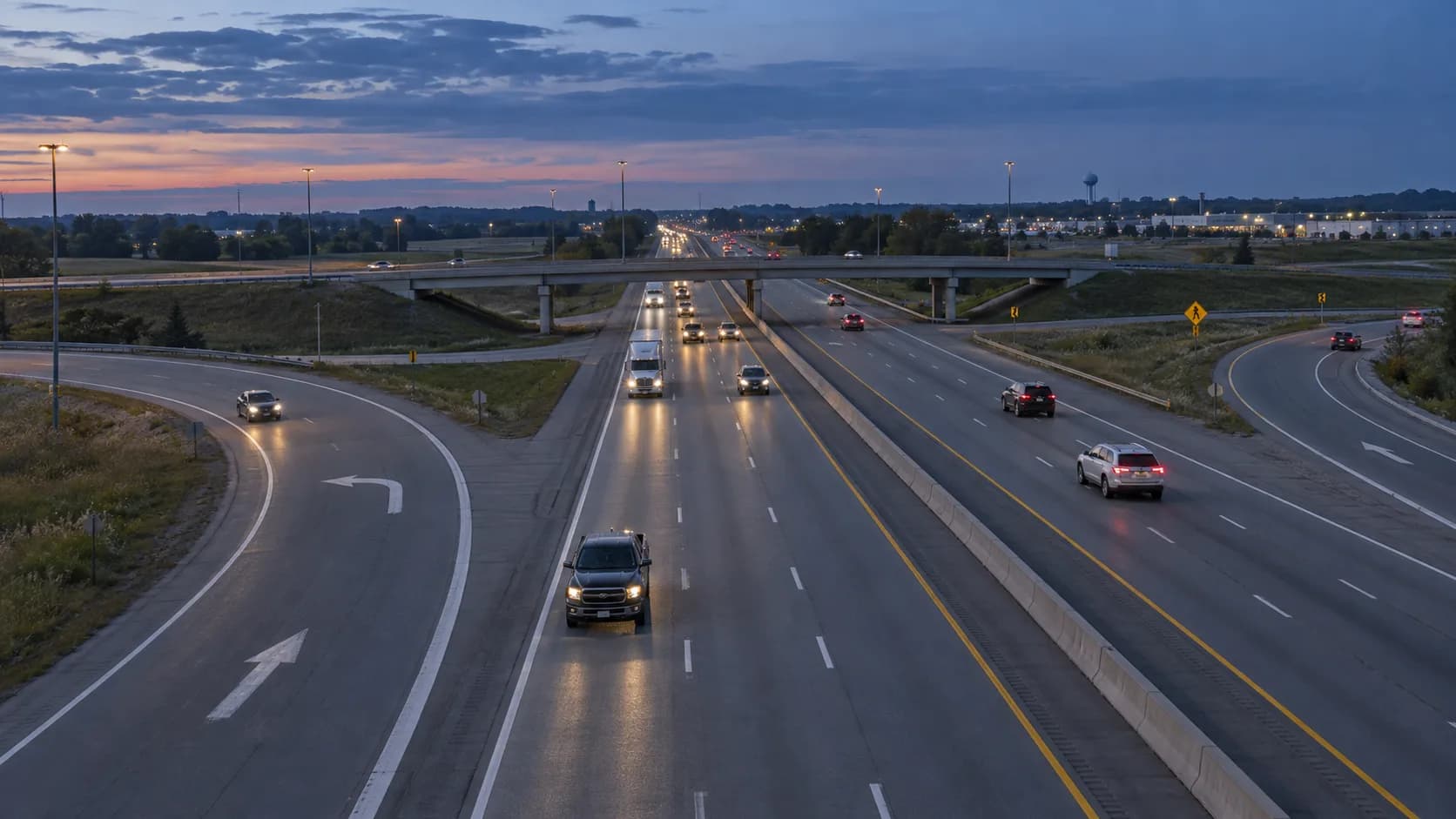
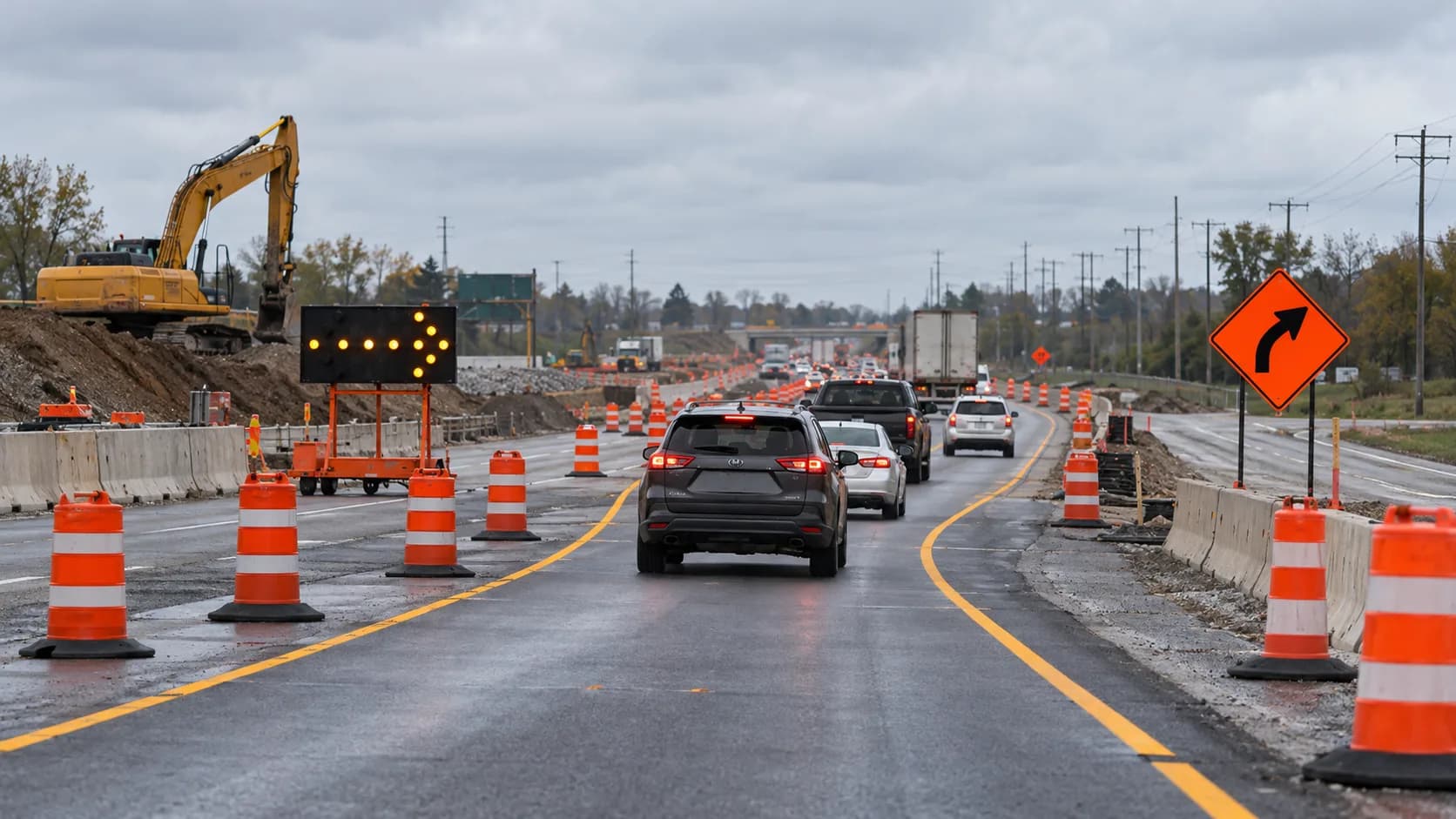
Construction alone does not prove that the contractor or road owner caused a crash. For a collision in Fort Wayne, Allen County, or elsewhere in Indiana, separate the driving evidence from the work-zone setup and identify each potential defendant before assuming one rule covers everyone.
- Private-party comparative fault and government contributory negligence are different.
- Government notice periods can arrive well before the deadline for a lawsuit.
- Preserve the setup as it existed at the time—not just photographs taken after it changed.
- Seek prompt advice even when you do not yet know which agency or contractor controlled the site.
Who may be responsible for a construction-zone crash?
A driver: Investigate speed, attention, following distance, lane movement, and the warnings visible on the approach. A rear-end crash in a work-zone backup may raise different questions from a collision with construction equipment. These are investigation topics, not findings of fault. Our Fort Wayne car accident guide explains the broader claim process.

A contractor or subcontractor: Identify the company responsible for the particular task, not merely the logo on nearby equipment. Preserve the contract, approved plans, change orders, inspection records, and relevant communications. Ask who placed and maintained the devices and whether the configuration changed before or after the collision.
INDOT’s published Work Zone Safety and Mobility Policy describes temporary traffic-control plans for contracted activities as including project-specific maintenance-of-traffic plans, contract provisions, standard drawings, and standard specifications. These documents define how construction is phased and detail the physical work zone. INDOT Work Zone Safety and Mobility Policy, Transportation Management Plans[1].
The Comparative Fault Act preserves the legal requirements of causal relation for fault and contributory fault. Indiana Code 34-51-2-3[2]. Use the actual project documents and the requirements applicable to that project. A general policy is not proof of a particular contractor’s breach, and an apparent departure from a plan does not by itself establish that it caused the crash.
A government entity: Determine which agency owned or controlled the road and what work it actually performed. An interstate location or a city street address alone does not resolve responsibility. Keep public-entity claims separate from claims against private drivers or contractors.
The Tort Claims Act contains specific immunity provisions. For example, it addresses discretionary functions and certain highway-design claims, with conditions and qualifications. Government ownership does not establish liability, and a construction zone does not establish blanket immunity. Indiana Code 34-13-3-3, pages 102–106[3].

Why private-party and government claims need different fault analyses
Ordinary private-party claims: In actions governed by the Comparative Fault Act, a claimant’s contributory fault reduces compensatory recovery. A claimant more than 50% at fault is barred; at 50%, recovery is reduced rather than automatically barred. The jury provisions address allocation among defendants and qualifying nonparties. Indiana Code 34-51-2-5 through -8, pages 617–618[4].
A defendant may assert that a nonparty caused all or part of the damages. The defendant bears the burden of proving that defense, while the claimant still must prove that the defendant’s fault caused damages. Indiana Code 34-51-2-14 and -15[5].
Government tort claims: The Comparative Fault Act expressly does not apply to tort claims against governmental entities or public employees under the Indiana Tort Claims Act. Indiana Code 34-51-2-2[6].
Indiana’s Supreme Court applied contributory negligence in Murray v. Indianapolis Public Schools: even negligence that was a slight cause of the harm barred the claim against the public-school defendants. Thus, a claimant’s own negligence that contributes to the injury can bar a government negligence claim; being less than 51% at fault is not a safe harbor. Indiana Supreme Court: Murray, official court excerpt (August 8, 2019)[7].
One work-zone incident can involve private and public defendants without putting every claim under a single percentage-of-fault calculation. Have counsel analyze each defendant, the available defenses, and any nonparty allocation separately. The firm’s 51% fault-rule guide provides context for ordinary comparative-fault claims, not a substitute for the government-claim analysis.

Which government notice requirements can arrive first?
State claim: Subject to the statutory exceptions, notice must be filed with the Indiana attorney general or the state agency involved within 270 days after the loss occurs. The statute also addresses a reasonable attempt to identify and serve the correct state agency when notice was sent to the wrong one. Indiana Code 34-13-3-6(a)[8].
City, county, or other political subdivision: The general notice period is 180 days after the loss. Section 8 identifies the subdivision’s governing body and the Indiana political subdivision risk management commission, subject to the commission/fund provisions and the exception for a subdivision that was not a fund member when the act or omission occurred. Do not assume sending notice to a State office serves a local government. Indiana Code 34-13-3-8, pages 108–109[9].
Contents and delivery: The notice must give a short, plain statement of the circumstances, extent of loss, time and place, known persons involved, damages sought, and the claimant’s residence at the time of loss and filing. Section 12 requires written notice delivered in person or by registered or certified mail. Indiana Code 34-13-3-10 and -12[10].
Keep the signed notice, attachments, recipient information, and proof of delivery. Do not assume that a police report, phone call, insurance claim, or ordinary email satisfies the statute. Have the recipients and service method checked for the particular entity.
Notice is not the lawsuit: The general personal-injury limitations provision requires suit within two years after the cause of action accrues. The Tort Claims Act separately bars initiating suit against a government entity until the claim is denied in whole or part. These are separate requirements, not interchangeable deadlines. Indiana Code 34-11-2-4(a)[11].
The government has 90 days after filing to approve or deny the claim; a claim not approved in its entirety within that period is treated as denied unless the parties settled before the period expired. Denial is the prerequisite to suit described in section 13. Indiana Code 34-13-3-11 and -13[12].
Exceptions and individual facts can affect timing; section 9 addresses a person who is incapacitated and cannot give notice. Do not calculate your deadline from this article, assume negotiations extend it, or wait for every project record to arrive. Seek immediate review if government involvement is possible—even if you think a deadline has passed. The government tort-claim notice guide provides additional context.

A work-zone evidence worksheet for your consultation
This original worksheet is a practical organizing aid, not a statutory checklist or a finding of negligence. Separate observations from assumptions and mark unknown items as unknown. Collect evidence only from a safe, lawful location.
| Question | Record to preserve | Important distinction |
|---|---|---|
| Where and when? | Road, direction, nearest intersection or mile marker, lane, date, time, and weather | Record the crash location separately from where traffic first backed up. |
| What did a driver approach? | Original dashcam footage and photos of advance warnings, markings, merge points, barriers, and sight lines | Label when each image was taken; a later setup may differ. |
| Who did which work? | Project number, company names, contract, subcontract, approved plan, daily reports, and changes | A logo or nearby crew does not establish control of the relevant task. |
| Was a problem reported? | Dated complaints, inspections, repair records, and messages | Distinguish an actual documented warning from what someone recalls hearing. |
| What supports the injury claim? | Crash report, witnesses, treatment records, bills, work restrictions, and wage records | Preserve the originals; do not infer legal causation from one record. |
| Which notice steps were taken? | Entity names, notice copy, attachments, mailing or delivery proof, and responses | A public-records request or insurance report is not automatically tort-claim notice. |
Ask promptly about preservation requests for project records, available footage, and vehicle data. A records request does not itself decide fault or stop a deadline. The broader car-accident evidence checklist can help organize your file.
What should you do next?
- Prioritize emergency help and a safe location.
- Keep original photos and video; do not enter active lanes or a work area to collect them.
- Write down witnesses and visible project identifiers without guessing who was legally responsible.
- Discuss vehicle preservation before repair or salvage if physical evidence may matter.
- Keep treatment, expense, wage-loss, and insurance records.
- Get prompt advice on potential government notice, even while the identities of contractors or agencies remain uncertain.

Frequently asked questions
Is the contractor automatically liable for a construction-zone crash?
No. Investigate the contractor’s actual responsibilities, conduct, and connection to the injury. The presence of construction or a company logo does not prove fault.
Can both a driver and a contractor be responsible?
Potentially. Private-party claims governed by the Comparative Fault Act can involve several responsible actors and qualifying nonparties. A claim against a government entity requires a separate analysis.
Does Indiana’s 51% rule protect a claim against INDOT?
No. The Comparative Fault Act excludes Tort Claims Act defendants. Contributory negligence that contributes to the injury can bar a government negligence claim even below 51% fault.
How soon is notice generally required for a government claim?
Generally, notice is required within 270 days for a State claim or 180 days for a political-subdivision claim, subject to applicable exceptions. The recipient, contents, and delivery requirements also matter; obtain individual advice promptly.
Does a police report or insurance claim replace tort-claim notice?
Do not assume so. The notice statute has specific contents, recipients, and delivery requirements. Preserve proof of the notice actually sent and have compliance reviewed.
Does sending notice mean the government is liable?
No. Notice preserves a procedural step when properly given; it does not establish negligence, causation, damages, or defeat immunity. Lawsuit timing and other requirements remain separate.
Prepare for a private consultation
Delventhal Law Office can review the available records and questions about an Indiana construction-zone injury. Bring the worksheet and any notices or claim correspondence to a free consultation. You do not need a complete project file before asking for help.
This article is general information about Indiana law and is not legal advice. Reading it does not create an attorney-client relationship, and neither does contacting us.
Sources reviewed October 18, 2026. Illustrations are not photographs of an actual client incident.
Sources
- INDOT Work Zone Safety and Mobility Policy, Transportation Management Plans (in.gov) ↩
- Indiana Code 34-51-2-3 (iga.in.gov) ↩
- Indiana Code 34-13-3-3, pages 102–106 (iga.in.gov) ↩
- Indiana Code 34-51-2-5 through -8, pages 617–618 (iga.in.gov) ↩
- Indiana Code 34-51-2-14 and -15 (iga.in.gov) ↩
- Indiana Code 34-51-2-2 (iga.in.gov) ↩
- Indiana Supreme Court: Murray, official court excerpt (August 8, 2019) (caseclips.courts.in.gov) ↩
- Indiana Code 34-13-3-6(a) (iga.in.gov) ↩
- Indiana Code 34-13-3-8, pages 108–109 (iga.in.gov) ↩
- Indiana Code 34-13-3-10 and -12 (iga.in.gov) ↩
- Indiana Code 34-11-2-4(a) (iga.in.gov) ↩
- Indiana Code 34-13-3-11 and -13 (iga.in.gov) ↩