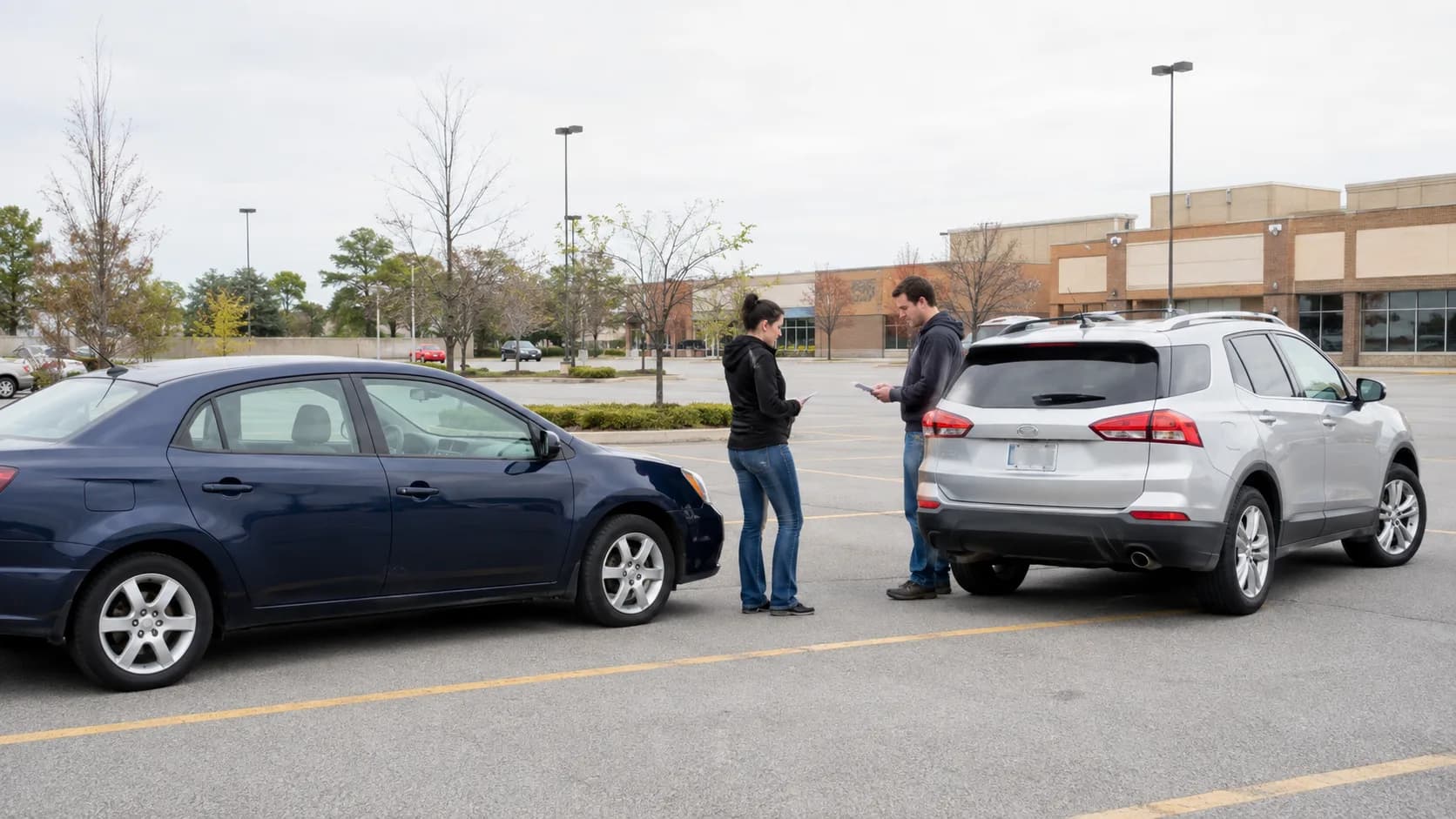
A parking-lot collision can involve vehicles leaving spaces, traffic moving through an aisle, pedestrians, limited sight lines, and private signs or pavement markings. The analysis is specific to the people, movements, and proof in that event.
Key takeaways
- Record whether each vehicle was backing, stopped, or moving through an aisle.
- When Indiana’s Comparative Fault Act applies, the factfinder assigns percentages of fault to the claimant, defendants, and qualifying nonparties whose fault proximately contributed to the damages.
- Photographs, original video files, witness contact details, and contemporaneous notes can preserve different parts of the event.
How does Indiana’s fault framework work?
The Indiana Court of Appeals states that a negligence claimant must prove a duty owed by the defendant, a breach, and injury proximately caused by that breach. See Brackemyre opinion[1].
Indiana Code[2] defines “fault” as an act or omission that is negligent, willful, wanton, reckless, or intentional toward the person or property of others, and also includes unreasonable assumption of risk and certain product-liability concepts. The act or omission must be a proximate cause of the claimed injury or property damage.
When the Act applies, the factfinder determines the percentage of fault of the claimant, defendants, and properly designated nonparties. The court then reduces an award in proportion to the claimant’s fault. In an action against one defendant, or defendants treated as one party, the claimant is barred if the claimant’s contributory fault is greater than the fault of all persons whose fault proximately contributed to the damages.
The Act has statutory exclusions, including tort claims against governmental entities or public employees under the Indiana Tort Claims Act. That is one reason a general “51% rule” summary should not be applied to every possible parking-lot event.
For a focused explanation, see Indiana’s comparative-fault rule. The firm’s car-accident practice page provides additional general information about vehicle-collision claims.
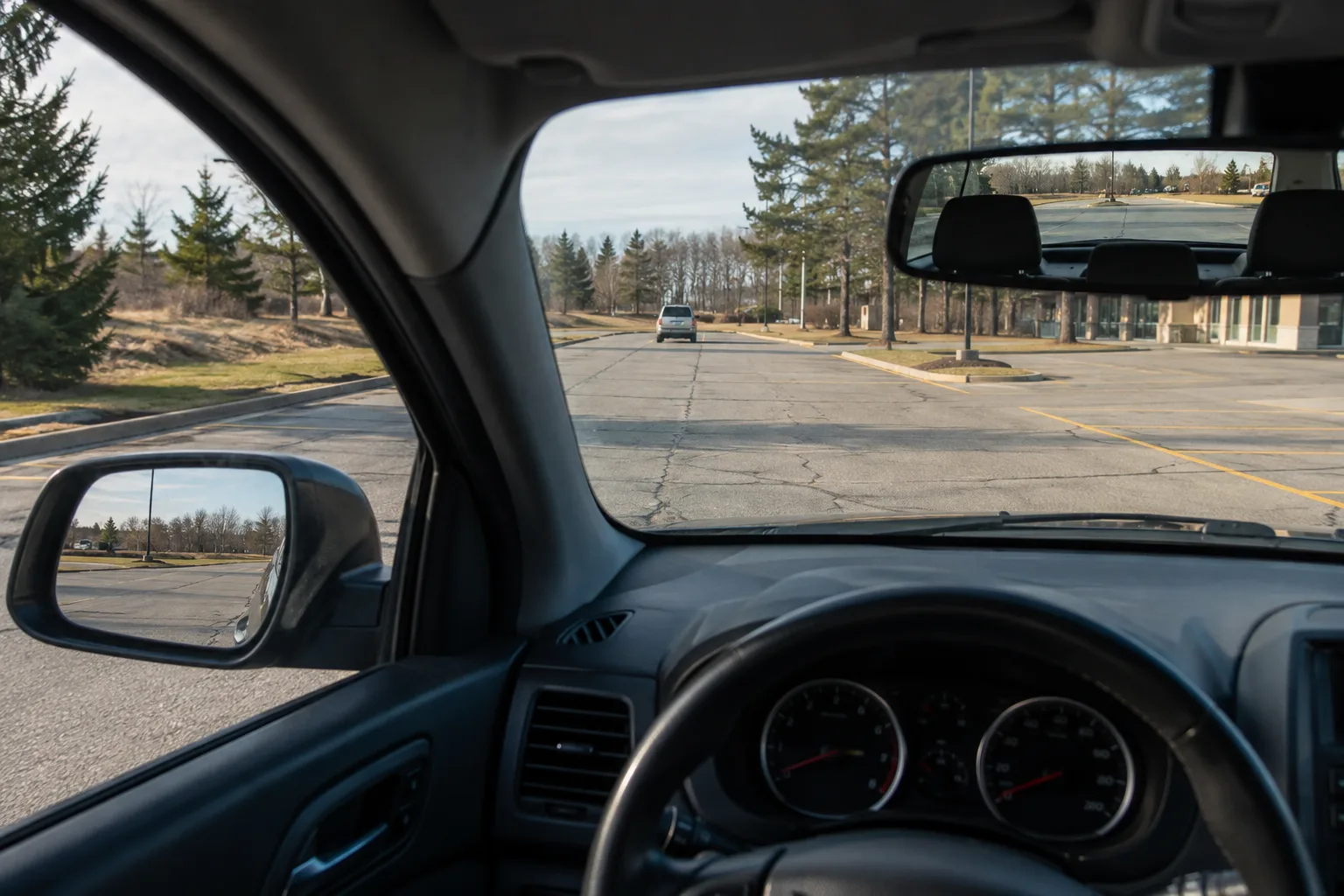
Which facts can matter in common parking-lot scenarios?
The following are practical prompts for collecting and comparing accounts. They are not presumptions, duties, or rules that decide fault.
| Situation | Information to identify |
|---|---|
| One vehicle leaves a space | Each vehicle’s direction, when movement began, sight lines, and contact points |
| Two vehicles leave spaces | Relative positions, timing, any stops, and available recordings |
| A vehicle moves through an aisle | Its path, observable movement, obstructions, markings, and signs |
| A pedestrian is involved | The pedestrian’s location and path, vehicle movement, lighting, and obstructions |
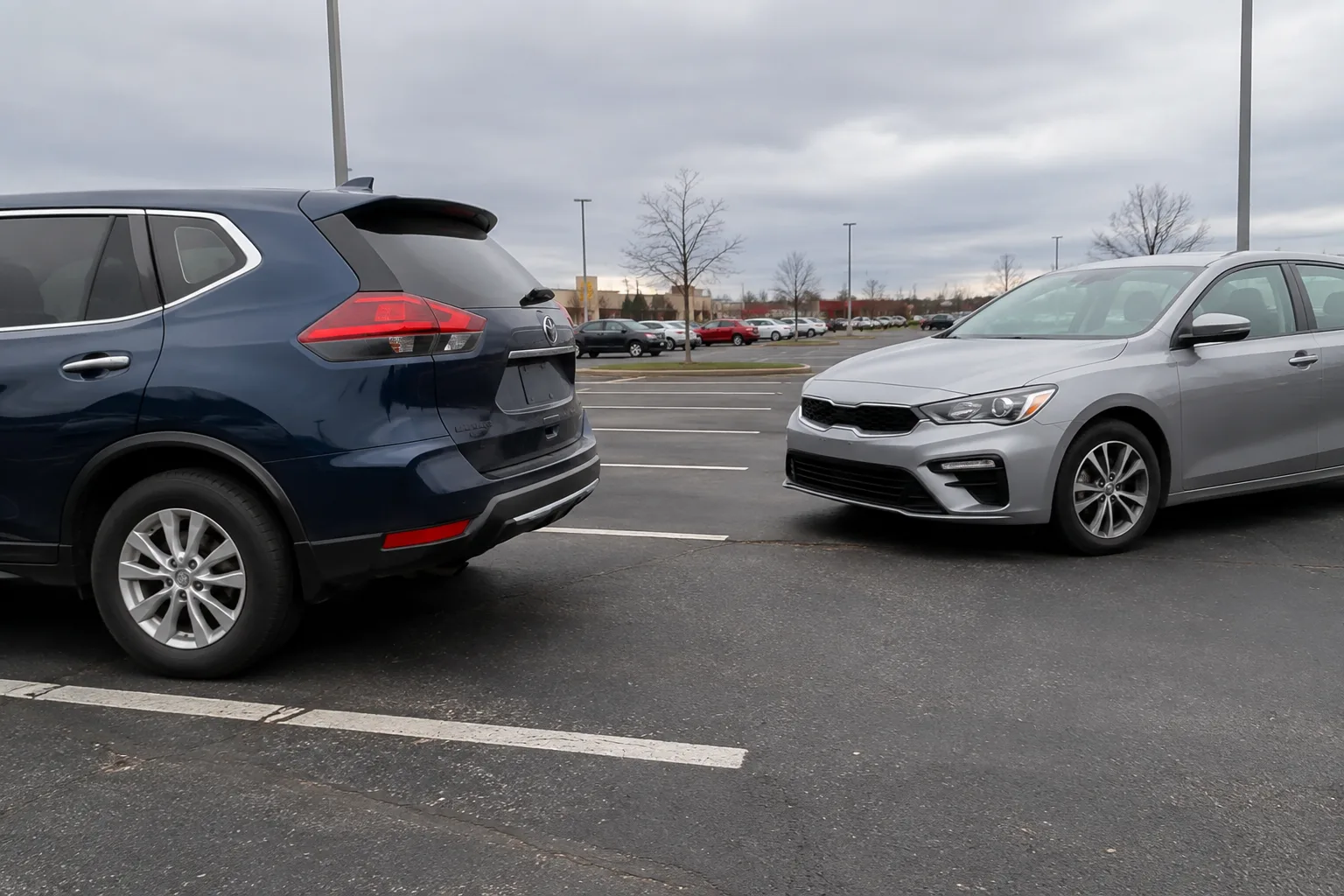
A close photograph of a vehicle corner or bumper is best kept with wider scene photographs and other records.
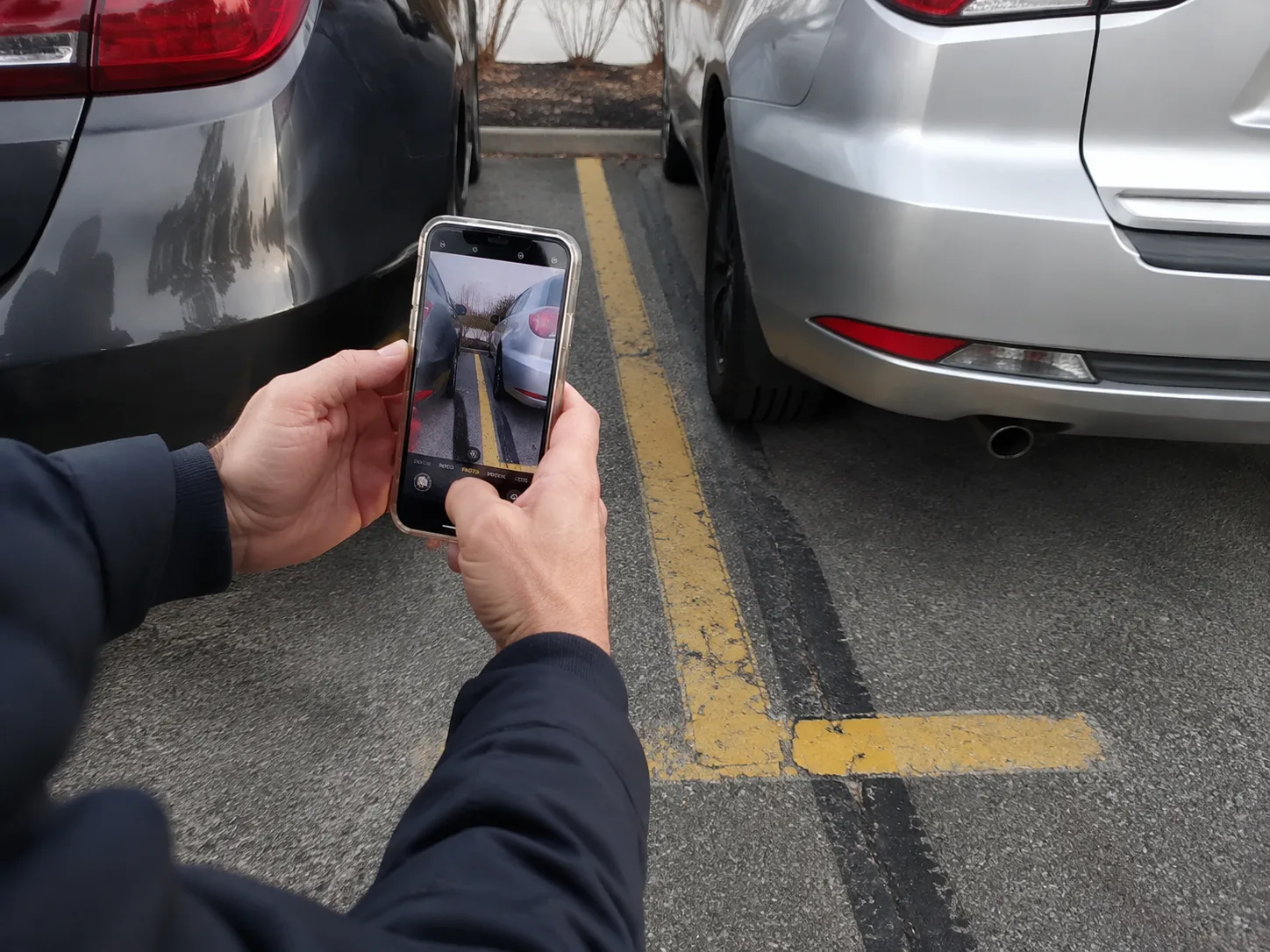
How can you organize information after the collision?
If it is safe and feasible, collect materials that record the scene and keep the original files:
- wide and close photographs of vehicle positions, damage, lines, arrows, signs, lighting, and sight obstructions;
- the original dashcam or phone video, without trimming or overwriting it;
- witness names and contact details;
- the business name, exact location, date, and approximate time;
- driver, vehicle, and insurance information exchanged at the scene; and
- notes separating what you personally observed from what someone else said.
Ask the property manager where a preservation request should be sent if a camera may have recorded the area. Keep a copy of the request. These are record-organization steps, not statements about what evidence a court must accept or how much weight it receives.
The Indiana Department of Insurance advises consumers to report a claim promptly, provide complete information, and keep copies and notes of communications. Its official claim tips[3] also advise reviewing the policy’s own terms.
For a broader checklist, see how to organize Indiana car-accident materials.
In Fort Wayne and elsewhere in Allen County, the same Indiana fault framework applies, but the layout, traffic controls, visibility, and available records at each parking lot remain specific to that location and event. Learn more about attorney Chad Delventhal and his Indiana practice.
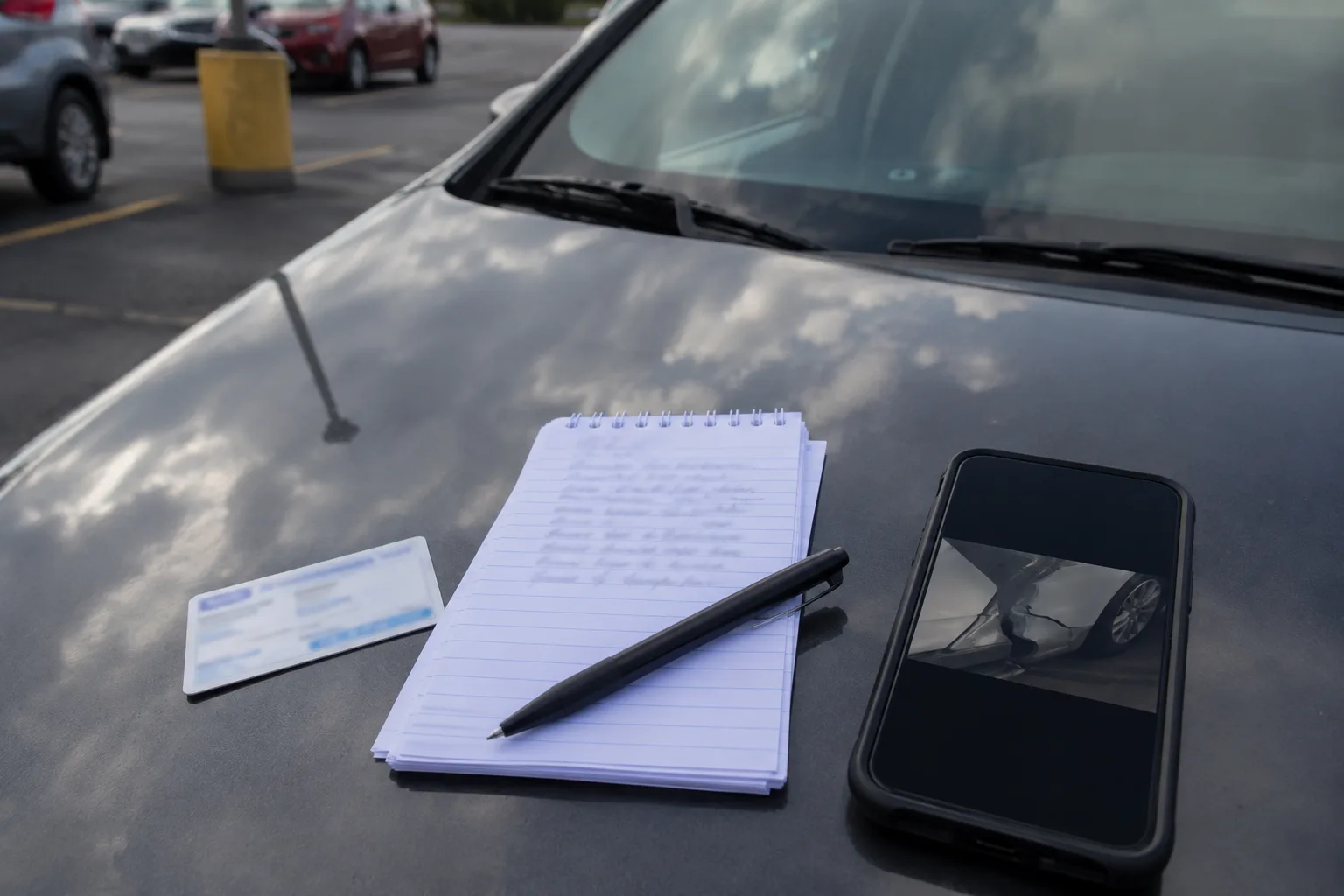
What deadline and notice issues require special care?
Indiana Code 34-11-2-4[4] generally states that an action for injury to a person or damage to personal property must be commenced within two years after the cause of action accrues. It does not calculate the filing date for a particular matter.
Claims involving a state agency or public employee may require notice within 270 days after the loss under Indiana Code 34-13-3-6[5]. Claims involving a political subdivision may require notice within 180 days after the loss under Indiana Code 34-13-3-8[6]. The Indiana Tort Claims Act contains the governing definitions, recipients, content rules, and exceptions, so identifying the correct governmental defendant matters. Our Indiana government tort-claim notice guide explains the notice framework and documents to gather.
Indiana Code 34-11-6-1[7] provides a different filing framework for a person under legal disability when the cause of action accrues. Indiana Code 1-1-4-5[8] defines “under legal disabilities” to include a person less than eighteen years of age, a person who is mentally incompetent, or a person out of the United States. When a claim accrues is fact- and claim-specific and requires analysis by an attorney.
An insurance policy may require notice within a stated time. The Department of Insurance therefore advises prompt reporting and checking the policy. Check all potentially applicable time requirements promptly.

Frequently asked questions
Is a backing driver automatically at fault in an Indiana parking lot?
No. The vehicle’s movement is one circumstance. When Indiana’s Comparative Fault Act applies, the factfinder assigns percentages of fault to the claimant, defendants, and qualifying nonparties whose fault proximately contributed to the damages.
What if both vehicles were moving?
When Indiana’s Comparative Fault Act applies, the factfinder assigns percentages of fault to the claimant, defendants, and qualifying nonparties whose fault proximately contributed to the damages. Timing, paths, sight lines, recordings, and witness accounts can help document the sequence.
What information should I save?
Keep original photographs and videos, witness contact details, exchanged driver and insurance information, the location and time, repair and towing documents, and a copy of communications about any available surveillance recording.
Is the filing deadline always two years?
No. Indiana Code 34-11-2-4[9] generally states that an action for injury to a person or damage to personal property must be commenced within two years after the cause of action accrues.
To ask the firm to review the circumstances, you may request a free case evaluation or use the firm’s contact page. Submitting information does not guarantee representation.
This is general information, not legal advice. Contacting the firm does not by itself confirm that the firm has accepted representation. Any engagement will be documented in writing.
Sources
- Brackemyre opinion (public.courts.in.gov) ↩
- Indiana Code (iga.in.gov) ↩
- official claim tips (in.gov) ↩
- Indiana Code 34-11-2-4 (iga.in.gov) ↩
- Indiana Code 34-13-3-6 (iga.in.gov) ↩
- Indiana Code 34-13-3-8 (iga.in.gov) ↩
- Indiana Code 34-11-6-1 (iga.in.gov) ↩
- Indiana Code 1-1-4-5 (iga.in.gov) ↩
- Indiana Code 34-11-2-4 (iga.in.gov) ↩