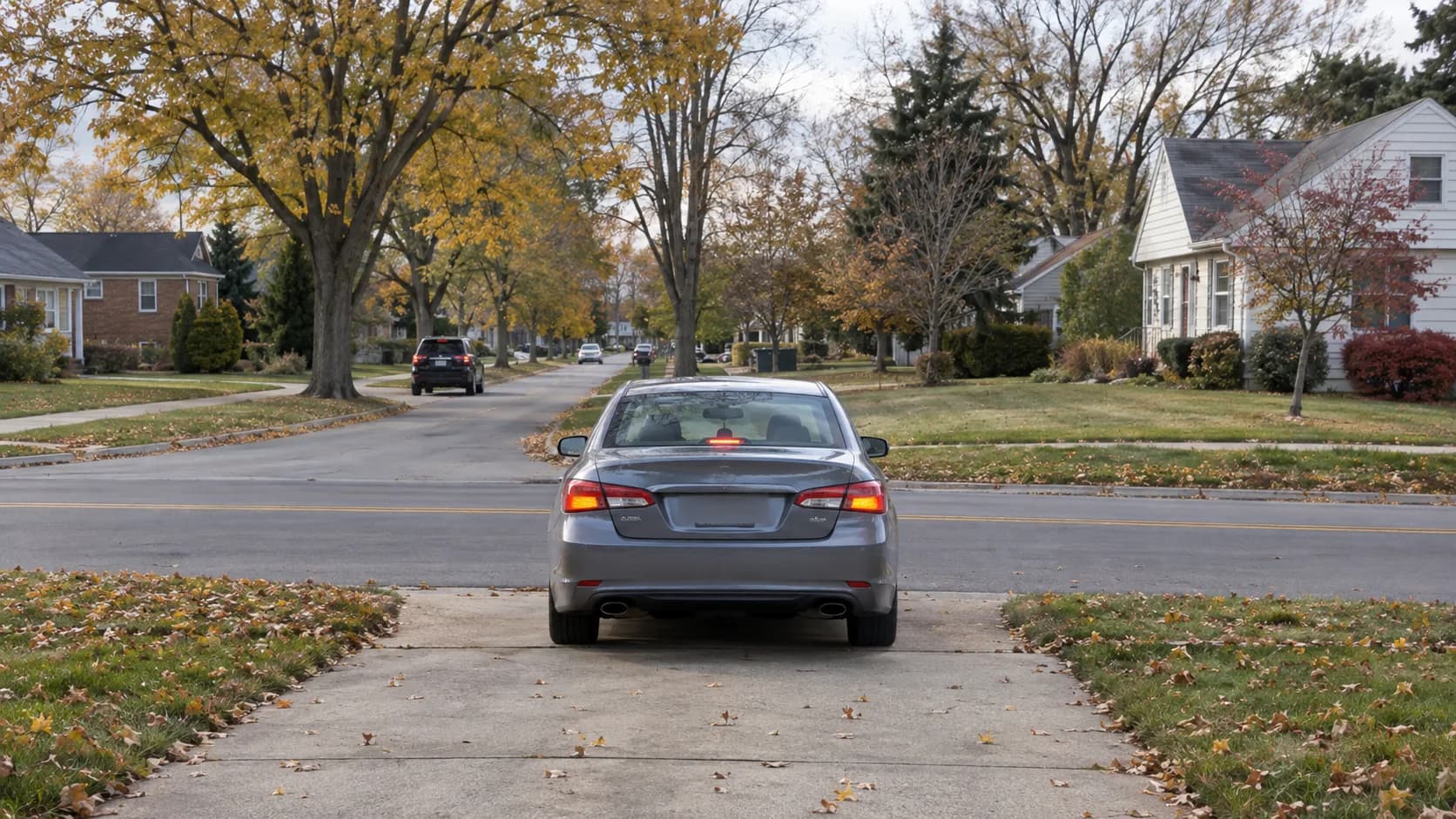
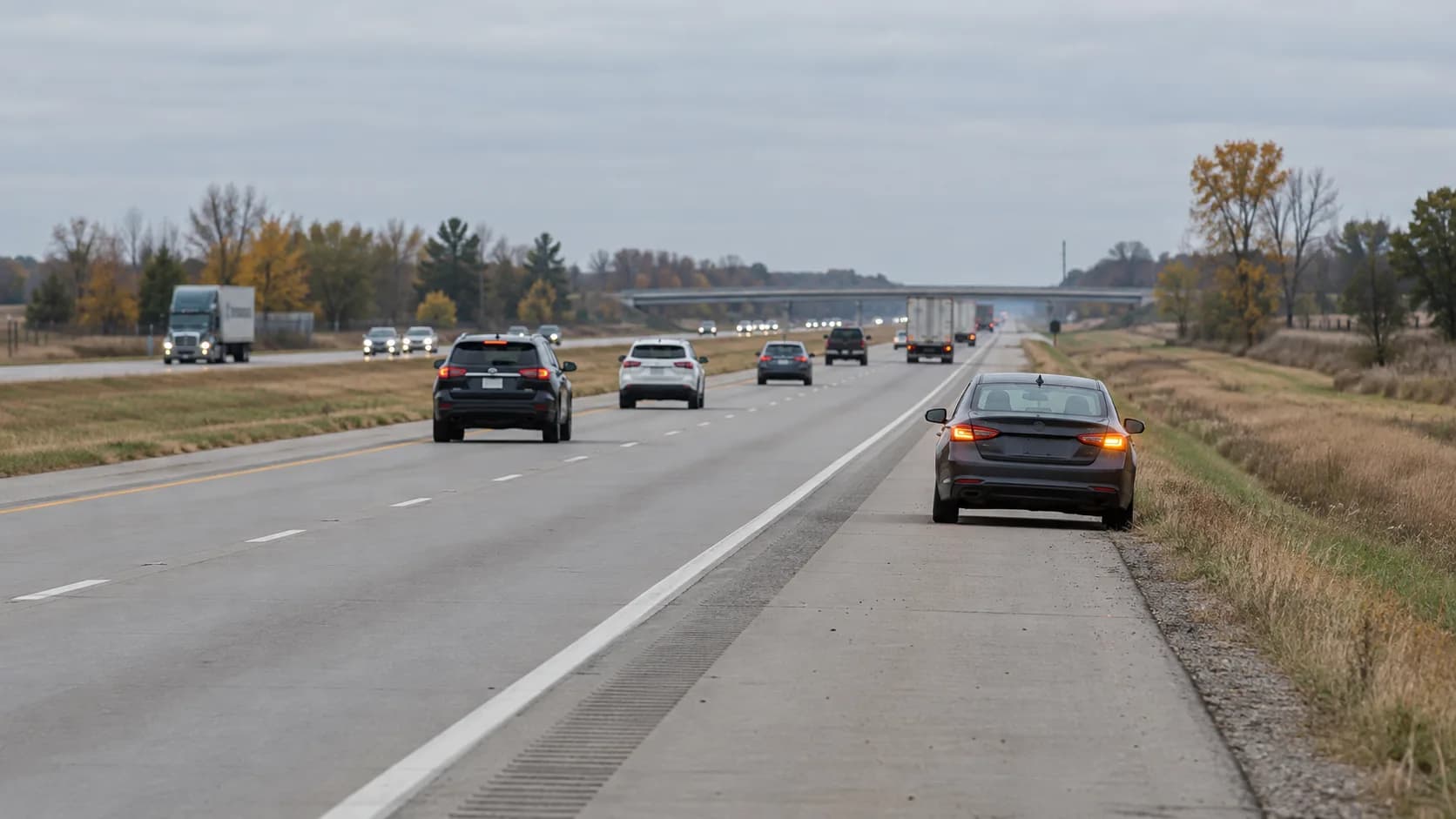
A vehicle stopped beside I-69, I-469, U.S. 30, or another Indiana road can create a dangerous situation without making fault automatic. A careful investigation should address the stopped driver’s choices, the approaching driver’s conduct, the roadway, visibility, and any mechanical emergency.
Key takeaways
- Outside a business or residential district, Indiana generally prohibits stopping on the paved or traveled portion of a highway when it is practicable to stop off that part of the road.
- The statutory exception for a disabled vehicle applies when avoiding a stop and temporarily leaving the vehicle in that position is impossible.
- An approaching driver must move over when safe or reduce speed when approaching a disabled vehicle displaying flashing hazard lights.
- Indiana’s comparative-fault system can divide responsibility between the stopped driver, an approaching driver, and another responsible person or company.
- An Indiana action for injury to a person or damage to personal property generally must be commenced within two years after the claim accrues, although a different rule may apply in a particular case.
Indiana rules for a stopped vehicle
Indiana Code section 9-21-16-1(b)[1] addresses stopping on the traveled part of a highway. Outside a business or residential district, a driver generally may not stop on the paved or traveled portion when it is practicable to stop off that part of the highway.
The separate clearance rule in section 9-21-16-2 requires sufficient unobstructed roadway for other vehicles to pass and a clear view of the stopped vehicle from 200 feet in each direction.
The exception in section 9-21-16-1(a) applies when a vehicle is disabled on the paved, improved, or main traveled part so that avoiding the stop and temporarily leaving it there is impossible. The exception is expressly to that section; it is not blanket permission to disregard other safety rules.
This means the reason for the stop matters. A sudden mechanical failure may present different facts from choosing to stop partly in a travel lane when a usable location was available farther away.

The move-over-or-slow-down rule
Under Indiana Code section 9-21-8-35(d)[2], approaching a disabled stationary vehicle displaying flashing hazard signals requires due caution. On a highway with at least four lanes and at least two lanes in the approaching driver’s direction, the driver must change into a nonadjacent lane if possible with due regard for safety and traffic conditions.
If changing lanes is impossible or unsafe, the driver must reduce speed to at least 10 mph below the posted limit while maintaining a safe speed for road conditions. This is not an instruction to swerve into opposing traffic.
INDOT’s Move Over or Slow Down guidance[3] explains that the disabled-vehicle protection applies on two-lane roads too, where slowing down may be the available response. INDOT also states that drivers cannot stop, stand, or park on the side of an interstate unless it is an emergency. Do not treat an interstate shoulder as a routine place to check directions or take a break.
The warning-light detail can become important. In a safe storage location, photograph the vehicle controls, exterior lights, battery condition, and any damage that may have affected the lights before the vehicle is repaired or salvaged.
Questions that shape fault
A shoulder collision rarely turns on one photograph or one statement. Start with a neutral timeline: why the vehicle stopped, how long it remained there, where its tires and body were positioned, which lights were visible, and what the approaching driver did.
Indiana’s Comparative Fault Act, sections 34-51-2-5 through -8,[4] reduces a claimant’s recovery in proportion to the claimant’s assigned fault, and a claimant whose fault is greater than 50 percent is barred from recovery in an ordinary comparative-fault case.
That framework allows a factfinder to consider more than one contributing act. For example, the investigation may examine both an avoidable encroachment into the travel lane and an approaching driver’s speed, lookout, lane position, or response to visible warning lights.
The Act’s government-claim exclusion, section 34-51-2-2,[5] means that this ordinary comparative-fault explanation does not govern tort claims against governmental entities or public employees under the Indiana Tort Claims Act. A case involving a government vehicle needs separate review.
For a broader explanation of shared responsibility, see Indiana’s 51% fault rule. The firm’s Fort Wayne car accident practice guide also explains the larger claim process.

Evidence checklist
This is a practical recordkeeping worksheet, not a legal determination. Collect information without standing in an active lane or placing yourself near moving traffic. The following table can help you organize what already exists or identify records to request.
| Issue | Useful material to preserve | Detail to record |
|---|---|---|
| Vehicle position | Wide photographs, close photographs, tow-yard photographs | Tire location, lane edge, shoulder width, vehicle angle |
| Visibility | Driver-view photographs, video, weather records | Curve, hill, darkness, glare, rain, obstructions |
| Warnings | Hazard-light video, reflective devices, witness accounts | Which lights were on and when they were observed |
| Reason for stopping | Tow invoice, repair-shop findings, dashboard alerts | What the driver noticed before stopping |
| Approaching vehicle | Dashcam file, vehicle data, photographs, witness contacts | Lane path, braking, steering, point of impact |
| Timeline | 911 record, phone log, roadside-assistance record | Stop time, calls made, responder and tow arrival |
Add an observation label: for each item, note who saw it, when, and whether it describes the vehicle before impact, after impact, or after towing. A tow-yard photograph cannot establish where the car sat before the collision. For a stop on I-69 or I-469, add travel direction, nearest exit or mile marker, and whether the vehicle was beside the left or right lanes. Record unknown details as unknown.
Example, not a real case: a witness saw flashing hazards before impact, but a later photograph shows dark lamps. Save both observations with their times; do not assume the later photograph disproves the earlier account. Keep the original files and the witness’s own description.
For a commercial-truck situation, use our separate disabled-semi warning-triangle guide. This article focuses on passenger-vehicle shoulder stops.
Preserve original files when possible. Keep the full video rather than only a shortened clip, and avoid adding filters, annotations, or edits to the only copy. Our guide to evidence after an Indiana car accident offers a broader records checklist.
What to do after a shoulder crash
- Protect people first. Call 911 when emergency assistance is needed and follow responder instructions.
- Avoid the travel lanes. Do not step into traffic to take photographs or retrieve debris.
- Identify the exact location. Save the road name, direction of travel, nearest exit or crossroad, mile marker, and available GPS information.
- Preserve the vehicle. Ask where it will be stored and photograph it before repairs, dismantling, or salvage if you can do so safely.
- Save electronic information. Download dashcam footage, screenshots, roadside-assistance messages, location history, and call records.
- Write a factual timeline. Record what happened before memories blur, while separating what you personally observed from what someone later told you.
For additional preparation steps, see our Fort Wayne post-crash checklist. Do not return to an exposed shoulder just to complete this worksheet.

Organizing the insurance claim
Report the event using accurate, limited facts. Do not guess about distance, speed, lighting, or fault. If you do not know an answer, say that you do not know and preserve the material that may answer it.
Separate the injury, vehicle-damage, towing, rental, and lost-income records into labeled folders. A claim diary can track calls, document requests, appointment dates, and open questions without turning the notes into an argument.
Filing time and early individual review
Under Indiana Code section 34-11-2-4(a)[6], an action for injury to a person or personal property generally must be commenced within two years after the cause of action accrues. This general rule is not a calculation of your filing date.
Do not use that general period as a reason to wait. Government-claim notice provisions, sections 34-13-3-6 and -8,[7] impose separate, shorter notice periods for claims against the state or political subdivisions, subject to their exceptions. Seek individual review early. Separately, preserve video and physical records before they are overwritten, changed, or discarded.

Frequently Asked Questions
Is the driver stopped on the shoulder always at fault?
No. Indiana fault depends on the circumstances, including whether the stop was unavoidable, whether the vehicle could be moved farther from traffic, whether warnings were operating, and how the approaching driver responded.
May a driver stop on an Indiana interstate shoulder?
INDOT’s guidance says drivers cannot stop, stand, or park on the side of an interstate unless it is an emergency. A routine pause to check directions should be made at a safe off-highway location, not on the interstate shoulder.
Must approaching drivers move over for a disabled vehicle?
For a disabled stationary vehicle displaying flashing hazard signals, the move-over rule requires due caution and a safe move to a nonadjacent lane on a highway with at least four lanes and at least two in the approaching driver’s direction. If changing lanes is impossible or unsafe, slow to at least 10 mph below the posted limit while maintaining a safe speed for conditions.
What if the stopped vehicle was partly in the traffic lane?
Lane encroachment is an important fact, but it does not by itself assign all fault. In an ordinary comparative-fault case, the factfinder evaluates contributing conduct. Preserve evidence of the breakdown, the available space, warnings, and the approaching vehicle’s path.
What evidence should I save first?
Prioritize original photographs and video, the vehicle’s location, visible warning lights, dashcam files, witness contact information, tow and repair records, and a factual timeline.
How long do I have to file an Indiana injury lawsuit?
An Indiana action for injury to a person generally must be commenced within two years after the claim accrues, but exceptions or shorter requirements may affect a particular matter.

If you were hurt in a shoulder collision near Fort Wayne or elsewhere in Indiana and want help sorting the evidence, insurance questions, and next steps, Delventhal Law Office offers a calm, no-pressure free consultation.
This article is general information about Indiana law and is not legal advice. Reading it does not create an attorney-client relationship, and neither does contacting us.
Sources
- Indiana Code section 9-21-16-1(b) (iga.in.gov) ↩
- Indiana Code section 9-21-8-35(d) (iga.in.gov) ↩
- INDOT’s Move Over or Slow Down guidance (in.gov) ↩
- Comparative Fault Act, sections 34-51-2-5 through -8, (iga.in.gov) ↩
- Act’s government-claim exclusion, section 34-51-2-2, (iga.in.gov) ↩
- Indiana Code section 34-11-2-4(a) (iga.in.gov) ↩
- Government-claim notice provisions, sections 34-13-3-6 and -8, (iga.in.gov) ↩