This article keeps those questions distinct and offers a practical way to organize the file. Its checklists are our suggested organizational steps, not requirements attributed to a court or agency. The broader Indiana car-accident practice page explains the firm’s role in collision claims.
A coverage map for the first review
| File to check | Question for that file |
|---|---|
| Owner's auto policy | What does it say about permission and insured drivers? |
| Your auto policy | Who qualifies for UM or UIM protection? |
| Medical-payments provision | Was it purchased, and what persons and expenses are included? |
| Health-plan document | What bills and repayment terms does the document address? |
| Work-injury file | Did the accident arise out of and occur in the course of employment? |

Keep the driver's conduct separate from the owner's conduct
For negligent entrustment of a vehicle, Bailey v. State Farm Mutual Automobile Insurance Co.[1] lists five elements: entrustment of the vehicle; an incapacitated person or person incapable of due care; the entrustor's actual and specific knowledge of that condition at the time of entrustment; proximate cause; and damages. Bailey also held that Indiana does not recognize a first-party negligent-entrustment claim by a voluntarily intoxicated adult to whom the vehicle was entrusted.
In a reported-theft crash, first determine whether anyone entrusted the vehicle at all before trying to apply Bailey's elements.
Read the owner's liability policy and investigate permission
Indiana Code § 27-1-13-7(a)[2] provides that an owner's motor-vehicle liability policy must insure the named person and any other person using the vehicle with the named person's express or implied permission, subject to the statute's stated requirements.
As a practical suggestion, collect the complete policy, the theft report, key records, and statements about access and permission for a case-specific review.

Do not treat UM and UIM as the same coverage
Indiana Code § 27-7-5-2(a)[3] requires policies covered by that subsection to provide uninsured- and underinsured-motorist coverage for insured persons legally entitled to recover specified damages, unless the coverage is rejected in writing by the named insured. The section contains additional exceptions and requirements, so the current text and the policy should be read together.
Indiana Code § 27-7-5-4[4] defines an uninsured motor vehicle. Indiana Code § 27-7-5-4.5[5] separately defines an underinsured motor vehicle by comparing available bodily-injury liability limits with the limits of the injured person's underinsured-motorist coverage. Neither section creates a category consisting of every stolen vehicle.
The practical review is policy-specific: identify every potentially relevant declarations page and policy, then ask each carrier for its written position and the provisions on which it relies.
Use the actual MedPay and health-plan documents
For MedPay, check the declarations page and the full auto policy for the purchased limit, included persons and expenses, exclusions, and submission terms. This is a contract review, not a conclusion that the theft label produces or defeats payment.
For an employer health plan governed by ERISA, Montanile v. Board of Trustees[6] held that when a participant dissipates an entire third-party settlement on nontraceable items, an ERISA plan fiduciary may not enforce an equitable lien against the participant's general assets under 29 U.S.C. § 1132(a)(3).
Our suggested file set includes the plan document, EOBs, bills, and a payment ledger.

If the crash happened during work
Indiana Code § 22-3-2-2(a)[7] requires compensation for an employee's personal injury or death by accident arising out of and in the course of employment, subject to the Workers' Compensation Act.
Indiana Code § 22-3-3-1[8] requires notice of the injury or death to the employer within thirty days, but says lack of notice or delay beyond thirty days does not bar proceedings when the employer or its representative had knowledge of the accident or when the Board excuses the lack of notice on the grounds stated in the section.
Indiana Code § 22-3-2-13[9] permits proceedings against a responsible third party while compensation is claimed or received, and it gives the employer or carrier reimbursement and lien rights described in that section. The section also allocates specified collection costs and addresses written consent for certain third-party settlements.
As our practical suggestion, report a potentially work-connected crash promptly and keep route, dispatch, time, and assignment records. Before signing anything, compare both files.
Our suggested organizational checklist
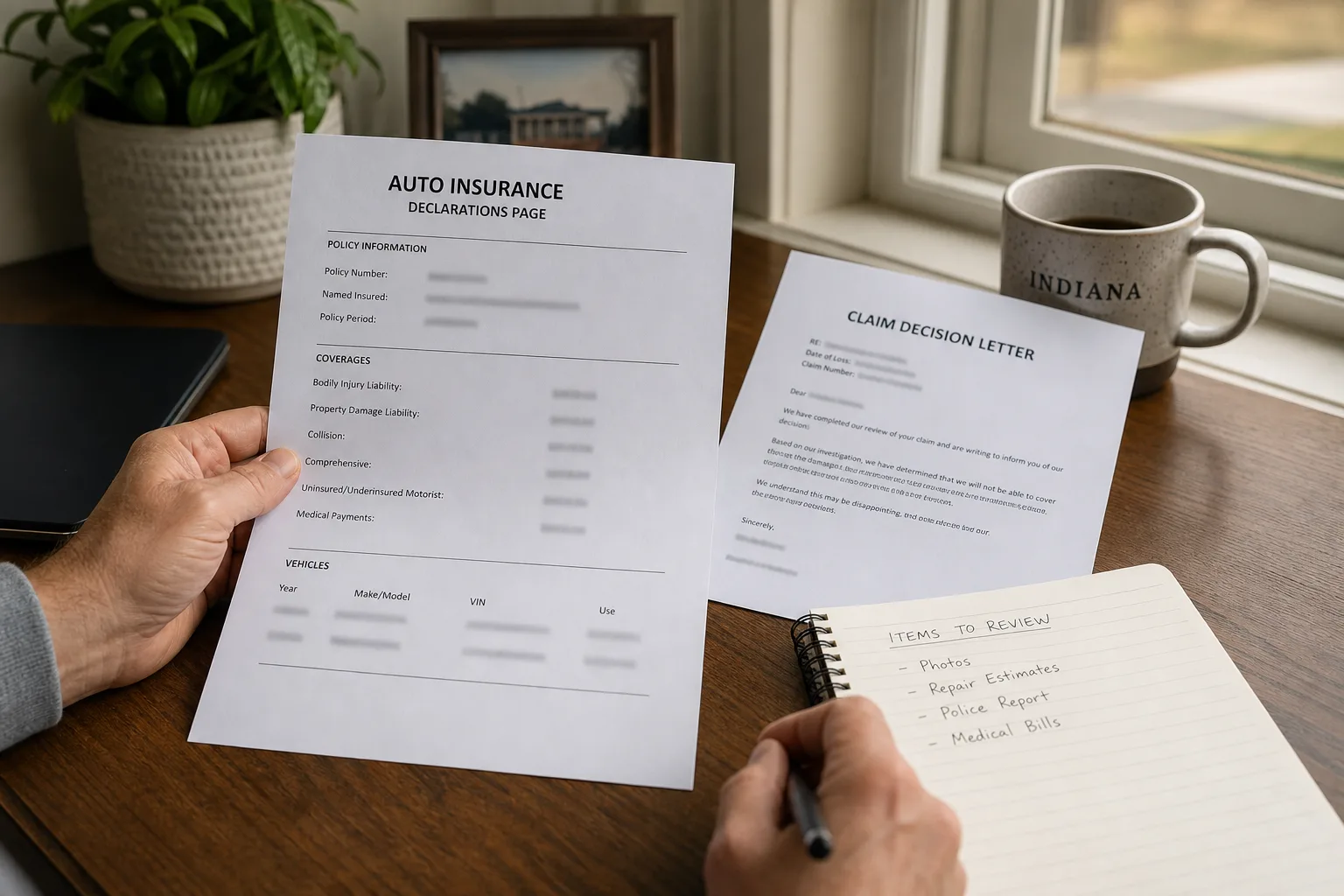
The following list is our practical suggestion for organizing the file; it is not presented as a list mandated by IDOI or a court.
- Crash and theft incident numbers, available reports, photographs, video, and witness contacts.
- Declarations pages, complete policies, endorsements, and written carrier positions.
- Itemized bills, EOBs, receipts, work restrictions, and wage records.
- For a work trip: dispatch, route, timekeeping, mileage, delivery, and assignment records.
- A dated call log and copies of correspondence.
The Indiana Department of Insurance complaint page[10] instructs consumers to try to resolve a problem with the company or producer first and to submit supporting documentation with a complaint.
Frequently Asked Questions
Is every stolen car an uninsured motor vehicle?
No. Indiana Code §§ 27-7-5-4 and 27-7-5-4.5 contain separate definitions for uninsured and underinsured motor vehicles; neither definition says that every stolen car belongs in either category.
Does the owner's policy always cover the driver?
No automatic answer follows from ownership. Indiana Code § 27-1-13-7[11](a) provides that an owner's motor-vehicle liability policy must insure the named person and any other person using the vehicle with the named person's express or implied permission, subject to the statute's stated requirements.
Should MedPay be checked?
Yes, if it appears on a potentially relevant declarations page. Read the full provision to see whom and what it includes.
Can a work crash involve both compensation and a third-party case?
Yes. Indiana Code § 22-3-2-13[12] permits the third-party proceeding described there while compensation is claimed or received, subject to the section's reimbursement, lien, expense-allocation, and consent provisions.
What records should I gather first?
Our suggested starting set is the crash and theft information, complete policies and declarations pages, carrier letters, bills, and—if the trip was work-connected—assignment and time records.

For related discussion, see our Indiana UM/UIM guide, our work-vehicle crash guide, or contact Delventhal Law Office about an evaluation.
This article is general information, not legal advice. Viewing this page or sending a message does not by itself establish that Delventhal Law Office represents you. Do not send confidential information until the firm confirms it can receive it.
Sources
- Bailey v. State Farm Mutual Automobile Insurance Co. (public.courts.in.gov) ↩
- Indiana Code § 27-1-13-7(a) (iga.in.gov) ↩
- Indiana Code § 27-7-5-2(a) (iga.in.gov) ↩
- Indiana Code § 27-7-5-4 (iga.in.gov) ↩
- Indiana Code § 27-7-5-4.5 (iga.in.gov) ↩
- Montanile v. Board of Trustees (supremecourt.gov) ↩
- Indiana Code § 22-3-2-2(a) (iga.in.gov) ↩
- Indiana Code § 22-3-3-1 (iga.in.gov) ↩
- Indiana Code § 22-3-2-13 (iga.in.gov) ↩
- Indiana Department of Insurance complaint page (in.gov) ↩
- Indiana Code § 27-1-13-7 (iga.in.gov) ↩
- Indiana Code § 22-3-2-13 (iga.in.gov) ↩