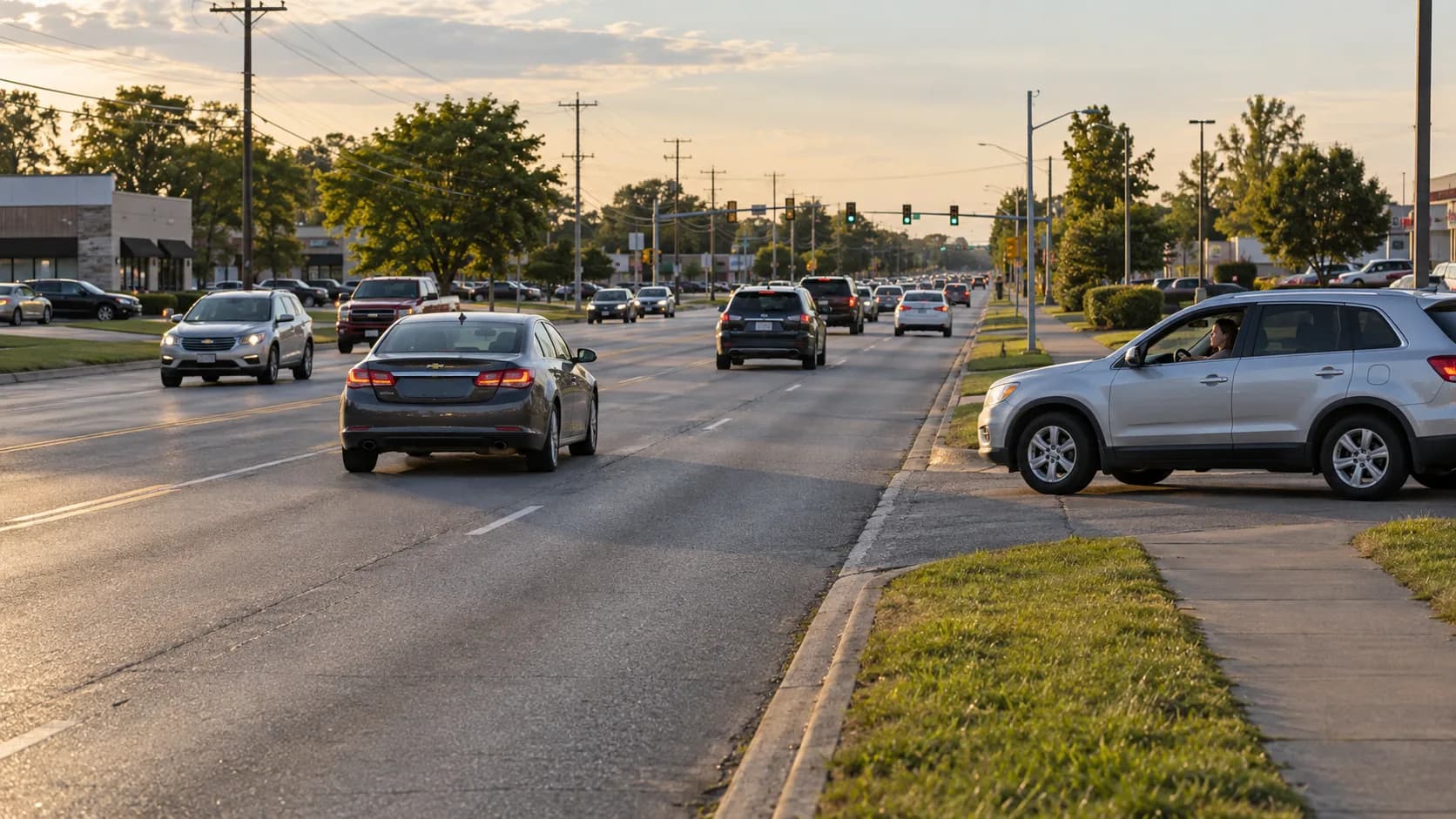
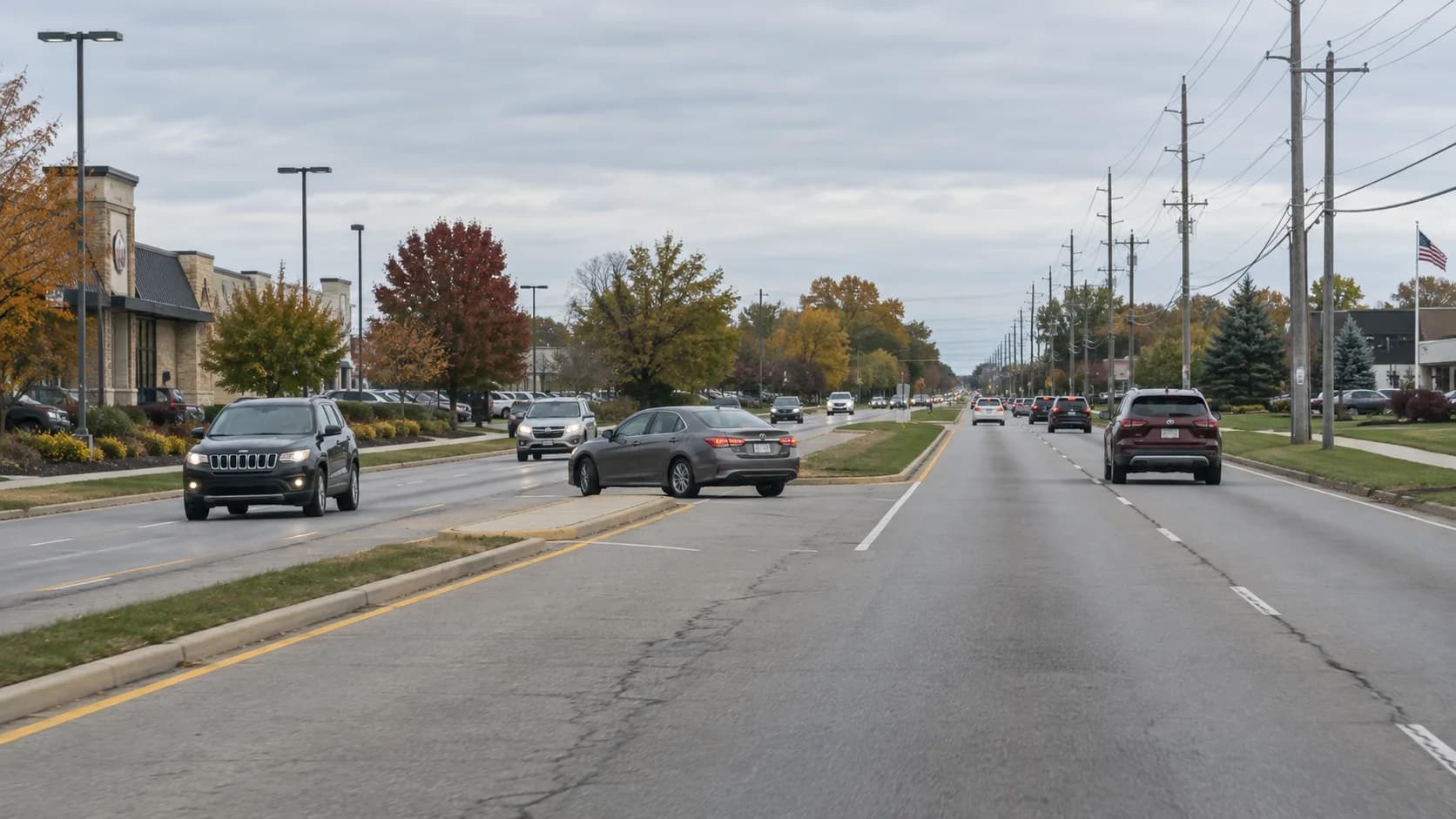
If another driver turned across your lane in Fort Wayne or elsewhere in Indiana, the important questions are where the turn happened, what each driver could see, whether a signal was used, and whether either vehicle had time to avoid the collision.
Key takeaways
- Indiana Code 9-21-8-22[1] prohibits a U-turn on a curve, on the approach to a grade, or near its crest when the vehicle cannot be seen by an approaching driver from either direction within 750 feet.
- Indiana Code 9-21-8-24[2] also says a driver may not turn from a direct course unless the movement can be made with reasonable safety.
- For ordinary negligence claims against private drivers under Indiana’s Comparative Fault Act, fault is allocated among the people whose conduct caused the loss; a U-turn label alone does not settle that allocation.
- Photos, video, witness information, vehicle damage, and the official crash report can help reconstruct how the turn occurred.

What does Indiana law say about U-turns?
Indiana does not impose a blanket statewide ban on every U-turn. Instead, Indiana Code 9-21-8-22[3] prohibits the maneuver on a curve, on the approach to a grade, or near its crest when the turning vehicle cannot be seen by a driver approaching from either direction within 750 feet.
A separate rule matters even when visibility exceeds that distance: Indiana Code 9-21-8-24 prohibits moving right or left from a direct course unless the movement can be made with reasonable safety.
Section 24 also requires an appropriate stop or turn signal before the movement. The former distance-based rule in IC 9-21-8-25[4] is repealed; do not rely on the old 200-foot or 300-foot figures as the current statutory requirement. Signaling does not make an unsafe turn safe.
These rules make the physical setting important. Preserve the lane layout, sight distance, traffic controls, lighting, and location of each vehicle instead of focusing only on the label “U-turn.”

Is the U-turning driver always at fault?
No. An improper U-turn may be strong evidence against the turning driver, but fault is decided from the complete sequence of events. Evidence may also show that another driver was speeding, distracted, following too closely, or otherwise failed to use reasonable care.
For ordinary negligence claims against private drivers governed by Indiana’s Comparative Fault Act, IC 34-51-2-5 through -8 (official PDF, pages 617–618)[5] reduce damages by the claimant’s percentage of fault and bar recovery if the claimant is more than 50% at fault. Allocation to nonparties can also affect recovery from the named defendants.
Sections 1 and 2 (official PDF, page 616)[6] identify exceptions, including tort claims against governmental entities or public employees under the Indiana Tort Claims Act and certain medical-malpractice actions. Do not apply the private-driver percentage rule to a government claim without separate legal review.
If fault is disputed, organize the facts supporting each account. For a broader explanation, read our guide to Indiana’s 51% fault rule and our Fort Wayne car-accident practice overview.

What evidence can clarify an improper U-turn crash?
Our practical preparation checklist: Start with materials that show movement, visibility, timing, and the point of impact. These are documentation suggestions, not statutory evidence requirements. The following checklist can help you organize what already exists without putting yourself in danger or interfering with an investigation.
| Item to preserve | What to capture |
|---|---|
| Scene photographs | Photograph each approach from a safe place: turn restrictions, curves, grades, sight-line obstructions, lane markings and final positions. Record direction of travel; do not stand in traffic to measure 750 feet. |
| Video | Save original dashcam files with footage before and after impact. Note nearby cameras and ask about preservation; do not assume footage exists or that you can access it. |
| Witness information | Names, contact details and viewing position. Ask what direction each car traveled, when the turn began and whether a signal was actually seen. Separate observations from guesses. |
| Vehicle evidence | Damage to every side of each vehicle, interior damage, and repair or salvage communications |
| Trip records | Navigation history, delivery records, rideshare records, photographs, and relevant messages |
| Official records | Officer information, incident number, citations, diagrams, and the completed crash report |
The Indiana State Police maintains the state’s central crash-report repository and makes electronic reports available through BuyCrash[7].
For preparation, compare the report with photographs, video, vehicle damage, and witness accounts, and write down any specific disagreement without altering original records. Our guides explain what evidence helps prove an Indiana car-accident claim and how to preserve dashcam footage.

What should you do after a U-turn collision?
The Indiana Driver’s Manual, chapter 8 (printed page 58)[8] says to stop immediately or as close to the scene as possible. It explains moving a vehicle off the traveled highway, but specifically says not to move the vehicle when the accident involves hazardous materials or results in injury, death, or entrapment. If someone may be injured or trapped, call 911 and follow emergency instructions instead of assuming there is only property damage.
The manual also says to remain at the scene, give your name, address and vehicle registration number, show your driver’s license, and provide reasonable assistance as directed by law enforcement, medical personnel or a 911 operator. Notify law enforcement as soon as possible when the accident results in injury or death.
Practical recordkeeping suggestions after immediate safety needs are addressed:
- Exchange insurance contact and policy information for claim handling; this is separate from the identifying-information requirements described above.
- Photograph the roadway and vehicles only from safe positions, without interfering with responders.
- Ask witnesses for contact details and note what they saw, without arguing about fault.
- Save original files and keep a private copy of your notes.
- Check your insurance policy’s reporting instructions and provide accurate information; distinguish what you know from estimates.
You can also use our broader post-crash checklist.

A U-turn visibility worksheet for your consultation
For a Fort Wayne intersection, business entrance or Allen County road, write down the road name, nearest cross street, direction of travel and the turning vehicle’s starting and ending lanes. Describe the curve or rise separately from temporary obstructions such as a truck. Record the time, weather and lighting as you remember them, and label anything learned later from someone else.
Keep three columns in your notes: what I observed; what another person reported; what remains unknown. For example, “I did not see a signal” is different from “the signal was not operating.” A photograph taken later may help orient the reader but should be labeled with its actual date and any changed conditions.
Do not recreate the turn, step into traffic or estimate a legal sight-distance conclusion from a single phone photo. Bring the originals and questions to a consultation so the need for further investigation can be assessed.
Frequently Asked Questions
Are all U-turns illegal in Indiana?
No. Indiana’s statewide U-turn statute specifically prohibits the maneuver on a curve or on the approach to or near the crest of a grade when approaching drivers cannot see the vehicle from at least 750 feet away, while the separate turning statute requires any lateral movement to be made with reasonable safety.
Does using a turn signal make a U-turn lawful?
No. Section 24 requires both reasonable safety and the appropriate signal before the movement. A signal does not remove the visibility restriction in section 22.
Can I recover if the insurer says I share fault?
Possibly. For ordinary negligence claims against private drivers governed by Indiana’s Comparative Fault Act, recovery is barred if you are more than 50% at fault; otherwise, damages are reduced by your percentage of fault. Government tort claims are excluded from this Act and need separate analysis.
How do I obtain the Indiana crash report?
The Indiana State Police makes electronic vehicle crash reports available through BuyCrash and maintains the central repository of Indiana crash reports.
When might a legal review be useful?
For a focused consultation, bring your sight-line notes, original photographs, witness details and questions about disputed movements. Identify missing information instead of filling gaps with guesses.
If you were hurt in a U-turn crash and are unsure how the evidence and fault questions fit together, Delventhal Law Office can review what happened and help you understand your options through a free consultation.
This article is general information about Indiana law and is not legal advice. Reading it does not create an attorney-client relationship, and neither does contacting us.
Sources
- Indiana Code 9-21-8-22 (iga.in.gov) ↩
- Indiana Code 9-21-8-24 (iga.in.gov) ↩
- Indiana Code 9-21-8-22 (iga.in.gov) ↩
- IC 9-21-8-25 (iga.in.gov) ↩
- IC 34-51-2-5 through -8 (official PDF, pages 617–618) (iga.in.gov) ↩
- Sections 1 and 2 (official PDF, page 616) (iga.in.gov) ↩
- Indiana State Police maintains the state’s central crash-report repository and makes electronic reports available through BuyCrash (in.gov) ↩
- Indiana Driver’s Manual, chapter 8 (printed page 58) (in.gov) ↩