If an insurance adjuster told you the crash was "your fault," or you are trying to figure out whether the other driver is legally responsible for your injuries, this guide explains what actually qualifies as an at-fault accident under Indiana law — and how fault is decided in the real world.
Key takeaways
- Fault means negligence. A driver is "at fault" when they breach a duty of reasonable care and that breach causes a crash and injuries.
- A ticket is evidence, not the final word. A police report or citation helps, but insurers, judges, and juries make the legal fault decision.
- Indiana uses a 50% rule. You can recover if you are 50% or less at fault; your award is reduced by your percentage, and recovery is barred above 50%.
- Evidence decides fault. Photos, witness statements, camera footage, damage patterns, and traffic laws all shape who is responsible.
- Deadlines matter. Most Indiana injury claims must be filed within two years, and claims against a government entity can be much shorter.
What is an "at-fault" accident?
In everyday language, an at-fault accident is a crash that someone caused by driving carelessly. In legal terms, "fault" almost always means negligence — the failure to use the level of care that a reasonably careful driver would use in the same situation.
To hold another driver responsible in Indiana, four things generally have to be true. These are sometimes called the elements of negligence:
- Duty — every driver owes a duty to operate their vehicle safely and follow traffic laws.
- Breach — the driver did something careless (or failed to do something) that broke that duty.
- Causation — that breach actually caused the crash and your injuries.
- Damages — you suffered real harm, such as injuries, medical bills, lost wages, or vehicle damage.
If you want a deeper walk-through of these, see our plain-language guide to the four proofs of negligence in Indiana. The important point: being "at fault" is not about who is a good or bad person — it is about whether a driver failed to use reasonable care and caused harm.
Common examples of at-fault driving in Indiana
Most crashes trace back to a driver breaking a basic rule of the road. Common examples that typically point to fault include:
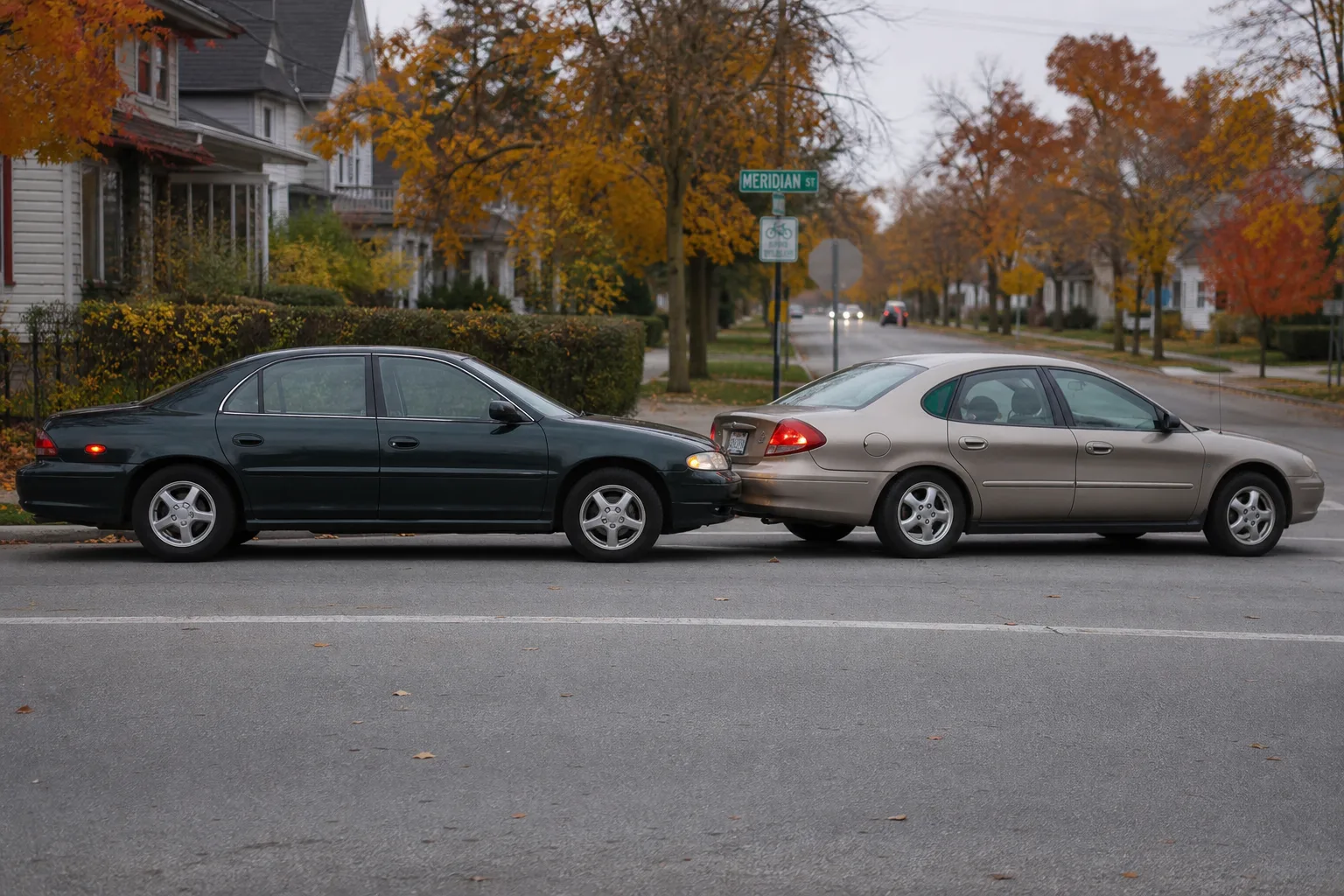
- Rear-end crashes. Indiana law prohibits following another vehicle more closely than is reasonable and prudent[1]. A driver who tailgates and cannot stop in time is frequently found at fault. (See our breakdown of who is at fault in a rear-end collision in Indiana.)
- Failure to yield. Not yielding the right-of-way at intersections, when turning left, or when merging is a leading cause of serious crashes.
- Running red lights and stop signs. Disregarding a traffic control device is a clear breach of duty.
- Distracted driving. Since July 1, 2020, Indiana's hands-free law[2] prohibits holding a telecommunications device while driving a moving vehicle.
- Impaired driving. Operating a vehicle with a blood alcohol concentration of 0.08 or more[3] is illegal and is strong evidence of fault.
- Speeding and unsafe lane changes. Driving too fast for conditions or side-swiping another car during a lane change often establishes negligence.
Not every crash fits neatly into one box, and some involve more than one careless driver. That is where Indiana's comparative fault system comes in.
Police reports vs. legal (and insurance) fault
One of the biggest points of confusion is the difference between what a police officer writes and who is legally at fault.
A responding officer investigates the scene and may issue a citation or note a probable contributing factor in the crash report. That report is useful evidence — but it is not the final legal decision. The officer usually did not witness the crash and is summarizing what they could piece together. Insurance companies, and ultimately a judge or jury, decide fault for a civil injury claim.
This cuts both ways:
- A crash report that blames you is not the end of your claim. Additional evidence can challenge or correct it.
- A citation issued to the other driver helps your case but does not guarantee the insurer will accept full responsibility.
If a report points a finger at you, read our guide on what to do when a police report says you are partly at fault. The takeaway: fault is proven with evidence, not assumed from a single document.
Indiana's comparative fault rule: the 50% line
Fault is rarely all-or-nothing. Indiana follows a modified comparative fault[4] system, which means fault can be divided between the people involved as percentages that add up to 100%.
Here is a simple example: suppose your damages are $100,000 and you are found 20% at fault for a crash. Your recovery would be reduced by 20%, to $80,000. But if you were found 60% at fault, you would recover nothing from the other driver under this rule.
Because a few percentage points can change everything, insurers often try to shift blame onto injured people. We explain this in detail in our guide to Indiana's 51% fault rule. (Note that a different, stricter rule can apply to certain claims against government entities.)

How fault is actually determined
Fault is a conclusion built from evidence. The stronger and better-preserved the evidence, the harder it is for an insurer to dispute responsibility. Key sources include:
- The crash report and any citations issued.
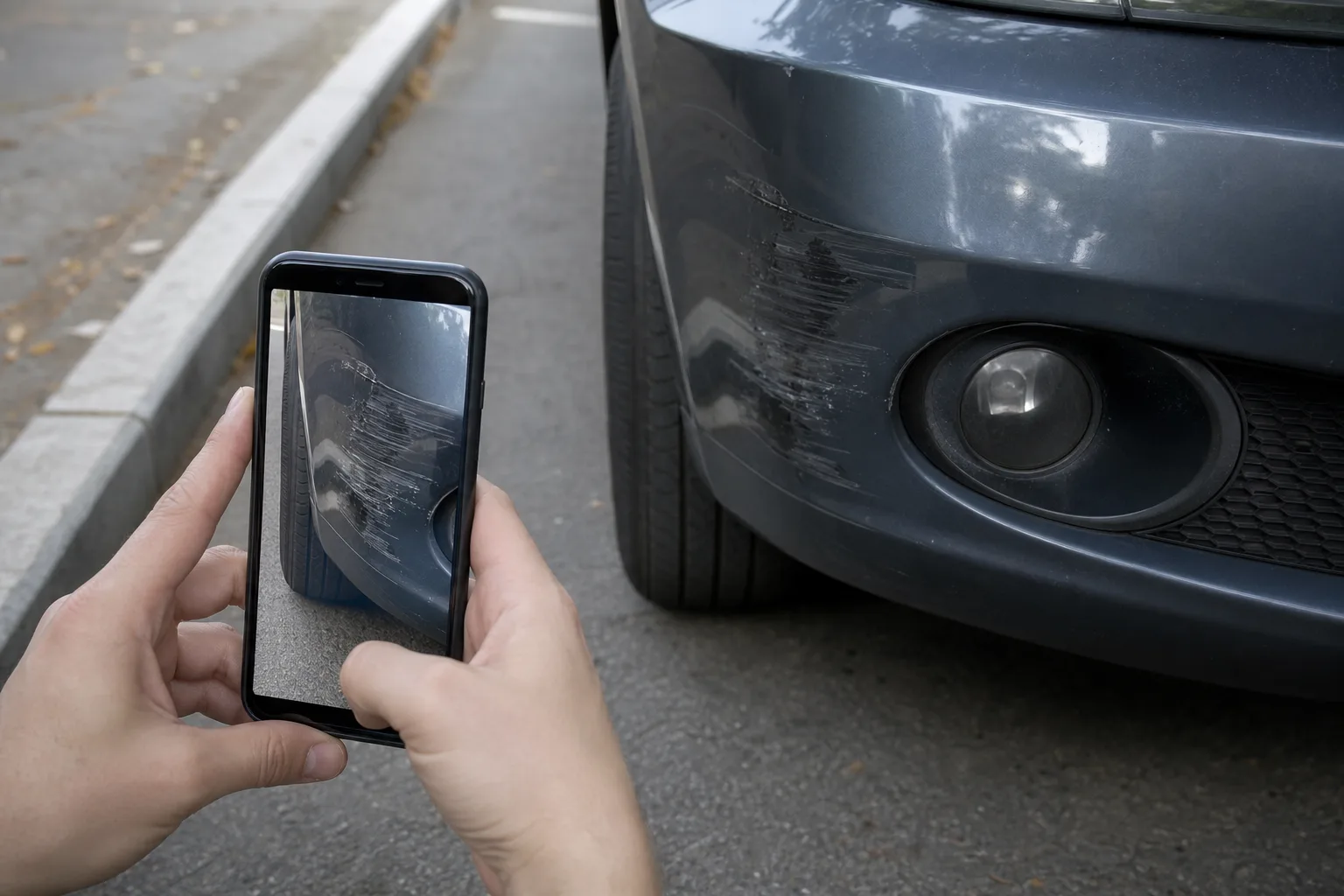
- Photos and video — scene photos, vehicle damage, skid marks, traffic signals, and any dashcam, doorbell, or business surveillance footage.
- Witness statements from neutral third parties.
- Physical evidence like damage patterns and the final resting positions of the vehicles.
- Traffic laws that were violated (right-of-way, following distance, signaling).
- Electronic data such as phone records in a distracted-driving case or a vehicle's event data recorder.
For a fuller checklist, see what evidence helps prove an Indiana car accident claim. Much of this evidence disappears quickly, which is why acting early matters.
How insurance companies dispute fault
Even in seemingly clear cases, an insurer may look for ways to reduce or deny a claim. Common arguments include:
- Claiming you were partly at fault (to push your percentage toward or over 50%).
- Arguing your injuries were pre-existing or not caused by the crash.
- Pointing to a gap in treatment to suggest you were not seriously hurt.
- Using your own recorded statement against you.
You are not required to give the other driver's insurer a recorded statement or a broad medical release right away. Being careful about what you say — and getting prompt medical care — helps protect both your health and your claim.

What to do if you were hit by an at-fault driver
If you believe another driver caused your crash, a few practical steps help preserve your ability to prove it:
- Get medical care promptly and follow through with treatment.
- Report the crash and obtain the official report number.
- Preserve evidence — photos, names and numbers of witnesses, and any footage before it is deleted.
- Keep records of medical bills, missed work, and out-of-pocket costs.
- Be cautious with insurers and avoid guessing about fault or minimizing your injuries.
- Watch the deadlines. Most Indiana injury lawsuits must be filed within two years[5] of the crash, and claims involving a government entity can require notice in as little as 180 days.
For Fort Wayne and Allen County drivers, our team can review the crash report, explain how Indiana's fault rules apply to your situation, and help you decide the next step. Learn more about how a Fort Wayne car accident attorney handles these cases, or explore our broader Indiana personal injury resources.

Frequently Asked Questions
Does getting a ticket mean I'm automatically at fault?
No. A traffic citation is evidence that can support a fault finding, but it is not the final legal decision. In a civil injury claim, an insurance company, judge, or jury determines fault based on all the evidence. A ticket can be helpful, but by itself it does not resolve who is legally responsible.
Can both drivers be at fault in Indiana?
Yes. Indiana divides fault into percentages under its comparative fault system. You can still recover damages if you are 50% or less at fault, but your recovery is reduced by your percentage. If you are more than 50% at fault, you generally cannot recover from the other driver.
What if there was no police report?
You may still have a claim. Fault can be proven with other evidence such as photos, witness statements, video footage, vehicle damage, and traffic-law violations. A police report is helpful, but its absence does not automatically defeat a claim.
How long do I have to file an at-fault accident claim in Indiana?
Most personal injury claims in Indiana must be filed within two years of the crash under the statute of limitations. Shorter deadlines can apply when a government entity is involved — sometimes as little as 180 days to provide notice. Because deadlines vary, it is wise to check yours early. If a government body or employee may be involved, review our Indiana government tort claim notice guide, because notice deadlines can be much shorter than the ordinary injury filing period.
The insurer says I'm at fault, but I disagree. What can I do?
An insurer's opinion is not the final word. You can gather and present additional evidence — witness statements, footage, photos, and the applicable traffic laws — to challenge that assessment. Having an attorney review the file can help you understand whether the fault determination is being applied fairly.
Talk with a Fort Wayne injury attorney
If you were hurt in a crash and are not sure who is legally at fault — or an insurer is blaming you — a free consultation can help you understand your options. Delventhal Law Office can review what happened, explain the Indiana deadlines that may apply, and help you decide the next step. You do not have to sort out the insurance process alone. Contact Delventhal Law Office to schedule a free case review.
This article is general information about Indiana law and is not legal advice. Reading it does not create an attorney-client relationship. For advice about your specific situation, speak with a licensed Indiana attorney.