Being hit by an impaired driver feels different from an ordinary crash. There is anger, a police investigation, maybe a news story, and a lot of confusion about what happens next. This guide explains, in plain language, how Indiana treats a drunk-driving crash — the criminal case, your civil claim, insurance, punitive damages, bar liability, and the evidence that matters most in Fort Wayne and Allen County.
Key takeaways
- The criminal case (the State vs. the driver) and your civil injury claim are two different tracks with different goals.
- You generally have two years from the crash date to file a civil personal injury claim in Indiana.
- A drunk driver’s conduct can support punitive damages, which are capped and mostly paid to the state.
- A bar, restaurant, or other server may share liability under the Indiana Dram Shop Act if it served someone who was visibly intoxicated.
- Your own uninsured/underinsured motorist coverage can matter if the drunk driver has little or no insurance.
- Evidence disappears fast — the police report, chemical test results, and bar records should be preserved early.
Criminal case vs. civil claim: two separate things
The single most important thing to understand is that a drunk-driving crash can create two legal cases, and they do not run through the same court or serve the same purpose.
In Indiana, operating a vehicle with a blood alcohol concentration of 0.08% or more is operating while intoxicated (OWI)[1], and the State — through the prosecutor — brings that criminal case. The goal there is to punish the driver with jail, fines, license suspension, or probation. As the injured person, you are a witness and a victim, but you are not in control of that case.
Your civil claim is your own case. Its goal is to compensate you for the harm the crash caused. You decide whether to pursue it, and it moves forward whether or not the driver is convicted, acquitted, or never charged.
| Criminal case | Civil injury claim | |
|---|---|---|
| Who brings it | The State (prosecutor) | You (the injured person) |
| Main goal | Punish the driver | Compensate you for losses |
| Possible outcome | Jail, fines, license loss, probation, restitution | Money for medical bills, lost wages, pain, and more |
| Standard of proof | Beyond a reasonable doubt | More likely than not (a lower standard) |
| Who is paid | Fines go to the State; restitution may go to you | Compensation goes to you |
A criminal court can order restitution[2] to a victim, but restitution is often limited and rarely covers the full cost of a serious injury. That is why the civil claim usually matters most for your financial recovery.
Does a criminal conviction help my civil claim?
It can. Because the criminal standard of proof (beyond a reasonable doubt) is higher than the civil standard (more likely than not), a conviction or a chemical test result showing intoxication is powerful evidence of fault in your civil claim. But you do not have to wait for the criminal case to end, and you do not need a conviction to recover. Your civil claim can succeed even if the prosecutor drops charges, so long as the evidence shows the other driver caused your injuries.

What can I recover after a drunk-driving crash?
In a civil claim, Indiana law lets an injured person seek compensation for the losses the crash caused. These usually fall into a few categories:
- Medical expenses — emergency care, hospital stays, surgery, imaging, therapy, and future treatment.
- Lost income — wages missed during recovery and reduced earning capacity for lasting injuries.
- Pain and suffering — physical pain, emotional distress, and reduced quality of life.
- Property damage — repair or replacement of your vehicle.
If a loved one was killed by a drunk driver, Indiana handles that through a wrongful death claim, which has its own rules about who may file and what may be recovered. Our Fort Wayne wrongful death attorney page explains how those claims work. To organize the pieces of a value estimate, you can also use our Fort Wayne car accident settlement calculator as an educational starting point — not a promise of any result.
Punitive damages: extra accountability for drunk driving
Ordinary compensation is meant to make you whole. Punitive damages are different — they are meant to punish especially reckless conduct, and drunk driving is a classic example. In Indiana, punitive damages must be proven by clear and convincing evidence, a higher standard than the rest of your case.
Two important limits apply. First, Indiana caps punitive damages[3] at the greater of three times your compensatory damages or $50,000. Second, most of any punitive award does not go to you — Indiana law directs 75% of a punitive award to the state’s violent crime victims compensation fund, with the injured person keeping 25%. Our overview of punitive damages in Indiana personal injury cases walks through how this works in more detail.

Can a bar or restaurant be responsible too?
Sometimes. Under Indiana’s Dram Shop Act[4], a bar, restaurant, or other person who furnishes alcohol can be liable if two things are true: the server had actual knowledge that the person was visibly intoxicated when served, and that intoxication was a proximate cause of the injuries. This can also apply to a social host who serves a visibly intoxicated guest.
Proving actual knowledge is not automatic — it often depends on receipts, bar tabs, surveillance video, and witness accounts about how the person looked and acted. Because these records can be overwritten or discarded quickly, identifying where the driver was drinking early can make a real difference.
Insurance: what if the drunk driver has little or no coverage?
A drunk driver’s liability insurance is usually the first source of recovery. But some impaired drivers carry only minimum coverage — or none at all — which may not be enough for a serious injury. That is where your own policy can matter.
- Liability coverage from the at-fault driver’s insurer.
- Uninsured/underinsured motorist (UM/UIM) coverage on your own policy, which can apply when the drunk driver has no insurance or not enough.
- MedPay coverage, if you carry it, which can help with early medical bills regardless of fault.
If the impaired driver was uninsured or underinsured, our guide on uninsured and underinsured driver claims in Fort Wayne explains how these coverage layers fit together.
Be careful with the insurance company’s early moves. Even when their driver was clearly impaired, an adjuster may still argue that you share some fault. That matters because of Indiana’s comparative fault rule.
How Indiana’s fault rule affects your claim
Indiana uses modified comparative fault[5]. If you are found more than 50% at fault, you are barred from recovering. If you are 50% or less at fault, you can still recover, but your compensation is reduced by your percentage of fault. Being hit by a drunk driver does not guarantee you were zero percent at fault — the insurer may still point to speed, following distance, or other factors. Our explanation of Indiana’s 51% fault rule shows how these percentages can change what a claim is worth.
How long do I have to file?
In most Indiana personal injury cases, the deadline is two years from the date of the crash under Indiana’s statute of limitations[6]. Miss it, and your civil claim can be permanently barred, no matter how obvious the drunk driving was. Some situations — such as a claim involving a government vehicle or a minor — have different notice rules and timelines, so it is worth confirming your specific deadline early.

Evidence to preserve after a drunk-driving crash
Impaired-driving cases turn on proof. Some of the most important evidence has a short shelf life. Where you are safely able to do so, or with help from someone acting for you, try to preserve:
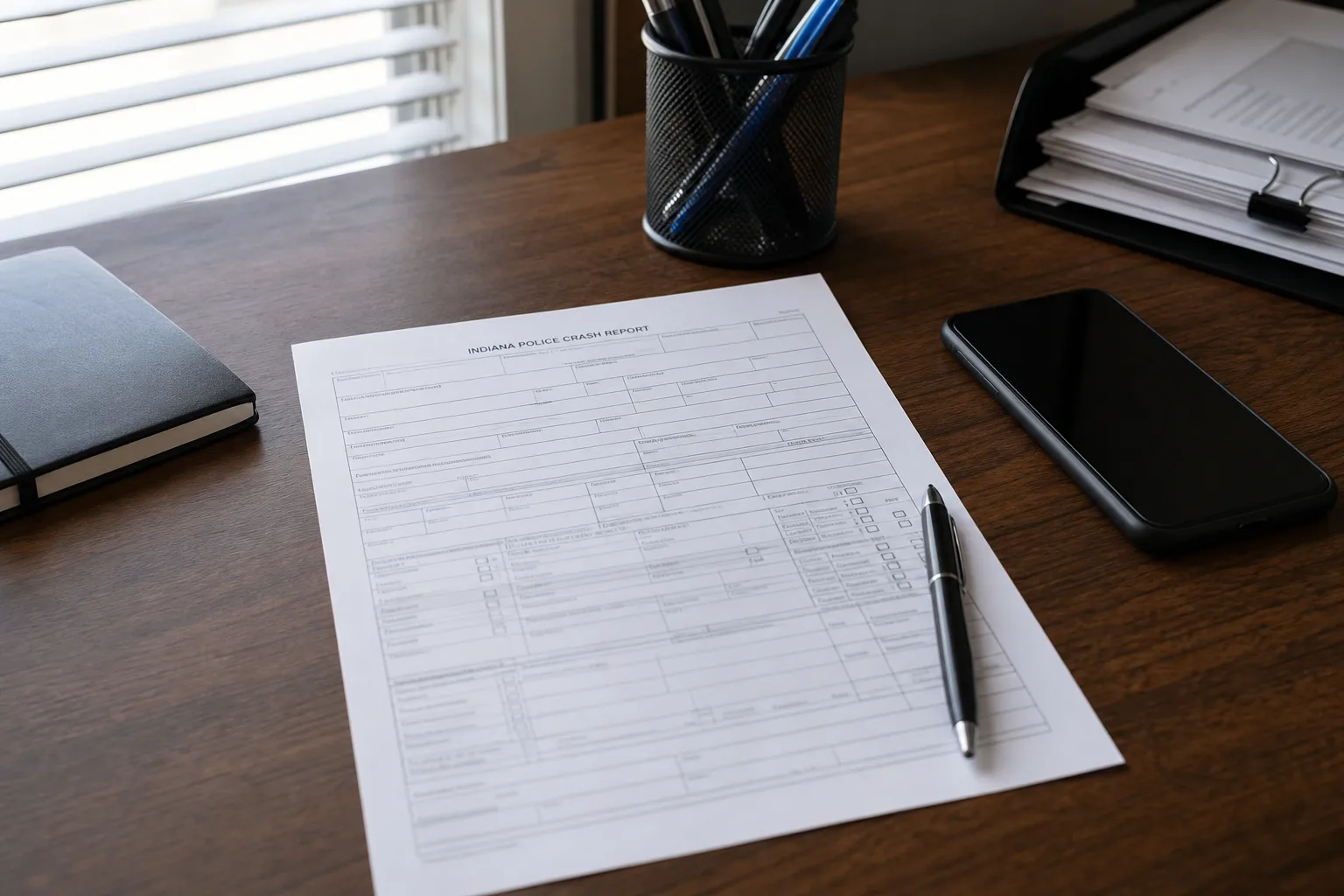
- The police crash report and the officer’s notes about impairment, field tests, and any chemical test.
- Photos and video of the vehicles, the scene, and your injuries.
- Names and contact information for witnesses, including anyone who saw the driver before or after the crash.
- Where the driver was drinking — a bar, restaurant, event, or private home, which may matter for a dram shop claim.
- Your medical records and bills, plus a simple journal of symptoms and missed work.
For a fuller list, see our guide on what evidence helps prove an Indiana car accident claim.
Practical next steps
- Get medical care and follow through with treatment, even if you feel “okay” at first.
- Report the crash to your own insurer and ask what coverages (UM/UIM, MedPay) you have.
- Request the police report and note whether the driver was arrested or tested.
- Write down where the driver may have been drinking before the crash.
- Be cautious about recorded statements and quick settlement offers from the other insurer.
- Talk with an attorney about the deadlines and options that apply to your situation.
Frequently asked questions
What if a criminal case or guilty plea follows the crash?
The criminal prosecution — including any restitution process — and your civil injury claim are separate. Under Miller v. Patel, Indiana Supreme Court Case 22S-CT-371[7], an entered guilty plea has the same preclusive effect as a trial verdict for issues necessarily settled by the plea; it does not automatically prove every element of a civil claim. Any criminal restitution is governed by Indiana Code 35-50-5-3[8] and should not be treated as payment of every civil loss. Indiana Code 34-11-2-4[9] generally provides a two-year period for a civil personal-injury action, so do not assume the criminal case or guilty plea pauses that deadline.
What if the driver was never charged or was found not guilty?
You can still pursue a civil claim. The civil standard of proof is lower than the criminal standard, so you may recover compensation even without a criminal conviction, as long as the evidence shows the other driver caused your injuries.
Will I automatically get punitive damages because the driver was drunk?
Not automatically. Punitive damages require clear and convincing evidence, are capped at the greater of three times compensatory damages or $50,000, and most of the award goes to a state fund rather than to you.
Can I sue the bar that served the drunk driver?
Possibly, under Indiana’s Dram Shop Act, if the bar had actual knowledge the person was visibly intoxicated when served and that intoxication was a proximate cause of the crash. It depends on the facts and available records.
What if the drunk driver has no insurance?
Your own uninsured/underinsured motorist coverage may apply, and other sources such as a dram shop claim may exist. A Fort Wayne car accident lawyer can help identify every available layer of coverage.
Talk with a Fort Wayne drunk-driving crash attorney
If you were hurt by an impaired driver in Fort Wayne or anywhere in Indiana, you do not have to sort out the criminal process, the insurance claims, and the deadlines alone. Delventhal Law Office can review what happened, explain the deadlines that may apply, and help you decide the next step. Learn more about how we help after a Fort Wayne drunk driving crash, or reach out through our contact page for a free consultation.
This article is general information about Indiana law and is not legal advice. Reading it does not create an attorney-client relationship. For advice about your specific situation, please consult a licensed attorney.
Sources
- operating while intoxicated (OWI) (iga.in.gov) ↩
- restitution (iga.in.gov) ↩
- Indiana caps punitive damages (iga.in.gov) ↩
- Dram Shop Act (iga.in.gov) ↩
- modified comparative fault (iga.in.gov) ↩
- Indiana’s statute of limitations (iga.in.gov) ↩
- Miller v. Patel, Indiana Supreme Court Case 22S-CT-371 (public.courts.in.gov) ↩
- Indiana Code 35-50-5-3 (iga.in.gov) ↩
- Indiana Code 34-11-2-4 (iga.in.gov) ↩