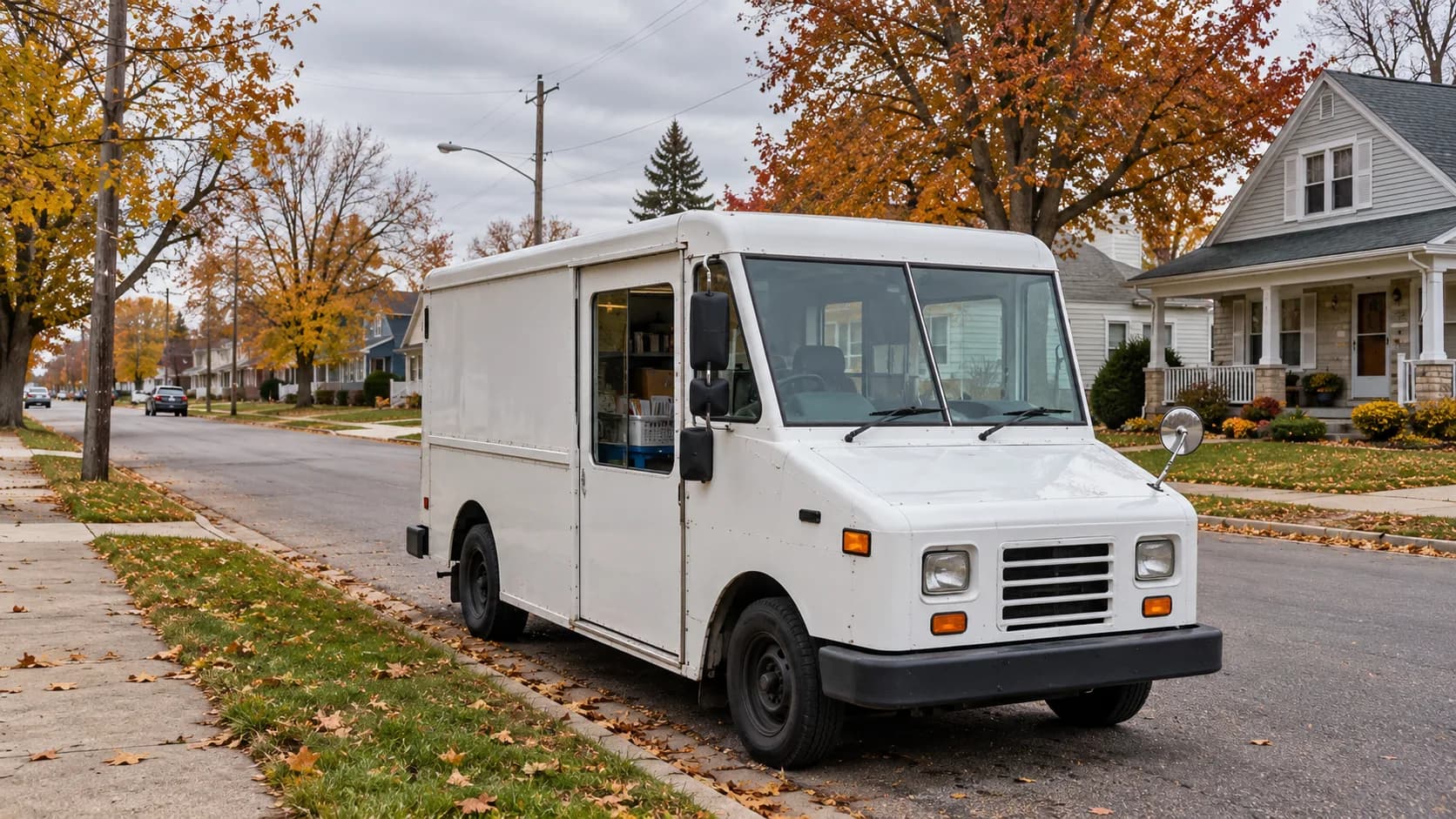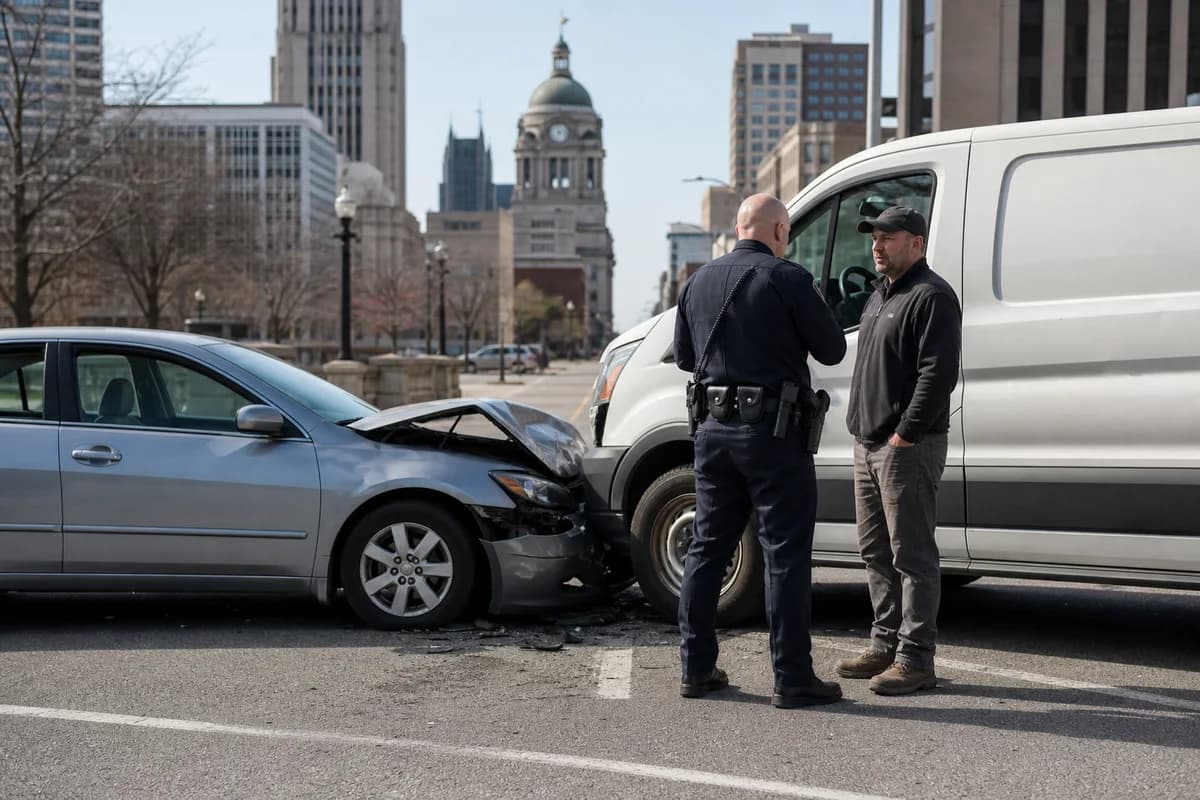
A Fort Wayne crash involving a delivery van, utility truck, sales employee, home-health worker, contractor, or company car is often more complicated than an ordinary two-driver collision. The employee may be negligent, but the investigation cannot stop with the name on the driver’s license. Evidence controlled by the employer may determine who is responsible and what insurance applies.
Key takeaways
- An employer may share responsibility when an employee was acting within the course and scope of employment.
- Ownership and employment are different questions. A personal vehicle can be used for work, and a company vehicle can sometimes be used for a purely personal trip.
- Commercial evidence disappears quickly. Dispatch records, GPS data, dashcam video, phone data, time logs, and vehicle telematics should be preserved.
- More than one insurance policy may matter. Do not assume the policy handed over at the scene is the only coverage.
- Indiana comparative fault still applies. Fault percentages can affect recovery under Indiana Code Chapter 34-51-2[1].
When can an employer be responsible?
Indiana’s respondeat superior doctrine can make an employer vicariously liable for an employee’s tort committed within the scope of employment. In practical terms, the investigation asks whether the driver was engaged in authorized work or conduct sufficiently connected to the employer’s business when the crash occurred.
| Fact | Why it may matter |
|---|---|
| Driver was making a scheduled delivery | Strong evidence the trip served the employer |
| Driver was traveling between job sites | Often different from an ordinary commute |
| Employer directed the route or appointment | Shows work control and purpose |
| Driver was clocked in or paid for travel time | Can support a work connection |
| Vehicle carried tools, products, patients, or company equipment | May confirm the trip’s business purpose |
| Driver substantially departed for a personal errand | May create a scope-of-employment dispute |
Common Fort Wayne working-driver crashes
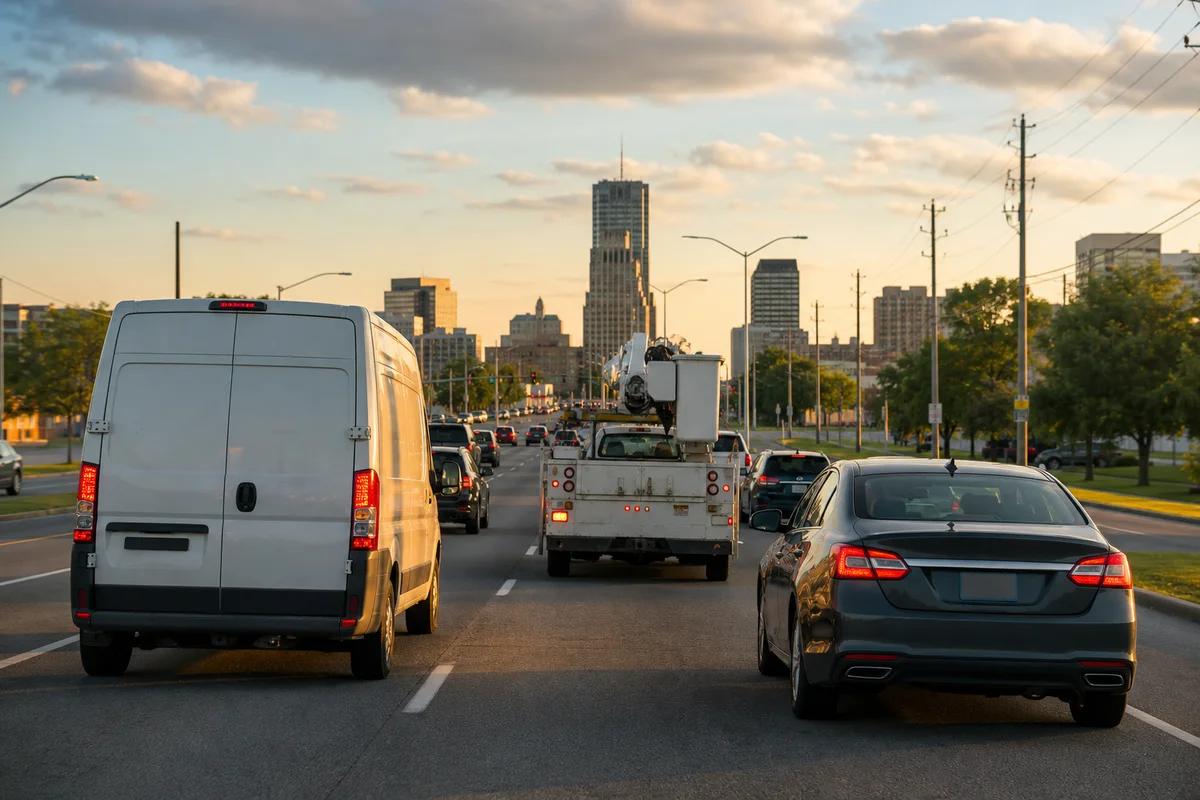
These cases are not limited to tractor-trailers. On I-69, I-469, Coliseum Boulevard, Lima Road, Jefferson Boulevard, and neighborhood streets, working drivers may include:
- parcel, grocery, restaurant, and pharmacy delivery drivers;
- utility, HVAC, plumbing, electrical, and landscaping crews;
- sales representatives and employees traveling to customer sites;
- home-health, medical transport, and social-service workers;
- construction workers moving between sites;
- rideshare and app-based drivers;
- truck drivers and other regulated commercial motor-vehicle operators;
- government employees and public vehicles, which can trigger special notice rules.
The commute rule is not the end of the analysis
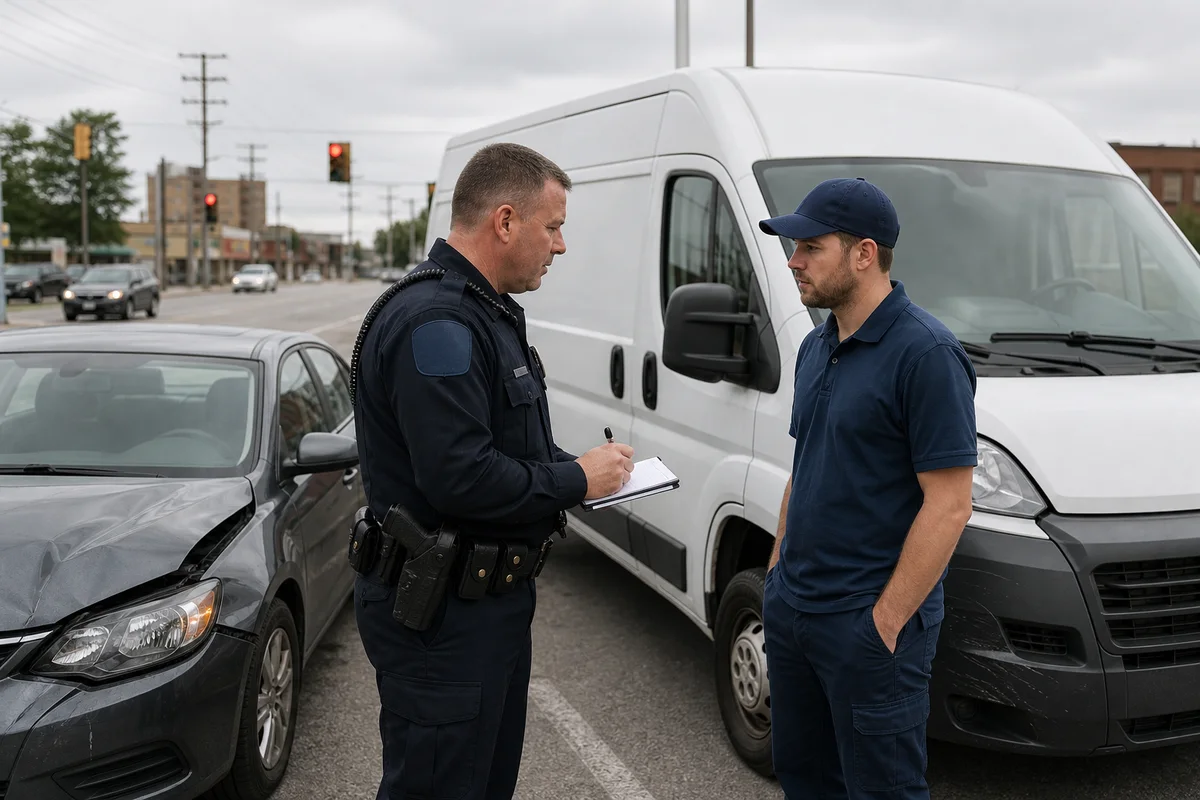
An ordinary commute to or from a fixed workplace is often treated differently from a trip made to carry out employer business. But labels are not enough. A driver may be heading home while also transporting company property, completing a directed stop, responding to a call, or traveling between assignments. Conversely, being in a company vehicle does not automatically prove the driver was acting within the scope of employment.
Useful questions include: Where had the driver just been? Where were they going? Who selected the destination? Was the driver on the clock? Was mileage reimbursed? Was a customer, delivery, patient, tool, or product involved? Did the company expect the driver to take calls or respond after hours?
Who could be legally responsible?
| Potential party | Possible theory | Evidence to preserve |
|---|---|---|
| Driver | Unsafe driving, distraction, speeding, failure to yield, impairment | Statements, citations, phone records, video, vehicle data |
| Employer | Vicarious liability for employee acting within scope | Personnel file, schedule, dispatch, time records, route data |
| Employer or vehicle owner | Negligent hiring, retention, supervision, training, or entrustment when supported by facts | Driving history, policies, training, prior incidents, qualification records |
| Motor carrier | Carrier responsibility and regulatory violations | ELD/logs, inspections, maintenance, qualification file, dispatch |
| Contracting company | Potential direct or agency responsibility depending on control and relationship | Contracts, operating procedures, payment and control records |
| Maintenance company or manufacturer | Mechanical failure or defective component | Vehicle preservation, inspection history, parts and repair records |
Employee or independent contractor?
A company may describe the driver as an independent contractor, but the label in a contract does not necessarily resolve liability. The real relationship can depend on control over the work, route, schedule, equipment, customer interaction, and other facts. App-based delivery, rideshare, logistics, and franchise arrangements can also involve layered insurance and multiple entities.
Do not accept “the driver is not our employee” as the final answer without examining the agreement and how the work actually operated.
Insurance coverage may be broader—but also more complex
Commercial policies can have higher limits than an individual auto policy, but coverage depends on the vehicle, driver, business use, named insureds, endorsements, exclusions, and contractual arrangements. Federally regulated motor carriers may have insurance-filing obligations described by the Federal Motor Carrier Safety Administration[2]. Federal minimum financial-responsibility levels for certain interstate motor carriers are set out in 49 C.F.R. § 387.9[3]. Those rules do not mean every work vehicle is a federally regulated commercial motor vehicle.
| Possible coverage | When it may matter |
|---|---|
| Employer commercial auto policy | Owned, hired, or covered business vehicles and drivers |
| Driver’s personal auto policy | May apply, exclude, or dispute business use depending on terms |
| Umbrella or excess policy | Catastrophic injuries exceeding primary limits |
| Platform or contractor coverage | Rideshare, delivery, logistics, and contracted services |
| Your UM/UIM coverage | Insufficient or disputed liability coverage |
| Workers’ compensation | If you were working when struck, a separate work-injury claim may exist |
Evidence to preserve immediately
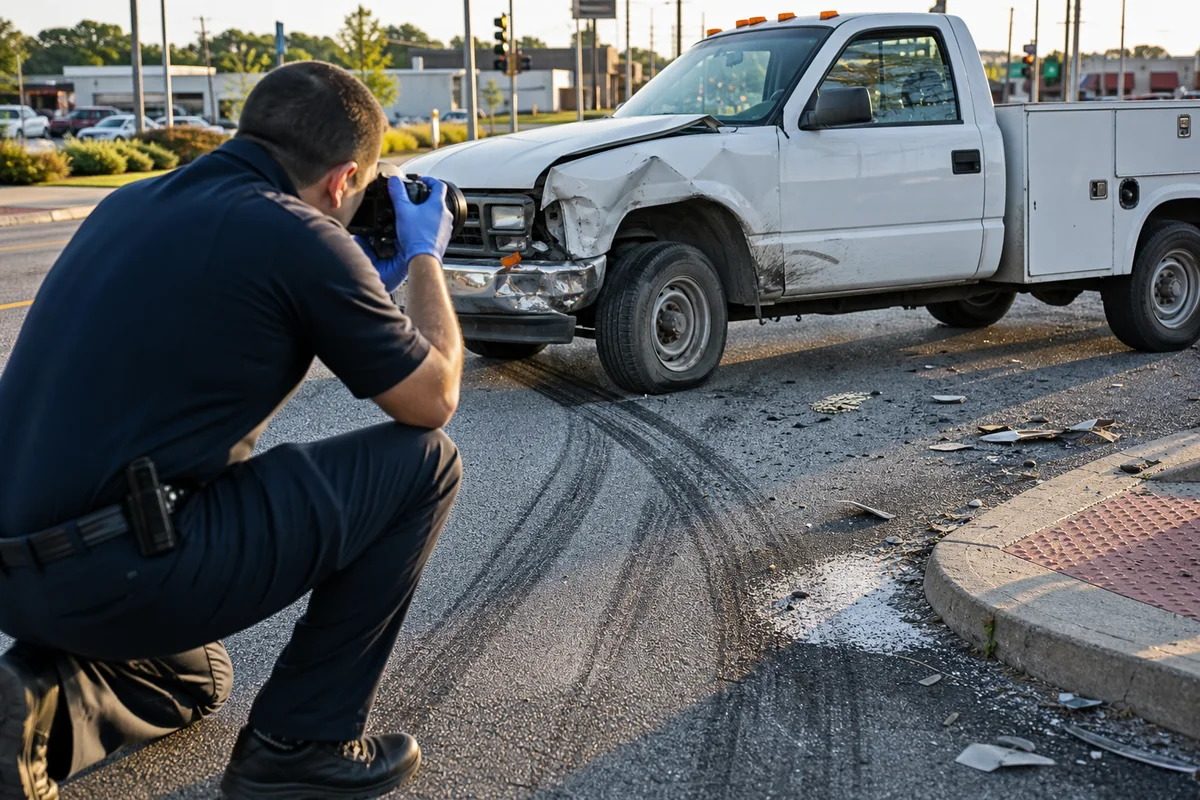
Commercial evidence can be overwritten under routine retention practices. Federal regulations illustrate why prompt preservation matters: 49 C.F.R. § 395.8[4] addresses records of duty status and their retention, while 49 C.F.R. § 391.51[5] identifies records maintained in a regulated driver qualification file. A targeted preservation letter can identify relevant material before it disappears. Depending on the vehicle and employer, that may include:
- dashcam and nearby surveillance video;
- GPS, route, dispatch, delivery, and telematics data;
- event-data-recorder or electronic control module information;
- employee timecards, schedules, work orders, and communications;
- mobile-phone and app activity;
- driver qualification, training, and disciplinary records;
- vehicle inspection, maintenance, and repair records;
- insurance policies, declarations, and coverage endorsements;
- contracts among employers, platforms, carriers, contractors, and vehicle owners.
For regulated trucking cases, federal safety rules and records may be especially important. Our guide to why truck claims differ from ordinary car accidents explains that broader investigation.
What should you do at the scene?
- Call law enforcement and request medical help when needed.
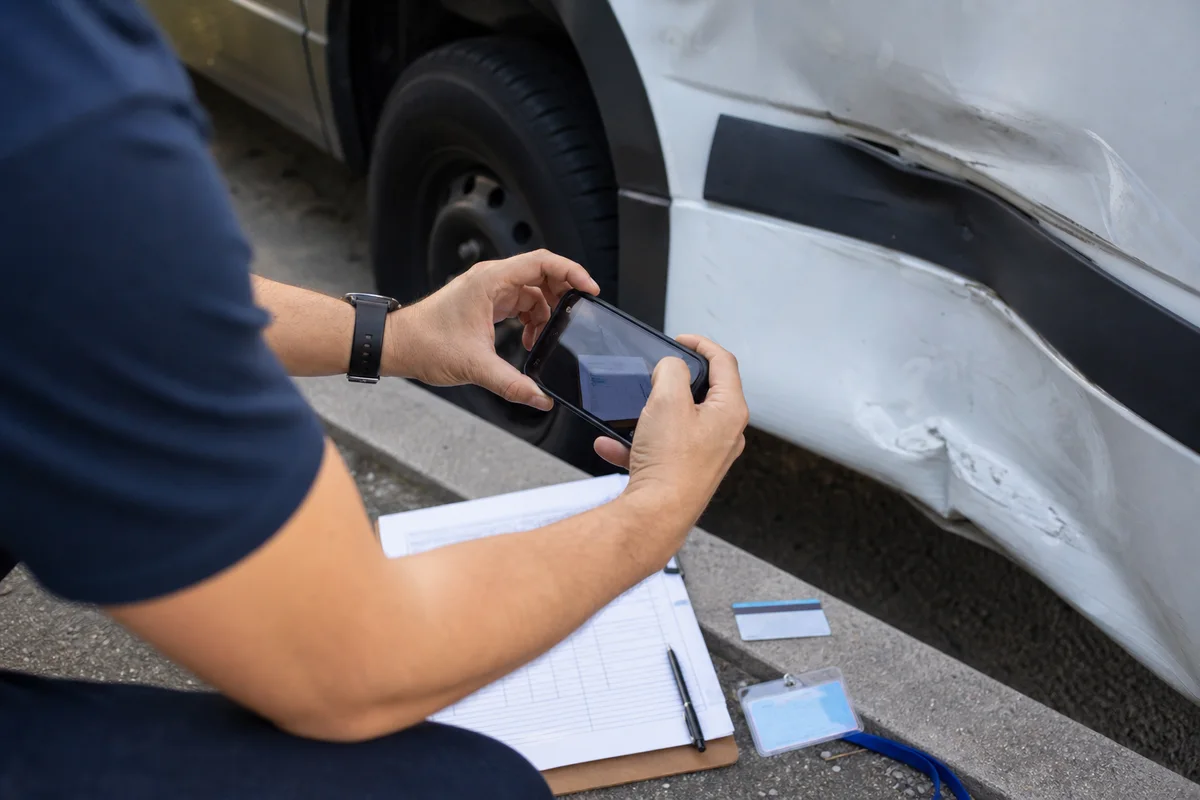
- Photograph every vehicle, plate, unit number, logo, USDOT number, and damage area.
- Ask for the driver’s personal and commercial insurance information.
- Record the employer or company name and the driver’s job role.
- Get witness names and contact information.
- Do not argue about employment status or accept a cash arrangement.
- Preserve your own dashcam video and phone photos.
- Obtain the report number and later check the report for errors.
Our car-accident information checklist provides a broader scene guide. If an adjuster asks for a recorded statement or blanket medical release, review our guide to insurance requests after an Indiana accident.

What damages may be available?
A valid Indiana injury claim may include past and future medical expenses, lost wages, reduced earning capacity, pain and suffering, disability, scarring, out-of-pocket expenses, and property damage. The amount depends on medical proof, causation, fault, coverage, and the injury’s effect on daily life. Our car accident settlement calculator explains common valuation factors, but no calculator can determine an individual result.
If you were also working when the collision occurred, you may have both workers’ compensation and third-party claims. Those claims can overlap without being identical. See our guide to Indiana workers’ comp versus third-party claims.
Government and short-deadline cases
If the working driver operated for a city, county, state agency, school, or other governmental entity, Indiana Tort Claims Act notice issues may apply. Indiana’s statutes generally address notice to the state in Indiana Code § 34-13-3-6[6] and notice to a political subdivision in Indiana Code § 34-13-3-8[7]. These notice periods can be much shorter than the ordinary personal-injury limitation period. A government vehicle should be treated as a reason for immediate legal review, not as a routine insurance claim. If a government body or employee may be involved, review our Indiana government tort claim notice guide, because notice deadlines can be much shorter than the ordinary injury filing period.
Frequently asked questions
Does a company logo prove the employer is liable?
No. A logo is useful evidence, but the driver’s work status, purpose, route, relationship, and the employer’s control still matter.
What if the employee used a personal car?
An employer may still be implicated if the employee was carrying out work. Vehicle ownership and scope of employment are separate issues.
What if the company says the driver was an independent contractor?
Preserve the contracts and investigate the actual working relationship. The company’s label is important evidence, but it may not end the analysis.
Can I sue both the driver and employer?
Potentially. The available claims depend on negligence, scope of employment, direct employer conduct, agency relationships, insurance, and the evidence.
Why act quickly?
Video, electronic vehicle data, app records, schedules, and dispatch information may be overwritten or lost. Early preservation can materially change the case.
Bottom line
When the at-fault driver was working, the case should be investigated as a business-vehicle claim from day one. Identify the employer, preserve electronic and employment evidence, locate every policy, and do not let the investigation stop at the driver. Delventhal Law Office represents injured people in Fort Wayne and across Northeast Indiana. Learn more on our Fort Wayne car accident attorney page or request a free case evaluation.
This article is general information, not legal advice. Reading it does not create an attorney-client relationship, and neither does contacting us. If you do contact us about a possible claim, Indiana Rule of Professional Conduct 1.18 requires us to keep what you tell us confidential whether or not we take the case — but please do not send documents or detailed facts until we have agreed in writing to represent you.